When Disneyland opened in 1955, what prices were charged for admission and rides?
A) Admission was free; customers paid for rides.
B) All customers paid the same price for admission; rides were free.
C) Admission prices varied by your age, home address and occupation; rides were free.
D) All customers paid the same low price for admission; customers were also charged
prices for rides.
Figure 13-1
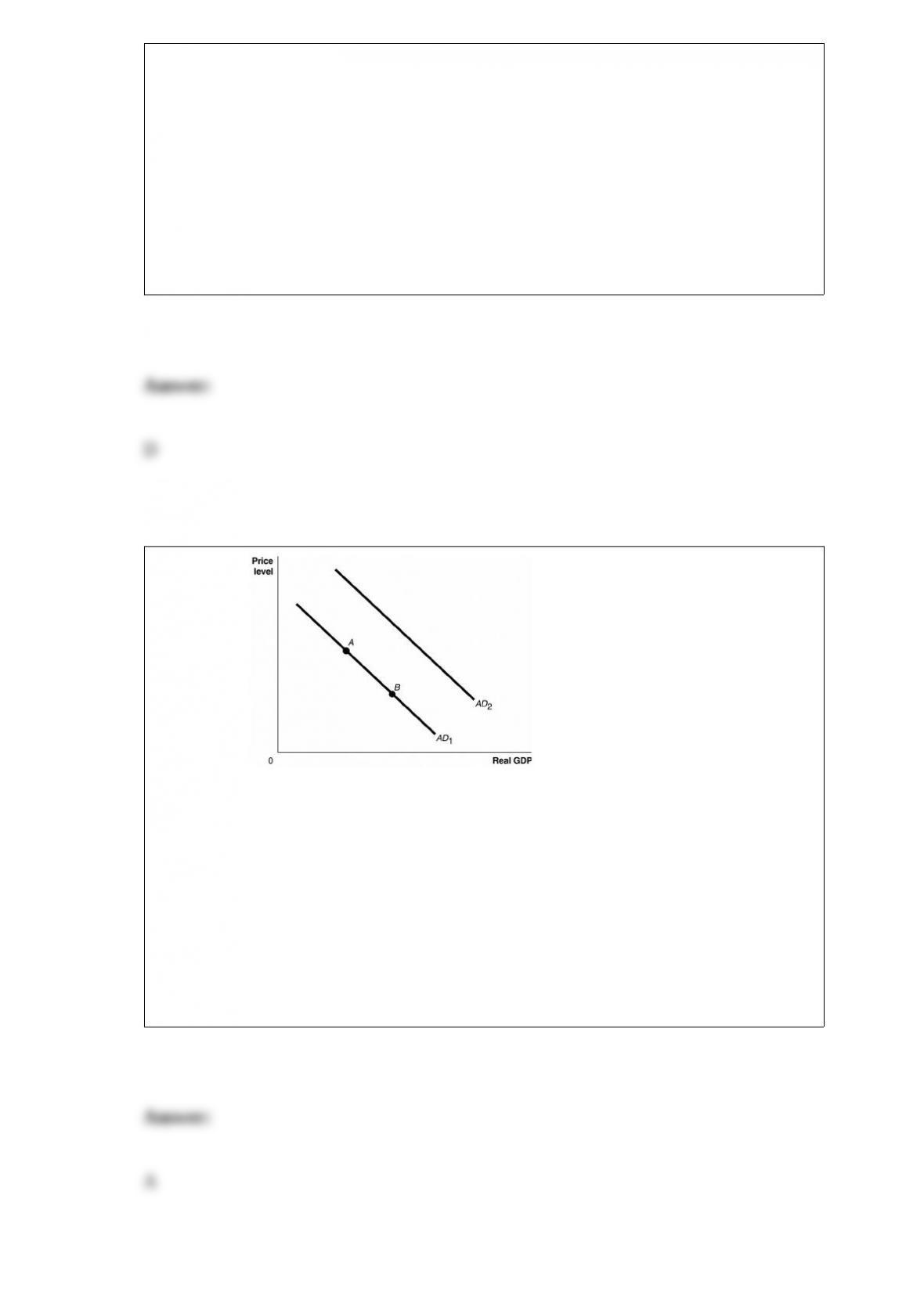
Ceteris paribus, a decrease in the value of the domestic currency relative to foreign
currencies would be represented by a movement from
A) AD1 to AD2.
B) AD2 to AD1.
C) point A to point B.
D) point B to point A.

Paul goes to Sportsmart to buy a new tennis racquet. He is willing to pay $200 for a
new racquet, but buys one on sale for $125. Paul’s consumer surplus from the purchase
is
A) $325.
B) $200.
C) $125.
D) $75.
Pegging a country’s exchange rate to the dollar can be advantageous if
A) the country does not trade much with the United States.
B) investors believe the dollar to be more stable than the domestic country’s currency.
C) a country wishes to conduct independent monetary policy.
D) imports are not a significant fraction of the goods the country’s consumers buy.
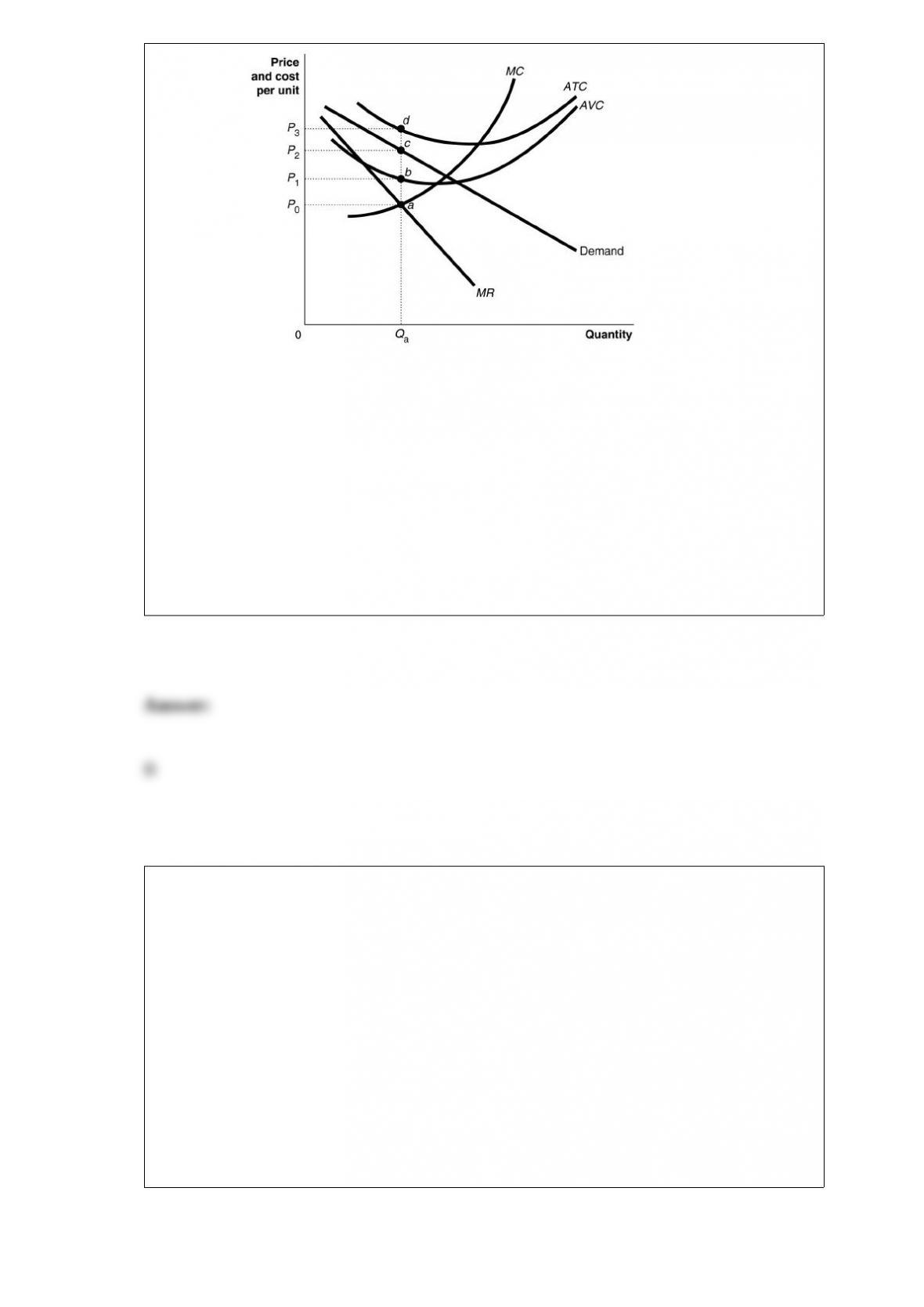
Figure 13-4 Figure 13-4 shows
short-run cost and demand curves for a monopolistically competitive firm in the market
for designer watches. Should the firm represented in the diagram continue to stay in
business despite its losses?
A) No, it should shut down.
B) Yes, its total revenue covers its variable cost.
C) No, it is not able to cover its fixed cost.
D) Yes, it should increase its revenue by raising its price.
Which of the following is a reason why a firm would experience diseconomies of scale?
A) To finance an increase in the size of its plant, a firm must borrow more money or
sell more shares of stock.
B) As the size of the firm increases, it becomes more difficult to find markets where it
doesn’t already have operations.
C) As the size of the firm increases, it becomes more difficult to coordinate the
operations of its manufacturing plants.
D) As the size of the firm increases, it must operate in other countries where differences
in language, customs and laws increase its average costs.

Daniel Hammermesh and Stephen Donald studied the determinants of the earnings of
college graduates years after they graduated. Which of the following is one result of
their study?
A) The earnings of identical twins were about 9 percent higher than the earnings of all
other students.
B) Students who had taken 15 credits of upper-division science and mathematics
courses and earned high grades in these courses earned about 10 percent more than
students who took no upper-division classes in these subjects.
C) Students who took more Advanced Placement (AP) courses while still in high school
earned significantly more income for each AP course they passed with a grade of 4 or 5.
D) Students who took at least three economics courses earned about 9 percent more
income than students who took no college economics courses.
Models that focus on factors other than changes in the money supply to explain
fluctuations in real GDP are called
A) nonmonetary business cycle models.
B) real business cycle models.
C) rational expectations models.
D) short-run macroeconomic models.

“Sin taxes,” such as taxes on alcoholic beverages, are intended to
A) increase the amount of the products supplied.
B) generate money to subsidize production of the products taxed.
C) reduce the quantity demanded.
D) generate funds to aid in the medical care of those harmed by the product.
In the United States in 2012, about two-thirds of those who were not covered by health
insurance
A) are single and unemployed.
B) live in families in which at least one member has a job.
C) live in families in which all members are unemployed.
D) are retired from the workforce.
Which of the following would increase public saving?
A) an increase in taxes
B) an increase in transfers
C) an increase in government purchases
D) All of the above would increase public saving.
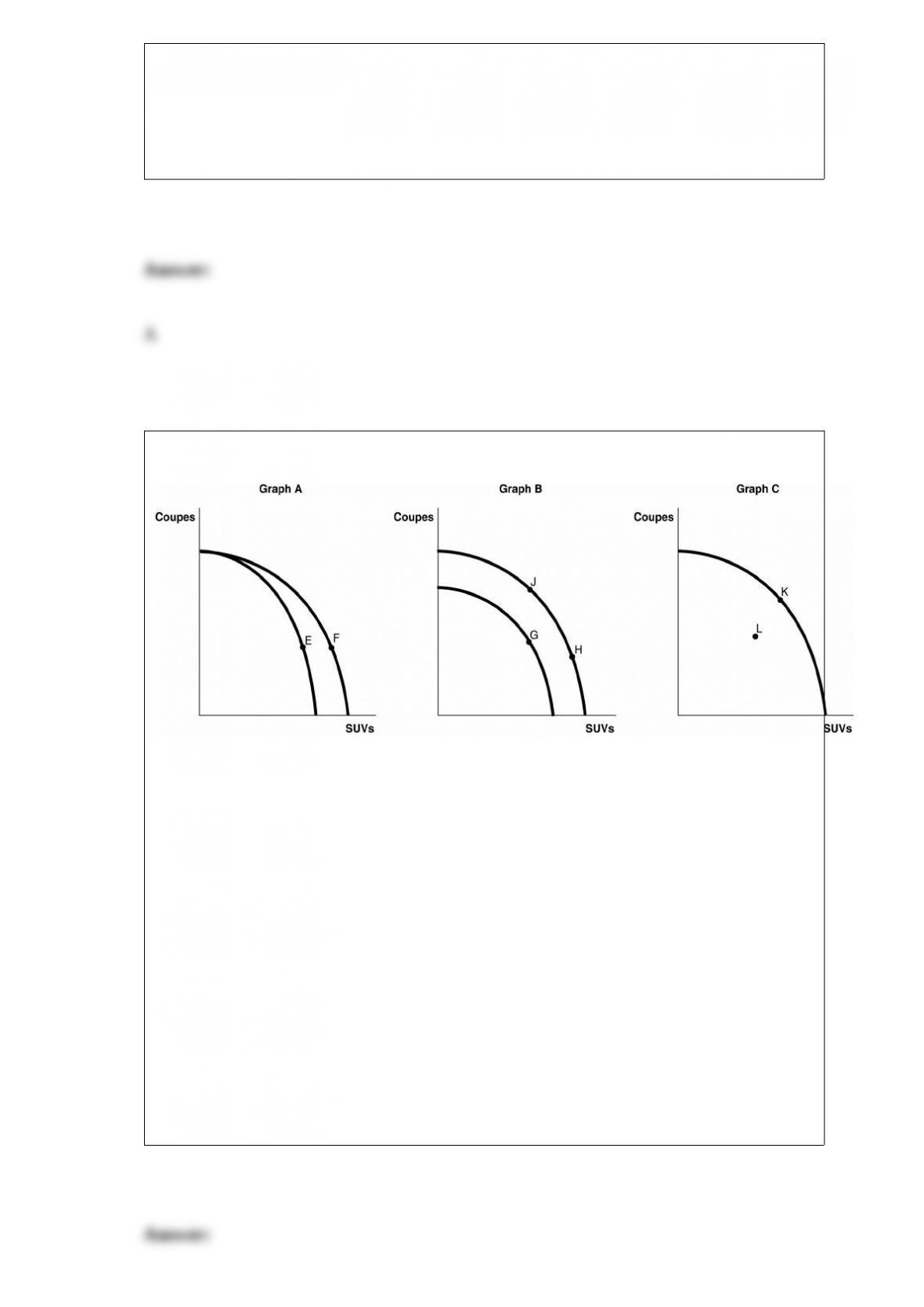
Figure 2-7
Mercedes Benz produces a full line of luxury automobiles, including coupes, sedans,
and SUVs, at a variety of manufacturing plants across the globe. Assume Mercedes
Benz produces both coupes and SUVs at its Tuscaloosa, Alabama factory. Figure 2-7
shows changes to its production possibilities frontier in response to new developments
and different strategic production decisions at this factory.
Suppose worker productivity increases so that the total number of vehicles produced
increases as the company adds more machinery, workers and changes the layout of the
factory. This is best represented by the
A) movement from E to F in Graph A.
B) movement from G to H in Graph B.
C) movement from K to L in Graph C.
D) movement from J to H in Graph B.

Jeremy is thinking of starting up a small business selling NASCAR memorabilia. He is
considering setting up his business as a sole proprietorship. What is one disadvantage to
Jeremy of setting up his business as a sole proprietorship?
A) As a sole proprietor, Jeremy would be taxed twice.
B) As a sole proprietor, Jeremy would not have control of the business.
C) As a sole proprietor, Jeremy would face unlimited liability.
D) As a sole proprietor, Jeremy would be subject to significant rules and regulations.