1) Answer the next two questions using the following information: The price of a bond
with no expiration date is $1000 and its fixed annual interest payment is $50; bond
annual rate of interest is 5%.
(a)If the price of this bond decreases by $250 to $750, what will its effective interest
rate be for the new buyer?
(b)If the price of this bond increases to $1200, what will its effective interest rate be for
the new buyer?
2) producer surplus:
a.is the difference between the maximum prices consumers are willing to pay for a
product and the lower equilibrium price.
b.rises as equilibrium price falls.
c.is the difference between the minimum prices producers are willing to accept for a
product and the higher equilibrium price.
d.is the difference between the maximum prices consumers are willing to pay for a
product and the minimum prices producers are willing to accept.
3) other things equal, an excise tax on a product will:
a.increase its supply.
b.increase its price.
c.increase the quantity sold.
d.increase its demand.
4)

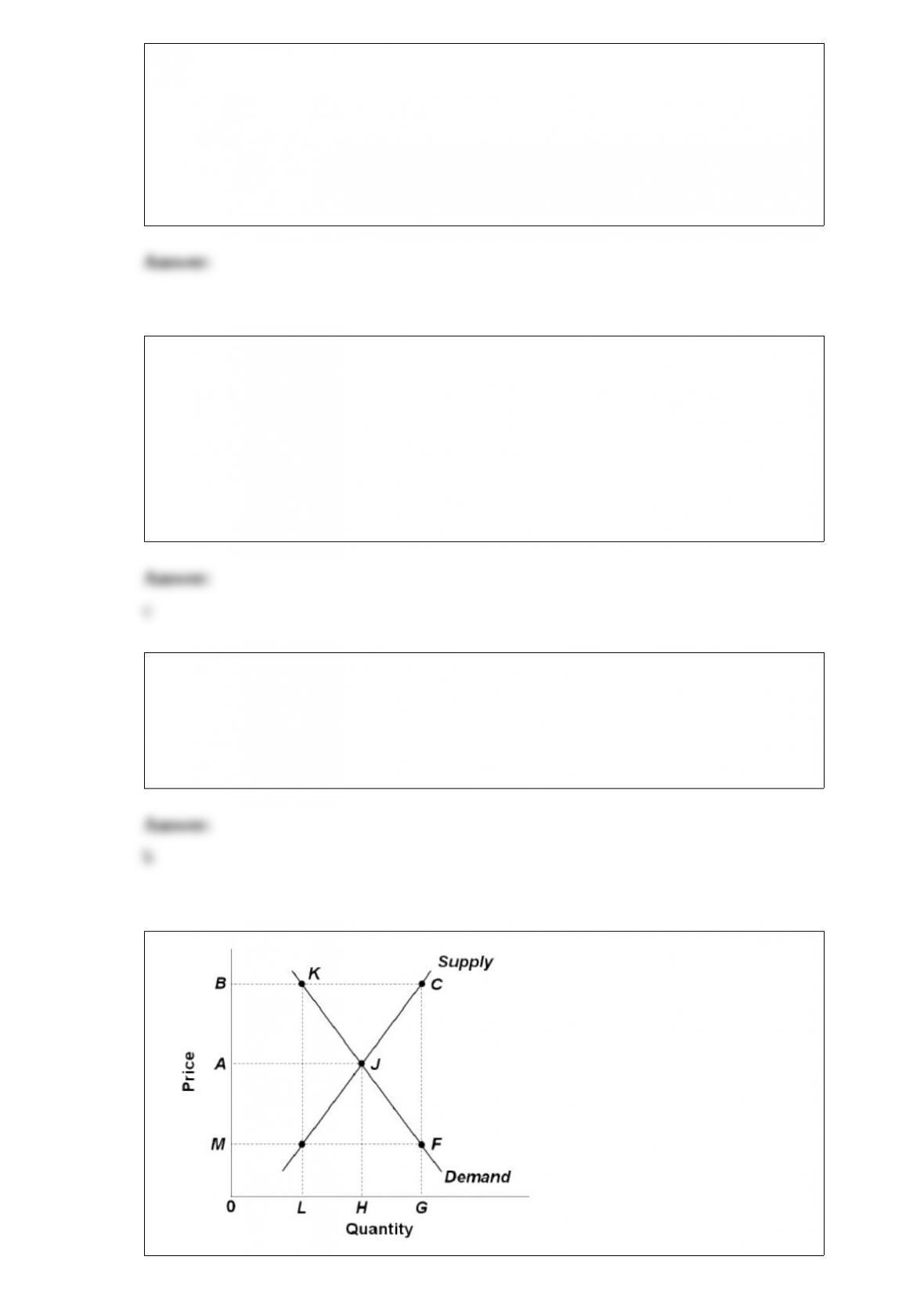
Refer to the above diagram for the corn market. As the result of a supported corn price
of B:
A.a surplus of LG will result.
B.a surplus of LH will result.
C.a surplus of HG will result.
D.a shortage of LG will result.
5) in a competitive market economy firms will select the least-cost production
technique because:
a.such choices will result in the full employment of available resources.
b.to do so will maximize the firms’ profits.
c.this will prevent new firms from entering the industry.
d.”dollar voting” by consumers mandates such a choice.
6) an increase in consumer desire for strawberries is most likely to:
a.increase the number of strawberry pickers needed by farmers.
b.reduce the supply of strawberries.
c.reduce the number of people willing to pick strawberries.
d.reduce the need for strawberry pickers.
7) at the economy’s natural rate of unemployment:
a.the economy achieves its potential output.
b.there is only a relatively small amount of cyclical unemployment.
c.only frictional unemployment exists.
d.only structural unemployment exists.
8)
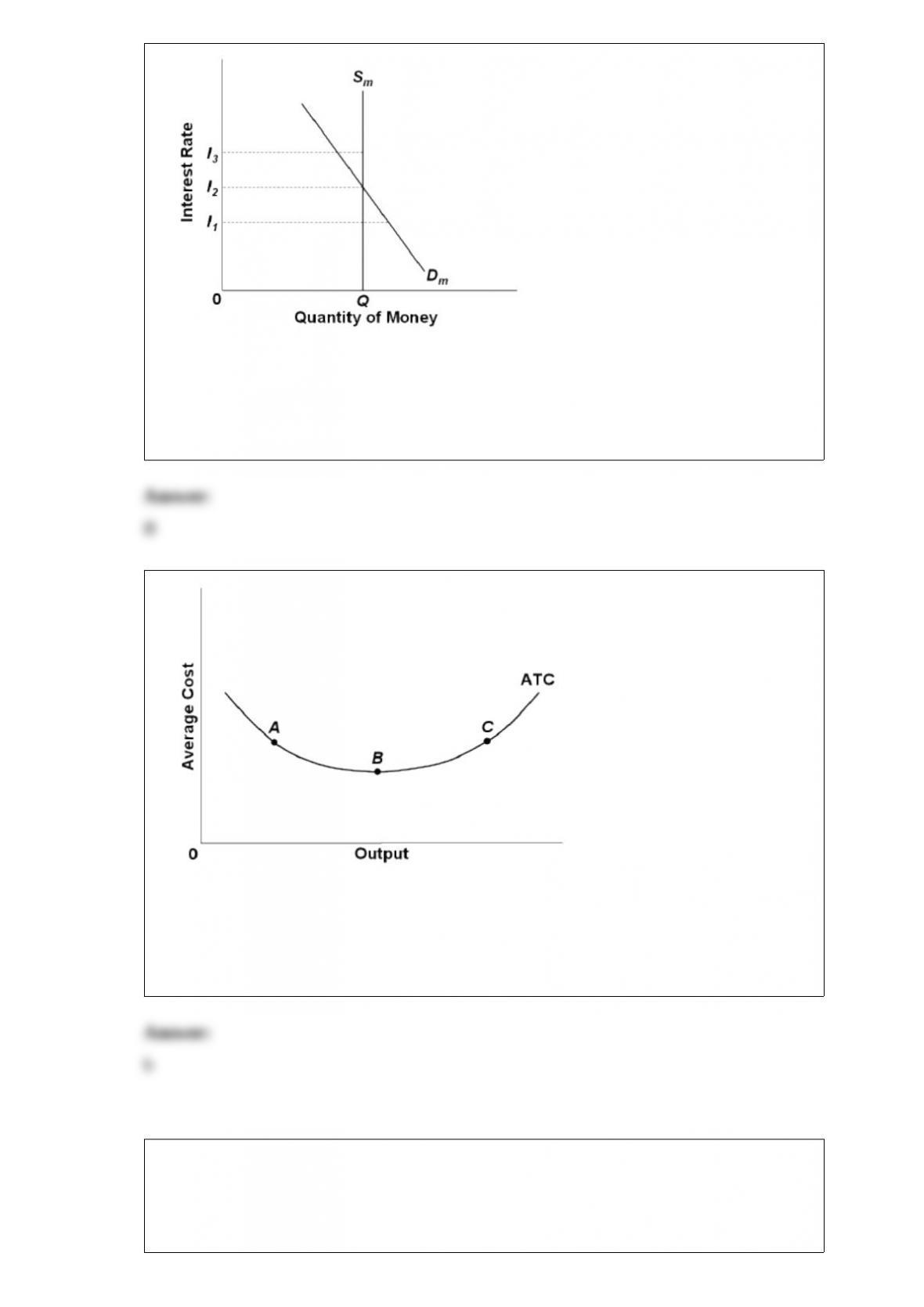
Refer to the above diagram of the market for money. The equilibrium interest rate is:
A.i1.
B.i2.
C.i3.
D.not determinable without additional information.
9)
in the above long-run average total cost curve the:
a.movement from a to b reflects diseconomies of scale.
b.movement from b to c reflects diseconomies of scale.
c.realization of economies of scale would shift the entire curve downward.
d.movement from b to c reflects the law of diminishing returns.
10) (Last Word) In their effort to provide disaster relief after Hurricane Katrina, the
Federal Emergency Management Agency (FEMA) made payouts on as many as
900,000 claims with invalid Social Security numbers or false names and addresses. This
example illustrates:
A.the benefits-received principle.
B.logrolling.
C.bureaucracy inefficiency.
D.the problem of limited and bundled choices.
11) foreign currency exchanges and interest payments on foreign debt are examples of:
a.financial flows.
b.trade flows.
c.capital flows.
d.technology flows.
12)
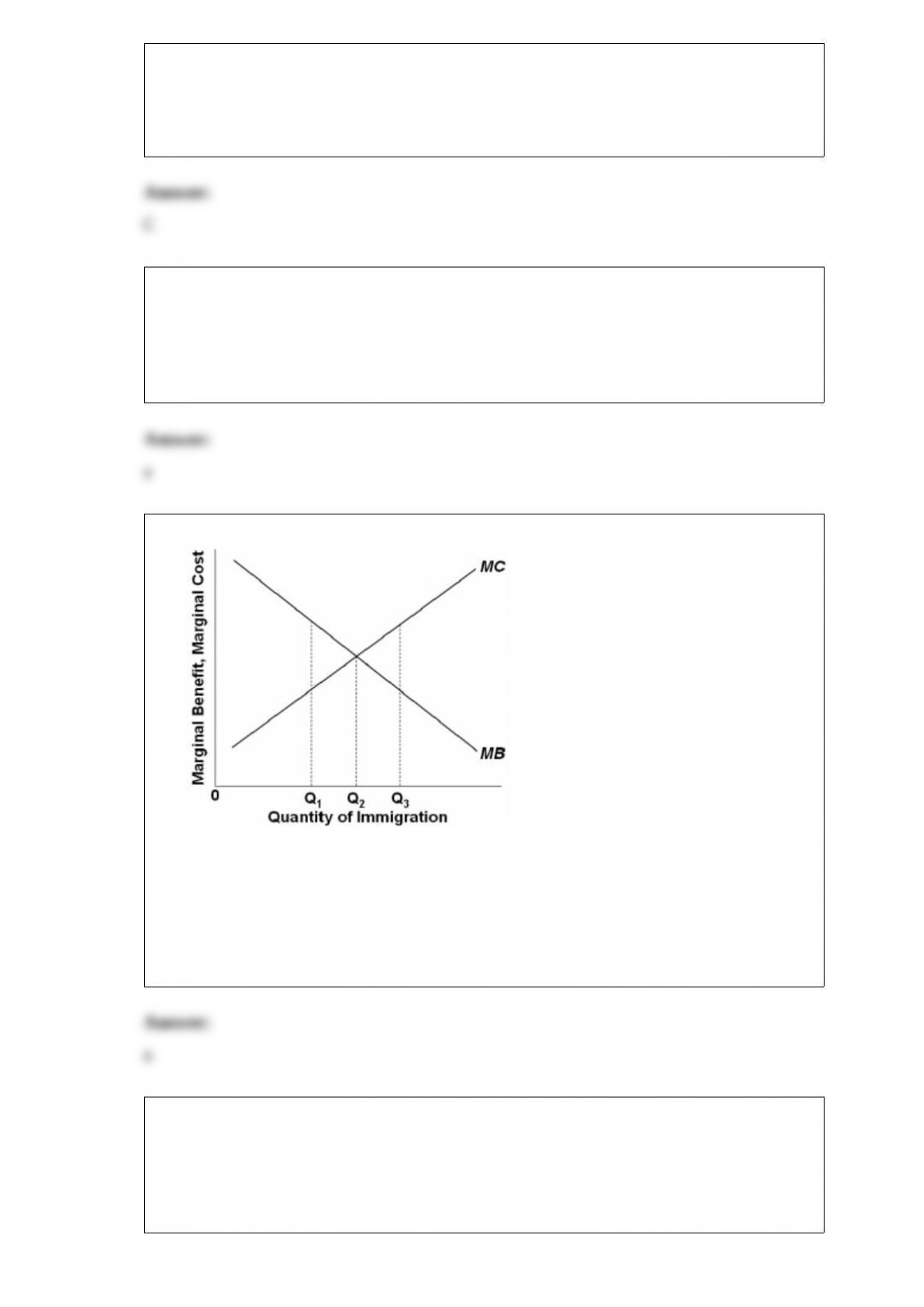
refer to the above figure. if more criminals are in the mix of potential immigrants, how
will this affect the optimal quantity of immigrants?
a.it will increase mc and reduce the optimal quantity.
b.it will increase mc and raise the optimal quantity.
c.it will lower mc and raise the optimal quantity.
d.it will lower mc and reduce the optimal quantity.
13) which of the following is not a characteristic of the market system?
a.private property.
b.freedom of enterprise.
c.government ownership of the major industries.
d.competition in product and resource markets.

14) camille’s creations and julia’s jewels both sell beads in a competitive market. if at
the market price of $5, both are running out of beads to sell (they can’t keep up with the
quantity demanded at that price), then we would expect both camille’s and julia’s to:
a.raise their price and reduce their quantity supplied.
b.raise their price and increase their quantity supplied.
c.lower their price and reduce their quantity supplied.
d.lower their price and increase their quantity supplied.
15) under which of the following situations would a monopolist increase profits by
lowering price (and increasing output):
a.if it discovered that it was producing where mc = mr
b.if it discovered that it was producing where its mc curve intersects its demand curve
c.if it discovered that it was producing where mc < mr
d.under none of these circumstances because a monopolist would never lower price
16) If the MPS in an economy is .1, government could shift the aggregate demand curve
rightward by $40 billion by:
A.increasing government spending by $4 billion.
B.increasing government spending by $40 billion.
C.decreasing taxes by $4 billion.
D.increasing taxes by $4 billion.
17) The interest rate at which the Federal Reserve Banks lend to commercial banks is
called the:
A.prime rate.
B.short-term rate.
C.discount rate.
D.Federal funds rate.

18) economic growth can be portrayed as a:
a.outward shift of the production possibilities curve.
b.inward shift of the production possibilities curve.
c.movement from a point on to a point inside a production possibilities curve.
d.movement from one point to another point on a fixed production possibilities curve.
19) the purchase by an american firm of the right to produce a prescription drug
patented in germany best illustrates a:
a.trade flow.
b.capital flow.
c.goods and services flow.
d.technology flow.
20) the nondiscriminating pure monopolist’s demand curve:
a.is the industry demand curve.
b.shows a direct or positive relationship between price and quantity demanded.
c.tends to be inelastic at high prices and elastic at low prices.
d.is identical to its marginal revenue curve.