
Which of the following is a normative economic statement?
A) The price of gasoline is too high.
B) The current high price of gasoline is the result of strong worldwide demand.
C) When the price of gasoline rises, the quantity of gasoline purchased falls.
D) When the price of gasoline rises, transportation costs rise.
Consider a downward-sloping demand curve. When the price of a normal good
decreases, the income and substitution effects
A) work in the same direction to increase quantity demanded.
B) work in the same direction to decrease quantity demanded.
C) work in opposite directions, and quantity demanded increases.
D) work in opposite directions, and quantity demanded decreases.
During a deflationary period,
A) the nominal interest rate is less than the real interest rate.
B) the real interest rate is less than the nominal interest rate.
C) the price level rises.
D) the nominal interest rate does not change.

The top policy goal for Paul Volcker when he became chairman of the Federal Reserve’s
Board of Governors in 1979 was
A) fighting inflation.
B) increasing employment.
C) increasing economic growth.
D) increasing regulation of commercial banks.
E) a low current account deficit.
If the bank of Waterloo receives a $10,000 deposit, and the reserve requirement is 10
percent, how much can the bank loan out? (Assume that before the deposit this bank is
just meeting its legal reserve requirement.)
A) $1,000
B) $9,000
C) $10,000
D) $11,000

Of the following high-income countries, which has the highest obesity rate?
A) Canada
B) Japan
C) the United Kingdom
D) the United States
Public schools in the United States get most of their operating funds from
A) government production and subsidies.
B) income taxes on corporate profits.
C) local property taxes.
D) tariffs collected on imported goods.
Article Summary. According to a study by the Center for Neighborhood
Technology, homes located within one-half mile of frequently-used public
transportation held their value much better during the recent housing market
downturn than did those without easy access to public transportation, and the
greater home values reflect greater demand for neighborhoods in close proximity
to public transportation. In addition to higher home values, the study found that
close proximity to public transportation offers lower transportation costs, a wider

variety of travel options, and access to more employment opportunities.
Source: Meg Handley, “Study: Proximity to Public Transit Boosts Home Values,”
U.S. News & World Report, March 22, 2013.
People who do not use public transportation can still benefit from it, as is shown by the
higher home values. As a result, the marginal social benefit from public transportation
is ________ the marginal private benefit to those who use public transportation.
A) equal to
B) greater than
C) less than
D) unrelated to
A general formula for the multiplier is
A) .
B) .
C) .
D) .

Common resources differ from public goods in that
A) common resources are non-excludable while public goods are excludable to those
who do not pay for the good.
B) unlike public goods, common resources are rivalrous in consumption.
C) common resources are collectively owned by a group of people while public goods
are government owned.
D) common resources are resources that cannot be renewed but the production of public
goods can be increased any time.
If the BLS counted persons that are on active military service in the totals for
employment, the labor force, or the working-age population, this would
A) decrease the measured unemployment rate.
B) decrease the measured labor force participation rate.
C) decrease the number of persons in the labor force.
D) decrease the number of persons in the working-age population.
Traditionally, economists have considered culture, customs, and religion as
A) very important influences on the choices consumers make.
B) relatively unimportant factors in explaining the choices consumers make.

C) important influences in explaining consumer choices in command economies but
less important in market economies.
D) subject to normative economic analysis rather than positive economic analysis.
Reporters from the Wall Street Journal found that the office supply store Staples
charged different prices for the same product to different online customers based
primarily on
A) the age of the customer.
B) how close the customer’s zip code was to competitors’ stores.
C) the gender of the customer.
D) how many times the customer had looked up the product on its Website.
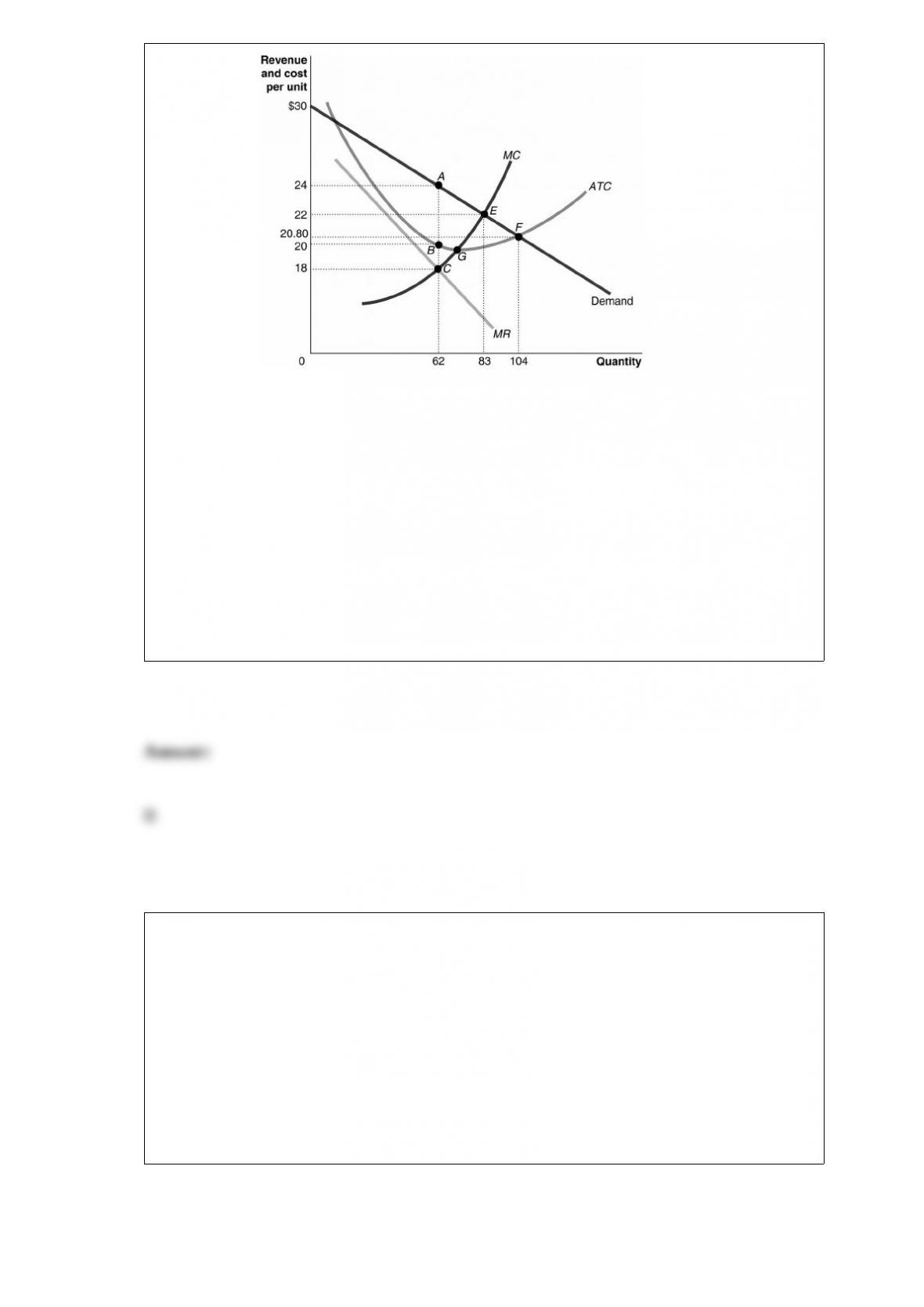
Figure 15-12 Figure 15-12 shows
the cost and demand curves for a monopolist.
If this industry was organized as a perfectly competitive industry, the market output and
market price would be
A) output = 62; price = $24.
B) output = 83; price = $22.
C) output = 62; price = $18.
D) output = 104; price = $20.80.
A numerical limit imposed by a government on the quantity of a good that can be
imported into the country is called a
A) tariff.
B) quota.
C) quantity floor.
D) barricade.

Which of the following statements is false?
A) Corporations can issue stocks and bonds, while proprietorships cannot.
B) Corporations have one owner, while proprietorships have many owners.
C) Corporations face more taxes than do proprietorships.
D) Proprietorships have unlimited liability while corporations have limited liability.
If aggregate expenditure is greater than GDP, how will the economy reach
macroeconomic equilibrium?
A) Inventories will decline, and GDP and employment will decline.
B) Inventories will rise, and GDP and employment will decline.
C) Inventories will decline, and GDP and employment will rise.
D) Inventories will rise, and GDP and employment will rise.