
The PDV of a perpetuity with a yearly payment of $500 at an interest rate of 5% is
A) $100.
B) $5,000.
C) $25,000.
D) $10,000.
E) $100,000.
If we plot the quantity of aluminum ore mined per year on the horizontal axis and the
real annual price of aluminum ore on the vertical axis, we find that the path of
price-quantity combinations generally indicates lower real prices and higher quantities
over time. Which of the following statements is a plausible explanation for this
observed outcome?
A) Aluminum supply shifted leftward faster than the aluminum demand curve shifted
rightward.
B) Aluminum supply shifted rightward faster than the aluminum demand curve shifted
rightward.
C) Aluminum supply shifted rightward and aluminum demand remained constant.
D) both A and B above
E) both B and C above

The marginal revenue product of labor is equal to
A) MPL P.
B) MPL / P.
C) MPL* MR.
D) MPL / MR
E) MR / MPL
If any of the assumptions of perfect competition are violated,
A) supply-and-demand analysis cannot be used to study the industry.
B) graphs with flat demand curves cannot be used to study the firm.
C) graphs with downward-sloping demand curves cannot be used to study the firm.
D) there may still be enough competition in the industry to make the model of perfect
competition usable.
E) one must use the monopoly model instead.

Two corporations (TruBlu and FlyByNight) issue perpetuities that both pay $1,000 per
year, but the market price of the FlyByNight bonds are much lower. The difference in
the bond prices may reflect the belief that the bonds issued by FlyByNight are
________ risky when compared to the TruBlu bonds.
A) less
B) more
C) equally
D) none of the above
The oligopoly model that is most appropriate when one large firm usually takes the lead
in setting price is the ________ model.
A) Cournot
B) Stackelberg
C) game theory
D) prisoner’s dilemma
Scenario 5.1:

Aline and Sarah decide to go into business together as economic consultants. Aline
believes they have a 50-50 chance of earning $200,000 a year, and that if they don’t,
they’ll earn $0. Sarah believes they have a 75% chance of earning $100,000 and a 25%
chance of earning $10,000.
Refer to Scenario 5.1. The expected value of the undertaking,
A) according to Sarah, is $75,000.
B) according to Sarah, is $100,000.
C) according to Sarah, is $110,000.
D) according to Aline, is $200,000.
E) according to Aline, is $100,000.
Suppose the supply of land is infinitely inelastic and the demand for land is downward
sloping but inelastic at the current equilibrium. If the supply curve shifts rightward
(e.g., previously unusable land is cleared for production), what happens to the aggregate
economic rents in this market?
A) Decrease
B) Increase
C) Remain the same
D) We do not have enough information to answer this question.

Scenario 4.5:
The demand curve for grilled cheese sandwiches has been estimated using statistical
techniques as follows:
log(Q) = -1.10 – 0.18 log(P) + 1.21 log(I) + 0.84 log(Ph)
where Q is the quantity of grilled cheese sandwiches
P is the price of grilled cheese sandwiches
I is income
Ph is the price of hamburgersScenario 4.5 indicates that grilled cheese sandwiches and
hamburgers are:
A) substitutes.
B) complements.
C) independent goods.
D) none of the above
The local mall has a make-your-own sundae shop. They charge customers 35 cents for
each fresh fruit topping and 25 cents for each processed topping. Barbara is going to
make herself a sundae. The total utility that she receives from each quantity of topping
is given by the following table:
Fresh Fruit Topping Processed Topping
# of Units Total Utility # of Units Total Utility
1 10 1 10
2 18 2 20

3 24 3 10
4 28 4 0
5 30 5 -10
6 28 6 -20
7 24 7 -30
8 18 8 -40
9 10 9 -50
10 -6 10 -60
a. What is the marginal utility of the 6th fresh fruit topping?
b. Of the two toppings, which would Barbara purchase first? Explain.
c. If Barbara has $1.55 to spend on her sundae, how many fresh fruit toppings and
processed toppings will she purchase to maximize utility?
d. If money is no object, how many fresh fruit toppings and processed toppings will
Barbara purchase to maximize utility?
e. Which of the basic assumptions of preferences are violated by preferences shown in
the table above?

If a competitive firm’s marginal costs always increase with output, then at the profit
maximizing output level, producer surplus is
A) zero because marginal costs equal marginal revenue.
B) zero because price equals marginal costs.
C) positive because price exceeds average variable costs.
D) positive because price exceeds average total costs.
E) positive because revenues are increasing faster than variable costs.
Standard game theory predicts a solution to the ultimatum game that is rarely observed
when people actually play the game. The key reason that behavioral economists believe
the predicted and observed outcomes differ is because people account for ________ of
the outcome when making decisions.
A) loss aversion
B) fairness

C) efficiency
D) utility
Which of the following is NOT true regarding monopoly?
A) Monopoly is the sole producer in the market.
B) Monopoly price is determined from the demand curve.
C) Monopolist can charge as high a price as it likes.
D) Monopoly demand curve is downward sloping.
Use the following statements to answer this question:
I. An increase in the firm’s fixed costs will also shift the firm’s short-run supply curve to
the left.
II. An increase in the firm’s fixed costs will not shift the firm’s short-run supply curve to
the right or left, but it may alter how much of the marginal cost curve is used to form
the short-run supply curve.
A) I and II are true.
B) I is true and II is false.

C) II is true and I is false.
D) I and II are false.
In the short run, a perfectly competitive profit maximizing firm that has not shut down
A) is operating on the downward-sloping portion of its AVC curve.
B) is operating at the minimum of its AVC curve.
C) is operating on the upward-sloping portion of its AVC curve.
D) is not operating on its AVC curve.
E) can be at any point on its AVC curve.
When the government controls the price of a product, causing the market price to be
below the free market equilibrium price,
A) some consumers gain from the price controls and other consumers lose.
B) all producers gain from the price controls.
C) both producers and consumers gain.
D) all consumers are better-off.

The price of on-campus parking from 8:00 AM to 5:00 PM, Monday through Friday, is
$3.00. From 5:00 PM to 10:00 PM, Monday through Friday, the price is $1.00. At all
other times parking is free. This is an example of
A) bundling.
B) second-degree price discrimination.
C) a two-part tariff.
D) tying.
E) none of the above
Which of the following statements is TRUE when comparing monopsony and
competitive labor markets?
A) The monopsony hires more workers but pays a lower wage.
B) The monopsony hires more workers at a higher wage.
C) The monopsonist’s wage is lower and quantity of labor higher than would prevail
under competition.
D) The monopsonist’s wage and quantity of labor are lower than would prevail under
perfect competition.
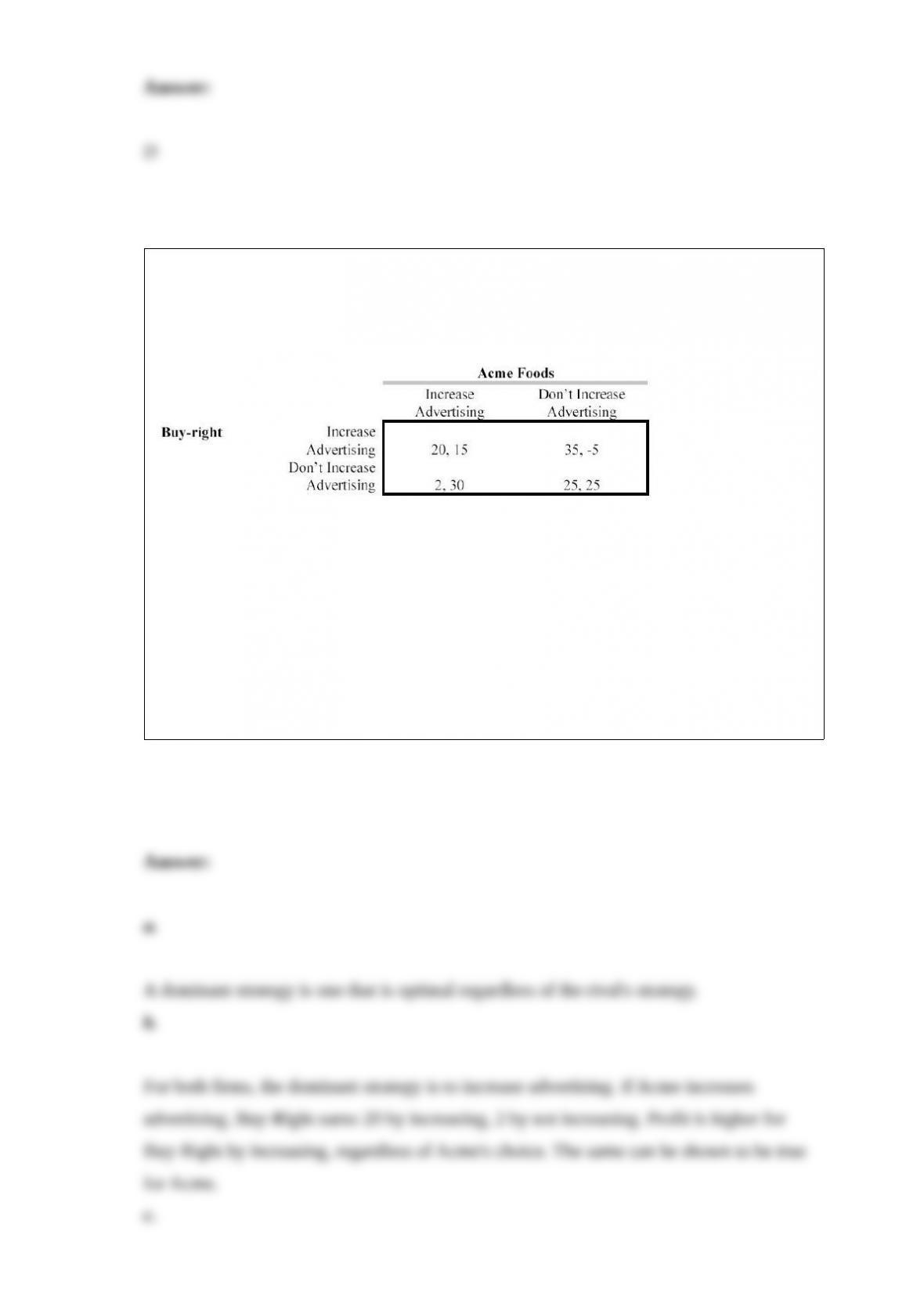
BuyRight is a chain of grocery stores operating in small cities throughout the
southwestern United States. BuyRight’s major competition comes from another chain,
Acme Food Stores. Both firms are currently contemplating their advertising strategy for
the region. The possible outcomes are illustrated by the payoff matrix below.
Entries in the payoff matrix are profits. BuyRight’s profit is before the comma, Acme’s
is after the comma.
a. Describe what is meant by a dominant strategy.
b. Given the payoff matrix above, does each firm have a dominant strategy?
c. Under what circumstances would there be no dominant strategy for one or both
firms?

For computers and other business equipment, small changes in business earnings tend
to generate relatively large short-run changes in the demand for this equipment. In the
long run, the responsiveness of demand for business equipment with respect to income
changes tends to be:
A) even more responsive.
B) less responsive.
C) equally responsive.
D) none of the above
A maximin strategy
A) maximizes the minimum gain that can be earned.
B) maximizes the gain of one player, but minimizes the gain of the opponent.
C) minimizes the maximum gain that can be earned.
D) involves a random choice between two strategies, one which maximizes potential
gain and one which minimizes potential loss.

If grades are to be a successful signal to potential employers of a student’s qualities,
then higher grades must be
A) easier for high-productivity students to earn than for low-productivity students to
earn.
B) easier for low-productivity students to earn than for high-productivity students to
earn.
C) easy for employers to check.
D) used for all future promotions within the firm.
E) often referred to in the hiring process.
Suppose the market demand curve for a Bertrand duopoly is downward sloping. What
happens to the Nash equilibrium price and market quantity if the constant marginal cost
declines?
A) Price and quantity decline
B) Price increases and quantity declines
C) Price decreases and quantity increases
D) Price and quantity increase

Consider the following game in which two firms decide how much of a homogeneous
good to produce. The annual profit payoffs for each firm are stated in the cell of the
game matrix, and Firm A’s payoffs appear first in the payoff pairs:
What are the dominant strategies in this game?
A) Both firms produce low levels of output
B) Both firms produce high levels of output
C) Firm A’s dominant strategy is to produce low levels of output, but Firm B does not
have a dominant strategy.
D) Firm B’s dominant strategy is to produce low levels of output, but Firm A does not
have a dominant strategy.
E) Neither firm has a dominant strategy
Under an infinitely inelastic supply of land, the economic rents to land ________ if the
price of land doubles.
A) increase by less than 100%
B) double
C) increase by more than 100%
D) none of the above

Use the following two statements to answer this question:
I. Isoquants cannot cross one another.
II. An isoquant that is twice the distance from the origin represents twice the level of
output.
A) Both I and II are true.
B) I is true, and II is false.
C) I is false, and II is true.
D) Both I and II are false.
At point B, demand is:

A) small.
B) inelastic, but not completely inelastic.
C) unit elastic.
D) elastic, but not infinitely elastic.
E) infinitely elastic.
Suppose your manufacturing firm is not a price-taking seller (i.e., has some control over
your product price) and sells machinery to U.S. (domestic) buyers as well as foreign
buyers. The domestic demand for your product is inelastic but the foreign demand is
elastic, and the machinery is bulky so that the high transport costs prevent resale among
the buyers. You could charge both groups of buyers the same price for the machinery,
but you know that you could increase total sales revenue by charging the domestic
buyers a ________ price and charging the foreign customers a ________ price.
A) higher, higher
B) higher, lower
C) lower, higher
D) lower, lower
Harding Enterprises has developed a new product called the Gillooly shillelagh. The

market demand for this product is given as follows:
Q = 240 – 4P
a. If the shillelagh is priced at $40, what is the point price elasticity of demand? Is
demand elastic or inelastic?
b. If the shillelagh price is increased slightly from $40, what will happen to the total
expenditure on the Gillooly shillelagh?
The Malthusian dilemma relates to marginal product in that
A) starvation can be averted only if marginal product is constant.
B) because of diminishing marginal product, the amount of food produced by each
additional member of the population increases.
C) because of diminishing marginal product, the amount of food produced by each
additional member of the population decreases.
D) because of diminishing marginal product, the wage falls as the population decreases.
E) because of diminishing average product, the population will not have additional
capital to work with.

The “NPV Criterion” is that a firm should invest in a new capital project if
A) the present value of the expected future cash flows is larger than the present value of
the cost of the investment.
B) the future value of the expected future cash flows is larger than the cost of the
investment.
C) financing can be secured on the basis of new bonds.
D) financing can be secured on the basis of new stocks.
E) financing is not necessary because there are enough liquid assets in the company’s
portfolio to afford the investment.
Microeconomics is the branch of economics that deals with which of the following
topics?
A) The behavior of individual consumers
B) Unemployment and interest rates
C) The behavior of individual firms and investors
D) B and C
E) A and C
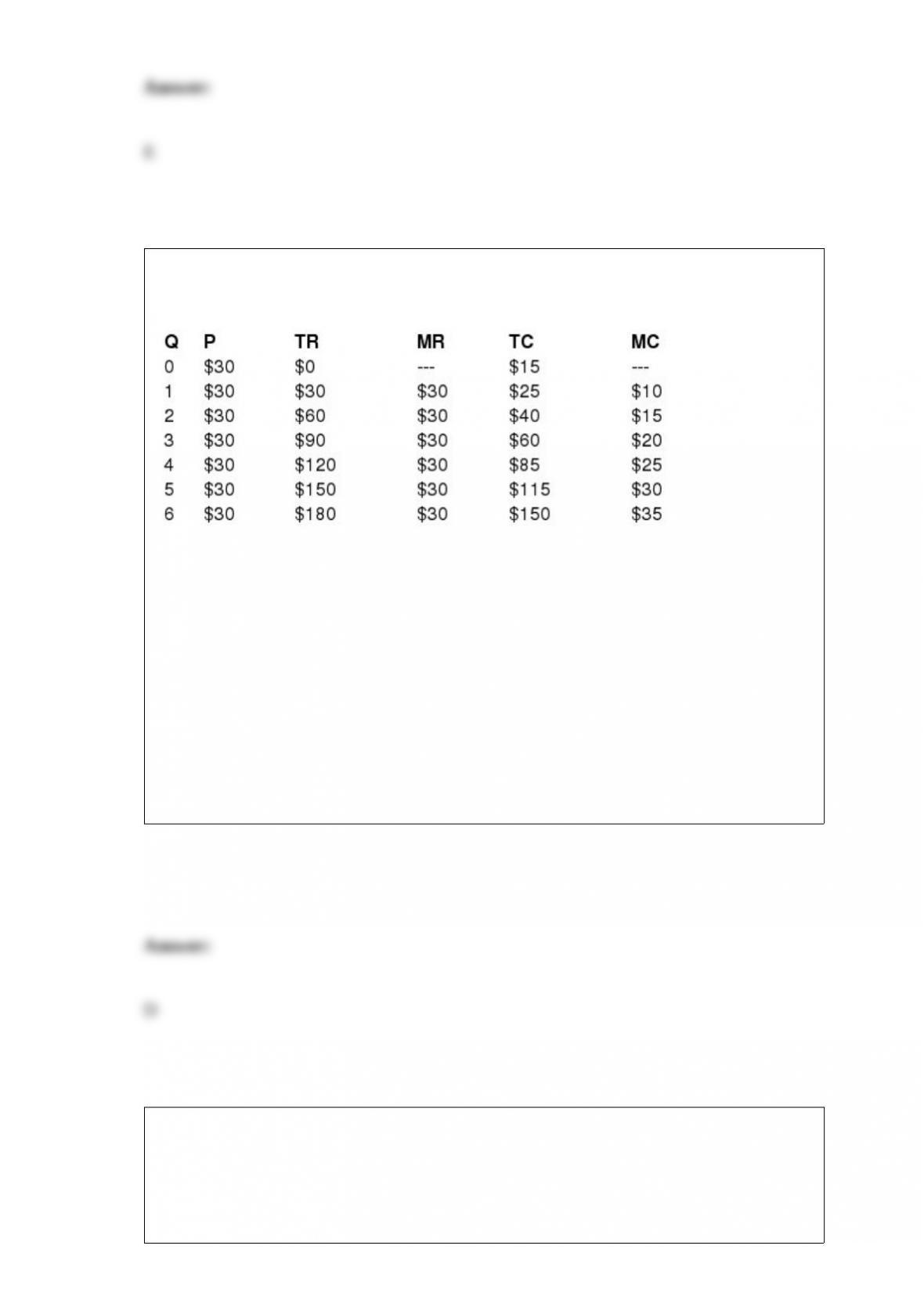
TABLE 8.1
That the firm is perfectly competitive is evident from its
A) increasing marginal cost.
B) increasing total cost.
C) zero economic profits.
D) constant marginal revenue.
E) absence of marginal values at Q = 0.
Pencils sell for 10 cents and pens sell for 50 cents. Suppose Jack, whose preferences
satisfy all of the basic assumptions, buys 5 pens and one pencil each semester. With this
consumption bundle, his MRS of pencils for pens is 3. Which of the following is true?
A) Jack could increase his utility by buying more pens and fewer pencils.

B) Jack could increase his utility by buying more pencils and fewer pens.
C) Jack could increase his utility by buying more pencils and more pens.
D) Jack could increase his utility by buying fewer pencils and fewer pens.
E) Jack is at a corner solution and is maximizing his utility.