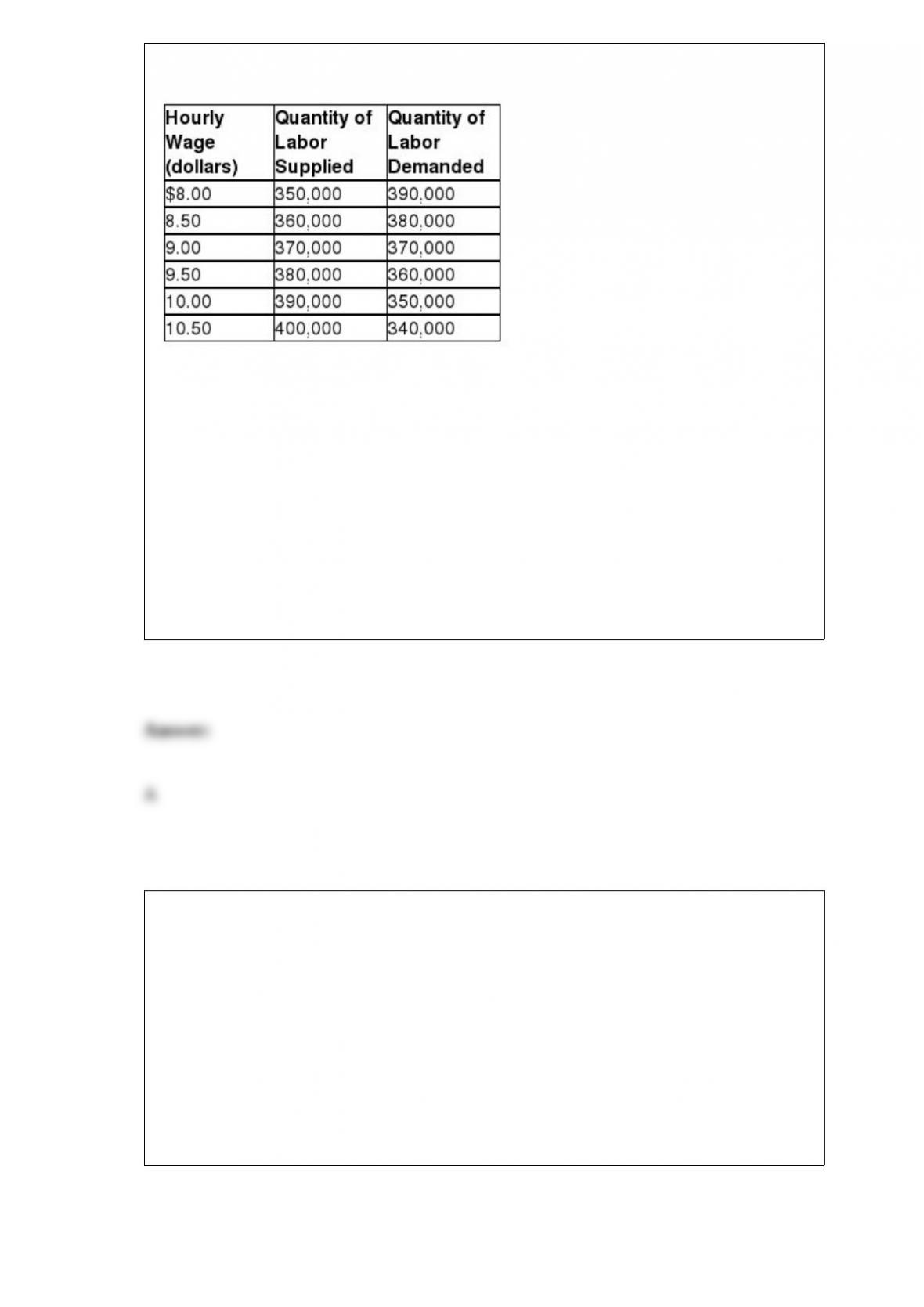
Table 4-4
Table 4-4 shows the demand and supply schedules for the low-skilled labor market in
the city of Westover.
What is the equilibrium hourly wage (W*) and the equilibrium quantity of labor (Q*)?
A) W* = $9.00; Q* = 370,000
B) W* = $8.50; Q* = 380,000
C) W* = $8.50; Q* = 360,000
D) W* = $9.00; Q* = 740,000
Most supermarkets charge the same price for the majority of goods sold. This suggest
that
A) the government regulates prices of most products sold in supermarkets.
B) supermarkets have colluded to fix prices on most of the goods sold.
C) mark-ups reflect the degree of competition in the supermarket industry.
D) the large supermarket chains are price leaders and smaller grocers take these prices
as given.

Which of the following is not a characteristic of a perfectly competitive market
structure?
A) There are a very large number of firms that are small compared to the market.
B) All firms sell identical products.
C) There are no restrictions to entry by new firms.
D) There are restrictions on exit of firms.
Which of the following statements about the distribution of income in the United States
is true?
A) The United States has the most unequal distribution of income of any high-income
country in the world.
B) The United States has a more unequal distribution of income than Bolivia and
Botswana.
C) The distribution of income in the United States is fairly equal and there have been no
dramatic changes over time.
D) The distribution of income in the United States is unequal and has become
significantly more unequal over time.
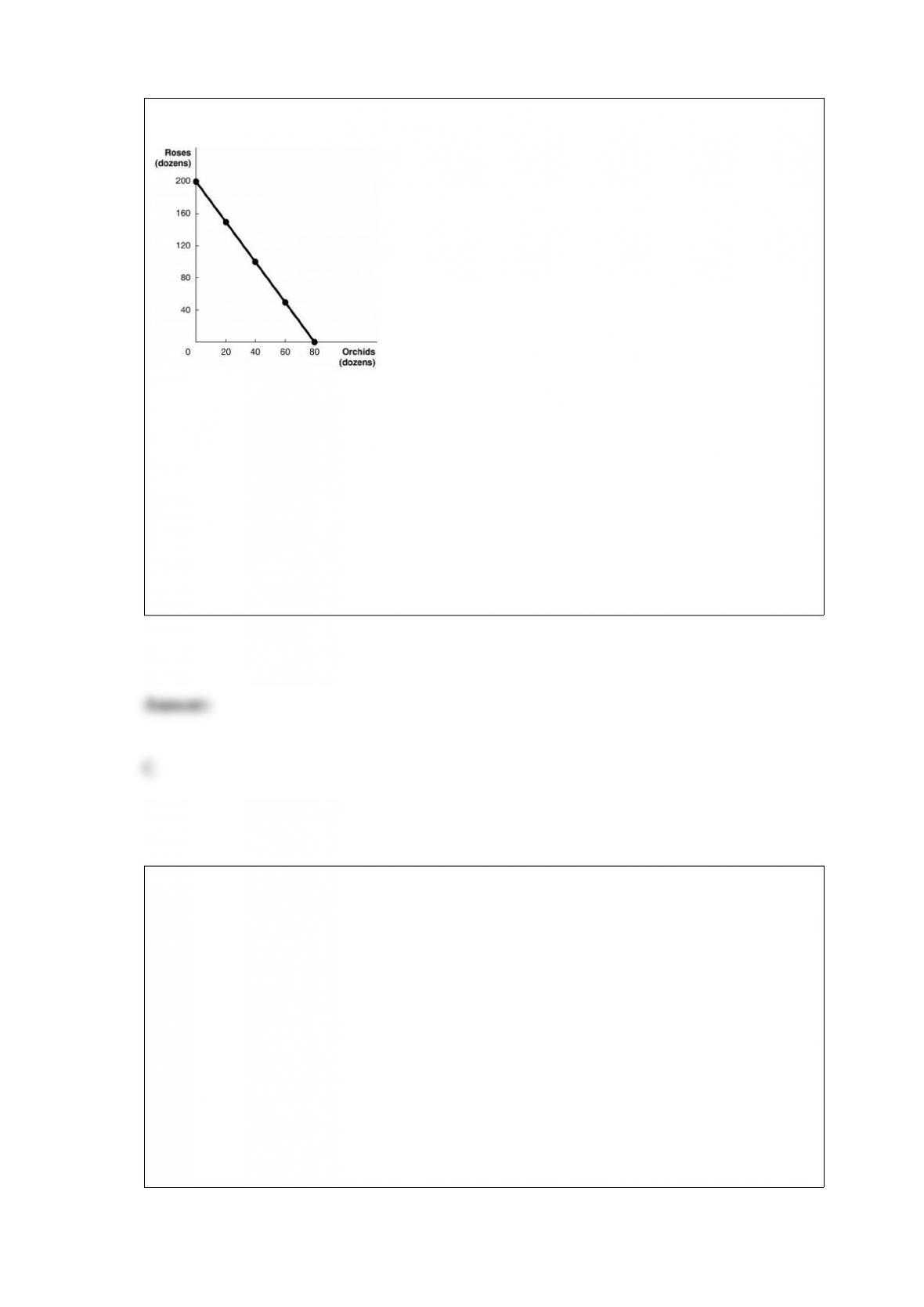
Figure 2-8
Figure 2-8 above shows the production possibilities
frontier for Vidalia, a nation that produces two goods, roses and orchids. What is the
opportunity cost of 100 dozen roses?
A) 0.8 dozen orchids
B) 5 dozen orchids
C) 40 dozen orchids
D) 80 dozen orchids
What is adverse selection?
A) It refers to the private, self-interested actions people that people pursue, which when
taken collectively leads to a loss in economic surplus.
B) It refers to the actions people take after they have entered into a transaction that
make the other party to the transaction worse off.
C) It refers to the situation in which one party to a transaction takes advantage of
knowing more than the other party to the transaction.
D) It refers to the actions people take before they enter into a transaction so as to
mislead the other party to the transaction.

In the long run,
A) GDP = potential GDP.
B) unemployment is below its natural rate.
C) LRAS and SRAS lie on the same line.
D) unemployment is above its natural rate.
Ariel is a Canadian citizen who works in Montreal, Canada and owns a winter home in
Palm Beach, Florida. When Ariel spends the winters in Palm Beach, an increase in the
value of the Canadian dollar relative to the U.S. dollar should
A) help Ariel as each Canadian dollar of her salary is now worth more U.S. dollars.
B) hurt Ariel as each Canadian dollar of her salary is now worth less U.S. dollars.
C) hurt Ariel as it is now more expensive to live in Palm Beach since the Canadian
dollar appreciation.
D) help Ariel as it is now less expensive to live in Canada since the Canadian dollar
appreciation.

Contractionary monetary policy causes
A) aggregate demand to rise and the price level to rise.
B) aggregate demand to fall and the price level to fall.
C) aggregate demand to rise and the price level to fall.
D) aggregate demand to fall and the price level to rise.
An unemployment insurance program has which of the following effects?
A) It decreases the amount of personal income of the unemployed.
B) It contributes to the severity of a recession or economic downturn.
C) It increases the amount of time spent searching for a job.
D) It lowers the overall unemployment rate.
Paul goes to Sportsmart to buy a new tennis racquet. He is willing to pay $200 for a
new racquet, but buys one on sale for $125. Paul’s consumer surplus from the purchase
is
A) $325.
B) $200.
C) $125.
D) $75.
Unemployment insurance is usually available to workers in ________ for a shorter
period of time than it is in ________.
A) the United States; Canada
B) Canada and some Western European countries; the United States
C) Canada; some Western European countries
D) some Western European countries; the United States
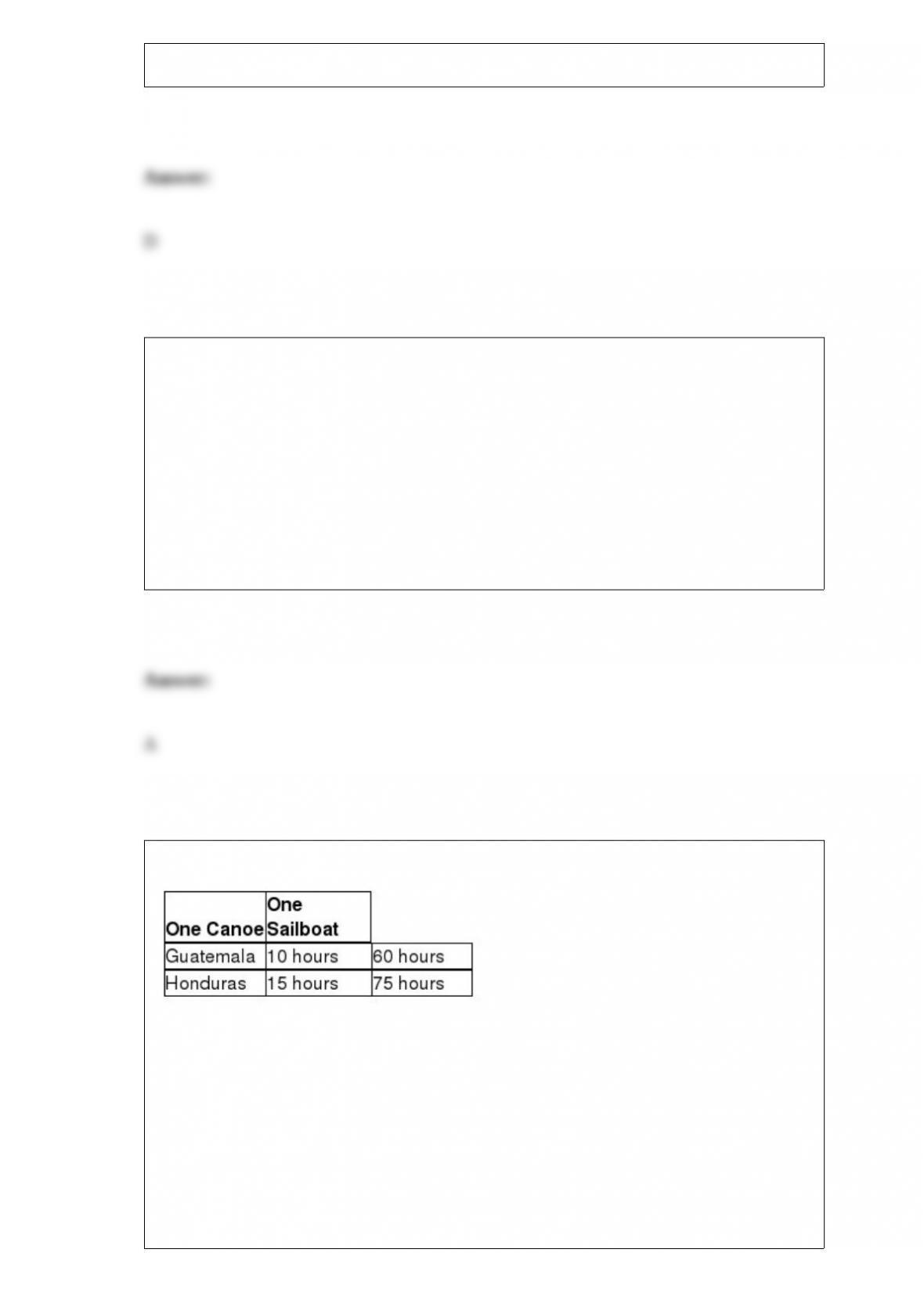
Table 2-12
Table 2-12 shows the number of labor hours required to produce a canoe and a sailboat
in Guatemala and Honduras.
If the two countries specialize and trade, who should export sailboats?
A) There is no basis for trade between the two countries.
B) Guatemala
C) Honduras

D) They should both be importing sailboats.
Why is it necessary for all economic systems to not only provide people with goods and
services, but also restrict them from getting as much of these goods and services as they
wish?
A) Failure to do this could reduce the efficiency of the system by producing some
goods and services that are not as highly valued as others.
B) Failure to do this could lead to an inequitable allocation of goods and services
produced.
C) Failure to do this could lead to drastic shortages of good and services.
D) Failure to do this could reduce efficiency and lead to an inequitable allocation of
output.
Based on the following information, what is the balance on the financial account?
Exports of goods and services = $12 billion
Imports of goods and services = $14 billion
Net income on investments = -$4 billion
Net transfers = -$1 billion
Increase in foreign holdings of assets in the United States = $5 billion
Increase in U.S. holdings of assets in foreign countries = -$3 billion A) $8 billion

B) $2 billion
C) $1 billion
D) -$1 billion
The health care system in ________ is referred to as a single-payer health care system,
and is a system in which the government provides national health insurance to all
residents.
A) Canada
B) Japan
C) the United Kingdom
D) the United States
During a(n) ________ many firms experience reduced profits, which reduces ________
and investment spending.
A) expansion; business confidence
B) recession; cash flow
C) expansion; cash flow
D) recession; government spending
All other factors held constant, increased growth in aggregate demand will
A) increase inflation.
B) reduce unemployment.
C) move the economy to a higher point on the short-run Phillips curve.
D) All of the above are correct.
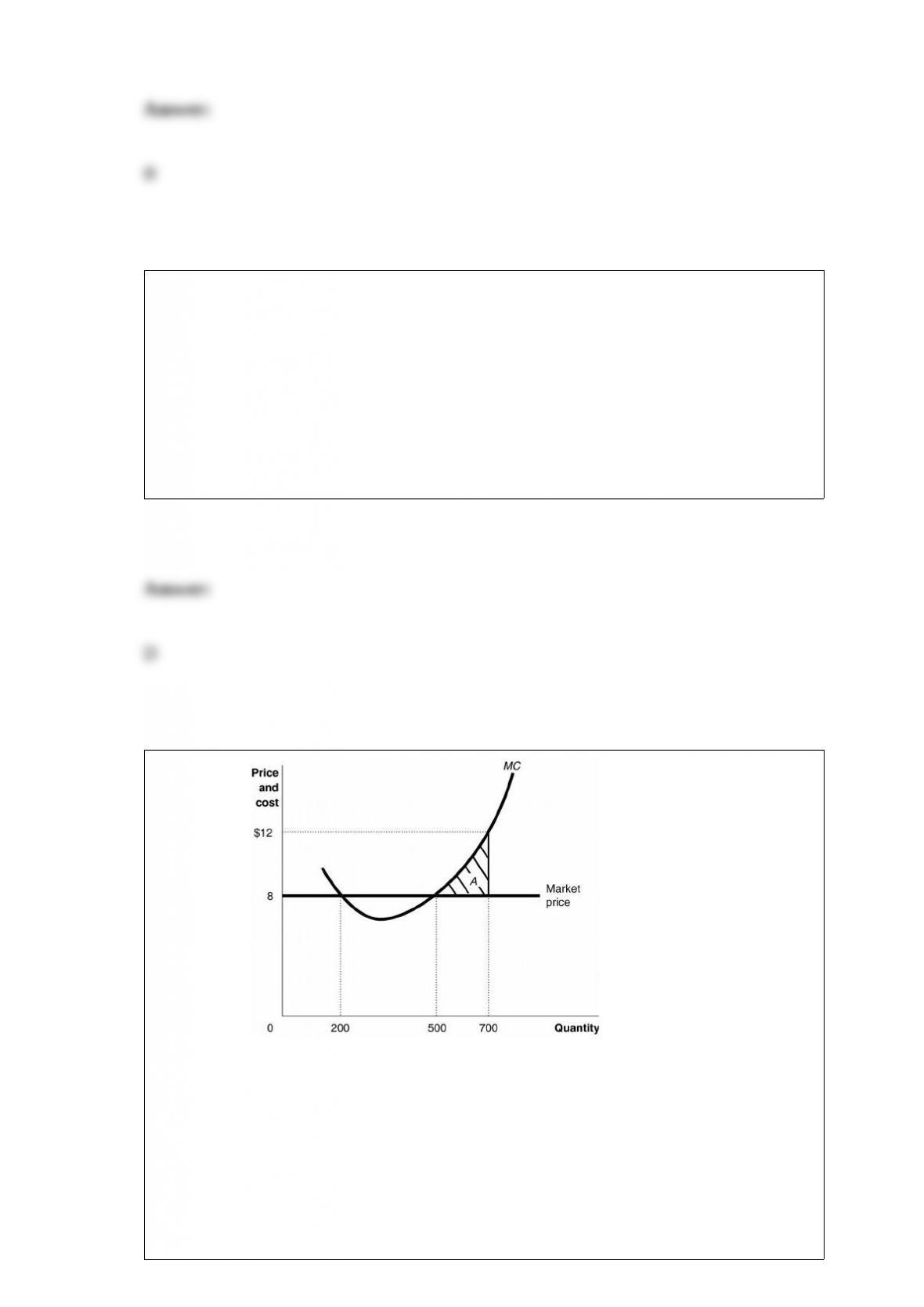
Figure 12-1
If the firm is producing 700 units, what is the amount of its profit or loss?
A) loss of $280
B) loss equivalent to the area A
C) profit equivalent to the area A

D) There is insufficient information to answer the question.