
1) personal income usually exceeds disposable income.
2) oligopoly firms may produce either standardized or differentiated products.
3) During the Great Depression most nations lowered tariffs and abolished import
quotas to encourage the flow of trade.
4) other things equal, younger workers are more likely to migrate than older workers.
5) The asset demand for money varies inversely with the nominal GDP.
6) As measured by the standardized budget, the U.S. government engaged in a
contractionary fiscal policy in 2002 and 2003.
7) A total fertility rate of approximately 1.0 will cause each generation to be half as
large as the preceding generation.
8) The following table shows the total costs and total benefits facing a city of five
different potential baseball stadiums of increasing size. All figures are in millions of
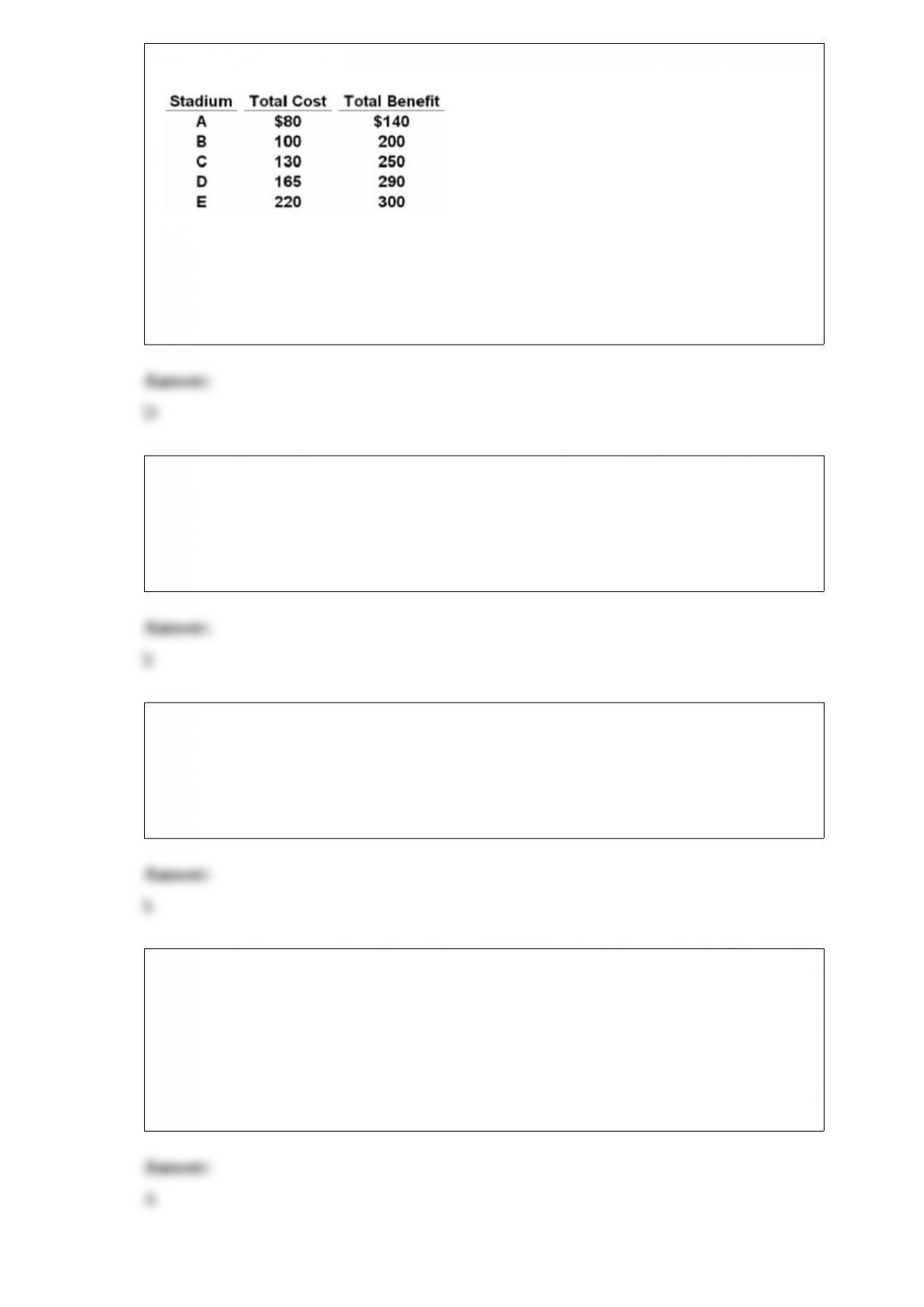
dollars.
Refer to the above table. Based on cost-benefit analysis, the city should:
A.not build any of these stadiums.
B.build stadium E.
C.build stadium C.
D.build stadium D.
9) which of the following statements is correct?
a.if demand increases and supply decreases, equilibrium price will fall.
b.if supply increases and demand decreases, equilibrium price will fall.
c.if demand decreases and supply increases, equilibrium price will rise.
d.if supply declines and demand remains constant, equilibrium price will fall.
10) by summing the dollar value of all market transactions in the economy we would:
a.be determining the market value of all resources used in the production process.
b.obtain a sum substantially larger than the gdp.
c.be determining value added for the economy.
d.be measuring gdp.
11) According to the Taylor rule, if inflation rises 1 percent above a target rate of 2
percent, the Fed should raise the Federal funds rate, relative to the current rate of
inflation, by:
A.0.5 percentage points.
B.1 percentage point.
C.1.5 percentage points.
D.2 percentage points.
12) In the table below, assume a monopsonist has the marginal-revenue-product
schedule for a particular type of labor given in columns 1 and 2 and that the supply
schedule for labor is that given in columns 1 and 3.
(a)Compute the firms total labor costs at each level of employment and the marginal
labor cost of each unit of labor, and enter these figures in columns 4 and 5.
(b)How many units of labor will the firm hire? What will be the wage rate?
(c)If this firm hired labor in a competitive labor market, what would be the wage rate
and number of workers hired?
13) an increase in the excise tax on cigarettes raises the price of cigarettes by shifting
the:
a.demand curve for cigarettes rightward.
b.demand curve for cigarettes leftward.
c.supply curve for cigarettes rightward.
d.supply curve for cigarettes leftward.
14)
In the above figure AD1 and AS1 represent the original aggregate supply and demand
curves and AD2 and AS2 show the new aggregate demand and supply curves. The
changes in aggregate demand and supply in the above diagram produce:
A.a higher price level.
B.an expansion of real output and a stable price level.
C.an expansion of real output and a higher price level.

D.a decline in real output and a stable price level.
15) Which of the following statements is correct for a private closed economy?
A.Saving equals planned investment only at the equilibrium level of GDP.
B.All levels of GDP where planned investment exceeds saving will be too high for
equilibrium.
C.Planned and actual investment are identical at all possible levels of GDP.
D.Saving equals actual investment only at the equilibrium level of GDP.
16) human capital refers to:
a.the accumulated knowledge and skills that allow a person to be productive.
b.machinery that requires extensive human interaction to be productive.
c.the accumulated financial assets of people.
d.all of these things.
17) The marginal benefit to a firm from its R&D expenditures is depicted by its:
A.interest-rate-cost of funds curve.
B.expected-rate-of-return curve.
C.venture capital acquisition curve.
D.retained earnings pay-out curve.
18) Other things equal, interest rates are:
A.higher on large loans than on small loans.
B.higher on loans with tax-exempt interest payments.
C.lower on less risky loans than on riskier loans.
D.lower on short-term loans than on long-term loans.
19) If government uses its stabilization policies to maintain full employment under
conditions of cost-push inflation:
A.a deflationary spiral is likely to occur.
B.an inflationary spiral is likely to occur.
C.stagflation is likely to occur.
D.the Phillips Curve is likely to shift inward.
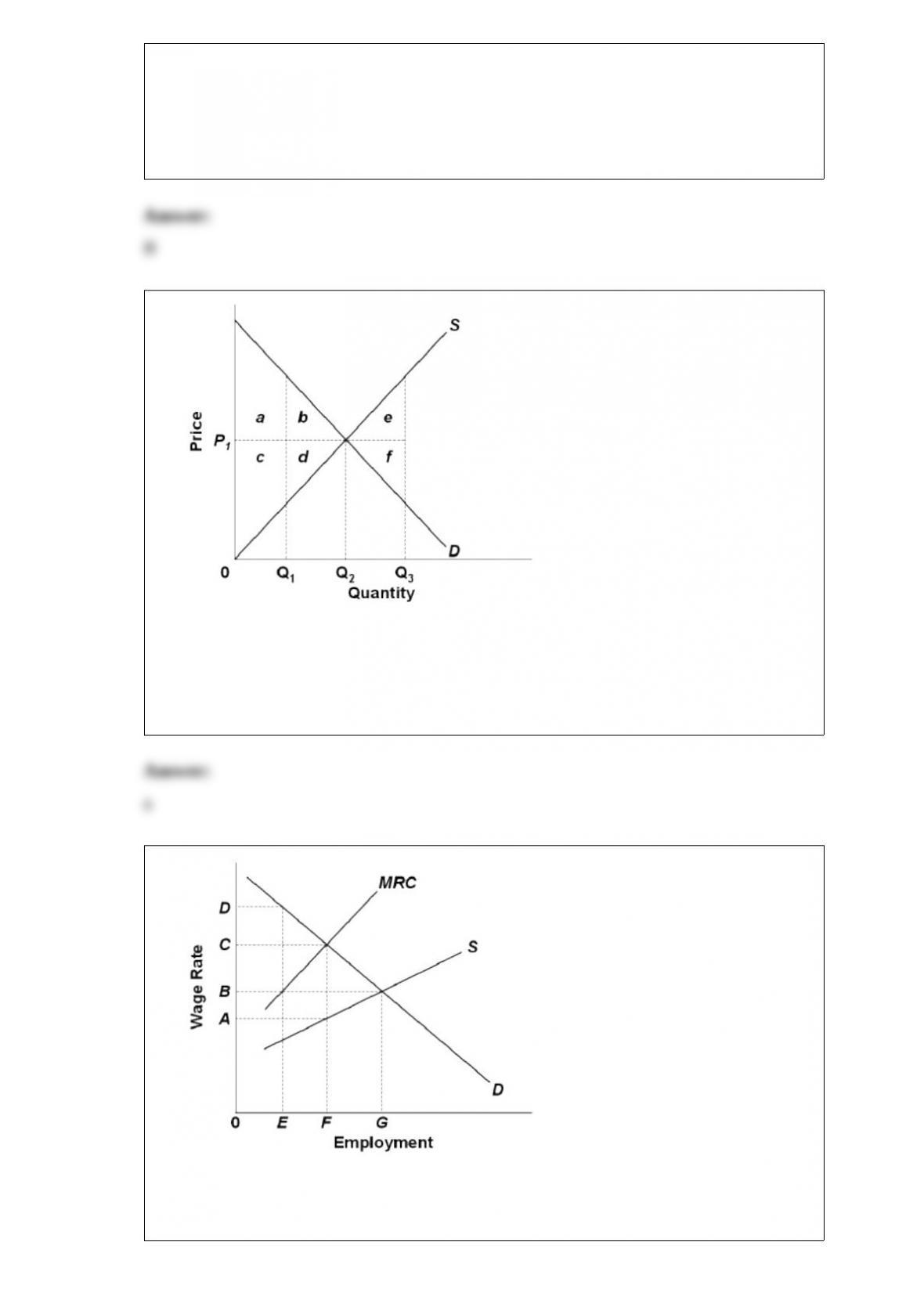
20)
refer to the above diagram. at quantity q1:
a.maximum willingness to pay exceeds minimum acceptable price.
b.the sum of consumer and producer surplus is maximized.
c.minimum acceptable price exceeds maximum willingness to pay.
d.an efficiency loss (or deadweight loss) of a + b occurs.
21)
Refer to the above diagram. Assume that an inclusive union is formed to bargain with
the monopsonistic employer of the previous question. To what level can this union
increase the wage rate without causing the number of jobs to decline below that which
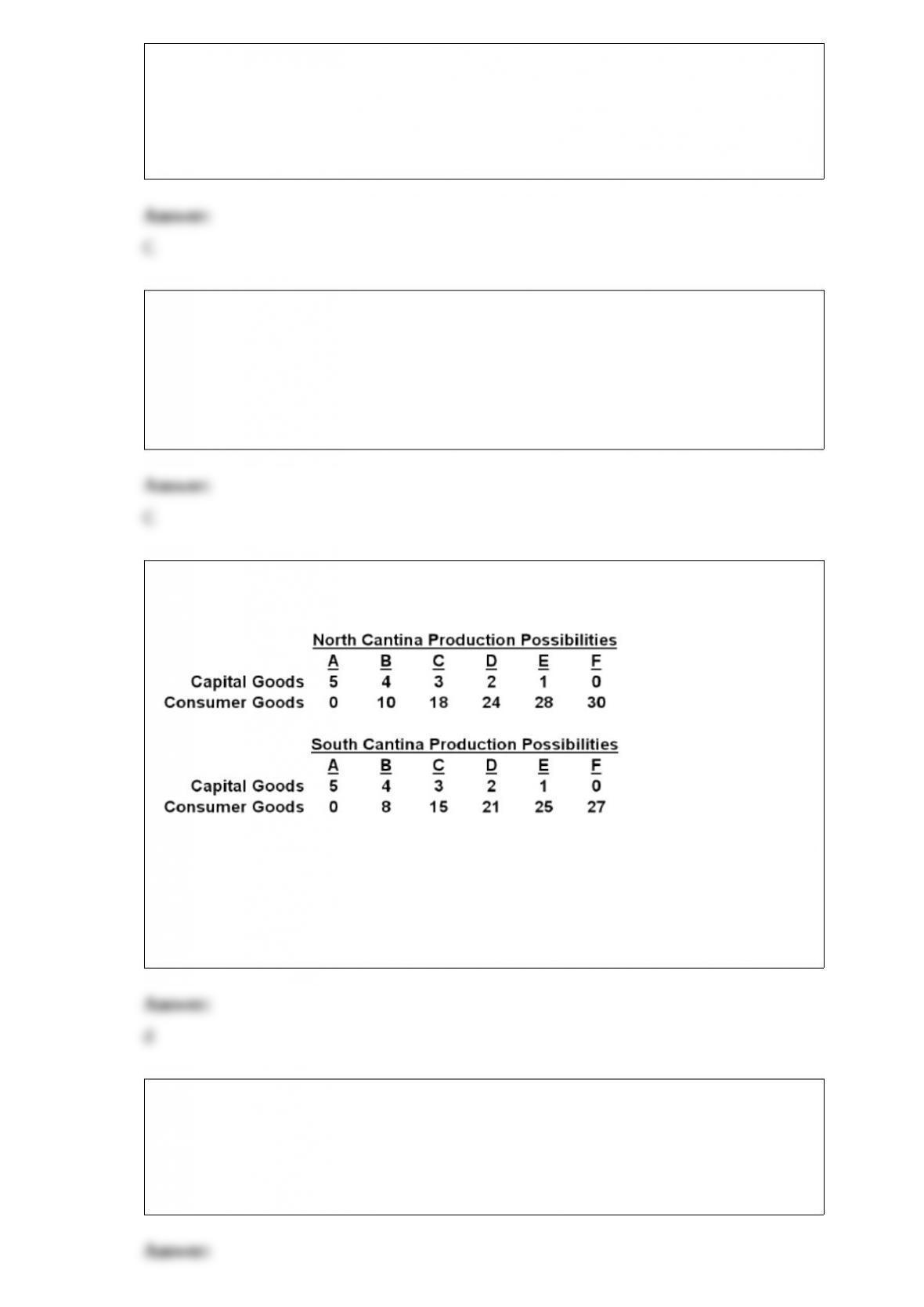
the monopsonist would otherwise have provided?
A.D minus A
B.D
C.C
D.B
22) Over the long run, real earnings per worker can increase only at about the same rate
as the economy’s rate of growth of:
A.total output.
B.stock of capital.
C.output per worker.
D.international trade.
23) answer the next question(s) on the basis of the following production possibilities
tables for two countries, north cantina and south cantina:
refer to the above tables. if south cantina is producing at production alternative d, the
opportunity cost of the third unit of capital goods will be:
a.3 units of consumer goods.
b.4 units of consumer goods.
c.5 units of consumer goods.
d.6 units of consumer goods.
24) Payment of interest on the U.S. public debt:
A.increases the current domestic standard of living in the United States.
B.has no effect on the distribution of income.
C.is thought to decrease income inequality.
D.is thought to increase income inequality.
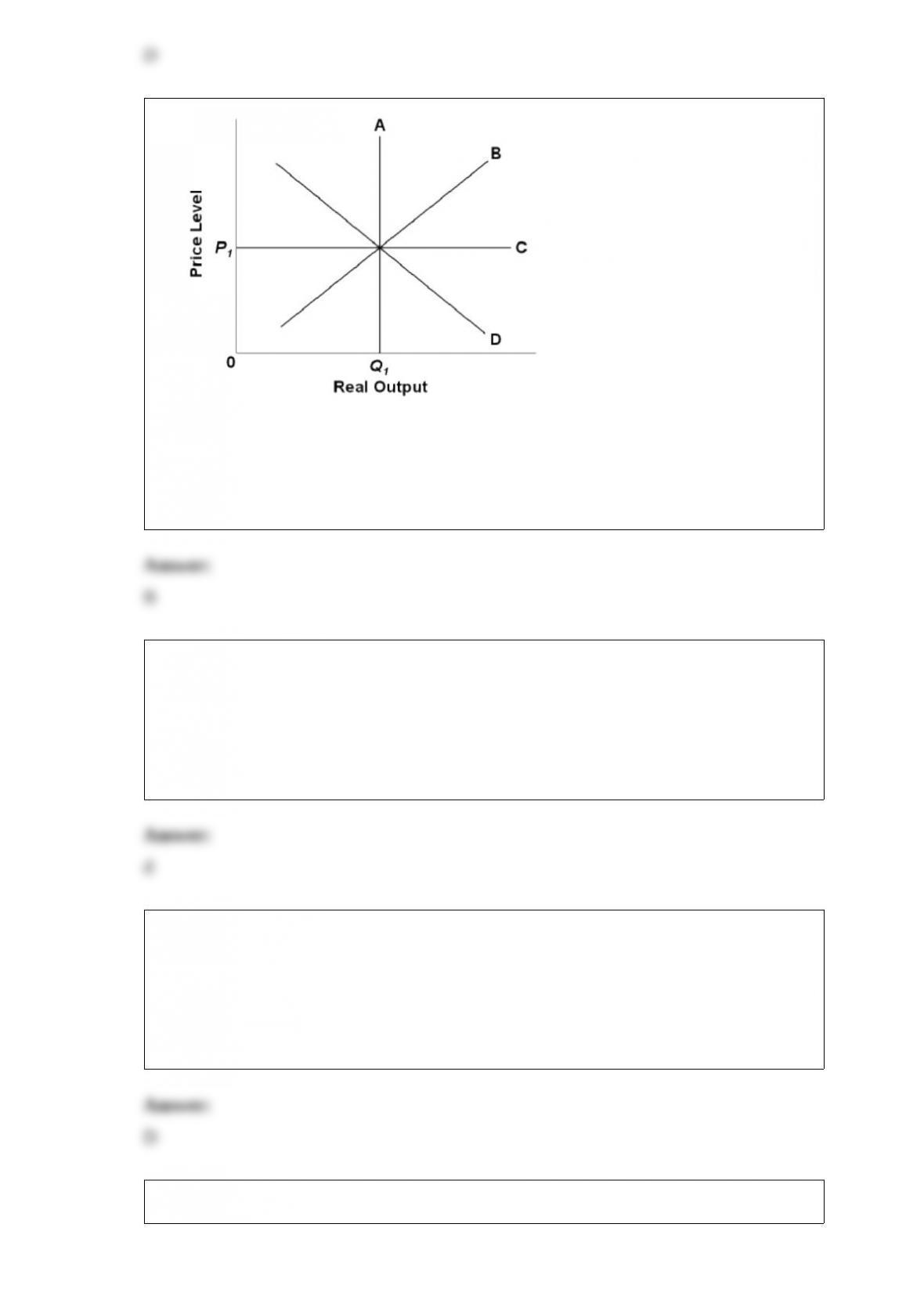
25)
Refer to the above diagram relating to short-run and long-run aggregate supply. The
A.short-run aggregate supply curve is A
B.short-run aggregate supply curve is B
C.long-run aggregate supply curve is B
D.long-run aggregate supply curve is D
26) at the output level defining allocative efficiency:
a.the areas of consumer and producer surplus necessarily are equal.
b.marginal benefit exceeds marginal cost the by the greatest amount.
c.consumer surplus exceeds producer surplus by the greatest amount.
d.the maximum willingness to pay for the last unit of output equals the minimum
acceptable price of that unit of output.
27) The largest proportion of the public debt is held by:
A.the U.S. public (individuals, businesses, financial institutions, etc.) and state and
local governments.
B.foreign individuals and institutions.
C.the Federal Reserve System.
D.U.S. government agencies.
28) Evaluate the statement: No nation can grow without a large natural resource base.
29) What are usury laws and what are their economic effects?
30) Explain how consumption and saving are related to disposable income in the
aggregate expenditures model.
31) How does simultaneous consumption affect economies of scale?
32) Explain the difference between final and intermediate goods, and give an example
of each.
33) Differentiate between nominal and real GDP.

34) What do critics of social regulation need to remember about government?
35) Inflation is frequently described as too much money chasing too few goods. Is this
an acceptable definition?