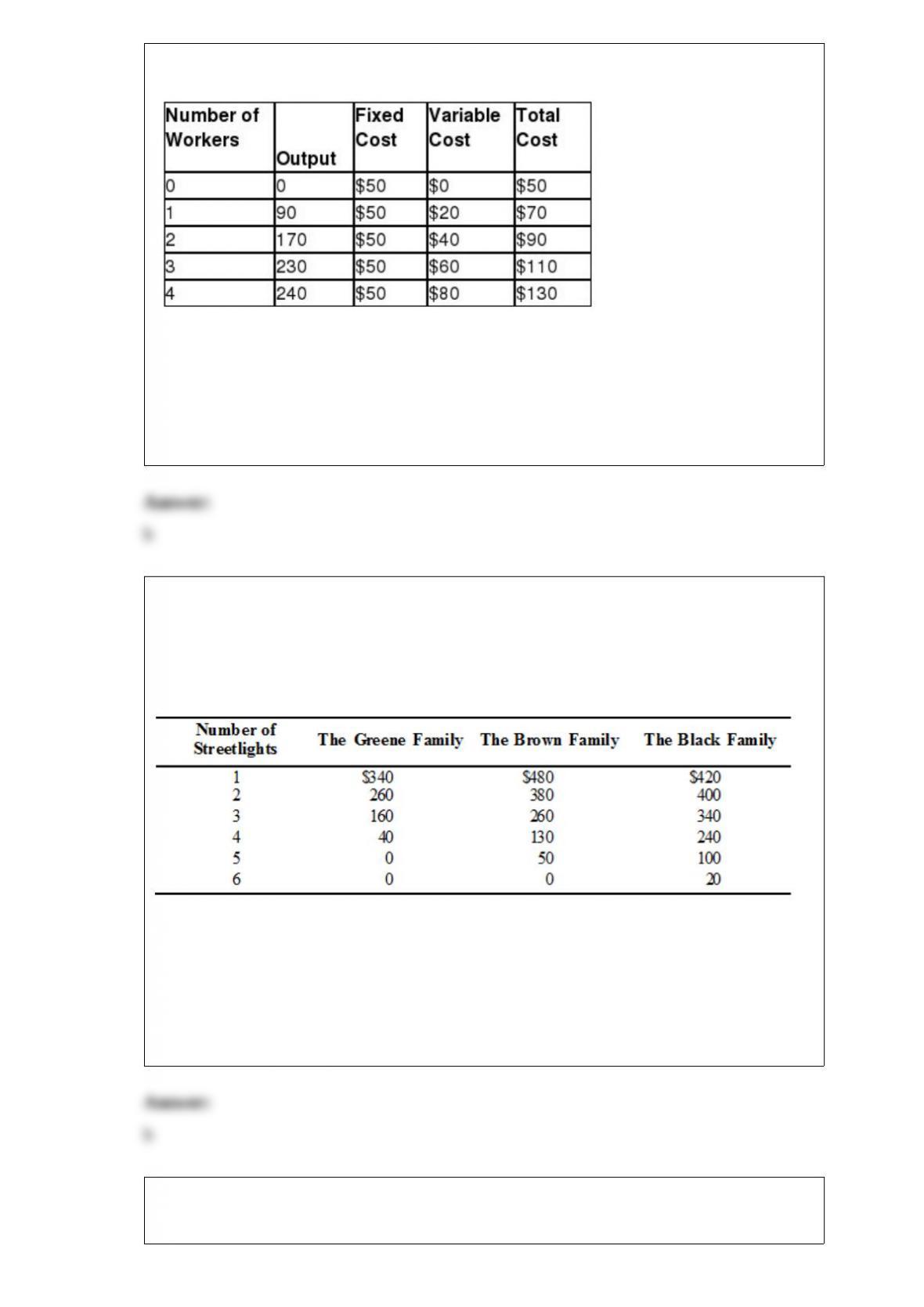
1) Table 13-3
If the firm can sell its output for $1 per unit, what is the profit-maximizing level of
output?
a.240 units
b.230 units
c.190 units
d.170 units
2) Consider a small town with only three families, the Greene family, the Brown family,
and the Black family. The town does not currently have any streetlights so it is very
dark at night. The three families are considering putting in streetlights on Main Street
and are trying to determine how many lights to install. The table below shows each
family’s willingness to pay for each streetlight.
Suppose the cost to install each streetlight is $900. How many streetlights should the
town install to maximize total surplus from the streetlights?
a.1 streetlight
b.2 streetlights
c.3 streetlights
d.4 streetlights
3) Figure 9-1
The figure illustrates the market for coffee in Guatemala.
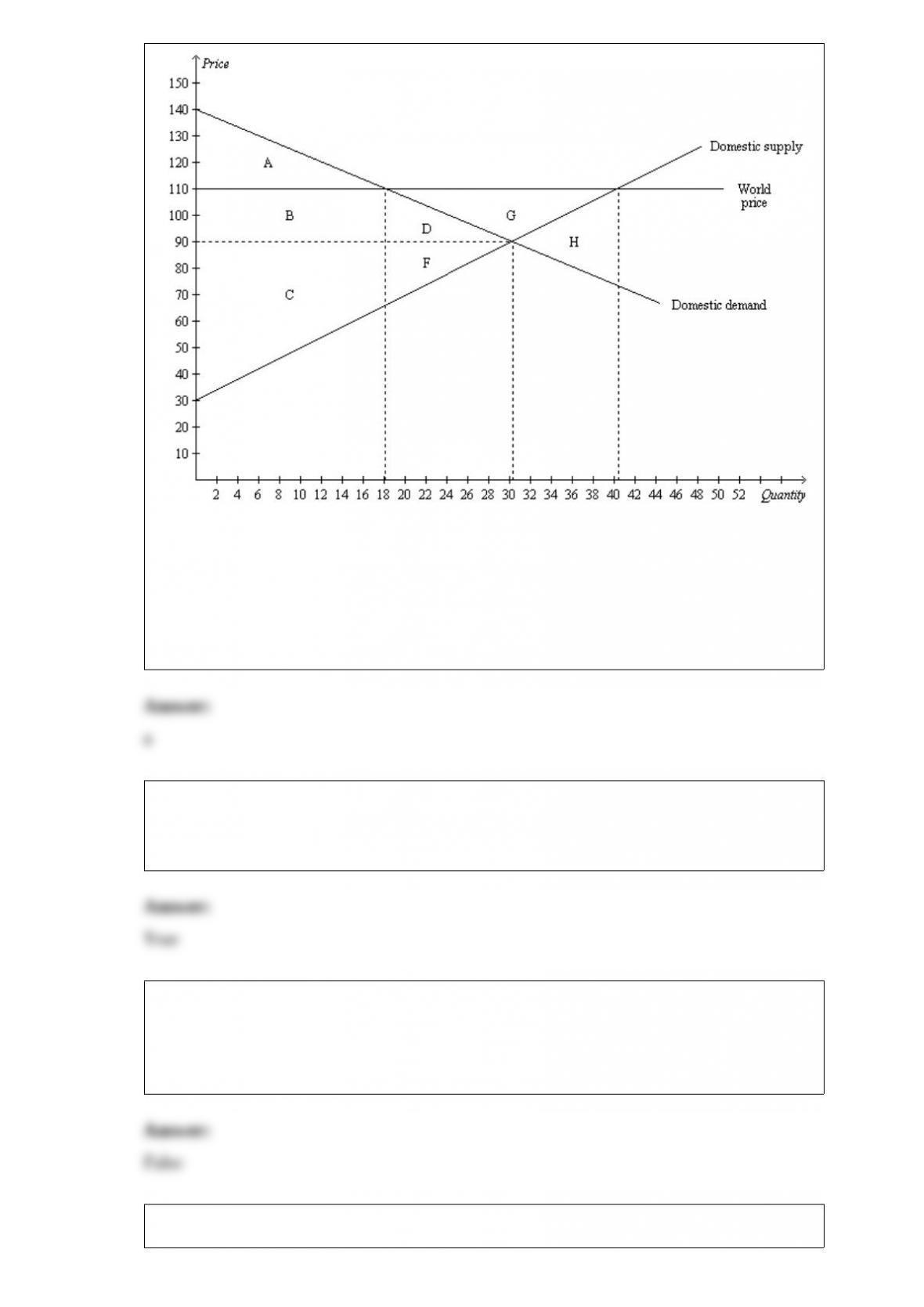
From the figure it is apparent that
a.Guatemala will export coffee if trade is allowed.
b.Guatemala will import coffee if trade is allowed.
c.Guatemala has nothing to gain either by importing or exporting coffee.
d.the world price will fall if Guatemala begins to allow its citizens to trade with other
countries.
4) Evaluating normative statements involves values as well as facts.
a.True
b.False
5) Government intervention in the economy with the goal of promoting
technology-producing industries is known as patent policy.
a.True
b.False
6) If mayonnaise and Miracle Whip are substitutes, then which of the following would

increase the demand for Miracle Whip?
a.a decrease in the price of Miracle Whip
b.an increase in the price of mayonnaise
c.a decrease in the price of mayonnaise
d.Both a and b are correct.
7) The substitution effect of a price change is depicted by a
a.movement along the budget constraint holding satisfaction constant.
b.shift in the budget constraint at the old prices.
c.movement along the consumer’s new indifference curve at the new prices.
d.movement along the original indifference curve to the point where the marginal rate
of substitution equals the price ratio for the new set of prices.
8) Pete is a non-union employee at The Electric Co. The majority of the employees at
The Electric Co. are unionized. The union at The Electric Co. has negotiated very good
benefits. Even though he is not a union member and he does not have to pay union
dues, Pete receives all the benefits that the union has negotiated. Pete’s behavior is an
example of
a.rivalry.
b.a barrier to entry.
c.free riding.
d.Taft-Hartley opposition.
9) Domestic consumers gain and domestic producers lose when the government
imposes a tariff on imports.
a.True
b.False
10) What is the most important factor that explains differences in living standards
among countries?
a.labor unions
b.minimum wage laws
c.productivity
d.efficiency
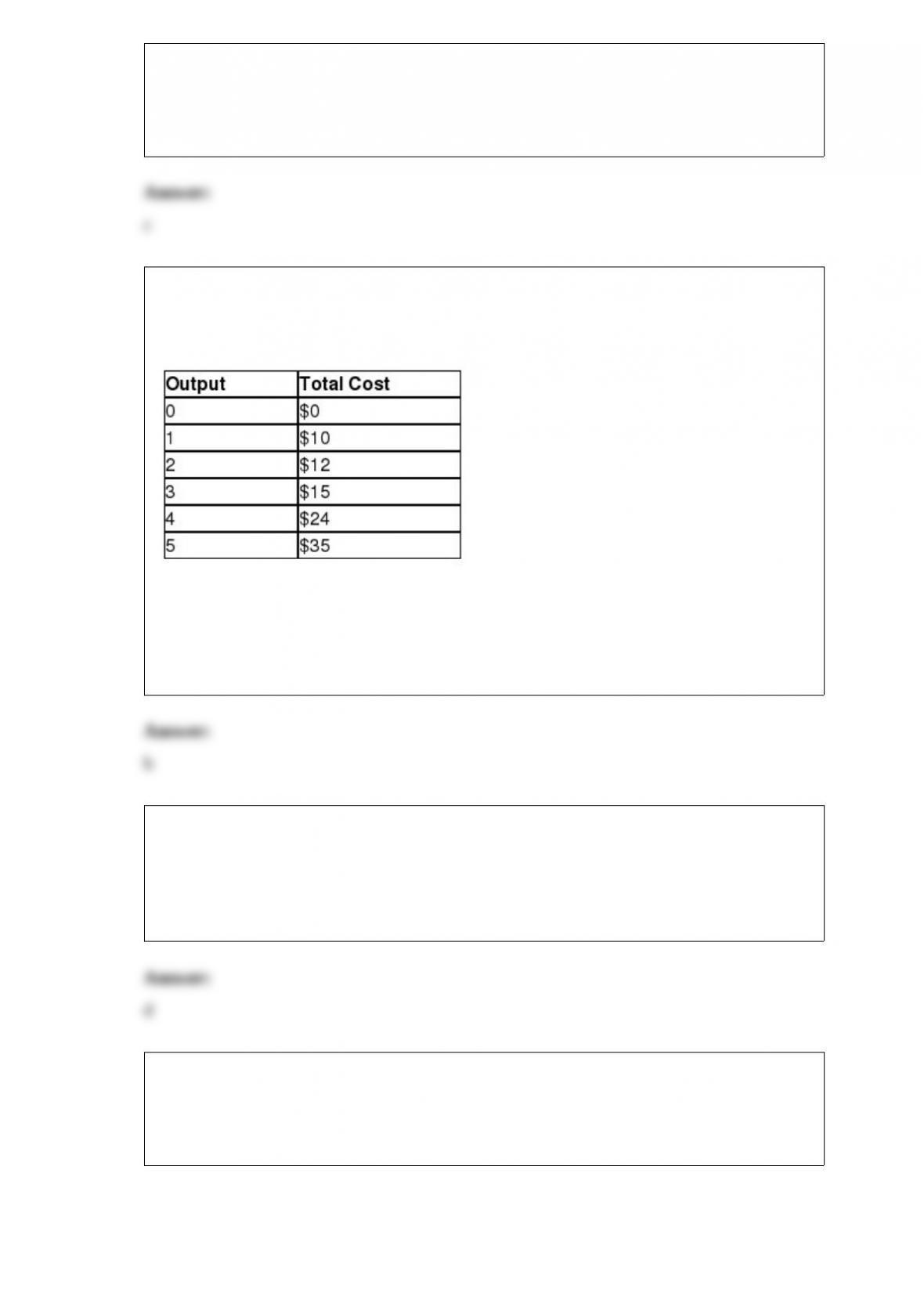
11) In the short run, there are 500 identical firms in a competitive market. The firms do
not use any resources that are available in limited quantities, and each of them has the
following cost structure:
The long-run supply curve for this market is
a.positively sloped for all prices above $10.
b.horizontal at a price of $5.
c.horizontal at a price of $6.
d.horizontal at a price of $7.
12) In the simple circular-flow diagram,
a.households own the factors of production.
b.households buy all the goods and services that firms produce.
c.land, labor, and capital flow from households to firms.
d.All of the above are correct.
13) Table 22-16
The Johnson family is planning a vacation and, though Mr. and Mrs. Johnson will be
paying for the trip, they have decided to use a democratic voting process to choose their
destination. The family members’ preferences are reflected in the table below.

Refer to Table 22-16. If the family uses a Borda count to make their decision, what is
their vacation destination?
a.Grand Canyon
b.Sea World
c.Opryland
d.Disneyland
14) In competitive markets, firms that raise their prices are typically rewarded with
larger profits.
a.True
b.False
15) Why would lack of cooperation between criminal suspects be desirable for society
as a whole?
a.The suspects are able to choose optimal outcomes for themselves by acting in their
own self interest.
b.The prisoners’ dilemma safeguards the criminals’ constitutional rights.
c.More criminals will be convicted.
d.None of the above is correct.
16) Sally runs a hair styling salon. Sally is a profit-maximizing owner whose firm
operates in a competitive market. The marginal cost of a haircut is $15. What is the
maximum wage that Sally will pay her stylists?
a.less than $15 per haircut
b.$15 per haircut
c.more than $15 haircut
d.There is insufficient information to answer this question.
17) Shelley’s Salsa produces and sells organic salsa. Last year it sold 3 million tubs of
salsa at a price of $3 per tub. For last year, the firm’s
a.accounting profit was $9 million.
b.economic profit was $9 million.
c.total revenue was $9 million.
d.explicit costs were $9 million.
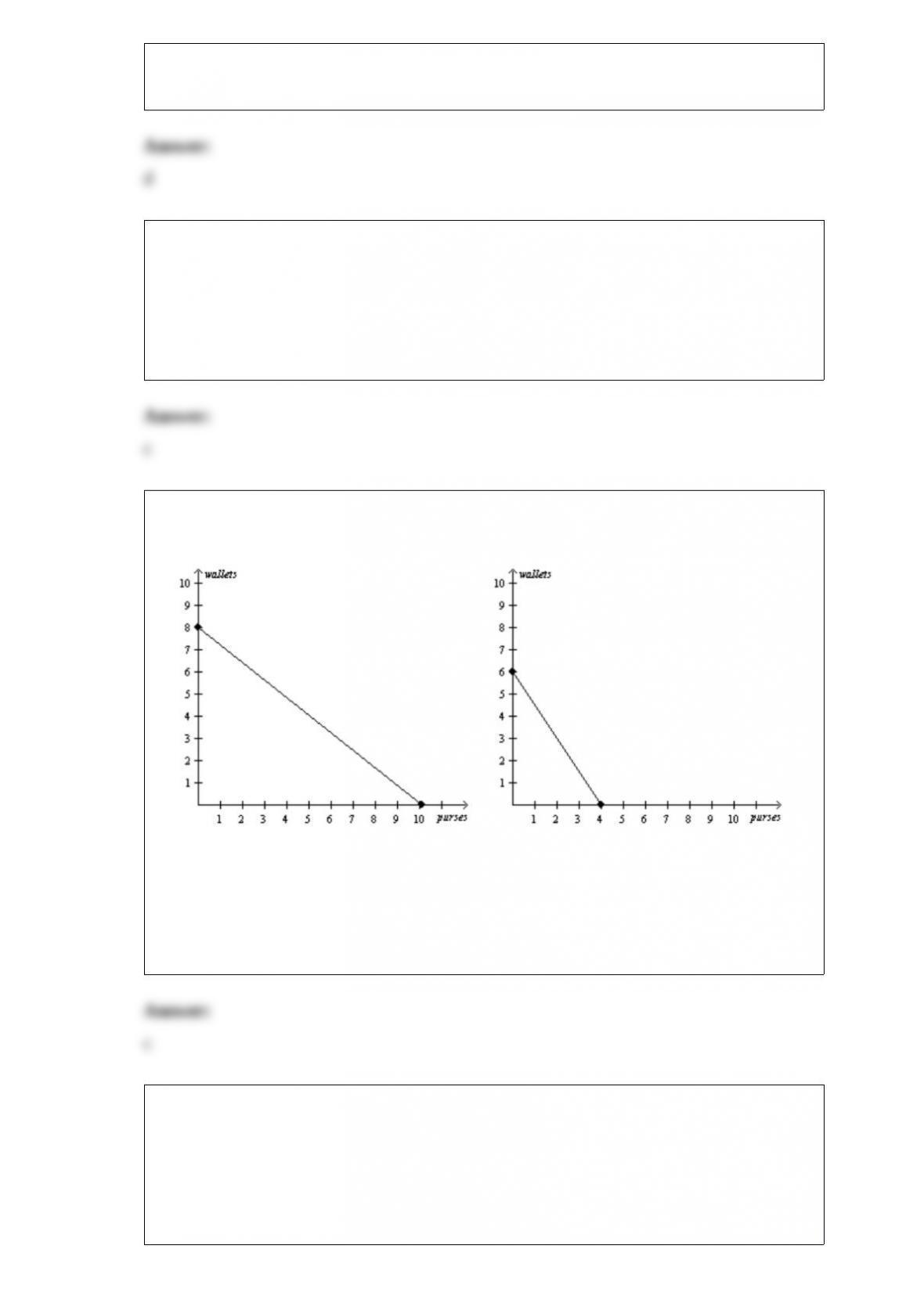
18) Hosne’s Production Possibilities FrontierMerve’s Production Possibilities
Frontier
Hosne has an absolute advantage in the production of
a.purses and Merve has an absolute advantage in the production of wallets.
b.wallets and Merve has an absolute advantage in the production of purses.
c.both goods and Merve has an absolute advantage in the production of neither good.
d.neither good and Merve has an absolute advantage in the production of both goods.
19) Suppose that a worker in Freedonia can produce either 6 units of corn or 2 units of
wheat per year, and a worker in Sylvania can produce either 2 units of corn or 6 units of
wheat per year. Each nation has 10 workers. Without trade, Freedonia produces and
consumes 30 units of corn and 10 units of wheat per year. Sylvania produces and
consumes 10 units of corn and 30 units of wheat. Suppose that trade is then initiated
between the two countries, and Freedonia sends 30 units of corn to Sylvania in

exchange for 30 units of wheat. Freedonia will now be able to consume a maximum of
a.30 units of corn and 30 units of wheat.
b.40 units of corn and 30 units of wheat.
c.40 units of corn and 20 units of wheat.
d.10 units of corn and 40 units of wheat.
20) Scenario 22-6
Shana owns a boutique that sells highend women’s clothing and accessories. Katie
works part-time at the boutique and frequently is the only employee in this small store.
Shana pays Katie a wage that is higher than the market wage for this type of job. When
the store is not full of customers, Katie diligently works on displays and cleans to keep
the store looking its best. Belinda is a customer in the store who asks Katie’s opinion on
the quality of some jeans she is considering purchasing. Katie tells her the quality is
great even though she’s had several other customers return them due to flaws. Magda is
another customer who is returning a necklace without volunteering that a gem is
missing.
Refer to Scenario 22-6. Suppose Shana is tired of all of the problems with the brand of
jeans she carries and decides to carry a different, higher quality brand instead. She is
concerned that her customers will not trust the quality of the new brand so she offers a
60 day money-back guarantee. The action taken by Shana is called
21) Scenario 15-11
Vincent operates a scenic tour business in Boston. He has one bus which can fit 50
people per tour and each tour lasts 2 hours. His total cost of operating one tour is fixed
at $450. Vincent’s cost is not reduced if he runs a tour with a partially full bus. While
his cost is the same for all tours, Vincent charges each passenger his/her willingness to
pay: adults $18 per trip, children $10 per trip, and senior citizens $12 per trip. At those
rates, on a typical day Vincent’s demand is:
Assume that Vincent’s customers are always available for the tour¾ therefore, he can
fill his bus for each tour as long as there is sufficient total demand for the day.
One of Vincent’s friends tells him he would be more profitable if he charged a single
price of $18. Assuming no changes in consumer demand, what would Vincent’s profit
be if he charged every customer $18?

22) What are the typical effects on the labor market of technological progress?
23) If in-kind transfers were included in income at their market value, what would
happen to the number of families below the poverty line?
24) The Earned Income Tax Credit (EITC) is a tax provision that allows poor working
families to receive income tax refunds greater than the taxes they paid during the year.
Therefore, the EITC works much like a .