
1) Demographers expect world population to decline in the next century.
2) Human capital investment refers to spending on education and worker training.
3) Kara’s Kettles, Inc. has developed a new and improved type of cookware. Alex, a
typical consumer, will necessarily purchase Kara’s new product if his MU/P for the new
cookware exceeds that of competing products.
4) The U.S. poverty rate for the elderly (65 and over) is higher than for the general
population.
5) generally speaking, the demand for luxury goods is more price elastic than is the
demand for necessities.
6) A total fertility rate of 1.0 is necessary to keep the population constant over time.
7) Reduction of tariff barriers against DVC imports would benefit both the DVCs and
the IACs.
8) there is a consensus among economists that the amount of resources allocated to the
health care industry is optimal.
9) A commercial bank’s reserves are:
A.liabilities to both the commercial bank and the Federal Reserve Bank holding them.
B.liabilities to the commercial bank and assets to the Federal Reserve Bank holding
them.
C.assets to both the commercial bank and the Federal Reserve Bank holding them.
D.assets to the commercial bank and liabilities to the Federal Reserve Bank holding
them.
10) which of the following statements is true about migration behavior?
a.older workers are more likely to migrate than younger workers.
b.migrants are more likely to migrate to countries farther rather than nearer to their
home country.
c.single workers are more likely to migrate than workers with spouses and children.
d.workers are less likely to migrate where “beaten paths” exist.
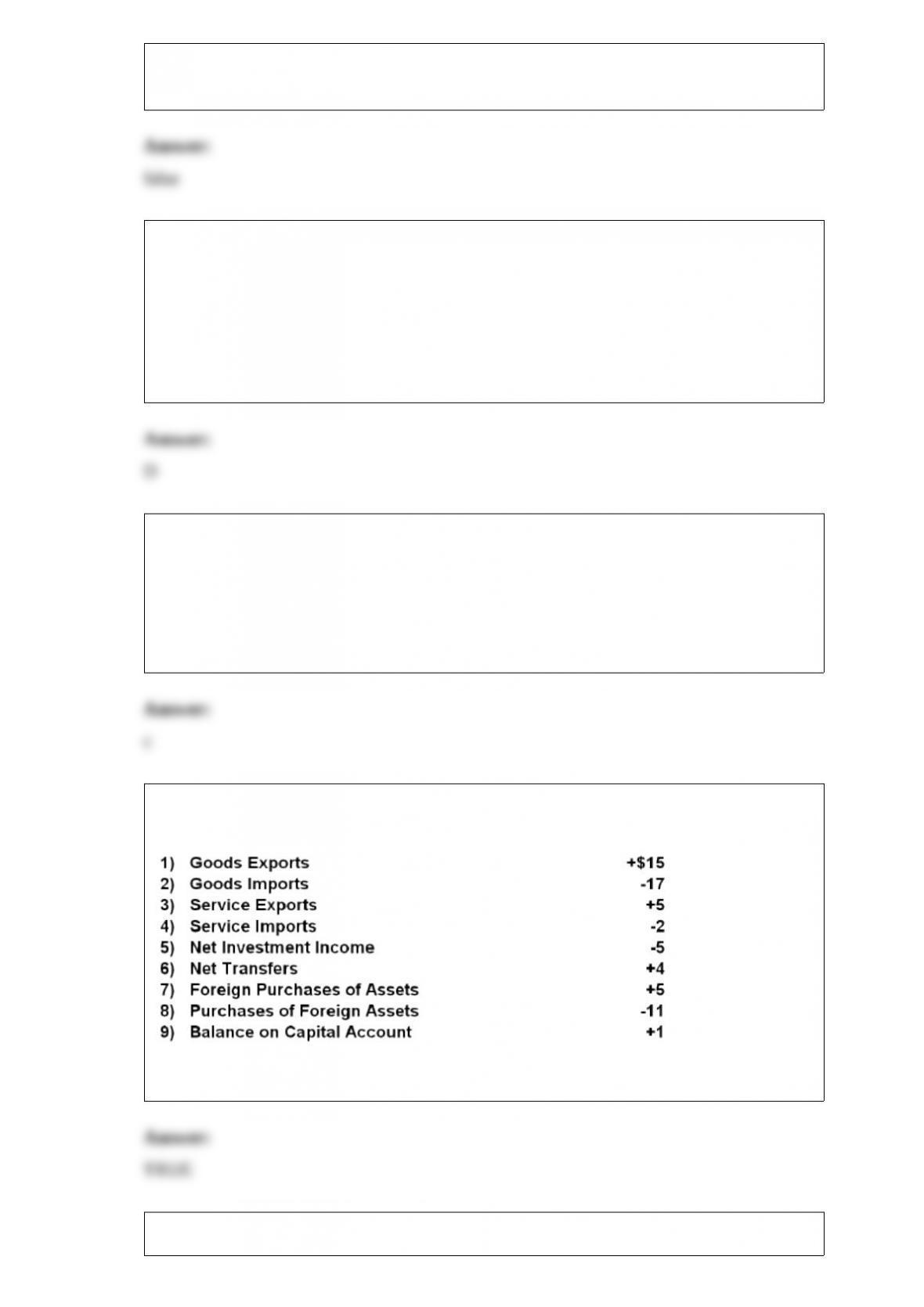
11) The following 2008 balance of payments statement for Transylvania. All figures are
in billions of dollars.
Refer to the above data. Foreigners made a smaller volume of asset purchases in
Transylvania in 2008 than Transylvanians made asset purchases abroad.
12) the countries comprising nafta are:

a.canada, the united states, and puerto rico.
b.the united states, mexico, and chile.
c.the united states, united kingdom, and france.
d.canada, mexico, and the united states.
13) If a portion of the loans extended by commercial banks is taken as cash rather than
as checkable deposits, the maximum money-creating potential of the commercial
banking system will:
A.be equal to twice the reciprocal of the reserve ratio.
B.be unaffected.
C.increase.
D.decrease.
14) if the production and consumption of a good cause both positive and negative
externalities:
a.the equilibrium output will be the optimal allocation of resources to its production.
b.resources will necessarily be underallocated to its production.
c.resources will necessarily be overallocated to its production.
d.resources may be either underallocated or overallocated to its production.
15) when total product is increasing at an increasing rate, marginal product is:
a.positive and increasing.
b.positive and decreasing.
c.constant.
d.negative.
16) A consumer will buy a new product rather than an existing product:
A.when the MU/P of the new product is less than the MU/P of the existing product.
B.when the substitution of the new product for the old product increases the consumer’s
total utility.
C.only if the new product has a lower price than the existing product.
D.only if the MU of the new product exceeds the MU of the existing product.

17) The demand for loanable funds is downsloping:
A.because businesses find that more investments are profitable at low interest rates than
at high interest rates.
B.because households are willing to save more at high interest rates than at low interest
rates.
C.only when the nominal interest rate exceeds the real interest rate.
D.because the amount of profitable business investment varies directly with the interest
rate.
18) The idea of government failure includes all of the following except:
A.limited and bundled choices.
B.bureaucratic inefficiency.
C.pressure by special-interest groups.
D.extensive positive externalities from public and quasi-public goods.
19) in the health care market:
a.demand has increased relative to supply.
b.supply has increased relative to demand.
c.neither demand nor supply has changed significantly in the past two decades.
d.the concepts of demand and supply are irrelevant.
20) In the equation of exchange the level of aggregate expenditures is indicated by:
A.MV.
B.MV/Q.
C.PM.
D.MV/P.
21) The international flow of goods helps compensate for the international immobility
of resources. Analyze and explain.
22)
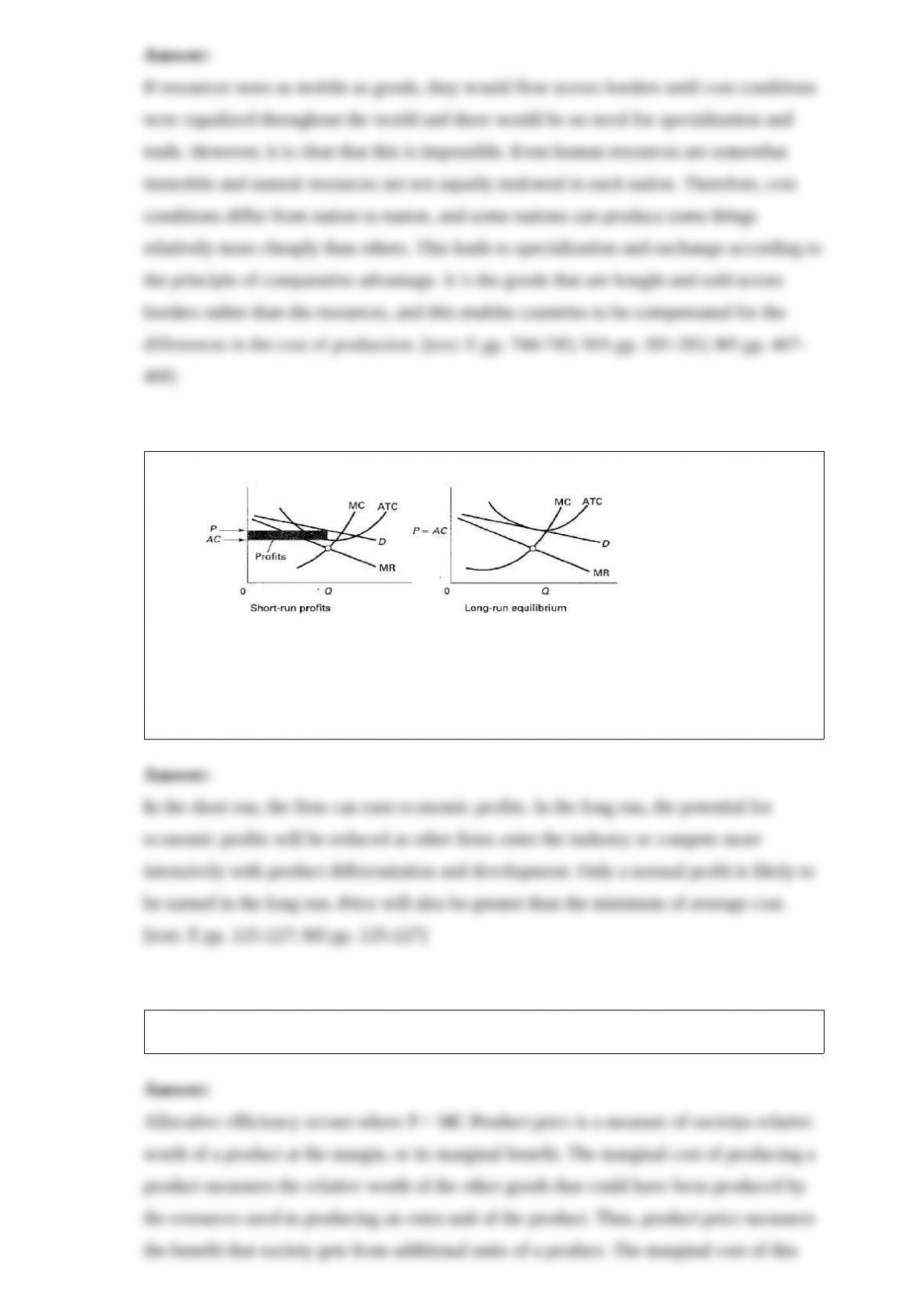
In the first graph below, illustrate the cost curves and demand conditions for a
monopolistically competitive firm making short-run profits. In the second graph,
illustrate what those conditions are most likely to be in the long run. Explain the major
differences in the two graphs.
23) Explain what allocative efficiency is and how it is achieved in pure competition.
24) What happens to bring the ADAS system back into equilibrium when prices are
below the equilibrium level? Above the equilibrium level?
25) What is the aggregate demand curve? What is the character of its slope?