
1) One reason why better-looking workers may have higher earnings is that physical
attractiveness may enhance a worker’s productivity for certain jobs, especially for those
workers who deal with the public.
a.True
b.False
2) Refer to Figure 9-17. Relative to the free-trade outcome, the imposition of the tariff
a.decreases imports of the good by 16 units and increases domestic production of the
good by 8 units.
b.decreases imports of the good by 16 units and increases domestic production of the
good by 16 units.
c.decreases imports of the good by 24 units and increases domestic production of the
good by 8 units.
d.decreases imports of the good by 24 units and increases domestic production of the
good by 24 units.
3) In a perfectly competitive market, the process of entry and exit will end when
a.price equals minimum marginal cost.
b.marginal revenue equals marginal cost.
c.economic profits are zero.
d.accounting profits are zero.
4) A survey of professional economists revealed that more than three-fourths of them
agreed with fourteen economic propositions. Which of the following is not one of those
propositions?
a.A ceiling on rents reduces the quantity and quality of housing available.
b.Fiscal policy has a significant stimulative impact on a less than fully employed
economy.
c.The gap between Social Security funds and expenditures will become unsustainably
large within the next fifty years if current policies remain unchanged.
d.The United States should implement universal health care for its citizens.
5) Assume that Jamaica and Norway can switch between producing coolers and
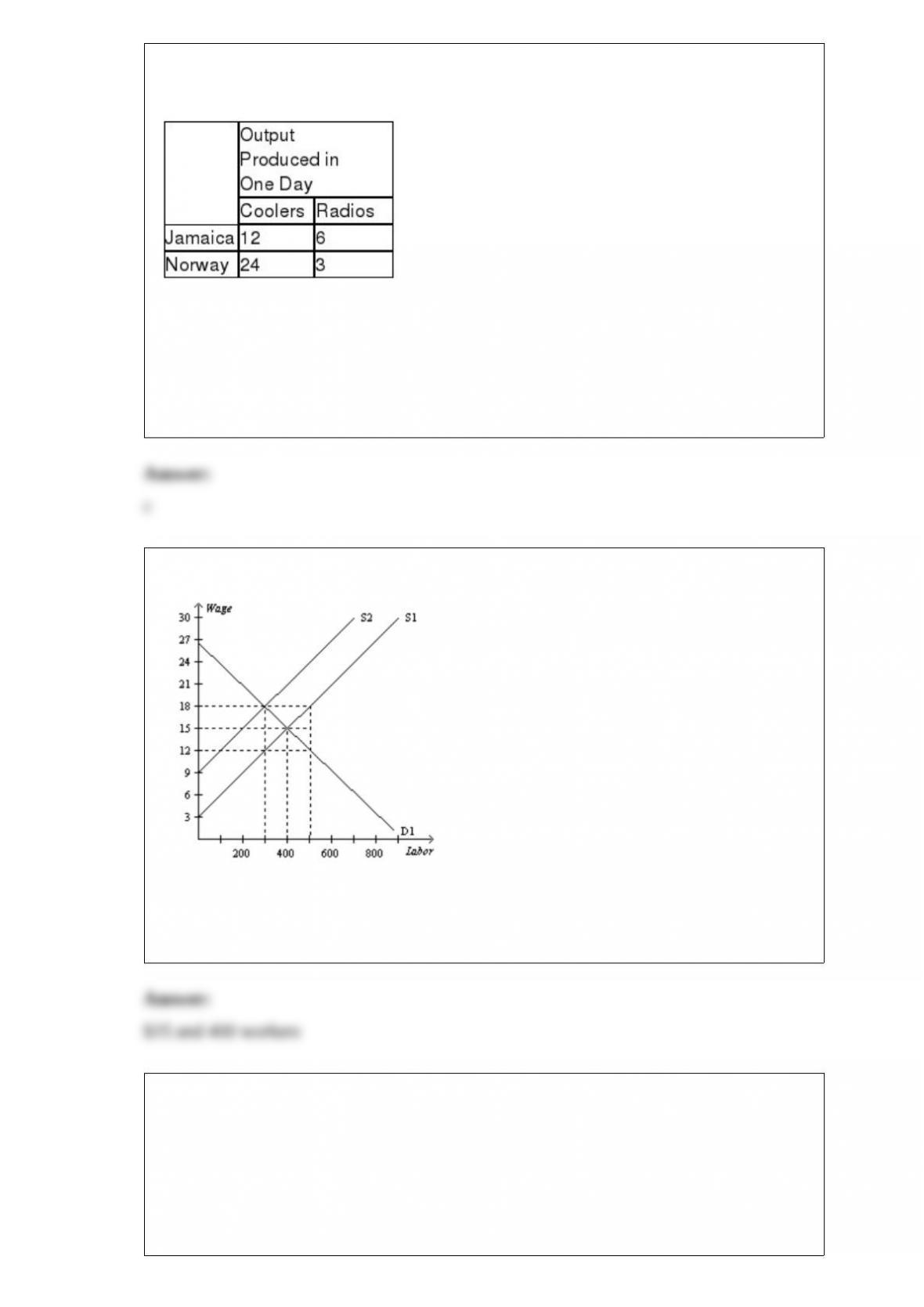
producing radios at a constant rate. The following table shows the number of coolers or
number of radios each country can produce in one day.
Jamaica and Norway would not be able to gain from trade if Norway’s opportunity cost
of one radio changed to
a.0 coolers.
b.1 cooler.
c.2 coolers.
d.Jamaica and Norway can always gain from trade regardless of their opportunity costs.
6) Figure 19-7
Refer to Figure 19-7. The figure shows labor demand and labor supply in a
non-unionized labor market. If the current labor demand is D1 and the current labor
supply is S1, what is the equilibrium wage and quantity of labor?
7) Scenario 13-7
Julia prepares tax returns and does bookkeeping. Last year her revenues from the tax
and bookkeeping business were $150,000, and her expenses for the business were
$15,000. When she started her tax and bookkeeping business, Julia gave up her
supplemental job doing in-home pet sitting. She used to earn $10,000 per year from pet
sitting. Assume that she incurred no costs for her pet sitting business.
Julia’s implicit costs are

a.0.
b. $10,000.
c. $15,000.
d. $25,000.
8) Suppose a consumer spends his income on CDs and DVDs. If his income decreases,
the budget constraint for CDs and DVDs will
a.shift outward, parallel to the original budget constraint.
b.shift inward, parallel to the original budget constraint.
c.rotate outward along the CD axis because he can afford more CDs.
d.rotate outward along the DVD axis because he can afford more DVDs.
9) Equilibrium price must increase when demand
a.increases and supply does not change, when demand does not change and supply
decreases, and when demand decreases and supply increases simultaneously.
b.increases and supply does not change, when demand does not change and supply
decreases, and when demand increases and supply decreases simultaneously.
c.decreases and supply does not change, when demand does not change and supply
increases, and when demand decreases and supply increases simultaneously.
d.decreases and supply does not change, when demand does not change and supply
increases, and when demand increases and supply decreases simultaneously.
10) With a lump-sum tax, the
a.marginal tax rate is always less than the average tax rate.
b.average tax rate is always less than the marginal tax rate.
c.marginal tax rate falls as income rises.
d.marginal tax rate rises as income rises.
11) The production possibilities frontier is a graph that shows the various combinations
of output that an economy
a.should produce.

b.wants to produce.
c.can produce.
d.demands.
12) As the number of firms in an oligopoly increases, the price approaches
a.zero.
b.marginal cost.
c.infinity.
d.the monopoly price.