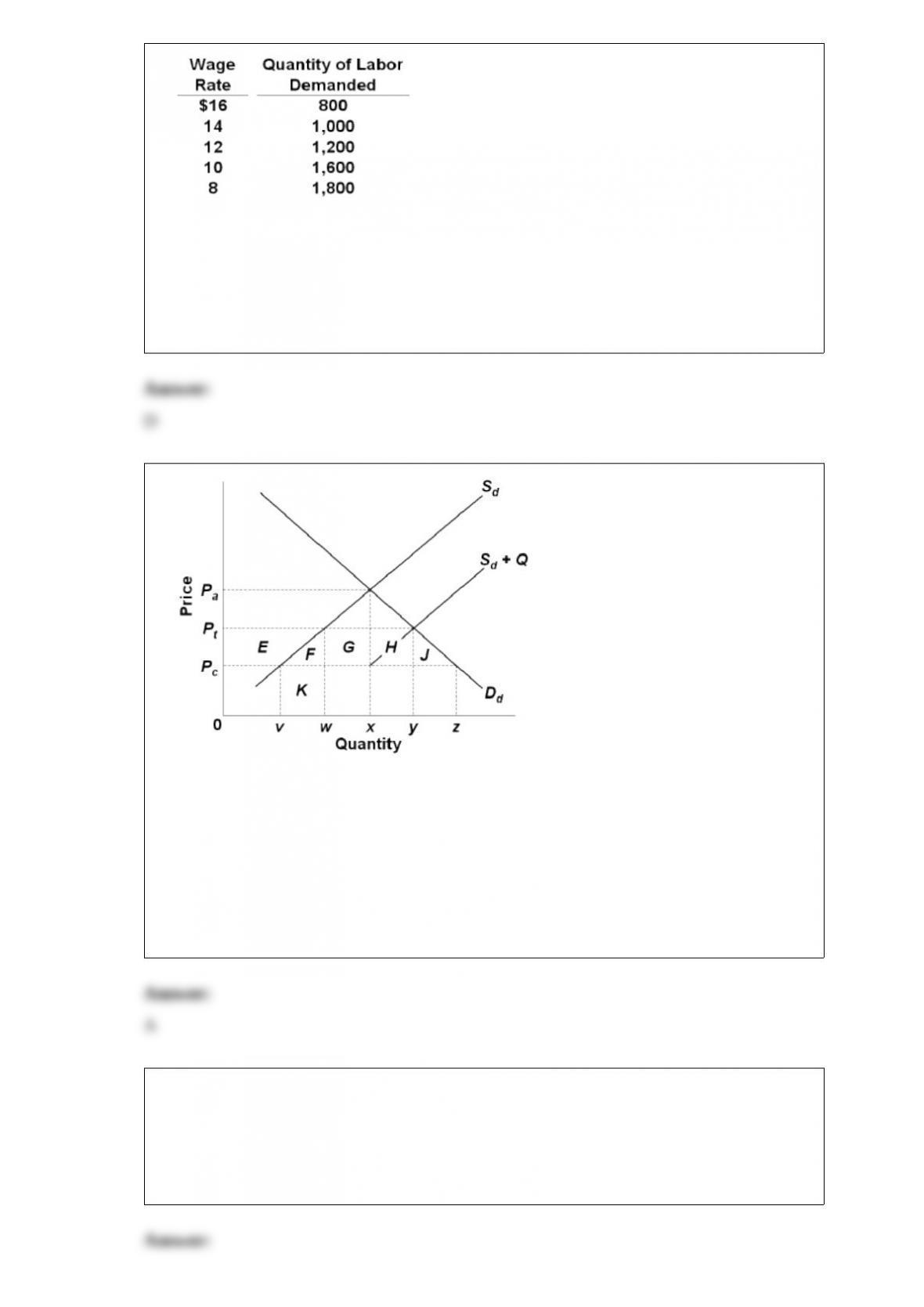
1)
Refer to the above data. Over the $10 to $8 range of wage rates, the demand for labor
is:
A.perfectly elastic.
B.elastic.
C.unit elastic.
D.inelastic.
2)
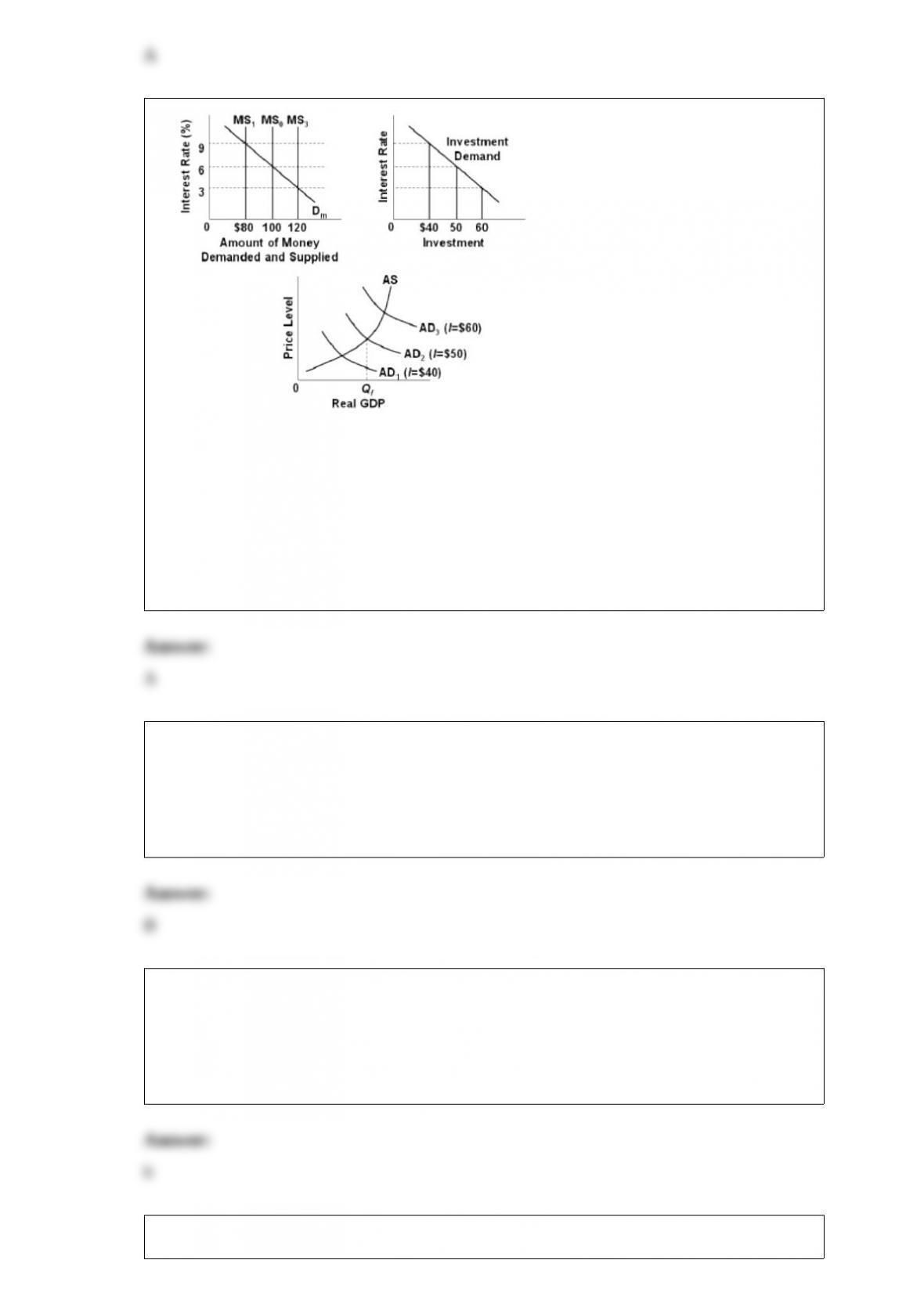
Refer to the above diagram, where Sd and Dd are the domestic supply and demand for a
product and Pc is the world price of that product. Sd + Q is the product supply curve
after an import quota is imposed. The effect of the import quota on domestic price and
domestic consumption is:
A.the same as that of a tariff of PcPt.
B.the same as that of a tariff of PtPa.
C.the same as that of a tariff of PcPa.
D.to raise price by more and reduce consumption less than a tariff of PcPt.
3) The immediate-short-run aggregate supply curve represents circumstances where:
A.both input and output prices are fixed.
B.both input and output prices are flexible.
C.input prices are fixed, but output prices are flexible.
D.input prices are flexible, but output prices are fixed.
4)
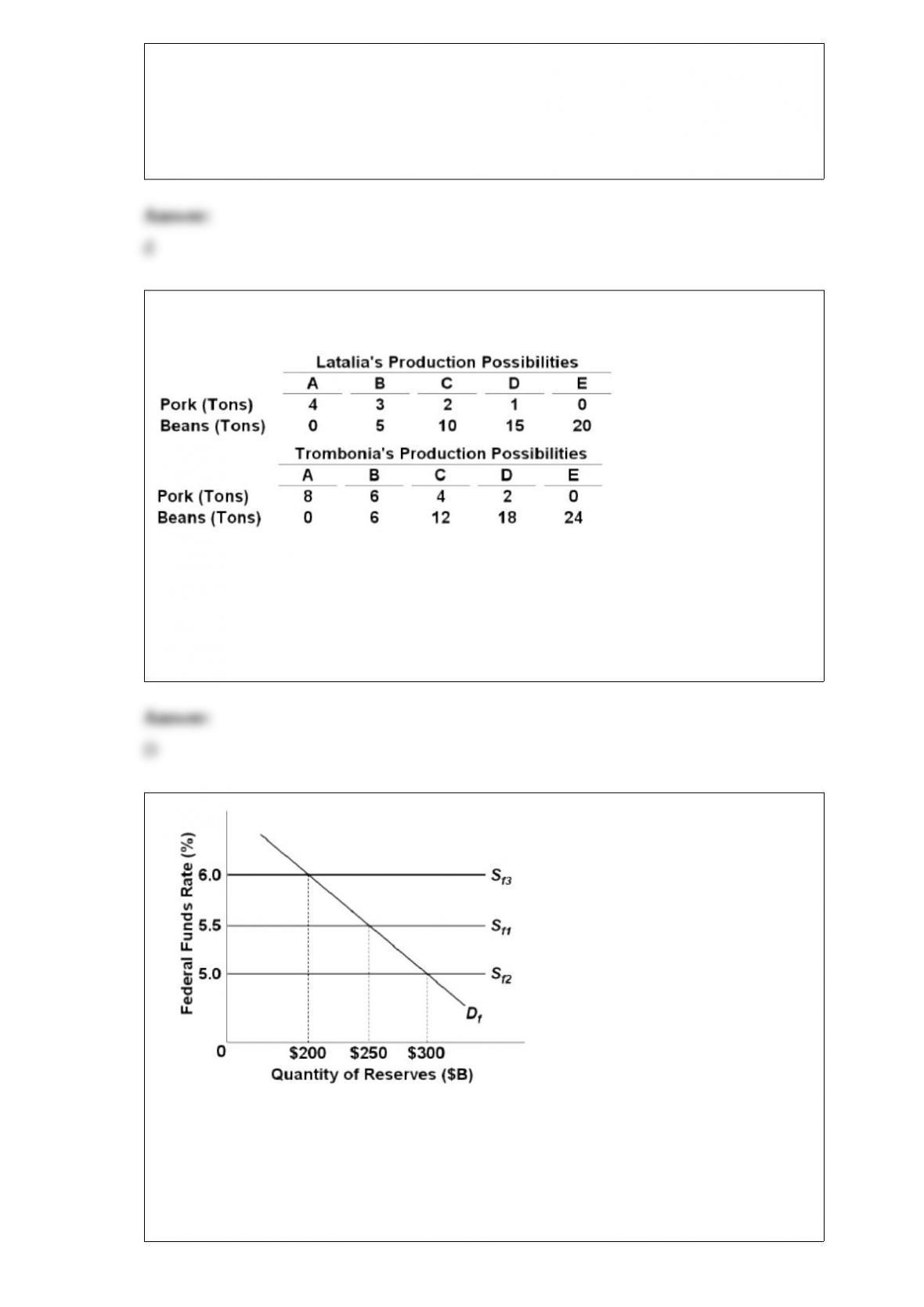
Refer to the above diagrams. The numbers in parentheses after the AD1, AD2, and AD3
labels indicate the levels of investment spending associated with each curve. All figures
are in billions. If the money supply is MS1and the goal of the monetary authorities is
full-employment output Qf, they should:
A.increase the money supply from $80 to $100.
B.increase the money supply from $80 to $120.
C.maintain the money supply at $80.
D.decrease the money supply from $80 to $60.
5) Entry fees at national parks and monuments are an example of:
A.the ability-to-pay principle of taxation.
B.the benefits-received principle of taxation.
C.government bureaucracy and inefficiency.
D.the principle of limited and bundled choice.
6) which of the following curves is not u-shaped?
a.mc
b.afc
c.avc
d.atc
7) the tax rates embodied in the federal personal income tax are such that:
a.a rising absolute amount, but a declining proportion, of income is paid in taxes.
b.the marginal and average tax rates are equal, making the tax progressive.
c.the average tax rate rises more rapidly than does the marginal tax rate.
d.the marginal tax rate is higher than the average tax rate, causing the average tax rate
to rise.
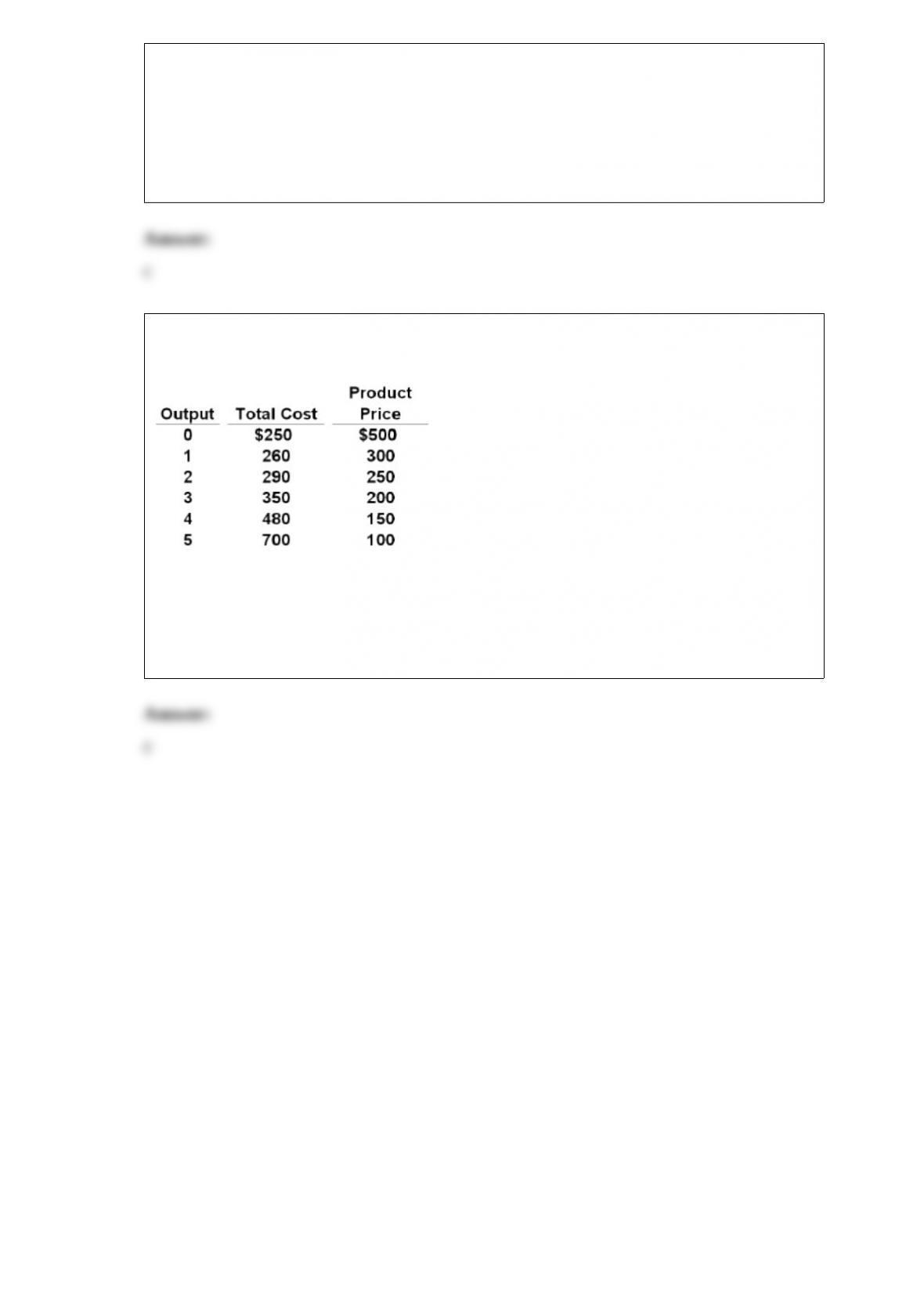
8) The following production possibilities tables for two countries, Latalia and
Trombonia:
Refer to the above tables. Which of the following would be feasible terms for trade
between Latalia and Trombonia?
A.1 ton of beans for 1 ton of pork
B.2 tons of beans for 1 ton of pork
C.6 tons of beans for 1 ton of pork
D.4 tons of beans for 1 ton of pork
9)
Refer to the above diagram for the Federal funds market. If the Fed supplies $200
billion in reserves, the equilibrium prime interest rate is:
A.6.0 percent.
B.5.5 percent.
C.5.0 percent.
D.undeterminable with the information given.

10) marginal cost:
a.equals both average variable cost and average total cost at their respective minimums.
b.is the difference between total cost and total variable cost.
c.rises for a time, but then begins to decline when diminishing returns set in.
d.declines continuously as output increases.
11) other things equal, which of the following would shift an economy’s production
possibilities curve to the left?
a.the discovery of a low-cost means of generating and storing solar energy
b.the entrance of more women into the labor force
c.a law requiring mandatory retirement from the labor force at age 55
d.an increase in the proportion of total output that consists of capital or investment
goods
12) suppose a firm is in a range of production where it is experiencing economies of
scale. knowing this, we can predict that:
a.the long-run average total cost curve is upsloping.
b.a 10 percent increase in all inputs will increase output by less than 10 percent.
c.a 10 percent increase in all inputs will increase output by more than 10 percent.
d.the firm is encountering problems of managerial bureaucracy because of its size.
13) Other things equal, if $100 billion of government purchases (G) is added to private
spending (C + Ig + Xn), GDP will:
A.increase by $100 billion.
B.increase by less than $100 billion.
C.increase by more than $100 billion.
D.fall by $100 billion.
14) which of the following conditions is true for a purely competitive firm in long-run
equilibrium?
a.p > mc = minimum atc.
b.p > mc > minimum atc.
c.p = mc = minimum atc.
d.p < mc < minimum atc.
15) the following information for a pure monopolist:
the above nondiscriminating monopolist should set its price at:
a.$300.
b.$250.
c.$200.
d.$150.