
Which of the following countries does not come close to the free market benchmark?
A) the United States
B) Japan
C) Cuba
D) France
Consumers usually pay less than the total cost of medical treatment because
A) a third party, usually an insurance company, often pays most of the bill.
B) the federal government pays for most medical procedures.
C) competition forces doctors and hospitals to charge prices that do not cover their
costs.
D) a third party, usually an employer, often pays most of the bill.
How can freedom of the press promote economic growth?
A) A free press can act as a watchdog for corruption, increasing chances for economic
growth.
B) A free press can be more easily swayed to report only one side of any issue.
C) A free press reduces the likelihood that judges will protect private property rights.
D) A free press does not promote economic growth.
Suppose that homemakers are included as employed in the labor force statistics, rather
than being counted as out of the labor force. This would
A) increase the measured unemployment rate.
B) increase the measured labor force participation rate.
C) decrease the number of persons in the labor force.
D) decrease the number of persons in the working-age population.
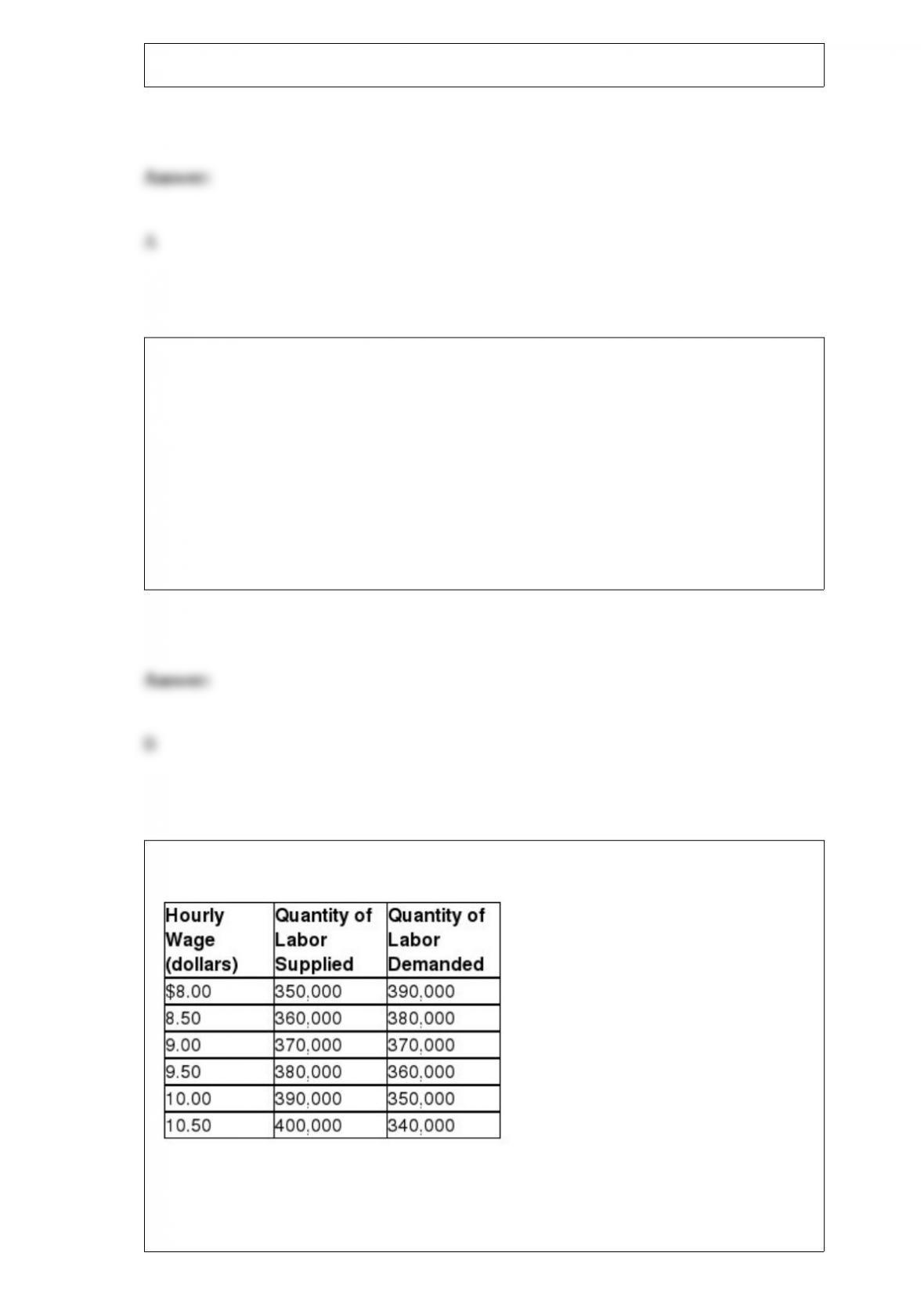
Table 4-4
Table 4-4 shows the demand and supply schedules for the low-skilled labor market in
the city of Westover.
If a minimum wage of $9.50 an hour is mandated, what is the quantity of labor

demanded?
A) 380,000
B) 370,000
C) 360,000
D) 10,000
Figure 5-2
Figure 5-2 shows a market with a negative externality.
The efficient output level is
A) Qd.
B) Q.
C) Qa.
D) Q – Qd.

Let MP = marginal product, P = output price, and W = wage, then the equation that
represents a situation where a competitive firm should lay off some workers to
maximize profits is
A) P MP = W.
B) P MP > W.
C) P MP < W.
D) MP W = P.
All of the following are true statements about the multiplier except
A) the multiplier rises as the MPC rises.
B) the smaller the MPS, the larger the multiplier.
C) the multiplier is a value between zero and one.
D) the multiplier effect occurs when autonomous expenditure changes.
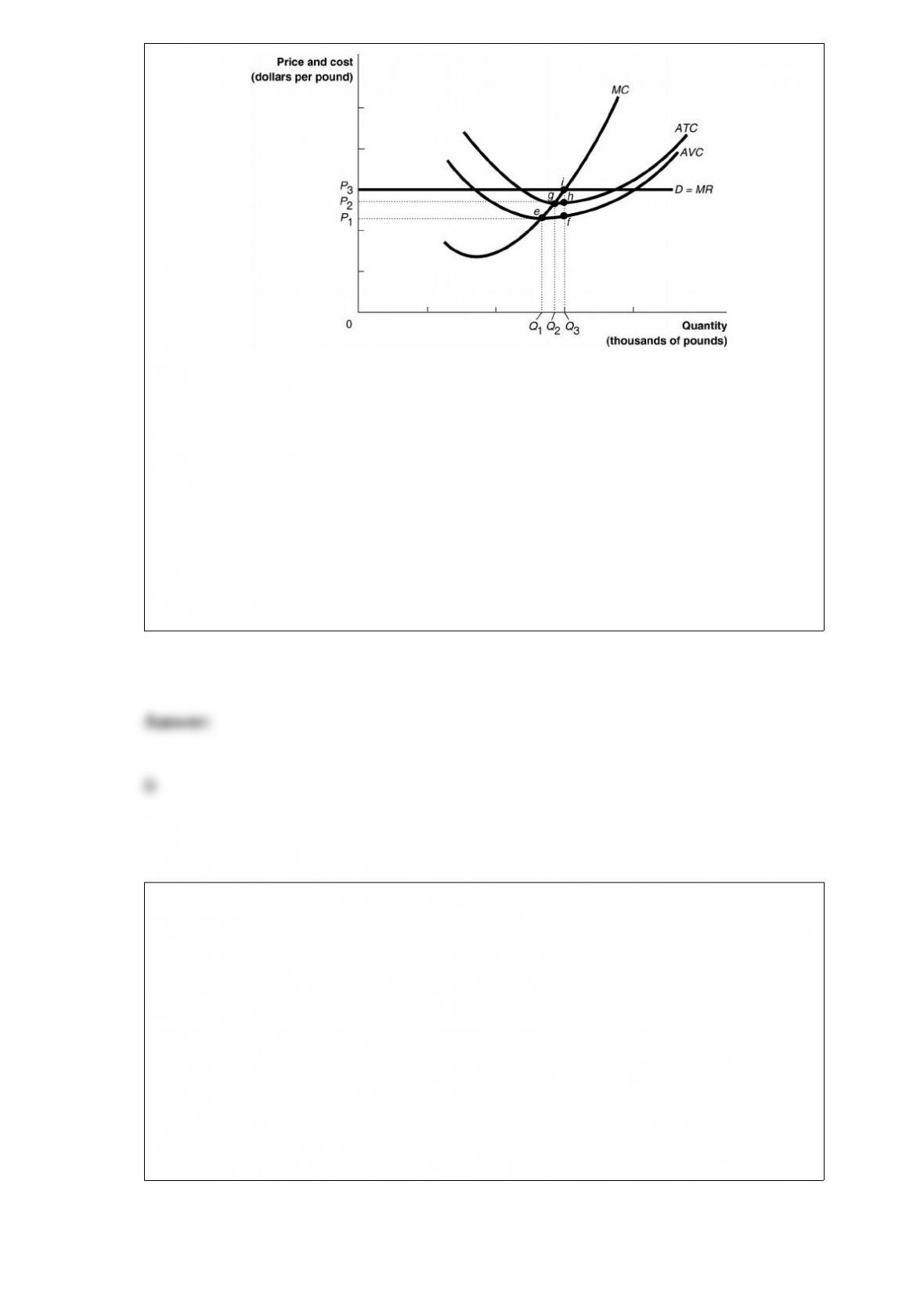
Figure 12-7 Figure
12-7 illustrates the cost curves of a perfectly competitive firm.
If the market price is P3, the firm
A) will break even.
B) will make a profit.
C) will earn enough revenue to cover its variable costs but not its fixed costs.
D) will produce a quantity of Q1.
If a theatre company expects $250,000 in ticket revenue from five performances and
$288,000 in ticket revenue if it adds a sixth performance, the
A) marginal revenue of the sixth performance is $48,000.
B) marginal revenue of the sixth performance is $38,000.
C) cost of staging the sixth performance is probably higher than the cost of staging the
previous five.
D) company will be making a loss on the sixth performance because its ticket sales will
be less than the average received from the previous five.
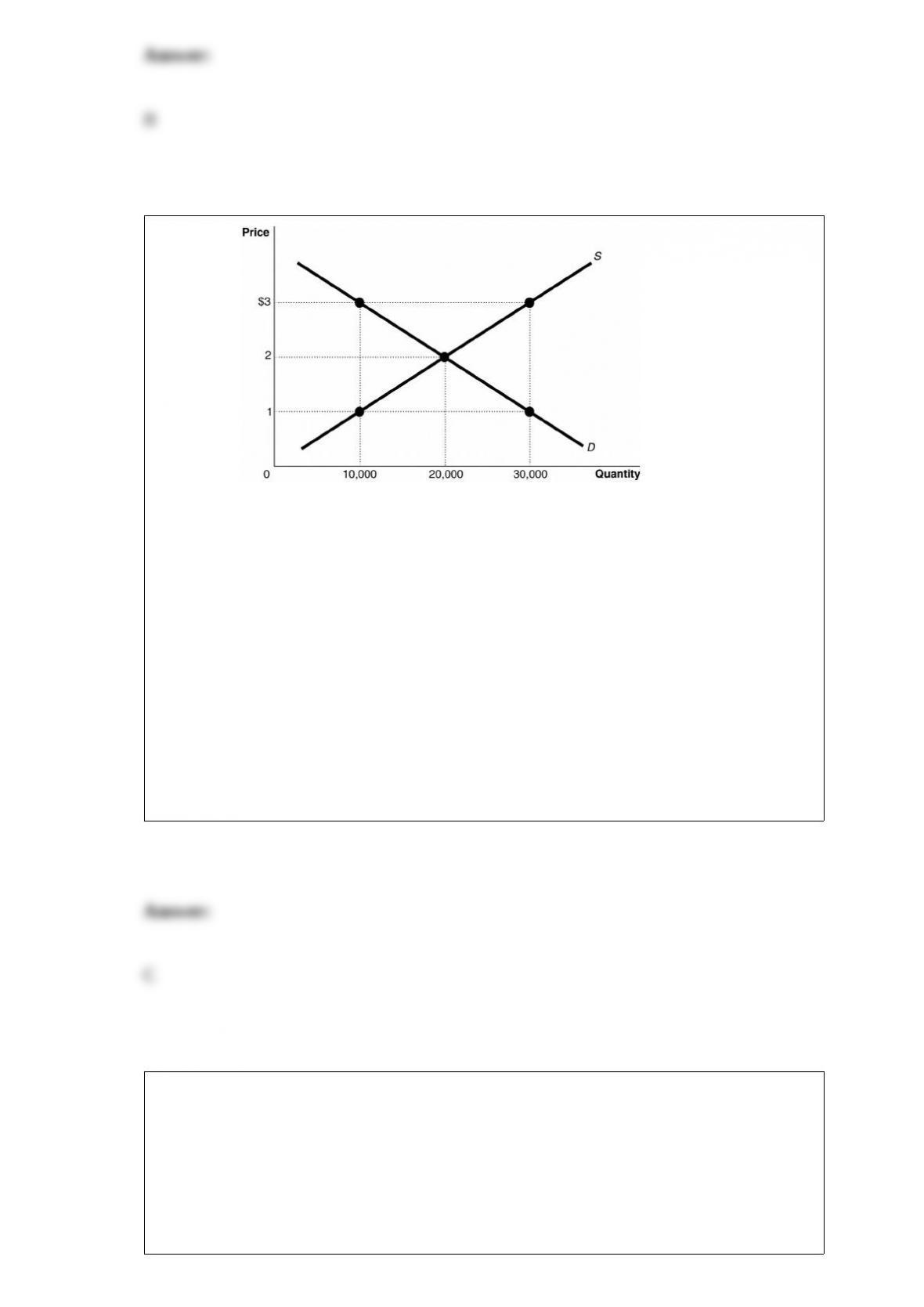
Figure 4-7
The figure above represents the market for iced tea. Assume that this is a competitive
market. Which of the following is true?
A) If the price of iced tea is $3, the output will be economically efficient but there will
be a deadweight loss.
B) If the price of iced tea is $3, consumers will purchase more than the economically
efficient output.
C) Both 10,000 and 30,000 are economically inefficient rates of output.
D) If the price of iced tea is $3, producers will sell 30,000 units of iced tea but this
output will be economically inefficient.
Suppose that in a market for used cars, there are good used cars and bad used cars
(lemons). Consumers are willing to pay as much as $6,000 for a good used car but only
$1,000 for a lemon. Sellers of good used cars value their cars at $5,000 each and sellers
of lemons value their cars at $800 each. Buyers cannot tell if a used car is reliable or is
a lemon. Based on this information, what is the likely outcome in the market for used
cars?

A) Sellers of good used cars will drop out of the market.
B) Sellers of good used cars will incur losses.
C) Sellers of lemons will drop out of the market.
D) Used cars will sell for $3,000.
________ occurs when one party takes advantage of having more information than
another party about the attributes of the good or service they will exchange.
A) A negative externality
B) Moral hazard
C) A transaction cost
D) Adverse selection
Figure 7-2 Suppose the U.S. government

imposes a $0.75 per pound tariff on coffee imports. Figure 7-2 shows the impact of this
tariff. Without the tariff in place, the United States produces
A) 12 million pounds of coffee.
B) 26 million pounds of coffee.
C) 33 million pounds of coffee.
D) 45 million pounds of coffee.
The “Buy American” provision in the 2009 stimulus package required that stimulus
money be spent only on U.S.-made goods, effectively acting as a quota of zero imports
when stimulus money was being spent. In the U.S. steel market, a “Buy American”
provision in the 2009 stimulus package would
A) convert some consumer surplus to deadweight loss.
B) transfer some deadweight loss to producer surplus.
C) transfer some producer surplus to consumer surplus.
D) reduce the producer surplus received by foreign manufacturers.
If the market price is $25 in a perfectly competitive market, the marginal revenue from
selling the fifth unit is

A) $5.
B) $12.50.
C) $25.
D) $125.
If opportunity costs are constant, the production possibilities frontier would be graphed
as
A) a ray from the origin.
B) a positively sloped straight line.
C) a negatively sloped curve bowed in toward the origin.
D) a negatively sloped straight line.
If a monopolistically competitive firm breaks even, the firm
A) is earning an accounting profit and will have to pay taxes on that profit.
B) is earning zero accounting and zero economic profit.
C) should advertise its product to stimulate demand.
D) should expand production.