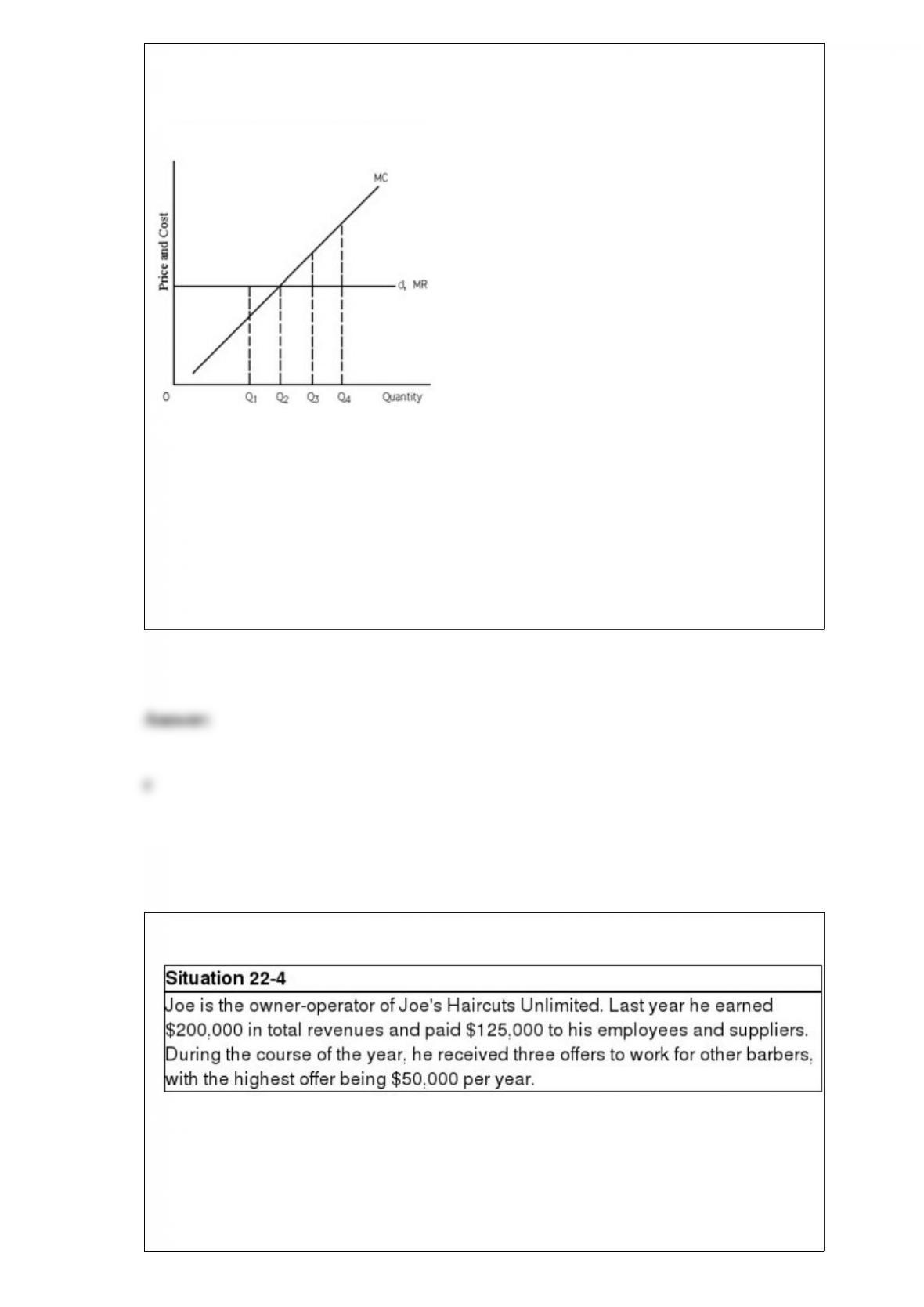
Refer to Exhibit 23-2. For the firm that faces the demand curve in the exhibit,
Exhibit 23-2
a. marginal revenue is constant.
b. price equals marginal revenue.
c. if the firm maximizes profits, it produces the quantity of output at which price equals
marginal cost.
d. a and c
e. a, b, and c
Refer to Situation 22-4.What are Joe’s accounting profits?
a. $0
b. -$75,000
c. -$25,000

d. $25,000
e. $75,000
We would expect the total utility of water to be high but its marginal utility to be low.
Why?
a. Because water is a fluid and we don’t need fluids to live as much as we need food.
b. Because we need water to live and there is so much of it.
c. Because we need water to live and there is very little of it.
d. Because water’s price is low.
Based on the income data presented for the United States (in the textbook), it follows
that the Gini coefficient for the United States is
a. greater than 0 and less than 1.
b. definitely less than 1, but it may be 0.
c. definitely greater than 0, but it may be 1.
d. definitely 1.
e. approximately 2.3.

The typical face value of a corporate bond is $1,000.
a. True
b. False
A theory is
a. built on the major factors or variables that the theorist believes explain some event.
b. a simplified abstract representation of the real world.
c. used to understand the real world.
d. a and b
e. a, b, and c
All sellers may be tempted to raise the price of what they sell, but a negative unintended
effect of raising the price could be __________ in units sold large enough to
__________ the seller’s total revenue earned.
a. an increase; raise
b. an increase; lower
c. a decrease; raise
d. a decrease; lower
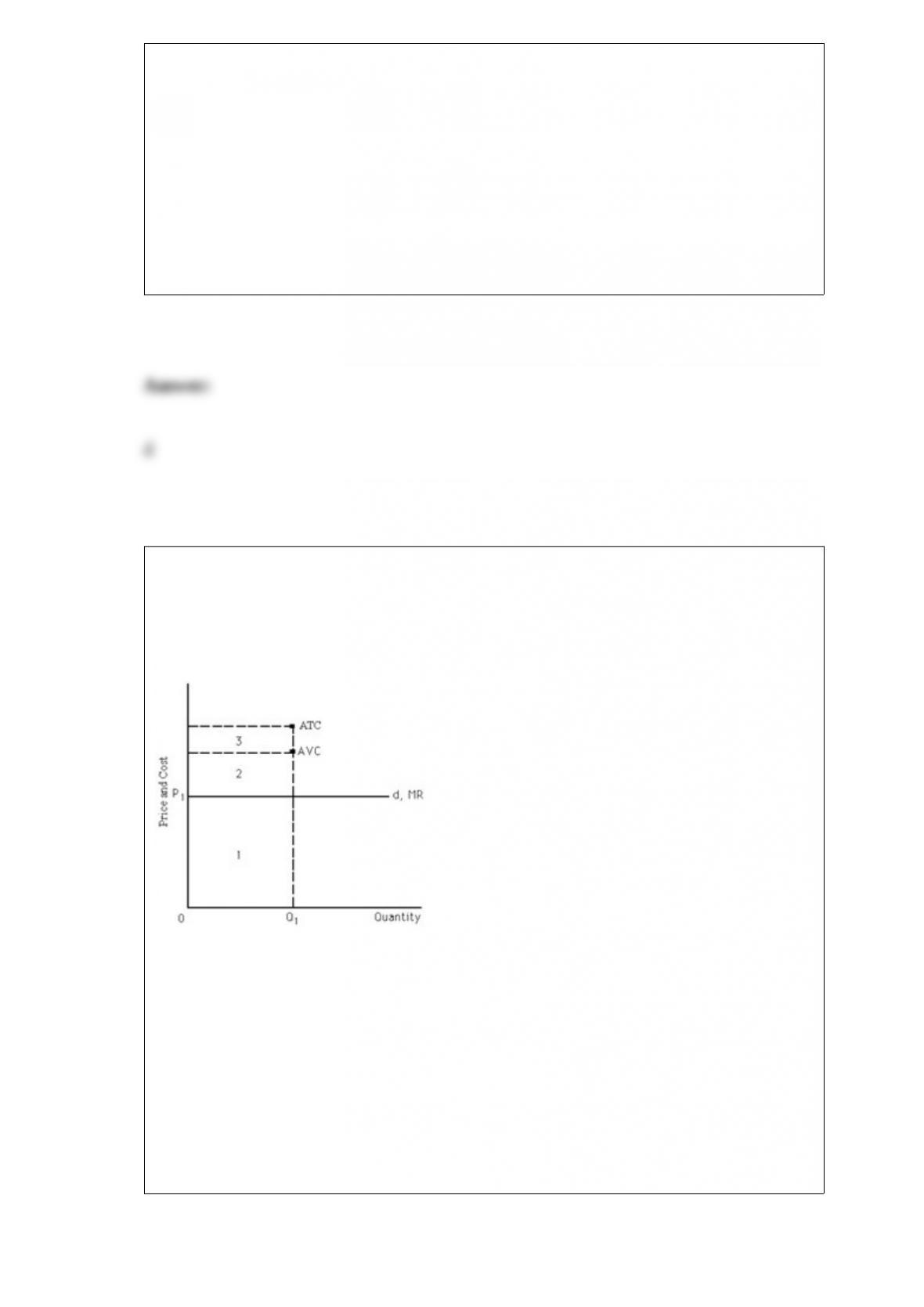
Refer to Exhibit 23-4. The firm sells its product at P1 and produces Q1. Given this
situation,
Exhibit 23-4
a. total variable cost is equal to area 1 + area 2.
b. total revenue is equal to area 1.
c. total cost is equal to area 2 + area 3.
d. a and b
e. a, b, and c

There is demand for and supply of dollars and a demand for and supply of pesos. Under
a flexible exchange rate system, if income growth in the United States is greater than
income growth in Mexico, then
a. the demand for dollars will shift to the right and the demand for pesos will shift to the
left.
b. the demand for pesos will shift to the right and the supply of dollars will shift to the
left.
c. the demand for pesos will shift to the left and the supply of pesos will shift to the
right.
d. the supply of pesos will shift to the right and the supply of dollars will shift to the
right.
e. none of the above
If the government sets out to make home buying easier for more people by forcing
lenders to accept ____________ down payments and ______________ interest rates,
the result will likely be a(n) _______________ in housing prices.
a. lower; lower; increase
b. higher; higher; increase
c. lower; higher; decrease
d. higher; lower; decrease
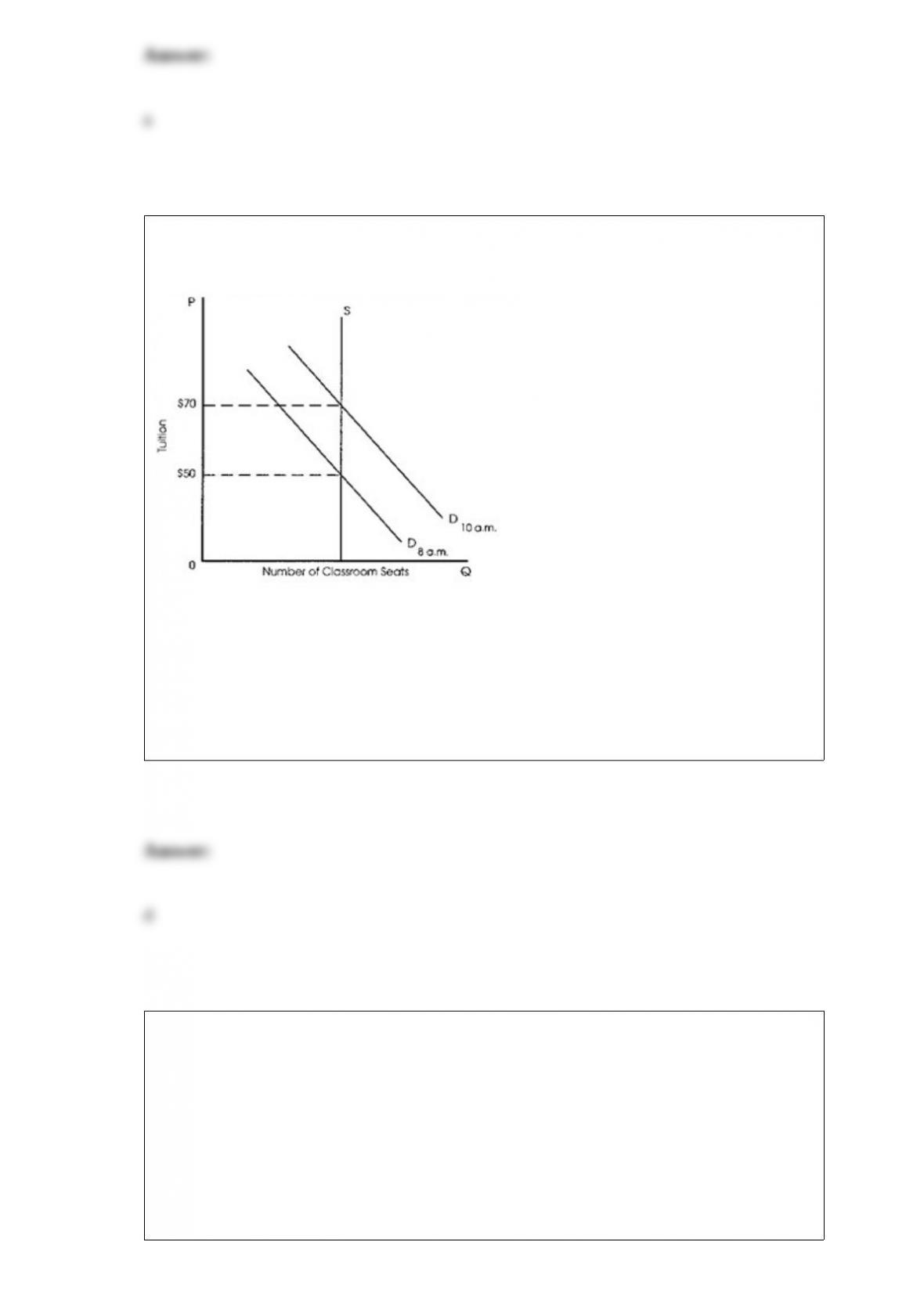
Refer to Exhibit 5-2. If the tuition is set at $50 there will be
Exhibit 5-2
a. a shortage at 10 a.m. and a surplus at 8
a.m.
b. a surplus at 10 a.m. and a shortage at 8 a.m.
c. equilibrium at 8 a.m. and a surplus of seats at 10 a.m.
d. equilibrium at 8 a.m. and a shortage of seats at 10 a.m.
The interest rate will be higher,
a. the longer the term of the loan.
b. the less risk associated with the loan.
c. the lower the processing costs of the loan.
d. the lower the administrative costs of the loan.
e. none of the above
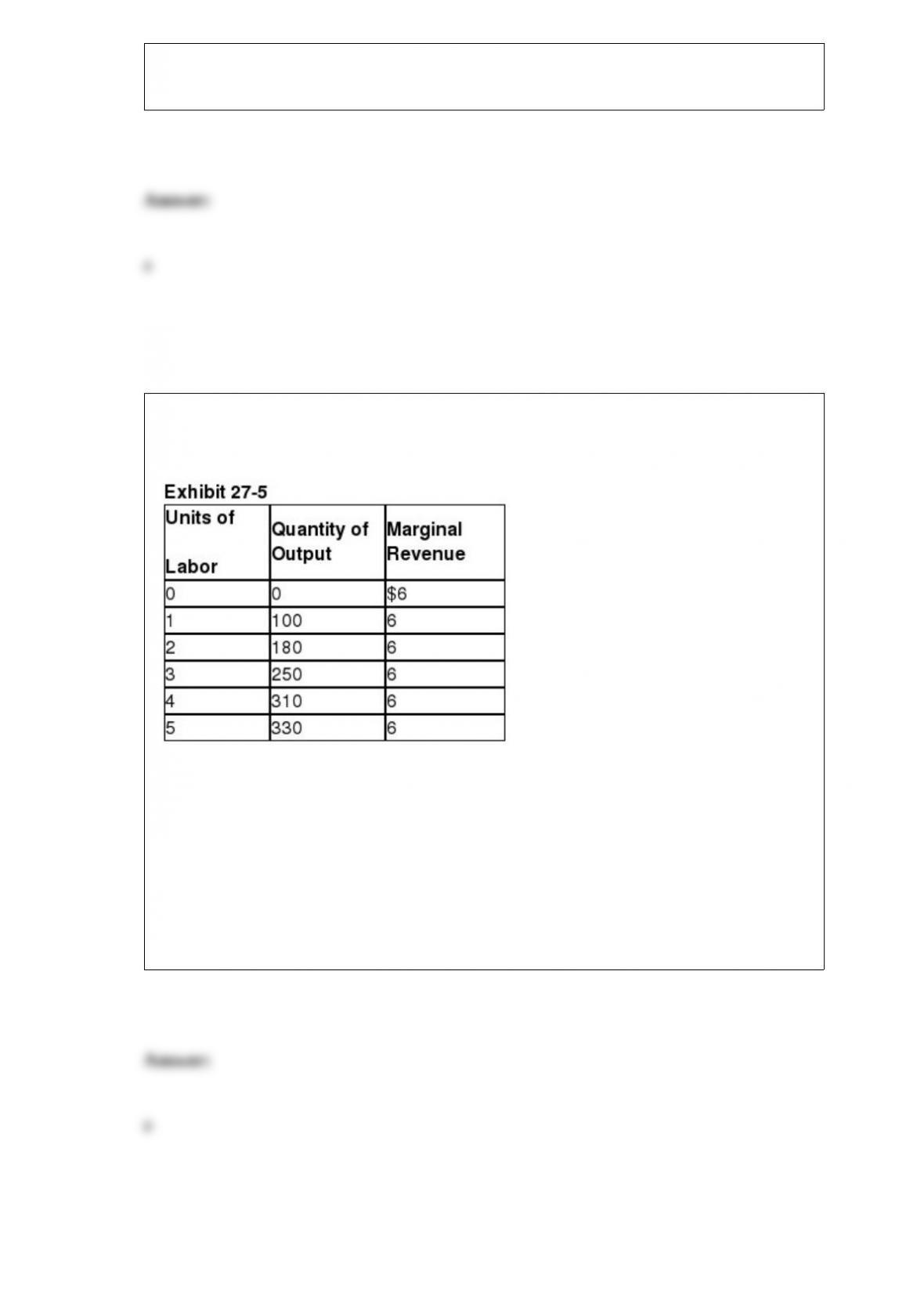
Refer to Exhibit 27-5. Marginal physical product of the fourth unit of labor
a. equals 60.
b. equals 40.
c. equals 24.
d. equals 310.
e. cannot be determined.

According to economists, competition exists because of
a. scarcity.
b. capitalism.
c. money.
d. unintended effects.
Which of the following statements is true?
a. There are more farms today than at the beginning of the 20th century.
b. An individual farmer prefers good weather to bad weather, but farmers as a group
may prefer bad weather to good weather, especially if the demand for their products is
inelastic.
c. Income elasticity of demand measures the responsiveness of a change in quantity
supplied to changes in income.
d. a and b
e. b and c
Jake is an excellent barber. However, all customers who come to him for a haircut must
buy a bottle of shampoo. This type of arrangement is known as
a. a tie-in sale.

b. a sweetheart deal.
c. an exclusive contract.
d. across subsidy.
“I’m not going to pay for the good if, once produced, the good cannot be denied to
anyone.”This statement is most relevant to
a. negative externalities.
b. positive externalities
c. private goods.
d. nonexcludable public goods.
e. the issue of rivalry versus nonrivalry in consumption.
Which of the following statements is false?
a. At equilibrium in a market, scarcity does not exist.
b. If there is a shortage of 100 units at a price of $2 per unit, the shortage will be greater
than 100 units at a price of $1 per unit.
c. If there is a surplus of 30 units at a price of $3, the surplus will be less than 30 units
(or even nonexistent) at a price of $2.
d. If there is a surplus, suppliers will not be able to sell all they had hoped to sell at a

particular price.