
1) Using income as the tax base, which of the following best illustrates a regressive tax?
A.the Federal inheritance tax
B.a 7 percent general sales tax
C.the corporate income tax
D.the personal income tax
2) the theory of consumer behavior assumes that consumers attempt to maximize:
a.the difference between total and marginal utility.
b.total utility.
c.average utility.
d.marginal utility.
3) most remittances flow toward:
a.european nations.
b.advanced industrial nations.
c.developing nations.
d.north america.
4) if quantity demanded is completely unresponsive to price changes, demand is:
a.perfectly inelastic.
b.perfectly elastic.
c.relatively inelastic.
d.relatively elastic.
5) A recessionary expenditure gap exists if:
A.planned investment exceeds saving at the full-employment GDP.
B.the aggregate expenditures schedule lies below the 45-degree line at the
full-employment GDP.
C.the aggregate expenditures schedule intersects the 45-degree line at any level of GDP.
D.the aggregate expenditures schedule lies above the 45-degree line at the
full-employment GDP.
6) enterprise managers and workers in the soviet union often resisted innovations in
production methods because:
a.production targets were often increased when innovation occurred.
b.there was a chronic shortage of computers.
c.workers could not be reallocated geographically.
d.innovations ordinarily increased dependence on world markets.
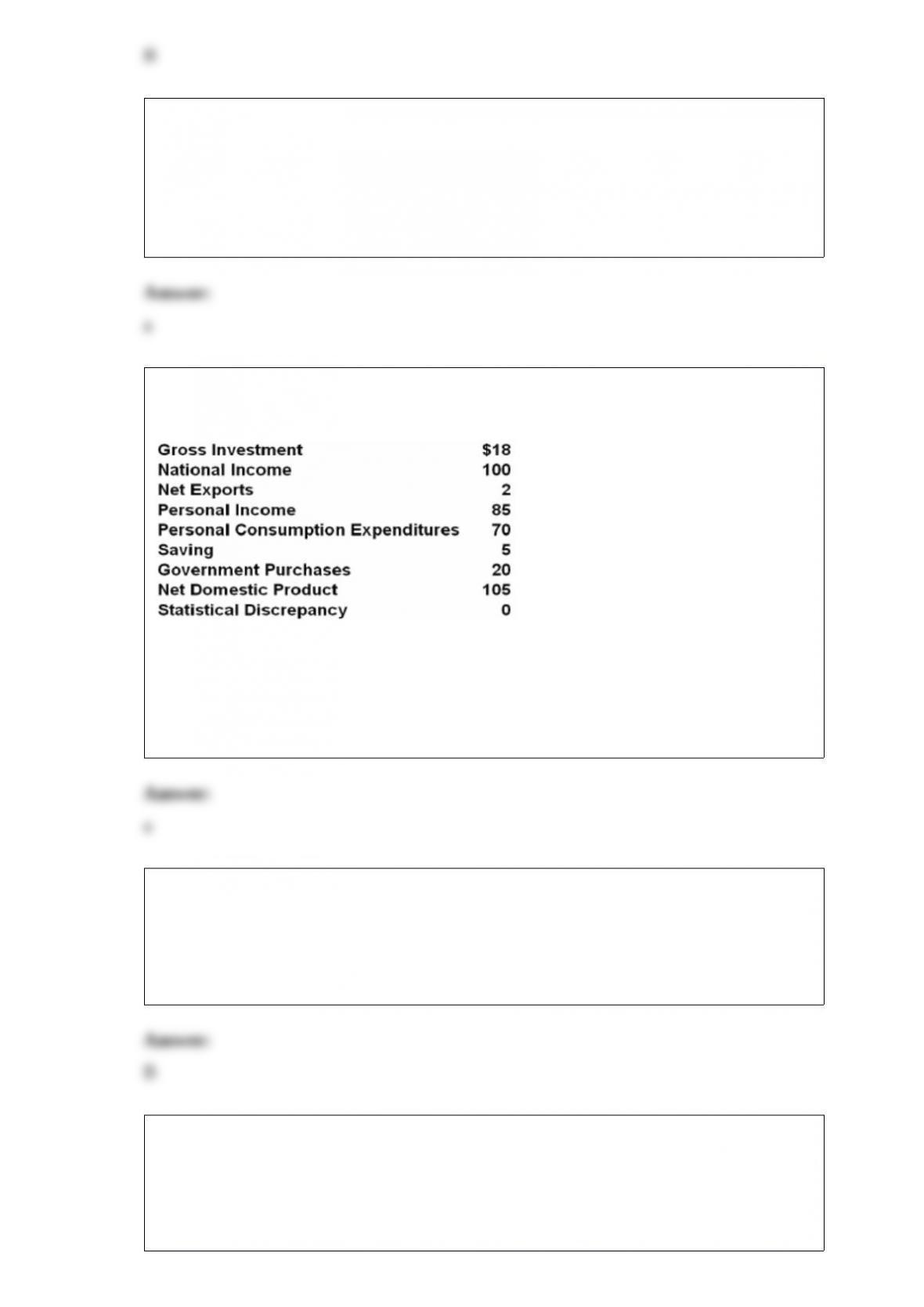
7) answer the next question(s) on the basis of the following data. all figures are in
billions of dollars.
refer to the above data. consumption of fixed capital is:
a.$5.
b.$10.
c.$20.
d.$30.
8) As monetarists view the equation of exchange:
A.V changes erratically and unpredictably.
B.V is quite stable.
C.V usually changes in the same direction of any given change in M.
D.V usually changes in the opposite direction of any given change in M.
9) If a certain household earns and spends $24,000 per year and, on the average, holds a
money balance of $6,000, then the velocity of money for this household is:
A.6.
B.1/6.
C.4.

D.1/4.
10) which of the following is incorrect?
a.total fixed cost does not change with output in the short run.
b.fixed costs exist only in the short run.
c.total fixed cost must be added to total variable cost to determine total cost.
d.total fixed cost equals total variable cost in the long run.
11) between 1995 and 2007, the u.s. productivity rate:
a.was slightly negative, mainly because of record levels of employment growth.
b.picked up substantially compared to prior years, leading some economists to predict a
long-lasting resurgence of productivity growth.
c.slowed considerably relative to the high rates between 1990 and 1995.
d.reached record low levels for the united states’ economy, leading some economists to
talk of ‘secular stagnation.”
12) Using the balance sheet below and assuming a required reserve ratio of 20%,
answer the following: (a) What is the amount of excess reserves? (b) This bank can
safely expand its loans by what amount? (c) By expanding its loans by this amount in
part (b), its checkable deposits would expand to what amount (if all loans were made to
checking account customers)? (d) If checks clear against the bank equal to the amount
loaned in (b), how much would remain in reserves and in checkable deposits?
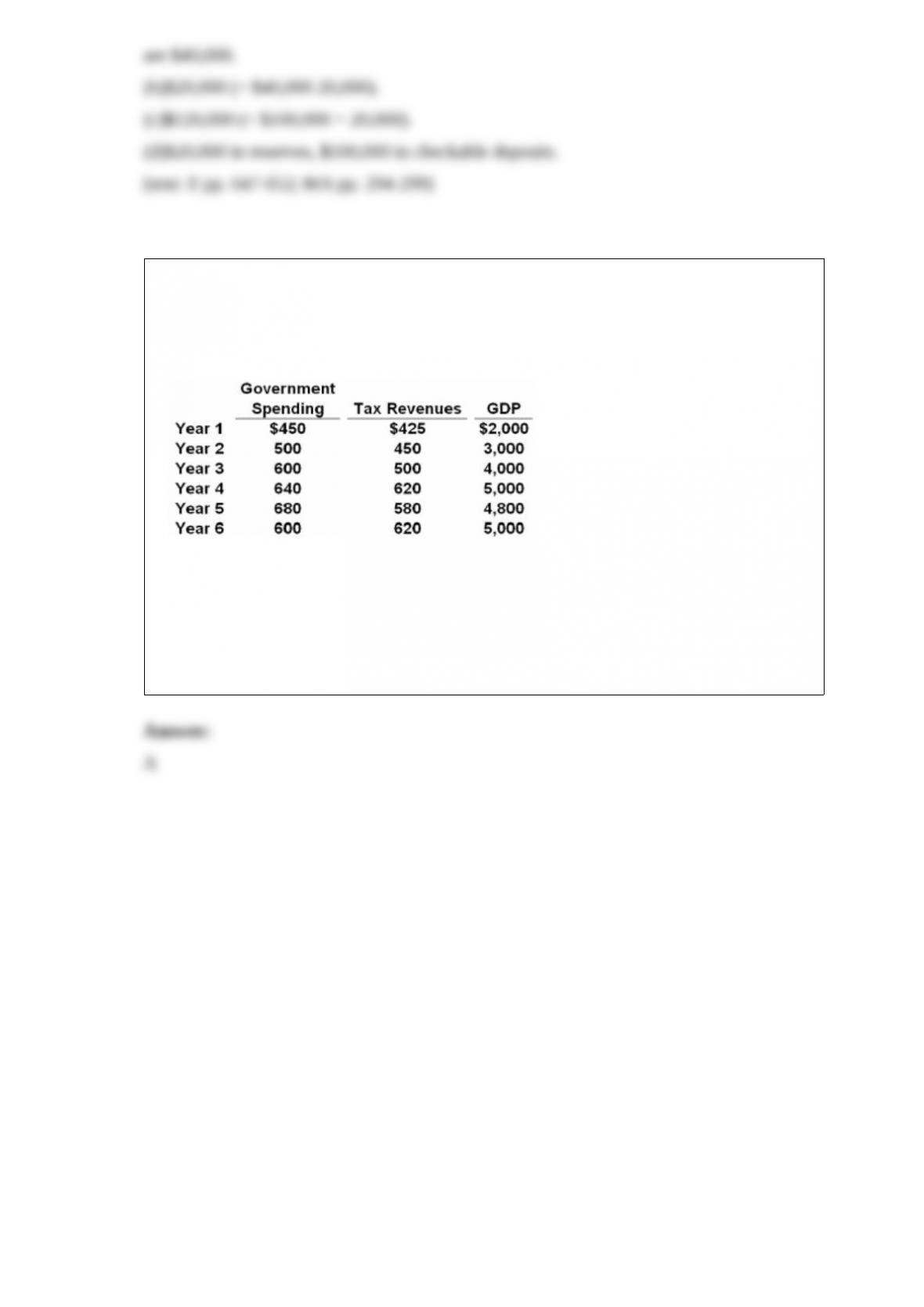
13) Answer the next question(s) using the following budget information for a
hypothetical economy. Assume that all budget surpluses are use to pay down the public
debt.
Refer to the above data. If year 1 is the first year of this nation’s existence and year 6 is
the present year, this nation’s public debt is:
A.$275 billion.
B.$100 billion.
C.$3540 billion.
D.$230 billion.