
Seth’s grandmother gave him a $50 savings bond for his birthday. The bond pays $50 at
maturity, which is in five years. If the interest rate is 5%, the bond has a present value
of $43.19.
Suppose the supply curve for digital cameras shifts to the right. This will cause a
relatively large decrease in the price of digital cameras if both demand and supply are
inelastic.
The income effect of a wage decrease examines the effect of the decrease in wage
income on a worker’s ability to purchase goods and services.
When negative externalities exist, the competitive market supply curve does not include
all of the costs borne by members of society.

A common mistake made by consumers is the failure to take into account the monetary
costs of their actions.
For a given supply curve, the deadweight loss from the imposition of a tax is smaller if
demand is more elastic.
When the demand for a product is less elastic than the supply, consumers pay the
majority of the tax on the product.

Decision trees can only be used to analyze sequential games.
One way by which firms differentiate their products is to find a market niche.
If at a price of $10, a vendor sells 5 units of a product and at a price of $8, 6 units are
sold, then, using the midpoint formula, the demand for this good is inelastic.
The income effect of a price change refers to the change in the quantity demanded of a
good that results from a change in the price of a complementary product.

As the number of firms in a market increases, the supply curve will shift to the right and
the equilibrium quantity will rise.
Economic profit is the difference between a firm’s revenue and its opportunity costs.
Consider a country that produces only two goods: parrots and iguanas. Suppose it is
impossible for this country to increase its production of parrots without producing
fewer iguanas. In this case, its current output combination is efficient.

The total cost schedule shows the relationship between different amounts of inputs and
the resulting level of output.
Holding all other factors constant, income earned from capital is more unequally
distributed than income earned from labor.
Competition has driven the economic profits in the video rental business to zero. Surya
Bacha, who owns a video rental business, would be better off leaving the industry for
another alternative.
If it costs Sinclair $300 to produce 3 suede jackets and $420 to produce 4 suede jackets,
then the difference of $120 is the marginal cost of producing the 4th suede jacket.

For the Coase theorem to work there must be clear assignment of property rights.
Advertising is the action of a firm that is intended to maintain the differentiation of its
product over time.
When a monopolistically competitive firm cuts its price to increase its sales, it
experiences a loss in revenue due to the income effect and a gain in revenue due to the
substitution effect.

Costs that change as output changes are called incremental costs.
A sunk cost is a cost that has already been paid and cannot be recovered.
If the cross-price elasticity of demand for goods A and B is zero, this means the two
goods are unrelated.
If the opportunity cost of producing more of one good remains the same as more of that
good is produced, then the production method is inefficient.

A profit-maximizing monopoly produces a lower output level than would be produced
if the
industry was perfectly competitive.
When there is a positive externality in a free market, too much of the good is produced
and consumed.
As nonunion construction workers replace a unionized work force, the average wage in
the construction sector is likely to rise.

If the demand for a product increases and the supply of the product does not change,
equilibrium price and equilibrium quantity will both increase.
Pro-globalization economists believe globalization increases wealth in both developed
and developing nations.
The decisions Apple makes in determining production levels for its iPhone is an
example of a microeconomics topic.

Dell Computers allows potential consumers to customize personal computers to their
desires. Dell’s strategy is successful because offering bundles that more exactly meets a
consumer’s preference allows Dell to extract more consumer surplus.
The price elasticity of demand for Kellogg’s Raisin Bran is larger in absolute value than
the price elasticity for all breakfast cereals.
Crude oil is not an example of a factor of production, but when crude oil is processed
into gasoline, it is a factor of production.
The National Football League has long-term leases with the stadiums in major cities.
Control of these stadiums is an entry barrier to a potential new football league.

Collusion would be common in an oligopoly and a monopolistically competitive
industry.
The airline industry routinely engages in price discrimination across time.
Between 1981 and 2011, deaths from cancer have increased in the United States.

A decrease in liabilities will reduce a firm’s net worth.
It is possible to have a comparative advantage in producing a good or service without
having an absolute advantage.
In 1995 ________, which was established in 1948, was replaced by ________.
A) the GATT; the WTO
B) the WTO; NAFTA
C) the Smoot-Hawley Tariff; the GATT
D) NAFTA; the Smoot-Hawley Tariff

The term that is used to refer to a situation in which one party to an economic
transaction has less information than the other party is
A) inefficient market hypothesis.
B) moral hazard.
C) information disparity.
D) asymmetric information.
The income effect of an increase in the price of peaches is
A) the change in the quantity demanded of peaches that results from the price increase
making peaches more expensive than other fruit, holding constant the effect of the price
change on consumer purchasing power.
B) the change in the demand for peaches as a result of the change in the price of
peaches, holding all other factors constant.
C) the change in the quantity demanded of other fruit that results from the impact of the
price change on purchasing power, holding all other factors constant.
D) the change in the quantity demanded of peaches that results from the effect of the
change in price on consumer purchasing power, holding all other factors constant.
Which of the following describes how output changes in the short run? Because of
specialization and the division of labor, as more workers are hired
A) output will first increase at an increasing rate, then output will increase at a
decreasing rate.
B) output will first decrease at an increasing rate, then increase at a decreasing rate.
C) the marginal product of labor will first decrease, then increase at a decreasing rate.
D) the marginal product of labor will first be negative and then will be positive.
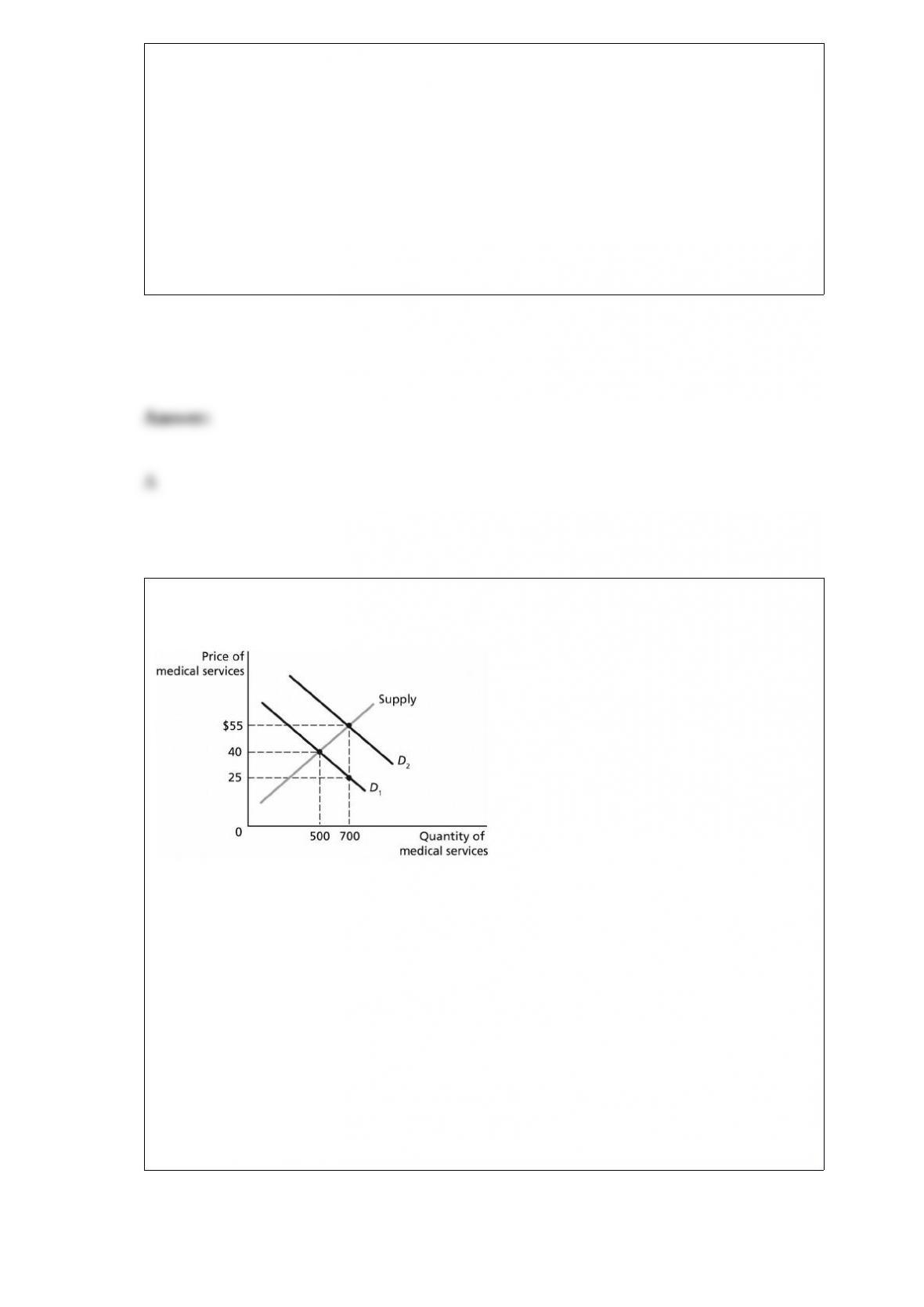
Figure 7-2
Figure 7-2 represents the market for medical services with and without insurance, and
the effect of a third-party payer system on the demand for medical services.
Refer to Figure 7-2. If consumers paid the full price of medical services, the
equilibrium quantity would be
A) 200.
B) 500.
C) 700.
D) >700.

Mortgages issued to borrowers whose credit histories include failures to make payments
on bills are known as ________ mortgages.
A) catastrophic
B) variable rate
C) subprime
D) Alt-A
The supply curve of a public goods shows
A) the total quantities that all producers are willing and able to supply at each price.
B) the maximum amount suppliers require to produce each quantity of the good.
C) the total cost of producing each unit of the good.
D) the marginal cost of producing each unit of the good.

The natural resources used in production are made available in the
A) goods and services market.
B) product market.
C) government market.
D) factor market.
For many products, such as fast foods, a variety of prices can be found, but sellers with
higher prices can expect to sell their products because
A) consumers are not sensitive to prices.
B) arbitrage will quickly eliminate price differences.
C) firms differentiate products in many ways, for example, higher priced fast food
restaurants may offer better service.
D) their demand is perfectly inelastic.
The reason that the Fisherman’s Friend restaurant in Stonington, Maine had a monopoly
on selling seafood dinners in that town is most likely due to
A) a government-imposed barrier.
B) occupational licensing.
C) no competitors apparently found the profit level attractive enough to enter the
market.
D) the restaurant owned all the fresh seafood in the state.
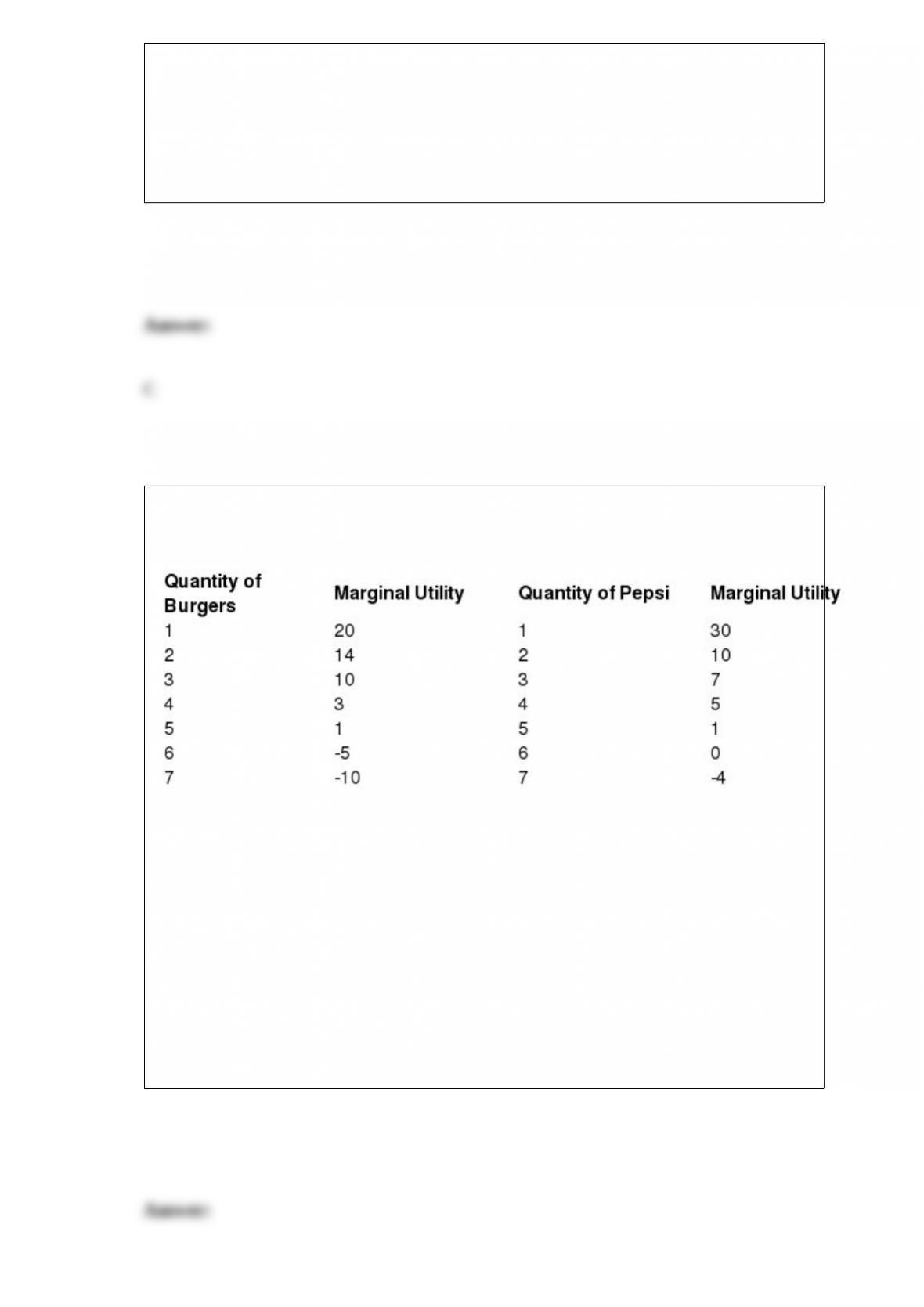
Table 10-6
Table 10-6 lists Jay’s marginal utilities for burgers and Pepsi. Jay has $7 to spend on
these two goods. The price of a burger is $2 and the price of a can of Pepsi is $1.
Refer to Table 10-6. What is Jay’s optimal consumption bundle?
A) 1 burger and 2 Pepsis
B) 2 burgers and 3 Pepsis
C) 3 burgers and 1 Pepsi
D) 3 burgers and 2 Pepsis

As a firm hires more labor in the short run, the
A) level of total product stays constant.
B) output per worker rises.
C) extra output of another worker may rise at first, but eventually must fall.
D) costs of production are increasing at a fixed rate per unit of output.
Which of the following explains why the marginal cost curve has a U shape?
A) Initially, the marginal product of labor falls, then rises.
B) Initially, the average product of labor rises, then falls.
C) Initially, the marginal product of labor rises, then falls.
D) Initially, the average cost of production rises, then falls.
Table 11-9
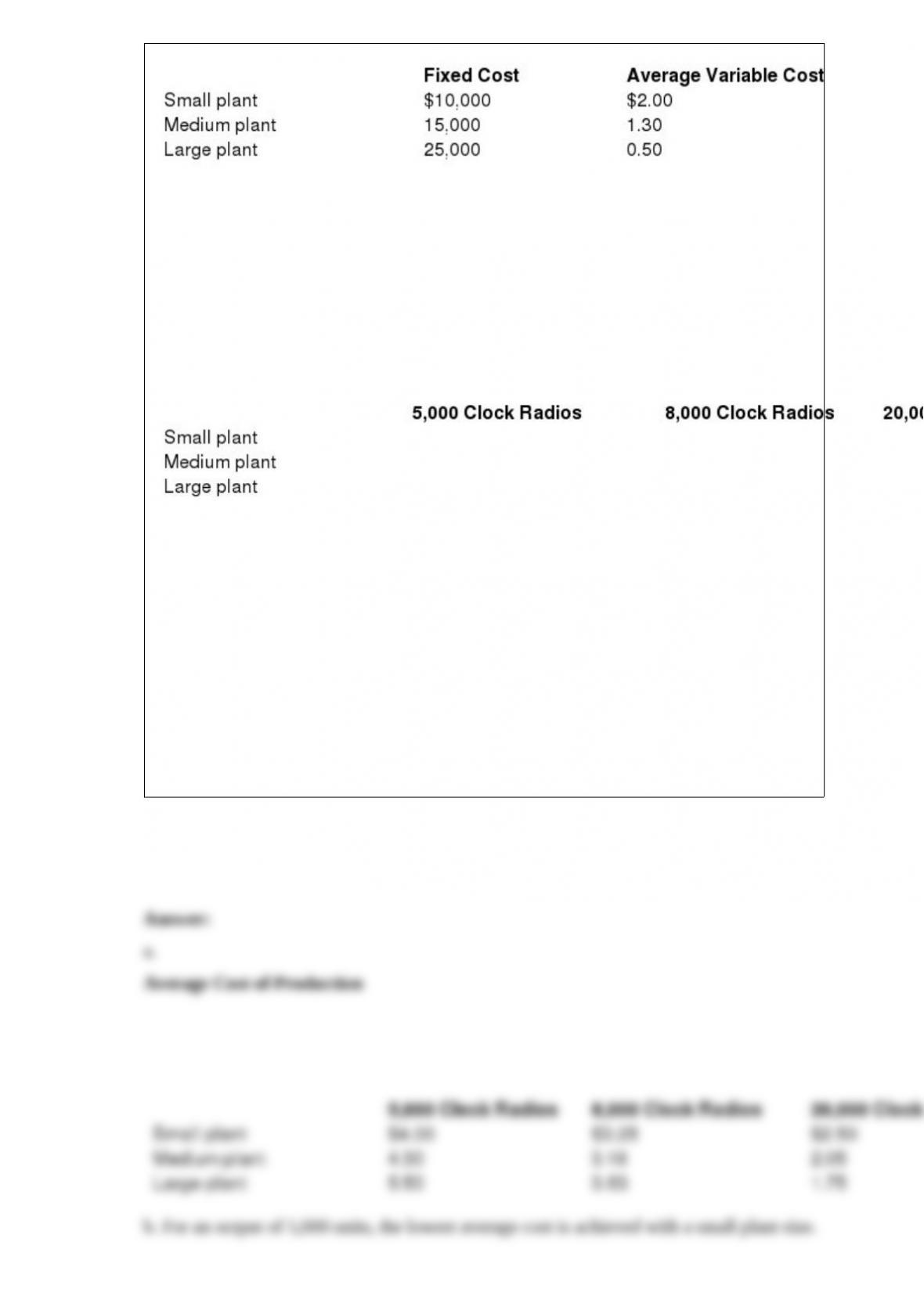
Refer to Table 11-9. Clock It To Me manufactures clock radios. The table above shows
estimates of fixed cost per period and average variable cost for three possible plant
sizes.
a. You are employed as the company’s cost accountant and have been asked to prepare
cost estimates for various output levels for each of the three possible plant sizes. Record
your calculations in the table below.
Average Cost of Production
b. For each of the three output levels, which plant size will generate the lowest average
total cost of production?
c. Suppose the firm currently sells 8,000 clock radios per period (using the optimal
plant size for this output level). Now, however, it has just secured a long-term contract
to supply 20,000 clock radios per period. In the short run, what is the average total cost
of producing 20,000 clock radios? Provide a numerical value based on your answer in
part a.
d. What happens to average total cost of production in the long run? Provide a
numerical value based on your answer in part a.
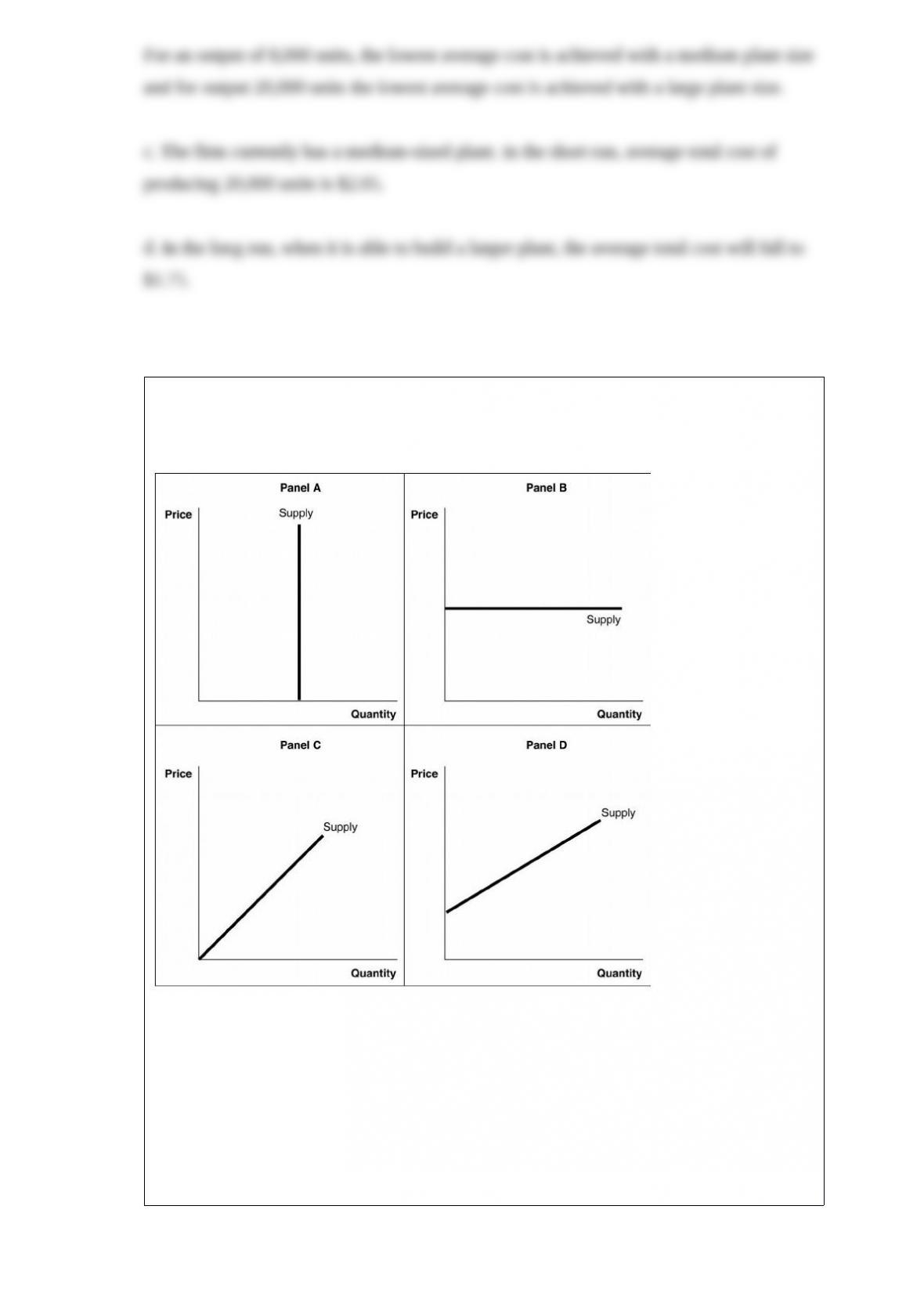
Figure 6-10
Refer to Figure 6-10. A unit-elastic supply curve is shown in
A) Panel A.
B) Panel B.
C) Panel C.
D) Panel D.

Table 2-9
Table 2-9 shows the number of labor hours required to produce a canoe and a sailboat in
Guatemala and Honduras.
Refer to Table 2-9. If the two countries specialize and trade, who should export
sailboats?
A) There is no basis for trade between the two countries.
B) Guatemala
C) Honduras
D) They should both be importing sailboats.
When colleges use yield management techniques, they
A) rank students on the basis of academic merit and award higher financial aid offers to
those at the top of the ranking.
B) increase financial aid offers to students whose demand for college education is likely
to be more price elastic and reduce financial aid offers to students whose demand for
college education is likely to be less price elastic.
C) rank students on the basis of academic merit and award higher financial aid offers to

those at the bottom of the ranking.
D) increase financial aid offers to students whose demand for college education is likely
to be more price inelastic and reduce financial aid offers to students whose demand for
college education is likely to be less price inelastic.
In the United States, many beekeepers travel from state to state, renting out their bee
colonies to farmers for pollination services. This is an example of
A) a Coasian solution to a positive externality problem.
B) a Pigovian solution to a positive externality problem.
C) a tradable exchange contract.
D) command and control policy.
According to the marginal productivity theory of income
A) the greater the quantity of resources owned by an individual, the greater his
incentive to increase productivity and his income.
B) the average income received by an individual who supplies resources is influenced
by the resources owner’s marginal productivity.
C) the income received by an individual who supplies labor services equals the
incremental benefit generated to the firm by that individual’s labor.
D) the income received by an individual who supplies labor services equals the profit
generated to the firm by that individual’s labor.
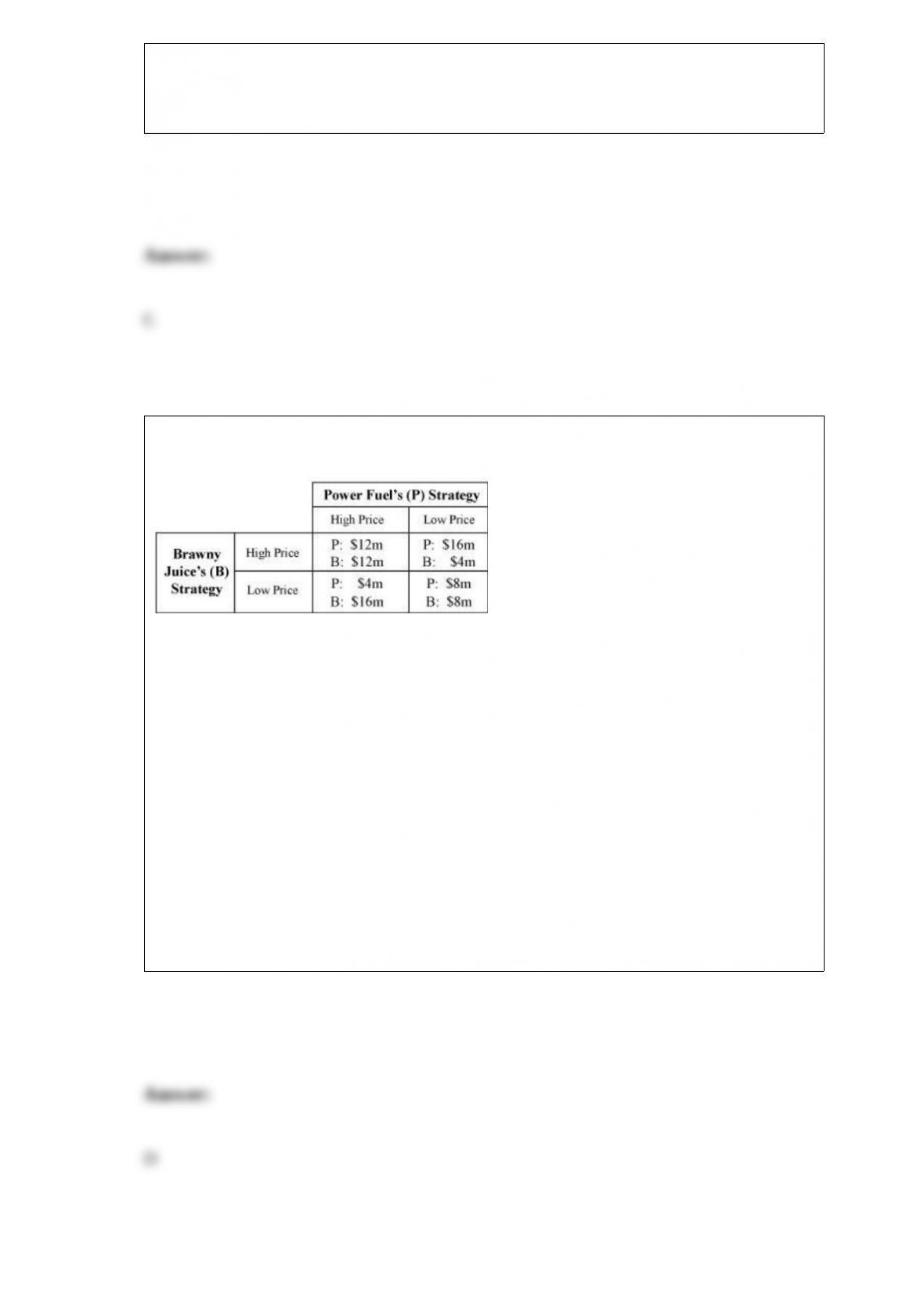
Table 14-8
Two rival oligopolists in the athletic supplements industry, the Power Fuel Company
and the Brawny Juice Company, have to decide on their pricing strategy. Each can
choose either a high price or a low price. Table 14-8 shows the payoff matrix with the
profits that each firm can expect to earn depending on the pricing strategy it adopts.
Refer to Table 14-8. If the firms act out of individual self-interest, which prices will
they select?
A) Both firms will select a high price.
B) Brawny Juice will select a high price, Power Fuel will select a low price.
C) Brawny Juice will select a low price, Power Fuel will select a high price.
D) Both firms will select a low price.

Ford Motor Company started producing the Model A at plants scattered around the
United States
A) to save on transport costs.
B) because diseconomies of scale at its initial River Rouge plant resulted in high
production costs.
C) to locate its production centers closer to its customers.
D) because it was not able to attract skilled workers in Michigan (where its first plant
was located).
Joss is a marketing consultant. Iris and Daphne are potential customers interested in
commissioning Joss to undertake a market survey and compile the findings in a report.
Iris is willing to pay $500 for the service while Daphne is willing to pay $800. Suppose
that the opportunity cost of Joss’s time is $1,200. Assume that Iris and Daphne do not
know each other. Which of the following statements is true?
A) Joss should charge each customer $600; that way he will earn his opportunity cost
and it will be fair to both Iris and Daphne.
B) Joss should charge Iris $500 and Daphne no more than $700; that way he earns his
opportunity cost and there is no loss in economic surplus.
C) Joss should charge Iris $500 and Daphne $800; that way economic surplus is
maximized.
D) Joss should charge Iris $500 but charging Daphne $800 is unfair because it allows
Joss to earn more than his opportunity cost.
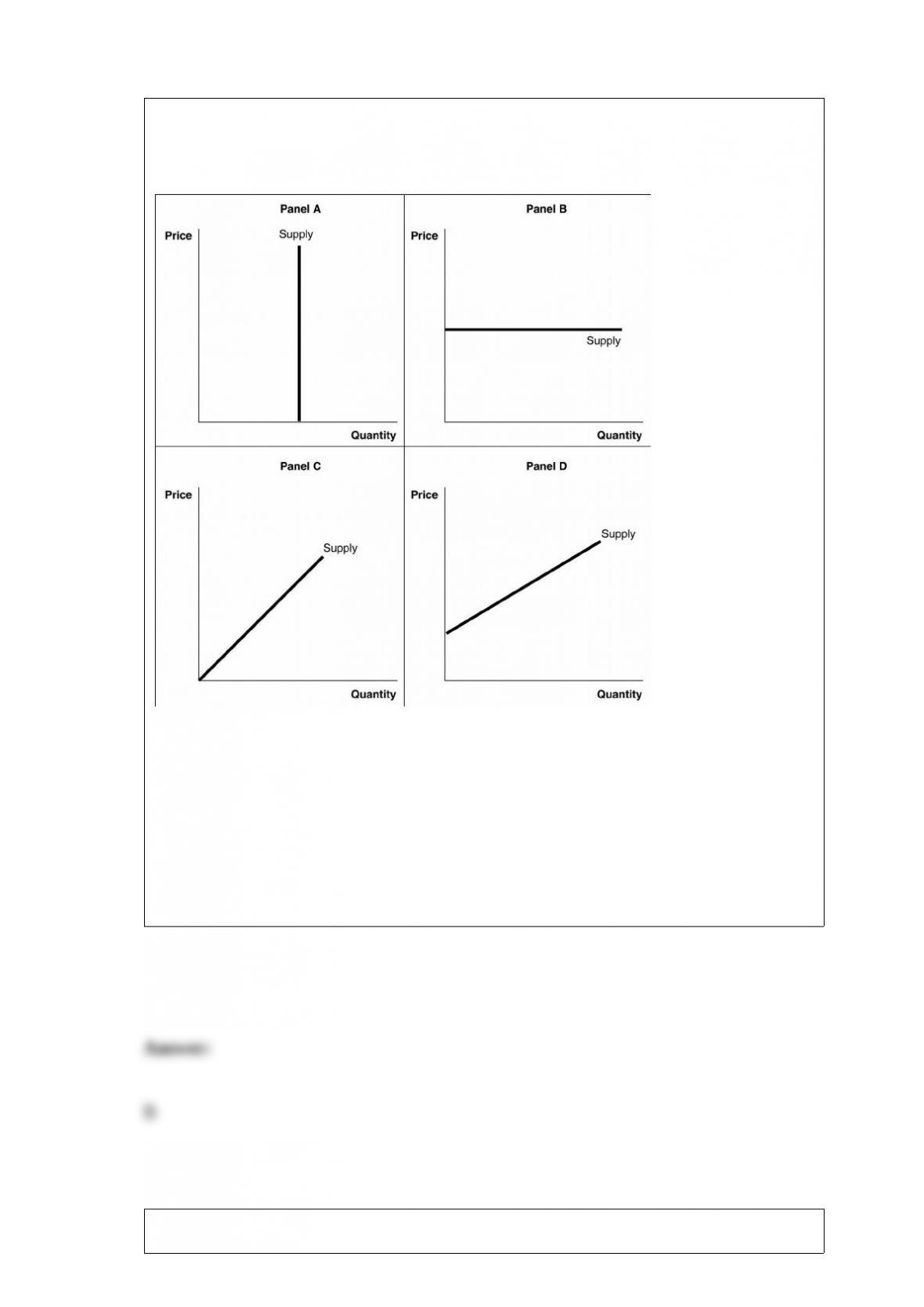
Figure 6-10
Refer to Figure 6-10. A perfectly elastic supply curve is shown in
A) Panel A.
B) Panel B.
C) Panel C.
D) Panel D.
Suppose in Belize, the opportunity cost of producing a sailboat is 5 hang gliders. In
Honduras, the opportunity cost of producing a sailboat is 8 hang gliders.
a. What is the opportunity cost of producing a hang glider for Belize?
b. What is the opportunity cost of producing a hang glider for Honduras?
c. Which country has a comparative advantage in the production of hang gliders?
d. Which country has a comparative advantage in the production of sailboats?
In September 2012, the average price of gasoline in the United States was $3.91 per
gallon and consumers bought 5 percent less gasoline than they had during September
2011, when the average price was $3.66 per gallon. Based on these numbers, what was
the price elasticity of demand for gasoline from September 2011 to September 2012?
A) -0.33
B) -0.76
C) -2.96
D) -6.75
All of the following products are most likely to have significant network externalities
except
A) cat food.
B) cell phones.
C) popular board games.
D) fax machines.
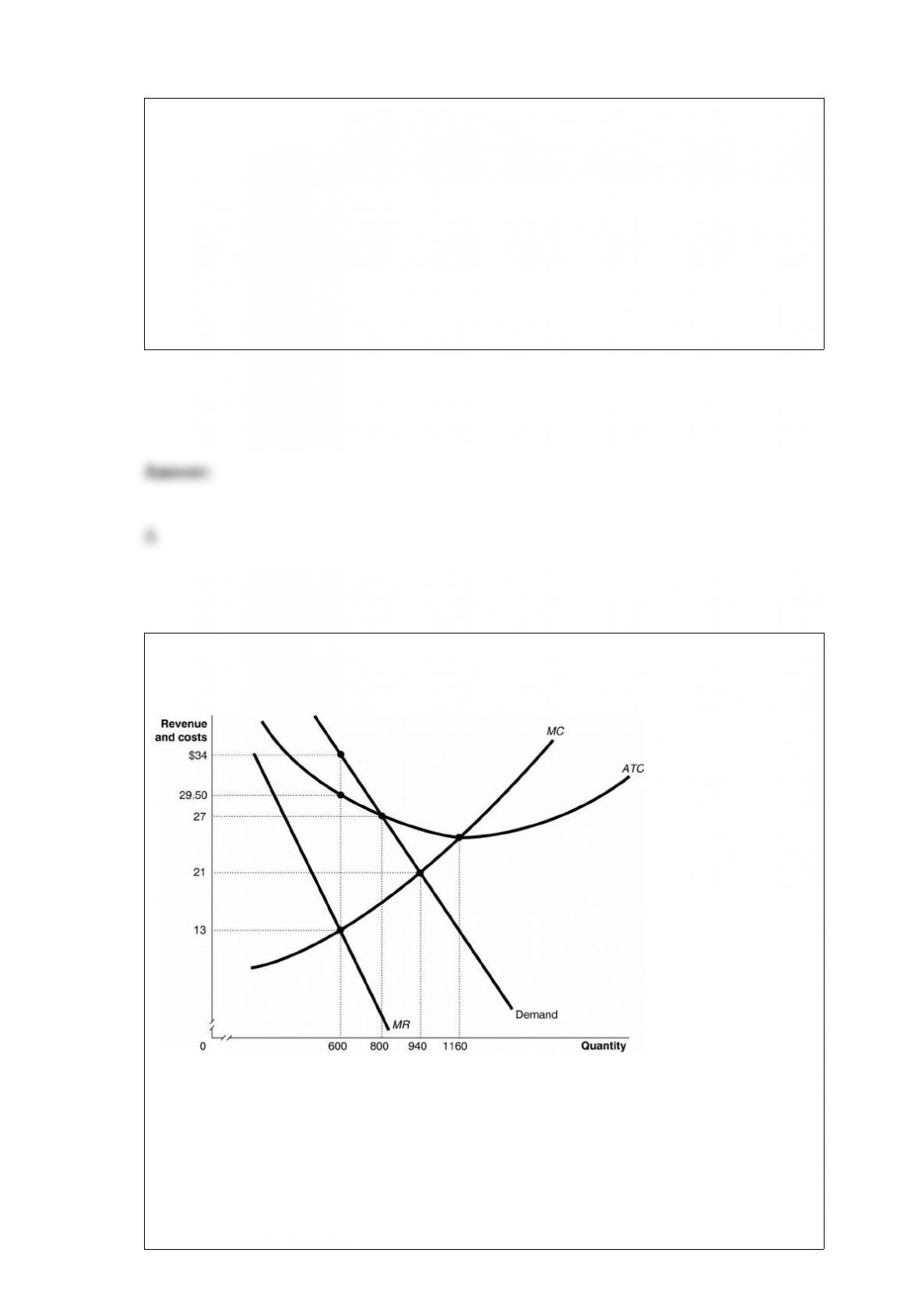
Figure 15-4
Figure 15-4 shows the demand and cost curves for a monopolist.
Refer to Figure 15-4. What is the price charged for the profit-maximizing output level?
A) $13
B) $21

C) $27
D) $34
A firm should hire more workers to increase its profits if
A) the marginal product of labor is greater than the wage the firm will pay these
workers.
B) the wage rate is less than the marginal revenue product of labor.
C) there is enough capital and other resources for the workers to use.
D) the demand for labor is elastic.
Table 4-5
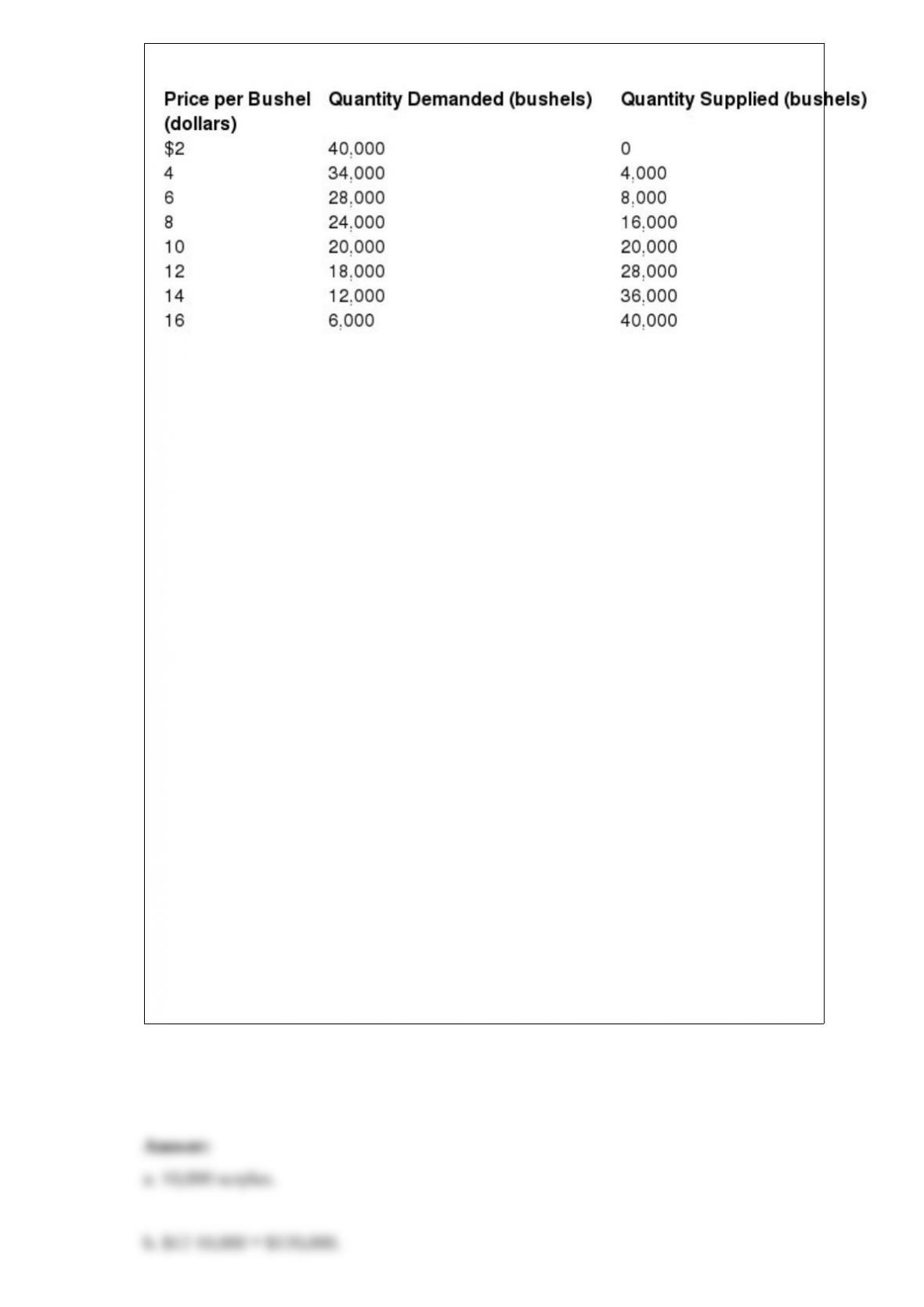
Table 4-5 above contains information about the corn market. Answer the following
questions based on this table.
Refer to Table 4-5. An agricultural price floor is a price that the government guarantees
farmers will receive for a particular crop. Suppose the federal government sets a price
floor for corn at $12 per bushel.
a. What is the amount of shortage or surplus in the corn market as result of the price
floor?
b. If the government agrees to purchase any surplus output at $12, how much will it
cost the government?
c. If the government buys all of the farmers’ output at the floor price, how many bushels
of corn will it have to purchase and how much will it cost the government?
d. Suppose the government buys up all of the farmers’ output at the floor price and then
sells the output to consumers at whatever price it can get. Under this scheme, what is
the price at which the government will be able to sell off all of the output it had
purchased from farmers? What is the revenue received from the government’s sale?
e. In this problem we have considered two government schemes: (1) a price floor is
established and the government purchases any excess output and (2) the government
buys all the farmers’ output at the floor price and resells at whatever price it can get.
Which scheme will taxpayers prefer?
f. Consider again the two schemes. Which scheme will the farmers prefer?
g. Consider again the two schemes. Which scheme will corn buyers prefer?

The Coffee Nook, a small cafe near campus, sells cappuccinos for $2.50 and Russian
tea cakes for $1.00 each. What is the opportunity cost of buying a Russian tea cake?
A) 2 1/2 cappuccinos
B) 2/5 of a cappuccino
C) $2.50
D) $1.00
According to public choice theory, policymakers
A) place the interests of the public above their own self-interest.
B) are likely to pursue their own self-interest, even if their self-interest conflicts with
the public interest.
C) act in ways to maximize economic efficiency.
D) act in ways to bring about an equitable distribution of society’s wealth.
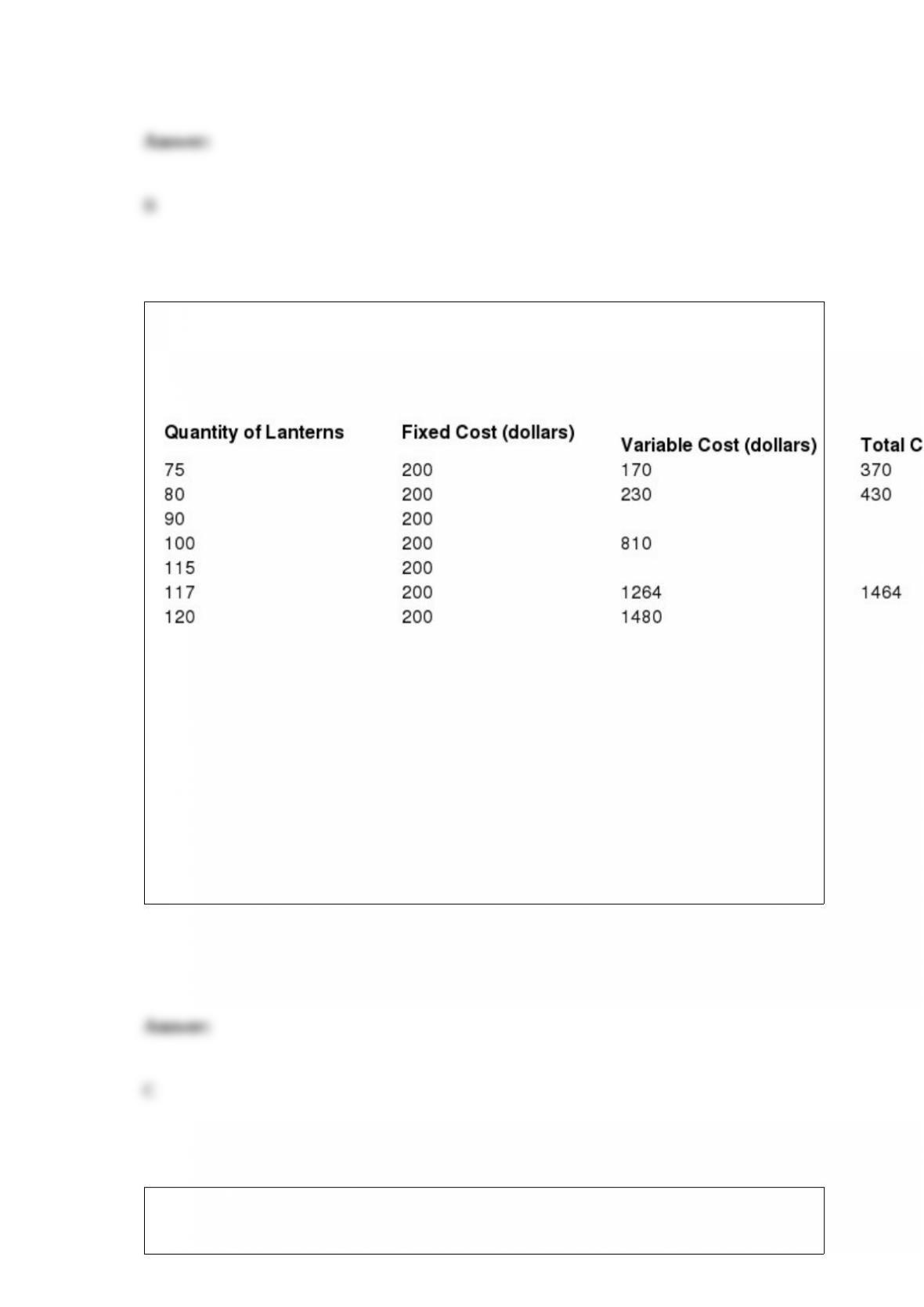
Table 11-7
Table 11-7 shows cost data for Lotus Lanterns, a producer of whimsical night lights.
Refer to Table 11-7. What is the average total cost of production when the firm
produces 120 lanterns?
A) $1,680
B) $72
C) $14
D) $12.3
Figure 13-18
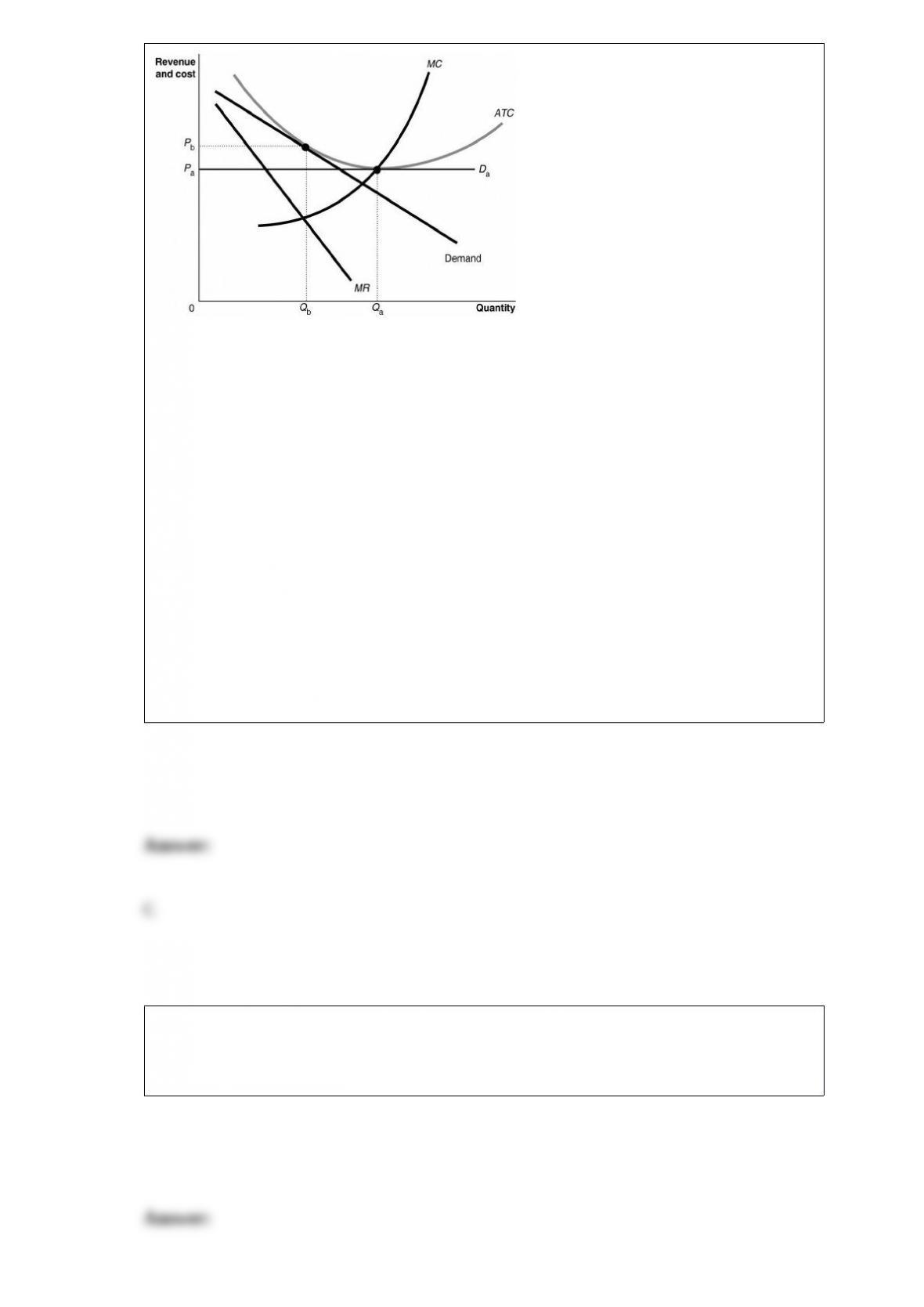
Refer to Figure 13-18. Which of the following statements is true?
A) Da represents the long-run demand curve facing a monopolistic competitor in a
constant-cost industry while Dbdepicts the demand curve in the short run.
B) Darepresents the long-run demand curve facing a monopolistic competitor in a
constant-cost industry while Dbdepicts the long-run demand curve in an increasing-cost
industry.
C) Darepresents the long-run demand curve facing a perfect competitor while Dbdepicts
the long-run demand curve facing a monopolistic competitor.
D) Darepresents the long-run supply curve in a perfectly competitive, constant-cost
industry while Dbdepicts the long-run demand curve facing a monopolistic competitor
in a decreasing-cost industry.
Explain the concepts of cross-price elasticity of demand and income elasticity of
demand. What do positive and negative values indicate for each of these demand
elasticities ?

Explain the economic concept of price elasticity of supply. How is price elasticity of
supply calculated?
How might a monopolistically competitive firm continually earn economic profit
greater than zero?

What is adverse selection?
Why are individual buyers and sellers in perfect competition called price takers?
What is the main difference between a single-payer health care system and socialized
medicine?
Draw a graph that shows producer surplus, consumer surplus, and deadweight loss in a
market where the seller practices perfect price discrimination. Be sure to identify the
demand curve, the marginal revenue curve, the marginal cost curve, and the profit
maximizing quantity on the graph.
Briefly explain the economic concept of elasticity.
Explain why it is more difficult to determine the incidence of the corporate income tax
than it is to determine the incidence of the tax on gasoline.
What is the signaling hypothesis of education?

On November 7, 1996, the Distilled Spirits Council of the United States decided to end
its voluntary ban on television and radio liquor advertisement. The ban on hard liquor
advertising had been in effect since 1936 for radio and 1948 for television. Did the
lifting of this ban likely increase or decrease the profits of hard liquor companies?
Briefly explain.
What is the difference between goods and services?
Describe how Wal-Mart has used positive technological change to manage its inventory.

What is the difference between the terms “marketing” and “advertising”?
What do economists mean by an efficient tax?