Recent rapid economic growth in India and China has reduced the amount of “brain
drain” in those countries.
A monopolist currently sells 18 units of a good. If marginal revenue on the last unit sold
is $117, then the price of the good must be less than $117.
In reality, because few markets are perfectly competitive, some loss of economic
efficiency occurs in the market for nearly every good or service.
In economics, technology only refers to the development of new products.
If the GDP deflator is equal to 100, then for that year nominal GDP is equal to real
GDP.
If the marginal tax rate is greater than the average tax rate, the tax structure is described
as regressive.
A market failure arises when an entire sector of the economy (for example, the airline
industry) collapses because of some unforeseen event.
Adverse selection is a situation in which one party to an economic transaction has less
information than the other party.

In the circular flow model, households supply resources such as labor services in the
product market.
If the demand curve for a product is vertical, any tax increase on the product is paid for
entirely by the consumer.
An increase in the supply of capital, which is a substitute to labor, will lead to a
decrease in the demand for labor.
Human capital refers to the accumulated skills and training that workers possess.
If the exchange rate between the U.S. dollar and the Indian rupee (rupees per dollar) is
greater than the relative purchasing power between the two countries, which of the
following would be true?
A) There are opportunities for profit by purchasing goods in India and then selling them
in the United States.
B) Purchasing power parity predicts that the value of the dollar will rise as traders take
advantage of arbitrage opportunities.
C) Purchasing power parity predicts that the dollar is undervalued as traders take
advantage of arbitrage opportunities.
D) There are no arbitrage opportunities for which traders can take advantage.
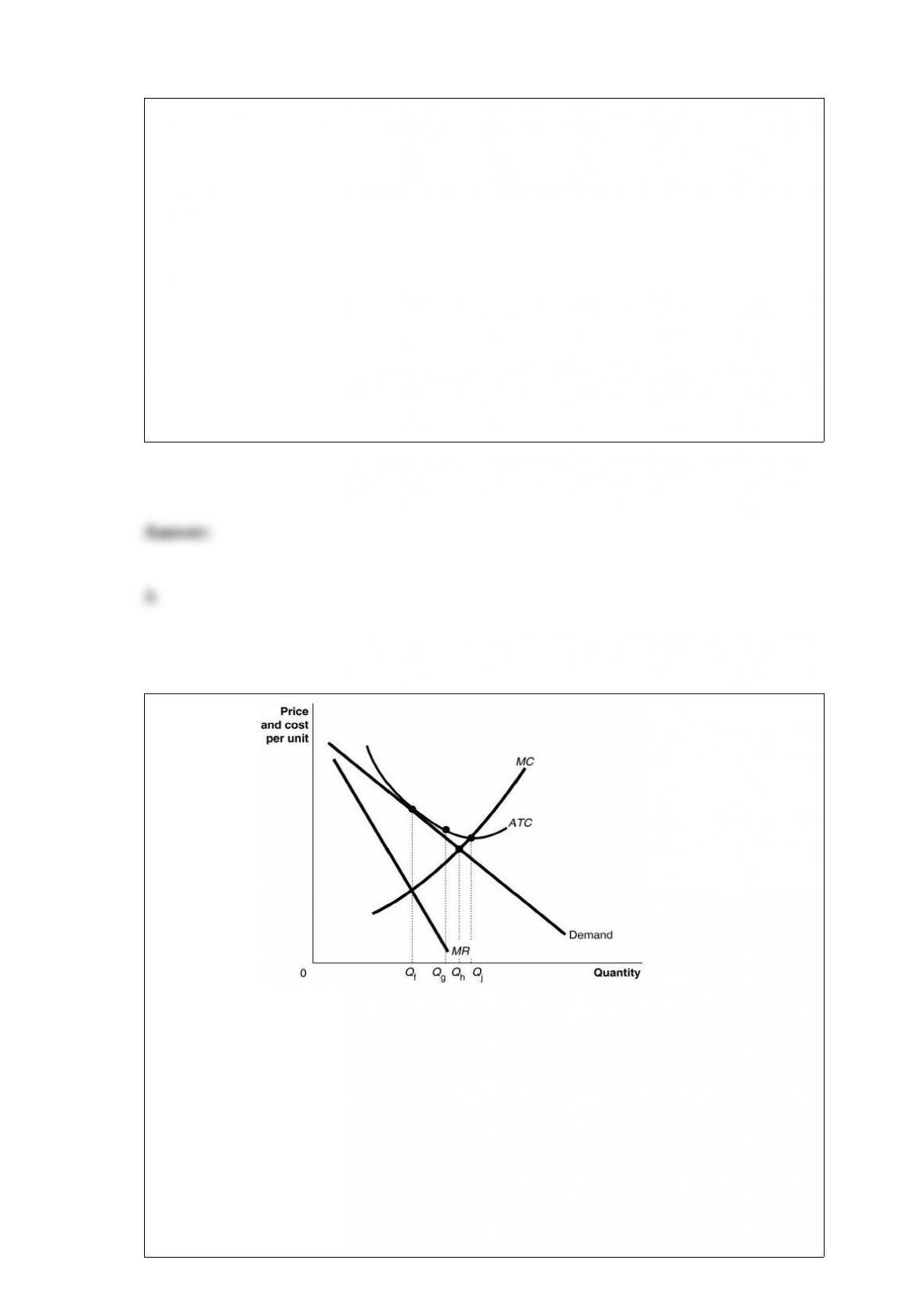
Figure 13-17
What is the amount of excess capacity?
A) Qh – Qf units
B) Qj – Qf units
C) Qj – Qh units
D) Qh – Qg units

Lionel’s Lawn Care is a company that maintains residential yards. Lionel’s cost for his
standard package of mowing, edging, and trimming is $15, and he charges $25 for this
service. For a total price of $40, Lionel will also trim shrubs, a service that adds an
additional $10 to the total cost of the standard package. Should Lionel continue to offer
the shrub-trimming service?
A) yes, his marginal benefit is greater than his marginal cost
B) yes, but only if he raises the price of the standard package
C) no, his marginal benefit is less than his marginal cost
D) More information is needed for Lionel to make this decision.
The level of long-run aggregate supply is affected by all of the following except
A) changes in the price level.
B) changes in the technology.
C) changes in the capital stock.
D) changes in the number of workers.
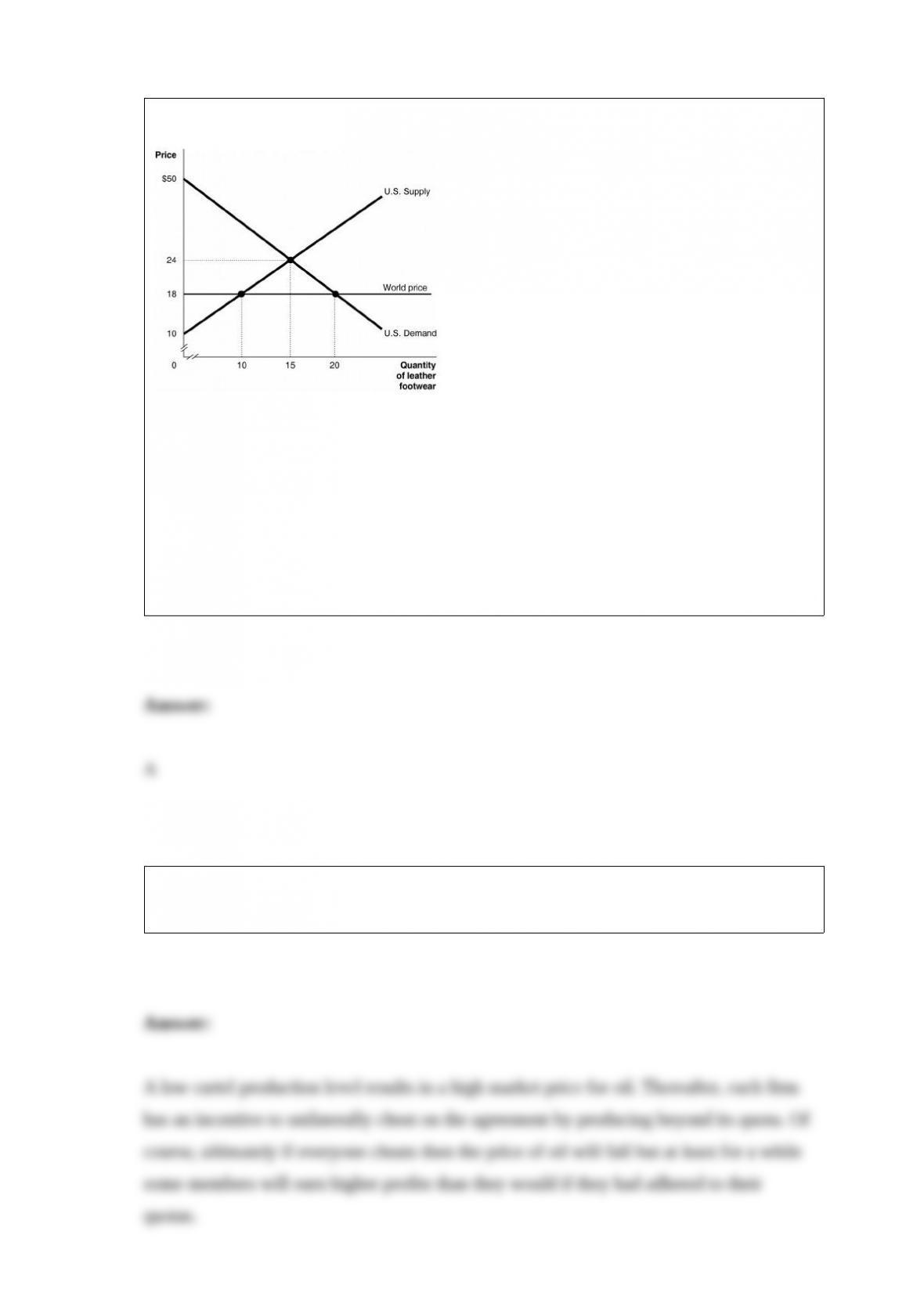
Figure 9-1
Figure 9-1 shows the U.S. demand and supply for
leather footwear. Under autarky, the consumer surplus is
A) $195.
B) $260.
C) $300.
D) $555.
Explain why member firms of a cartel like OPEC have incentives to agree to a low
cartel production level and then produce more than its quota.

Countries that abandoned the gold standard early in the Great Depression suffered an
average decline in production of 3 percent between 1929 and 1934. Countries that
stayed on the gold standard until 1933 or later suffered an average decline in production
of
A) 12 percent.
B) 18 percent.
C) 24 percent.
D) > 30 percent.
An insurance company is likely to attract customers like Clancy who want to purchase
insurance because he knows better that the company that he is more likely to make a
claim on a policy. What is the term used to describe the situation above?
A) moral hazard
B) adverse selection
C) asymmetric information
D) economic irrationality
Marginal benefit is equal to the ________ benefit to a consumer receives from
consuming one more unit of a good or service

A) total
B) unintended
C) additional
D) surplus
We can draw demand curves for firms in perfectly competitive and monopolistically
competitive industries, but not for oligopoly firms. The reason for this is
A) there are no barriers to entry in perfectly competitive and monopolistically
competitive industries. There are high barriers to entry in oligopoly industries.
B) we can assume that the prices charged by perfectly competitive and monopolistically
competitive firms have no impact on rival firms. For oligopoly this assumption is
unrealistic.
C) that perfectly competitive and monopolistically competitive firms are price takers.
Oligopoly firms are price makers.
D) perfectly competitive and monopolistically competitive firms sell standardized
products. Oligopoly firms sell differentiated products.
During a time when the inflation rate is increasing each year for a number of years, are
adaptive expectations or rational expectations likely to give the more accurate
forecasts? Briefly explain.
Define the tragedy of the commons. Give three examples of common resources. Briefly
explain why common property resources are subject to overuse.
Explain whether you agree or disagree with the following statement: “The reason that
inflation is bad is because it increases the cost of living – the costs of goods and services
we buy – without increasing income in general.”
What impact does a higher price level have on interest rates, wealth, and investment
spending?
If the exchange rate between the Mexican peso and the U.S. dollar expressed in terms
of pesos per dollar is 13.5 pesos = 1 dollar, what is the exchange rate when expresses in
terms of dollars per peso?
Economists have noted that businesses of a certain type tend to congregate
geographically, attracting workers with skills in those fields. This, in turn, lures more
firms seeking employees with those skills. Some examples include commercial
banking, software development, and the automobile industry. What mechanism is at
work here? Briefly explain how the mechanism works to the advantage of employers
and employees.
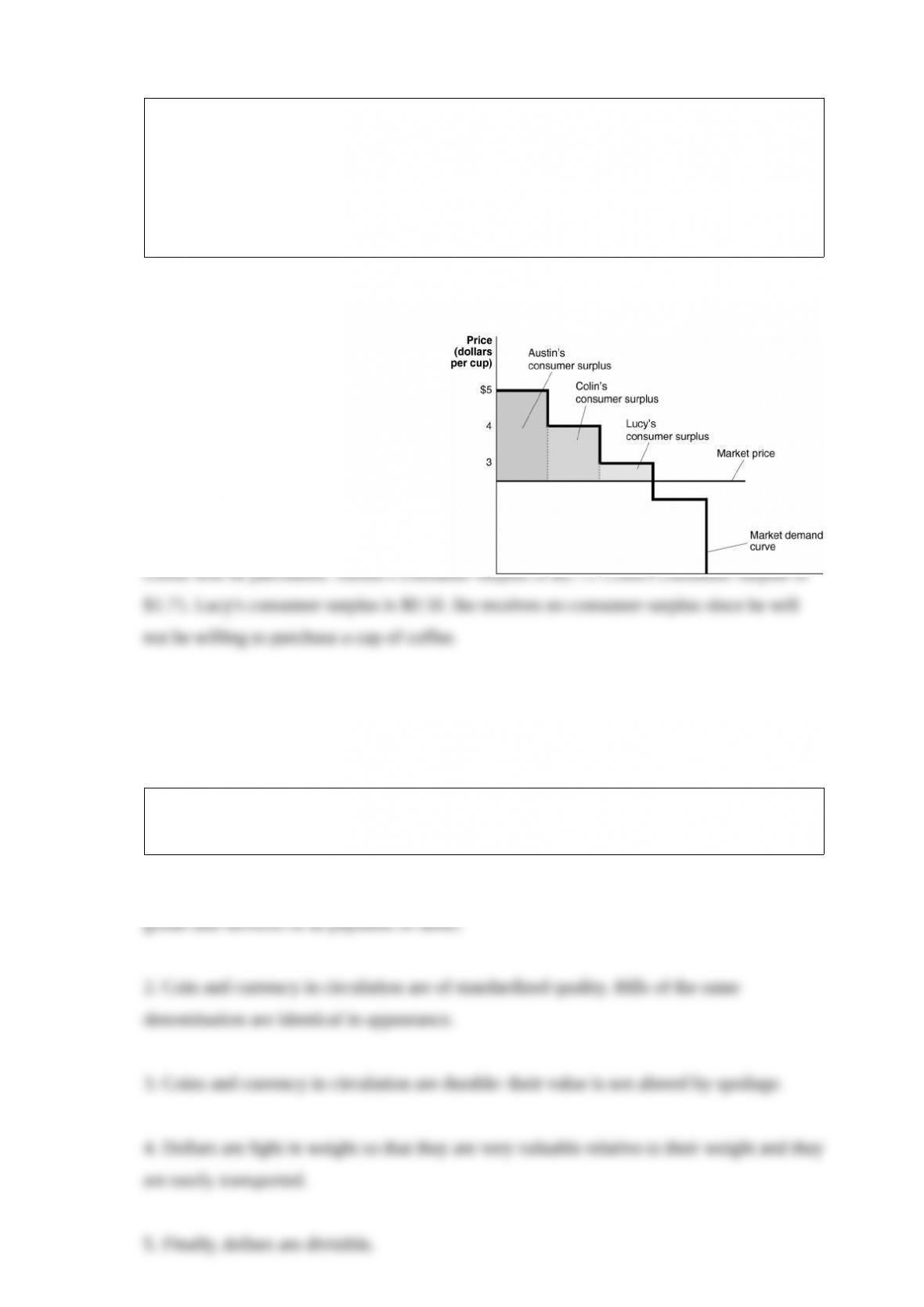
The market price for coffee is $2.25 per cup. Austin is willing to pay $5.00 per cup,
Colin is willing to pay $4.00 per cup, Lucy is willing to pay $3.00 per cup, and Ike is
willing to pay $2.00 per cup. Construct a graph showing the consumer surplus for each
cup of coffee purchased. How many cups of coffee will be purchased? What is the
value of the consumer surplus each of the four consumers receives from their coffee
purchases?
Using the five criteria in the book, explain how U.S. currency is suitable to use as a
medium of exchange.
Briefly explain the command-and-control approach in dealing with an externality such
as pollution. Give an example of the U.S. government using the command-and-control
approach to deal with the pollution problem.