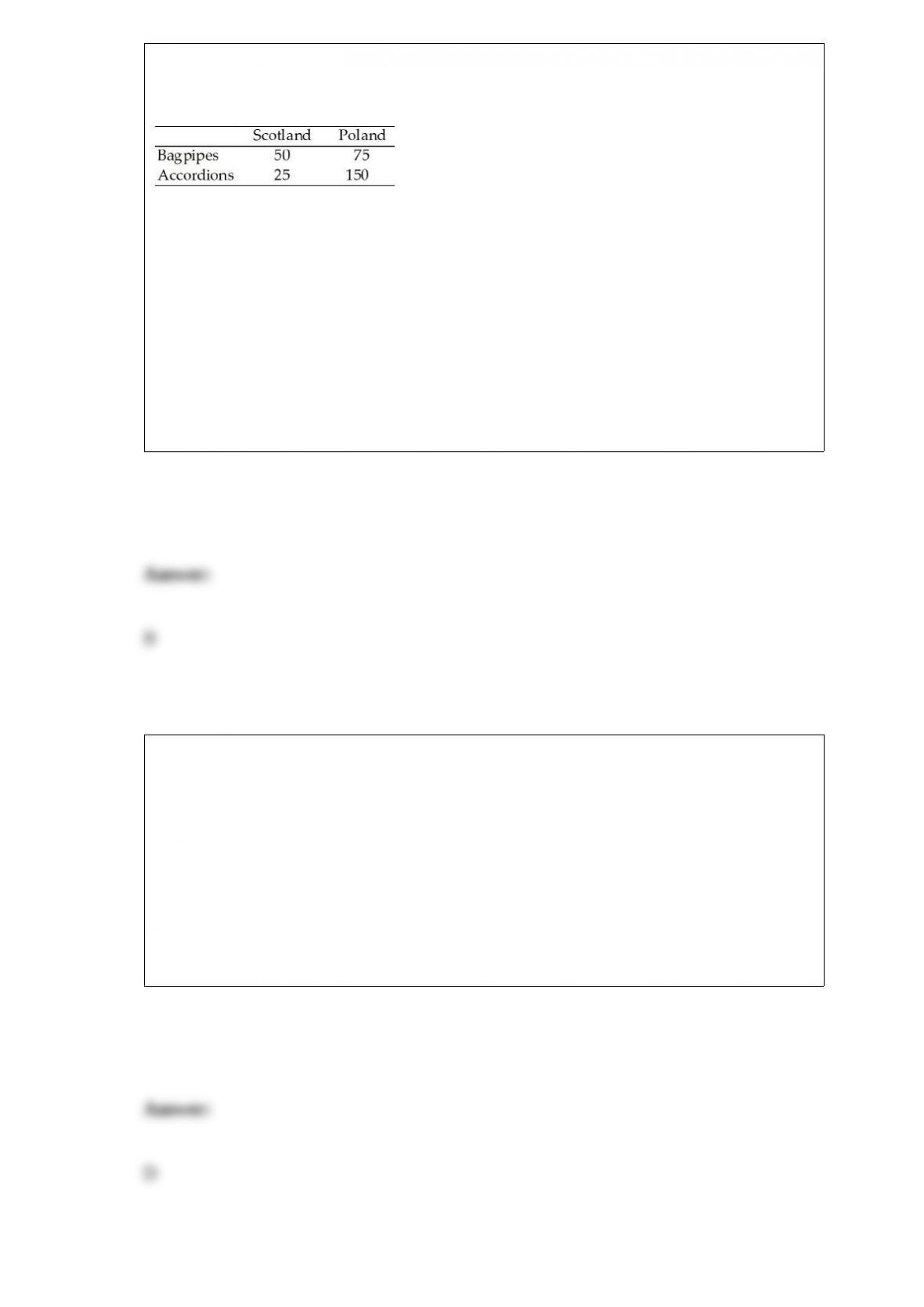
Daily Output of Scotland and Poland
Table 18.1
Refer to Table 18.1. Scotland has a comparative advantage in:
A) accordions.
B) bagpipes.
C) both accordions and bagpipes.
D) neither accordions nor bagpipes.
Lemon laws that allow consumers to return low-quality used cars are designed to help
solve the problem of ________ in used car markets.
A) moral hazard
B) thick markets
C) experience ratings
D) adverse selection
Price discrimination is based on differences in ________ among groups of consumers
and the differences in ________ that will result.
A) cross elasticities of demand; revenues
B) price elasticities of demand; profits
C) quantities supplied; marginal revenues
D) income elasticities of demand; marginal costs
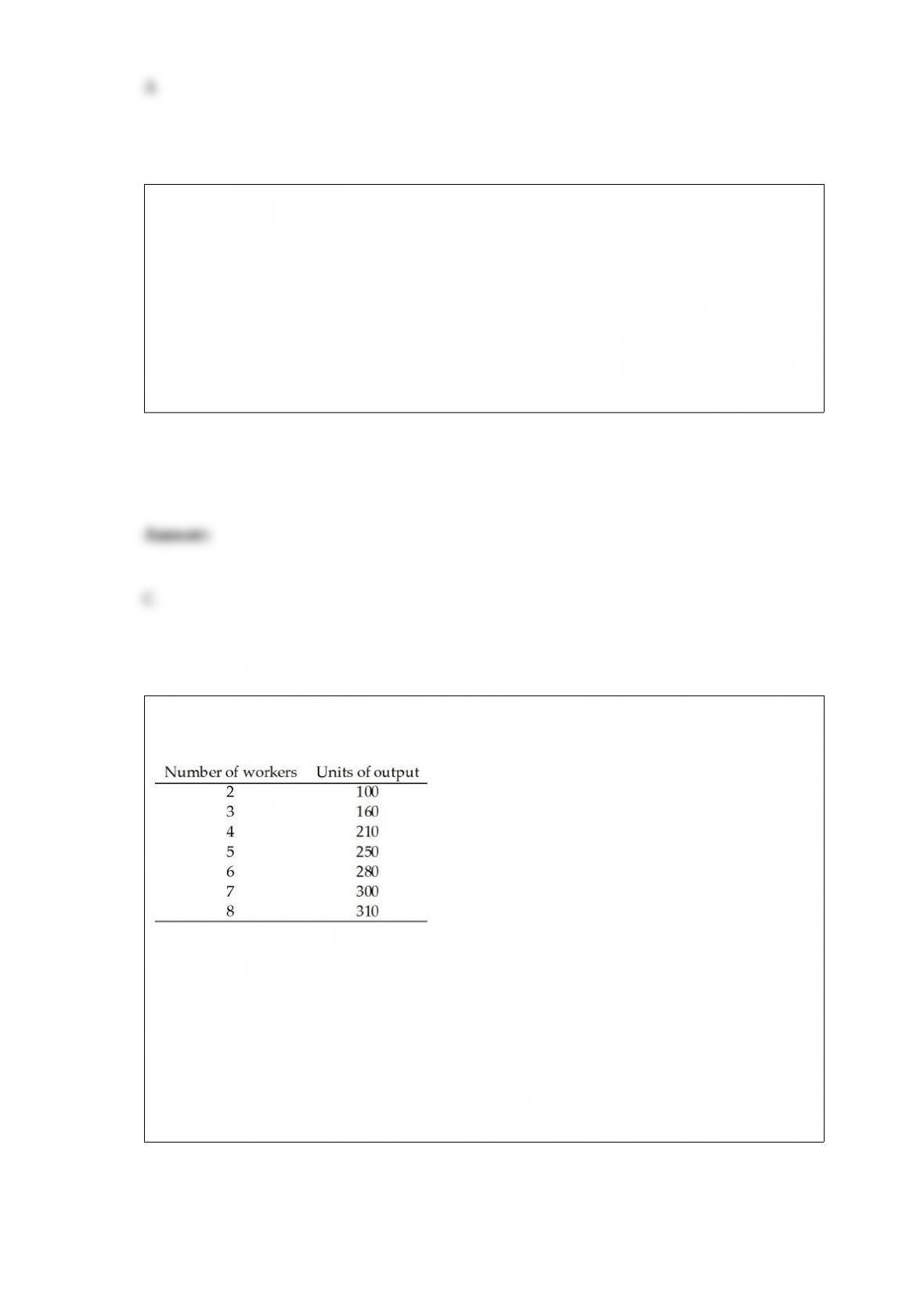
Figure 17.3 describes the labor market for a manufacturing industry. In the short run an
increase in the price of the good made by the workers will:
A) cause the equilibrium wage and the hours of labor used to increase.
B) not have an effect on this market.
C) cause the equilibrium wage to increase but will not change the hours of labor used.
D) cause the equilibrium wage and the hours of labor used to decrease.
If the price of a fixed factor of production increases, then:
A) total costs are unchanged.
B) marginal costs will increase.
C) variable costs are unchanged.
D) variable costs will increase.
Refer to Table 17.1. If the price of output is $2 per unit, the marginal revenue product of
the eighth unit of labor is:
Table 17.1
A) $10.
B) $20.
C) $310.
D) $620.

Antitrust laws are enforced by:
A) the Department of Commerce.
B) the Federal Trade Commission.
C) the Federal Reserve.
D) the Department of Labor.
Which of the following is a long-run impact of an increase in the wage?
A) The quantity demanded of labor increases because there are no diminishing returns.
B) The quantity demanded of labor increases because the marginal revenue product
curve shifts upward due to a higher product price.
C) The quantity demanded of labor decreases because firms face a higher degree of
diminishing returns.
D) The quantity demanded of labor decreases because firms will have an incentive to
use more of other inputs instead of labor.

The principle of diminishing returns does NOT apply to labor when all inputs are
allowed to vary because:
A) a firm can build an additional production facility so each worker’s share of the
facility doesn’t necessarily decrease.
B) eventually the marginal product of labor will begin to increase again.
C) a firm can fire inefficient workers.
D) None of the above, diminishing returns always apply.
The long-run marginal cost (LMC) is the increase in the cost incurred by the firm when
producing one additional output, holding:
A) neither the workforce nor the production facility constant.
B) the workforce and the production facility constant.
C) the workforce constant.
D) the production facility constant.
Refer to Table 8.5. If Sherry produces four pair of earrings, her average fixed costs are:
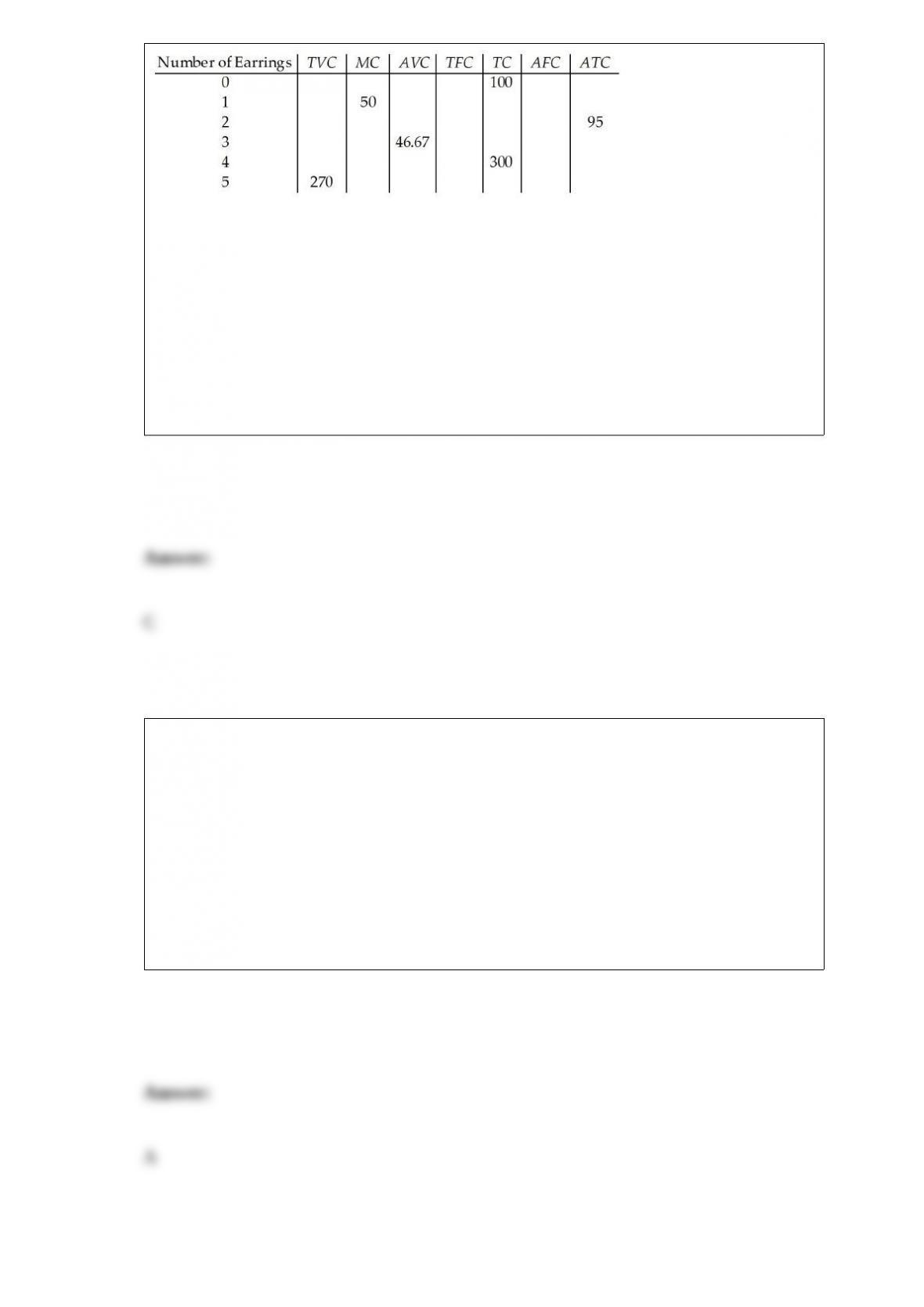
Table 8.5
A) $4.
B) $20.
C) $25.
D) $100.
In 2002, President Bush imposed a tariff on imported steel in order to protect domestic
steel producers. What was the reason why the tariff ended?
A) the threat of retaliatory tariffs by Europe
B) the threat of a possible recession in the U.S.
C) the improved profitability of domestic steel firms
D) the decrease in demand for steel by U.S. industries
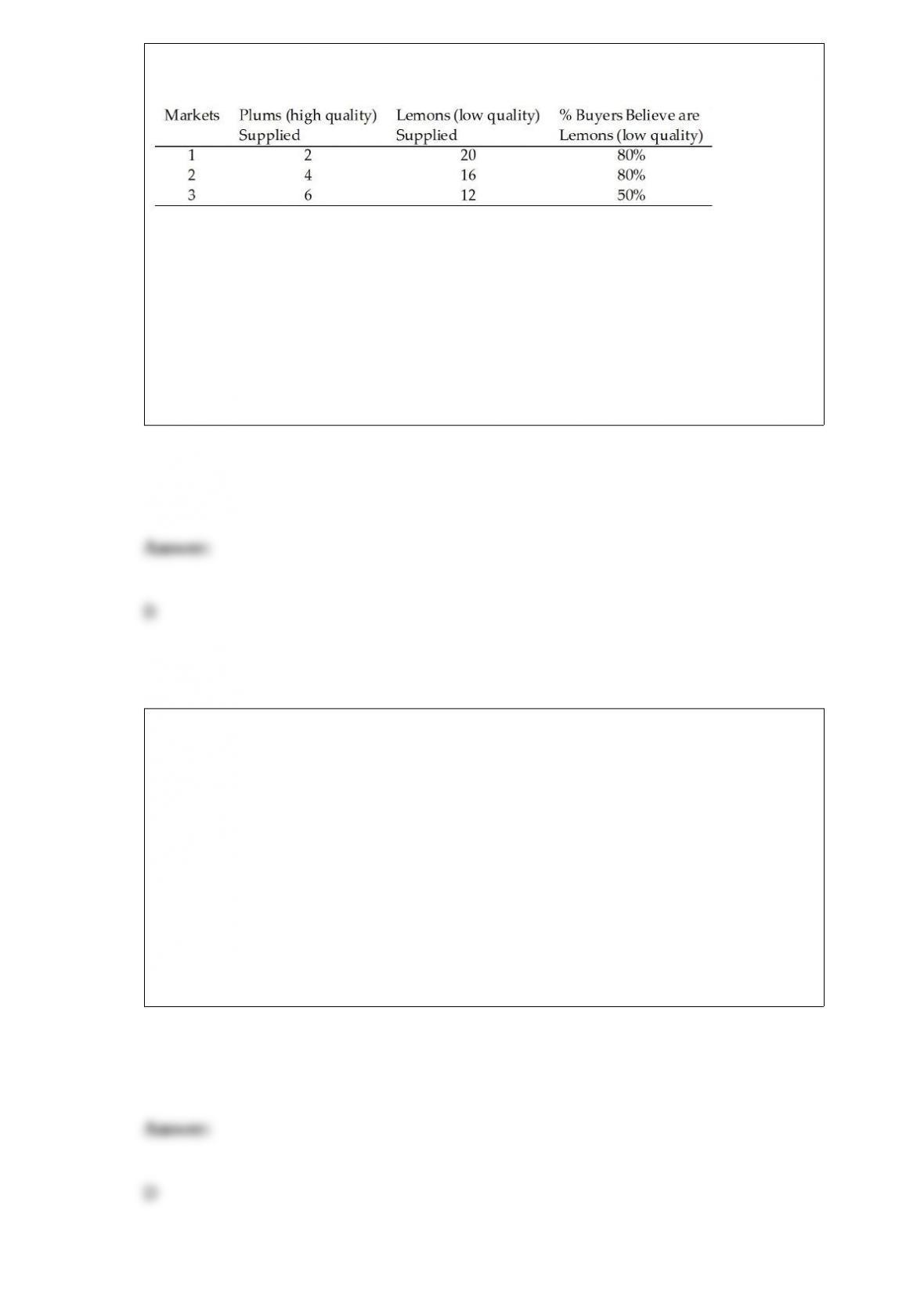
Table 14.4 represents 3 markets for used motorcycles. Which of the markets in Table
14.4 are in equilibrium?
Table 14.4
A) 1 only
B) 2 only
C) 3 only
D) 1 and 3
Claudia, the owner of a printing plant, is trying to decide whether to stay open for
business or to shut down. She needs to decide which costs are relevant and which ones
are irrelevant when making her decision. Which of the following costs are irrelevant to
Claudia?
A) machinery operation costs
B) paper
C) rent
D) A and C are irrelevant.

Command-and-control policies:
A) allow a low-cost firm to abate more pollution.
B) encourage firms to develop more efficient abatement technologies.
C) usually result in relatively low compliance costs.
D) allow us to predict the total amount of pollution that will be discharged.
Recall the Application. Suppose a low demander is willing to pay $8 for a movie, while
a high demander is willing to pay $12 for a movie and popcorn. If the theater charged
$8 for admission and $2 for popcorn, the low demander would receive a consumer
surplus of ________, and the high demander would receive a consumer surplus of
________.
A) $2; $6
B) $-2; $4
C) $10; $22
D) $0; $2
If the equilibrium price of a good decreases and the equilibrium quantity of the good
decreases, we can conclude that:

A) demand increased.
B) demand decreased.
C) supply increased.
D) supply decreased.
In which of the following situations should a firm reduce its efforts to abate pollution?
A) The marginal benefit of abatement is less than its marginal cost.
B) The marginal benefit of abatement is greater than its marginal cost.
C) The marginal benefit of abatement is equal to its marginal cost.
D) none of the above
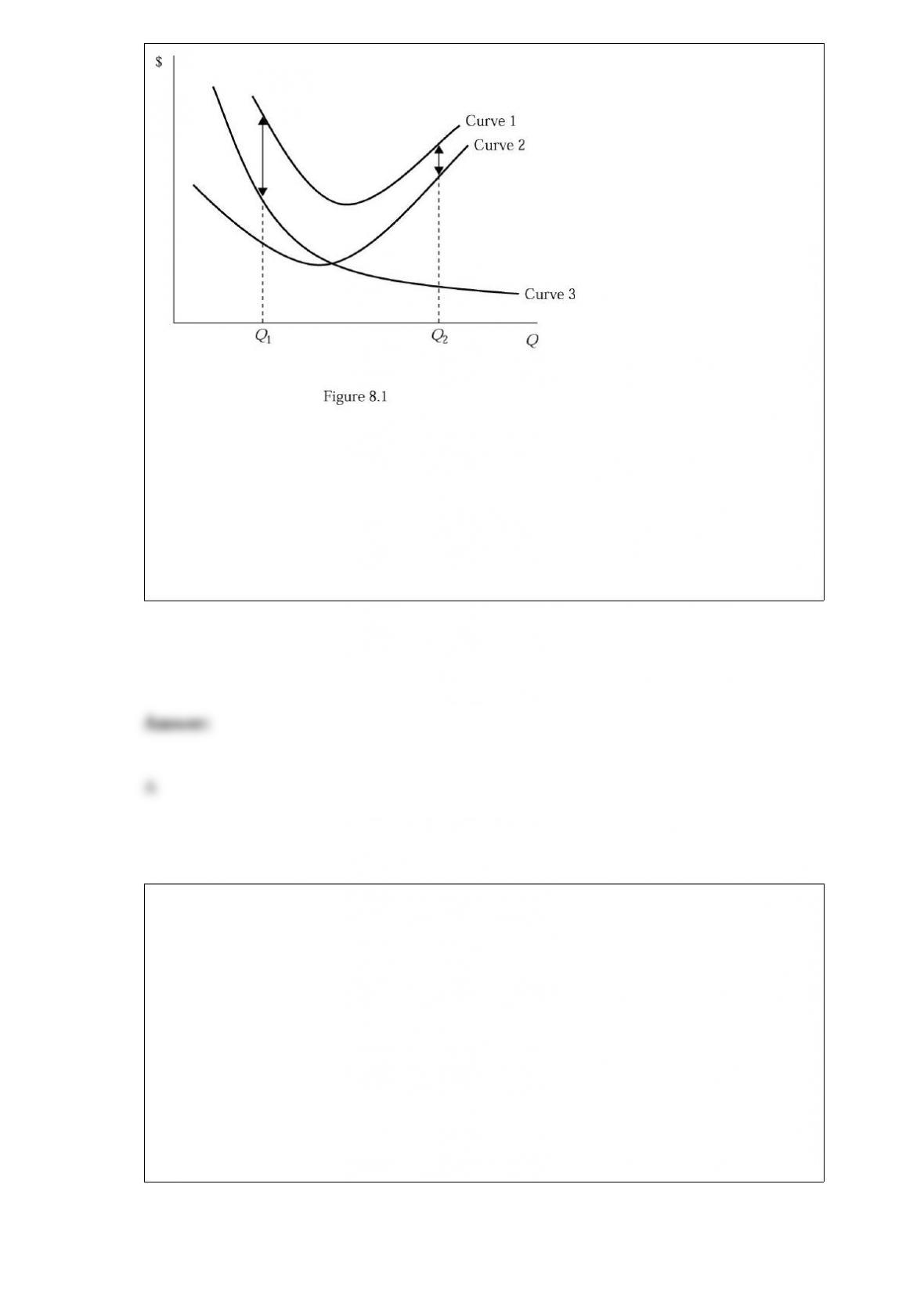
Refer to Figure 8.1, which shows a family of average cost curves. The average fixed
cost at a given level of output is represented by:
A) the vertical distance between Curve 1 and Curve 2 at a given level of output.
B) the vertical distance between Curve 1 and Curve 3 at a given level of output.
C) the vertical sum of Curve 1 and Curve 2 at a given level of output.
D) the vertical sum of Curve 1 and Curve 3 at a given level of output.
Suppose that the price of a hamburger is $3. Victoria is willing to pay $5 for the first
hamburger, David is willing to pay $4 for the second hamburger, Kelly is willing to pay
$3 for the third hamburger, and Antony is willing to pay $2 for the fourth hamburger. In
equilibrium, what is the total consumer surplus from the consumption of hamburger?
A) $0
B) $2
C) $3
D) $9
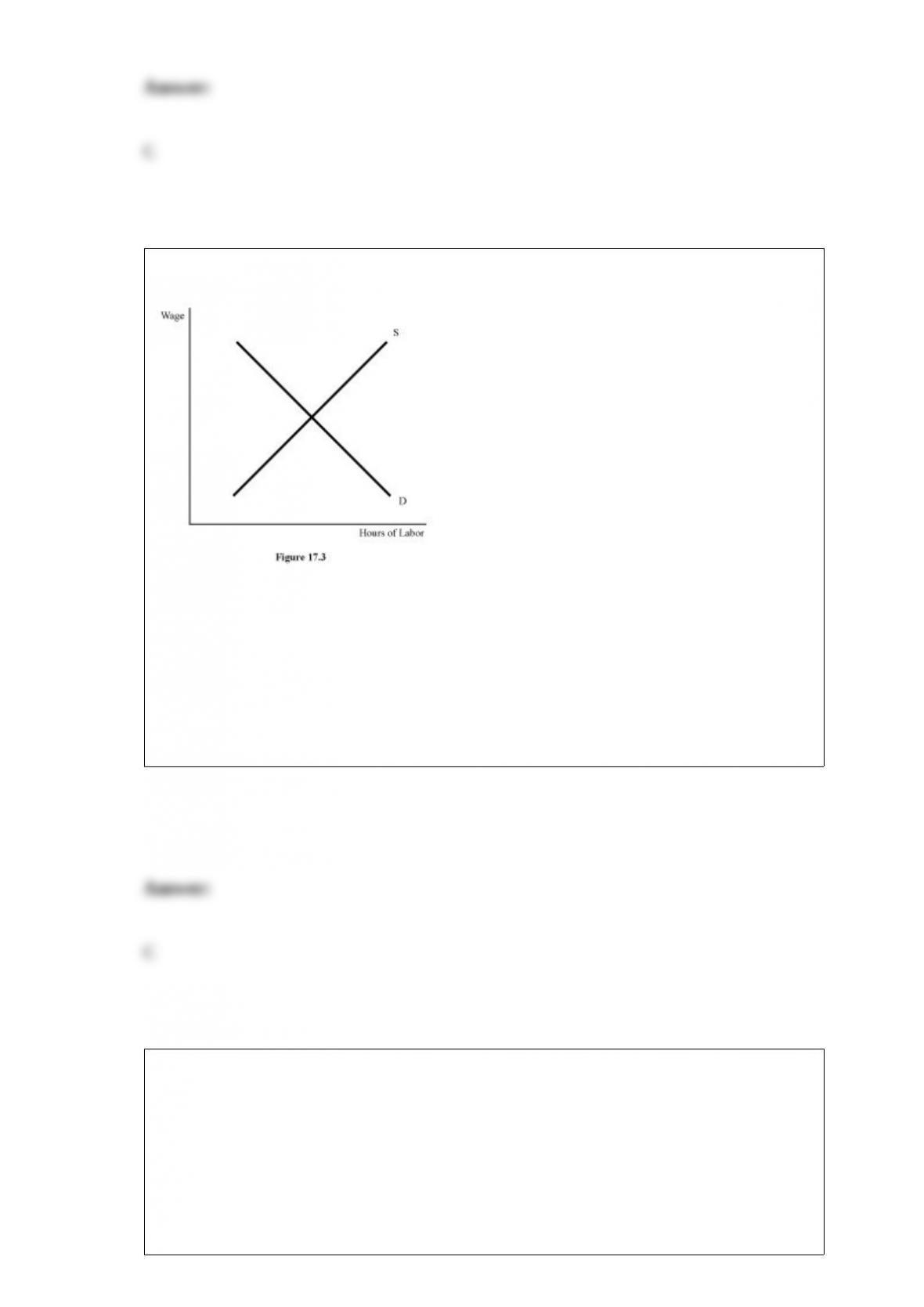
In Figure 17.3 a decrease in the supply of labor will cause the equilibrium:
A) wage and hours of labor used to increase.
B) wage and hours of labor used to decrease.
C) wage to increase and hours of labor used to decrease.
D) wage to decrease and hours of labor used to increase.
A good synonym for elasticity would be:
A) change.
B) demand.
C) responsiveness.
D) stickiness.
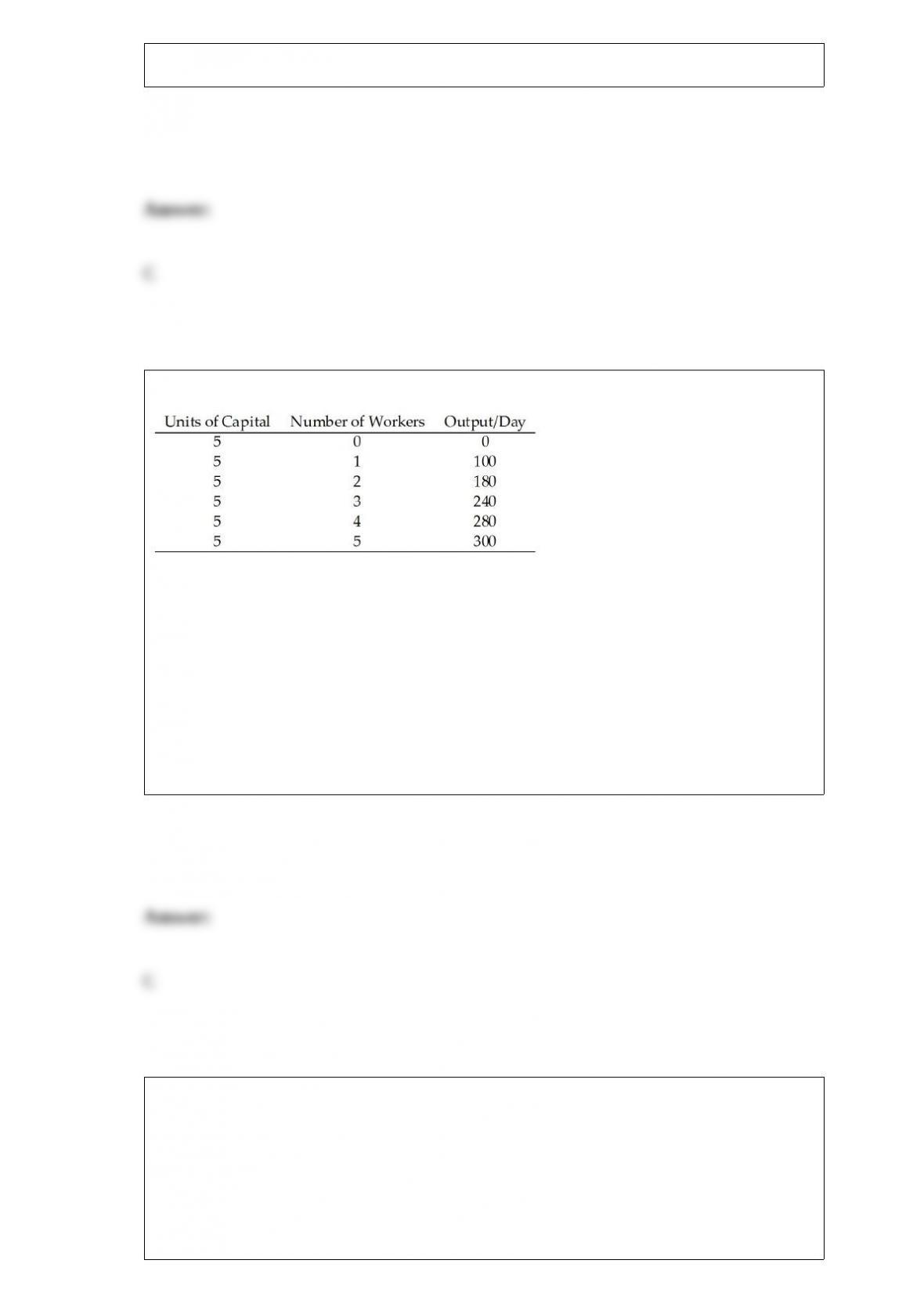
The firm depicted in Table 2.3 is facing diminishing returns because:
Table 2.3
A) capital and labor are both fixed.
B) capital and labor are both variable.
C) capital is fixed.
D) the number of workers can only be increased to 5.
A school bookstore tried to engage in price discrimination by selling novels to students
and faculty for different prices. Its strategy was to increase prices to faculty and
decrease prices to students. What is the most likely reason that this strategy failed?
A) Novels are sold in a competitive market.
B) There was nothing to prevent students from purchasing novels and reselling them to
faculty.
C) Everyone had inelastic demand for novels.
D) There was no easy way to distinguish the students from the faculty.
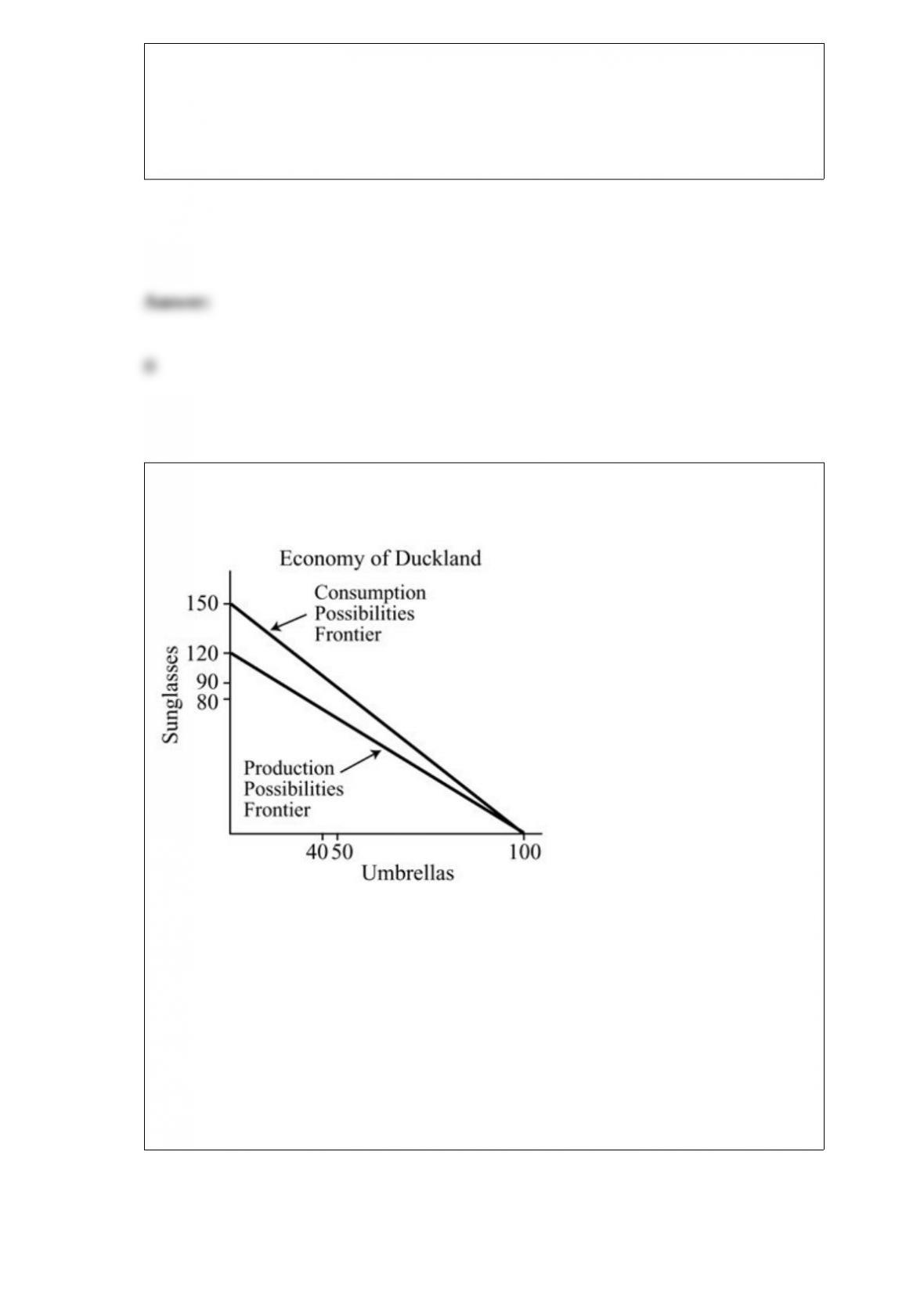
Figure 18.1
Refer to Figure 18.1. The opportunity cost of producing umbrellas in Duckland is:
A) 6/5 sunglasses.
B) 2/3 sunglasses.
C) 5/6 sunglasses.
D) 3/2 sunglasses.

Which of the following is a short-run adjustment?
A) Three new firms enter the computer chip industry.
B) A firm hires six new workers.
C) The number of farms in Kansas increases by 10%.
D) A firm opens two new plants.
All of the below are examples of negative effects of imposing rent control EXCEPT:
A) renters spend less time searching for apartments.
B) persons who get a place to live pay higher rent.
C) producer surplus decreases.
D) some people who would have rented apartments before rent control will not rent.

The Celler-Kefauver Act of 1950:
A) extended antitrust legislation to proprietorships and partnerships.
B) made it illegal to monopolize a market.
C) outlawed asset-purchase mergers that would substantially reduce competition.
D) outlawed price discrimination for the purpose of reducing competition.
A good that is available for everyone, regardless of who pays and who doesn’t, is:
A) rival.
B) nonrival.
C) excludable.
D) nonexcludable.
A firm will not shut down in the short run as long as price exceeds:
A) average fixed cost at the level of output where marginal revenue equals marginal
cost.
B) average variable cost at the level of output where marginal revenue equals marginal
cost.

C) marginal cost at the level of output where marginal revenue equals marginal cost.
D) total revenue at the level of output where marginal revenue equals marginal cost.
If a consumer can buy four DVDs for $44 and five DVDs for $50, then the marginal
cost of the fifth DVD is:
A) $10.
B) $50.
C) $11.
D) $6.
The Act which outlawed tying contracts was the:
A) Sherman Act.
B) Clayton Act.
C) Robinson-Patman Act.
D) Celler-Kefauver Act.

Since rent control outlaws transactions the would make both the consumer and supplier
better off, then rent control:
A) causes excess demand and increases total surplus.
B) causes inefficiency.
C) decreases total surplus.
D) B and C are correct.
Good X and good Y are substitutes if the:
A) income elasticity of each is negative.
B) income elasticity of each is positive.
C) cross-price elasticity is negative.
D) cross-price elasticity is positive.

According to the learning effect, college education:
A) leads to lower lifetime earnings.
B) alters an individual’s work ethic.
C) enhances a worker’s productivity.
D) signals natural ability.
Explain the income and substitution effects.
What is a marginal benefit?
Explain what is meant by predatory pricing, and the inherent difficulties involved with
predatory pricing from a firm’s point of view.
Explain the key issues presented by both sides of the Staples/Office Depot case in 1997.
What is a four-firm concentration ratio, and how is it used?
Define the marginal revenue product of labor. Explain two factors that could cause the
marginal revenue product curve of labor to shift to the right.
Suppose an unregulated monopoly faces a negatively-sloped and steep average cost
curve. If a second firm enters, what will happen to the first firm’s demand and average
cost of production?
How do you interpret the value of cross-price elasticity?
Explain the difference between accounting costs and economic costs.
The U.S. has a lot of both skilled and unskilled workers in the economy. Suppose that
the U.S.’s comparative advantage is in industries that require more skilled workers.
Instead of using protectionist policies, what other policy can the government use to
dampen the negative effects unskilled workers may face a result of free trade?
What is meant be strategic behavior?
Professional football players earn much higher wages than do accountants. Why?
Suppose a farmer suddenly realized that his marginal cost was below the market price
of the output. How would he react if he were a profit maximizer? Explain.
What is the GATT?
Explain three ways we can use microeconomics analysis.