
A natural monopoly
a. is a monopoly in the production of raw materials.
b. occurs when one firm can supply the entire market more cheaply than can a number
of firms.
c. is one result of a patent.
d. necessarily involves inefficient pricing.
Some economists have hypothesized that government bureaucracies seek to maximize
a. social well being.
b. gross national product.
c. fringe benefits for bureaucrats.
d. their own budgets.
“If an individual is to maximize the utility received from consumption, he or she should
spend all available income. . . .” This statement assumes
a. that saving is impossible.
b. that the individual is not satiated in all goods.
c. that no goods are “inferior.”
d. that saving is impossible and that the individual is not satiated in all goods.
If utility is given by U(x, y)= Min (x, 3y)then the bundle (3,2) provides the same utility
as the bundle
a. (1, 3).
b. (2, 3).
c. (4, 1).
d. (4, 2).
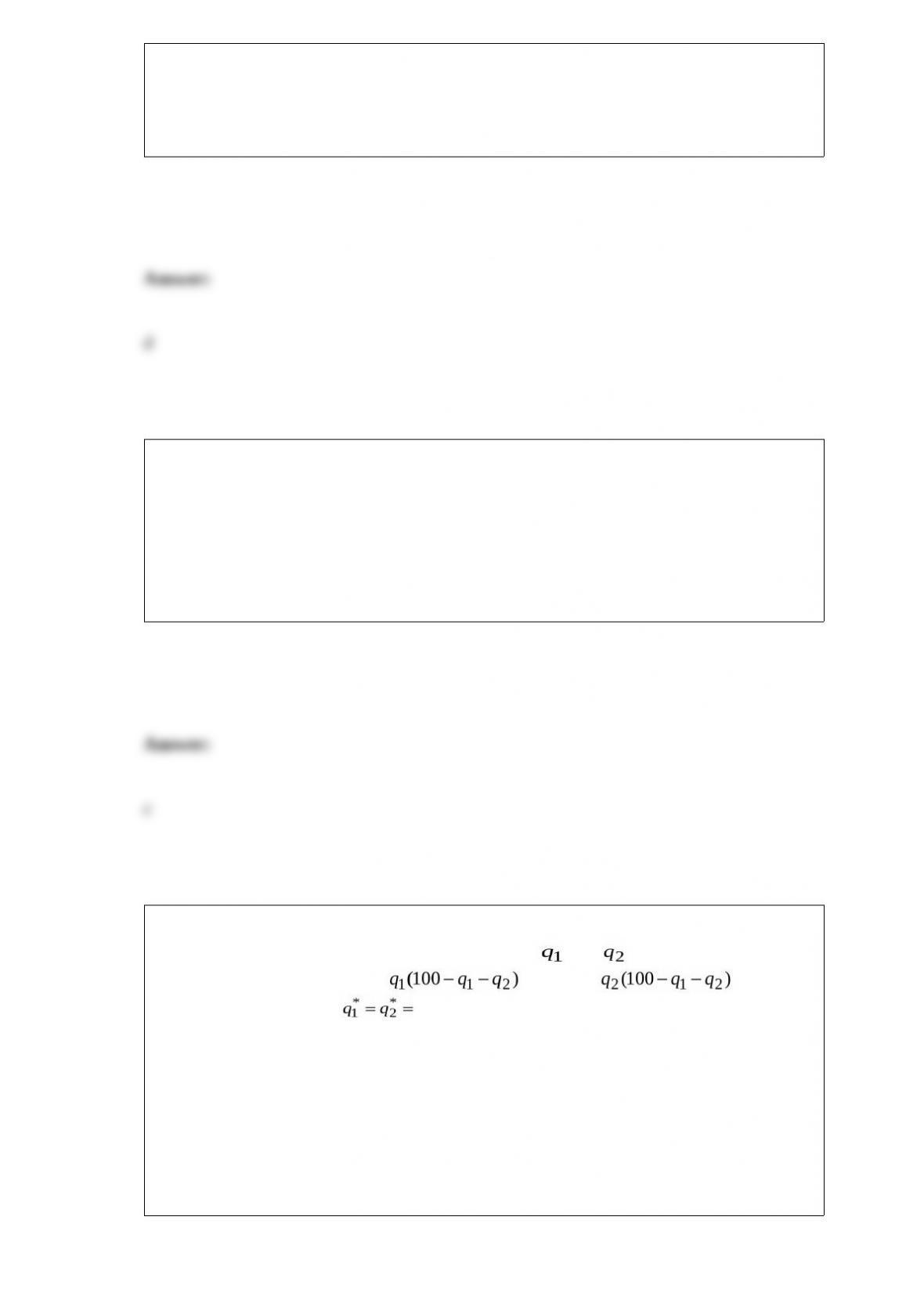
Consider a version of the Tragedy of the Commons in which herder 1 and 2
simultaneously choose to graze quantities of sheep and , respectively, and in
which the payoff functions are for 1 and for 2.
The Nash equilibrium is
a. 100.
b. 60.
c. 40.
d. 33.3.
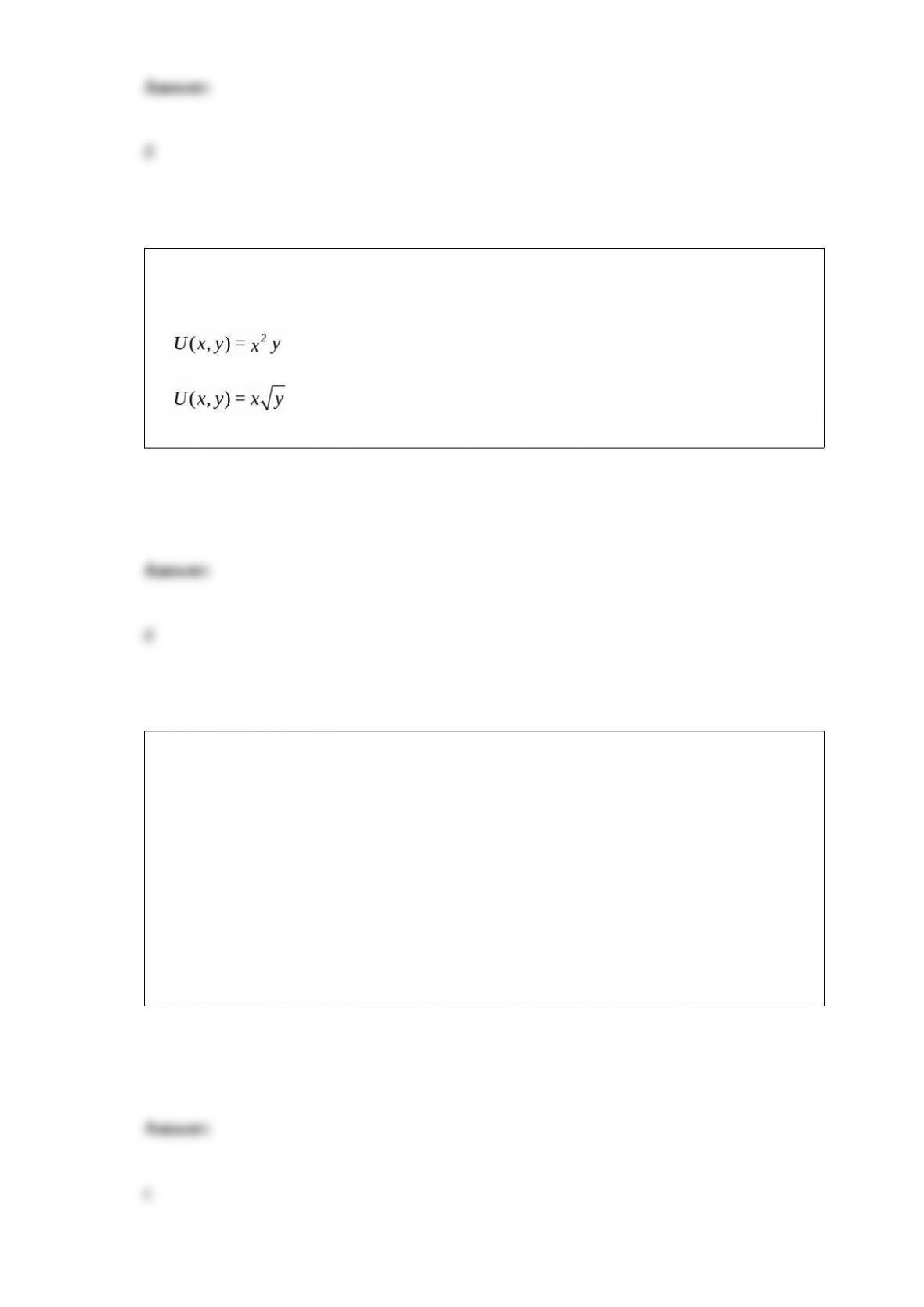
Which of the following utility functions would not be consistent with the notion that
xand yare both “goods” with positive marginal utilities?
a. .
b. U(x, y) = x + y .
c. .
d. U(x, y) = x/y .
Cheap talk
a. has no bearing on games; only “real” actions matter.
b. can transmit information in certain equilibria, but only if players’ interests are
sufficiently distinct.
c. can transmit information in certain equilibria, but only if players’ incentives are
sufficiently aligned.
d. always leads to the best equilibrium for the “talker”.

Efficient production of a public good requires
a. that individuals pay for such goods according to benefits received.
b. that each individual’s MRS be equal to the RPT of public goods for private goods.
c. that the sum of individuals’ MRSs be equal to the RPT of public goods for private
goods.
d. that governments produce at the low point of the average cost curve for the public
good.
Which of the following is not a technical barrier to entry in a monopolized market?
a. A patent.
b. Decreasing average cost.
c. A low cost method of production known only by monopolist.
d. Increasing returns to scale.
“Hicks’ Second Law of Demand” states that “most” goods must be
a. gross substitutes.
b. gross complements.

c. net substitutes.
d. net complements.
Which of the following utility functions would indicate the most (relative) risk averse
behavior?
a. U(W) = W.
b. U(W) = .
c. U(W) = ln W.
d. U(W) = –1/W.
The shortrun market supply curve is
a. the horizontal summation of each firm’s shortrun supply curve.
b. the vertical summation of each firm’s shortrun supply curve.
c. the horizontal summation of each firm’s shortrun average cost curve.
d. the vertical summation of each firm’s shortrun average cost curve.

If price is equal to shortrun average variable cost, the firm is at the point known as
a. the break-even point.
b. the profit maximizing point.
c. the shutdown point.
d. the revenue maximizing point.
If the prices of all goods increase by the same proportion as income, the quantity
demanded of good x will
a. decrease.
b. increase.
c. remain unchanged.
d. change in a way that cannot be determined from the information given.

“Missing markets” result from
a. high costs of the establishment of such markets.
b. strict price controls.
c. the inability of producers to gain economies of scale.
d. foreign countries dominating a domestic market for a product.
In the very short run
a. new firms may enter an industry.
b. existing firms may change the quantity they are supplying.
c. price and quantity supplied are absolutely fixed.
d. quantity supplied is absolutely fixed.
An input’s marginal revenue product is given by
a. the input’s marginal expense times marginal revenue.
b. the input’s marginal expense times the input’s marginal physical productivity.
c. marginal revenue times the number of units employed.

d. the input’s marginal physical productivity times marginal revenue of the firm’s
output.
With only two goods, x and y, if x and y are gross substitutes, a rise in px must
necessarily
a. increase spending in x.
b. reduce spending in x.
c. increase spending in y.
d. reduce spending in y.
If a firm wished to maximize total revenues it should produce where
a. marginal cost is zero.
b. marginal revenue is zero.
c. marginal revenue is equal to marginal cost.
d. marginal revenue is equal to price.

Suppose two goods (x and y ) are being produced efficiently and that the production of
x is always more labor intensive than the production of y. Production depends only on
two factors (capital and labor); these may be smoothly substituted for each other. The
total quantities of these inputs are fixed. An increase in the production of x and a
decrease in the production of y will
a. increase the capitallabor ratio in each firm.
b. decrease the capitallabor ratio in each firm.
c. leave the capitallabor ratio for each firm unchanged.
d. increase the capitallabor ratio in y production and decrease the capitallabor ratio in x
production.
If the price of an input falls, a firm would increase the use of that input for two reasons:
a. The input is now more productive, and the firm can substitute this input for other
relatively more expensive inputs.
b. The input is now more productive, and overall production costs are now lower,
meaning a firm may choose to increase production.
c. Overall production costs are now lower and the firm can substitute this input for
other relatively more expensive inputs.
d. Overall production costs are now lower and the firm will have more of other inputs to
use with the one in question.

A risk averse individual is offered a gamble that promises a gain of $1000 with
probability 0 .25 and a loss of $300 with probability 0.75 . Given this situation, he or
she will
a. definitely take the gamble.
b. definitely not take the gamble.
c. definitely take the gamble if his or her income is high enough.
d. take an action that cannot be determined given the information available.
If an individual is maximizing his or her utility, his or her marginal rate of substitution
of leisure hours for consumption will be
a. equal to one divided by his or her wage rate.
b. greater than one divided by his or her wage rate.
c. equal to his or her wage rate.
d. less than his or her wage rate.
The Nash equilibrium in a Bertrand game in which firms produce perfect substitutes
and have equal marginal costs is
a. efficient because all mutually beneficial transactions will occur.
b. efficient because of the free entry assumption.
c. inefficient because some mutually beneficial transactions will be foregone.
d. inefficient because of the uncertainties inherent in the game.
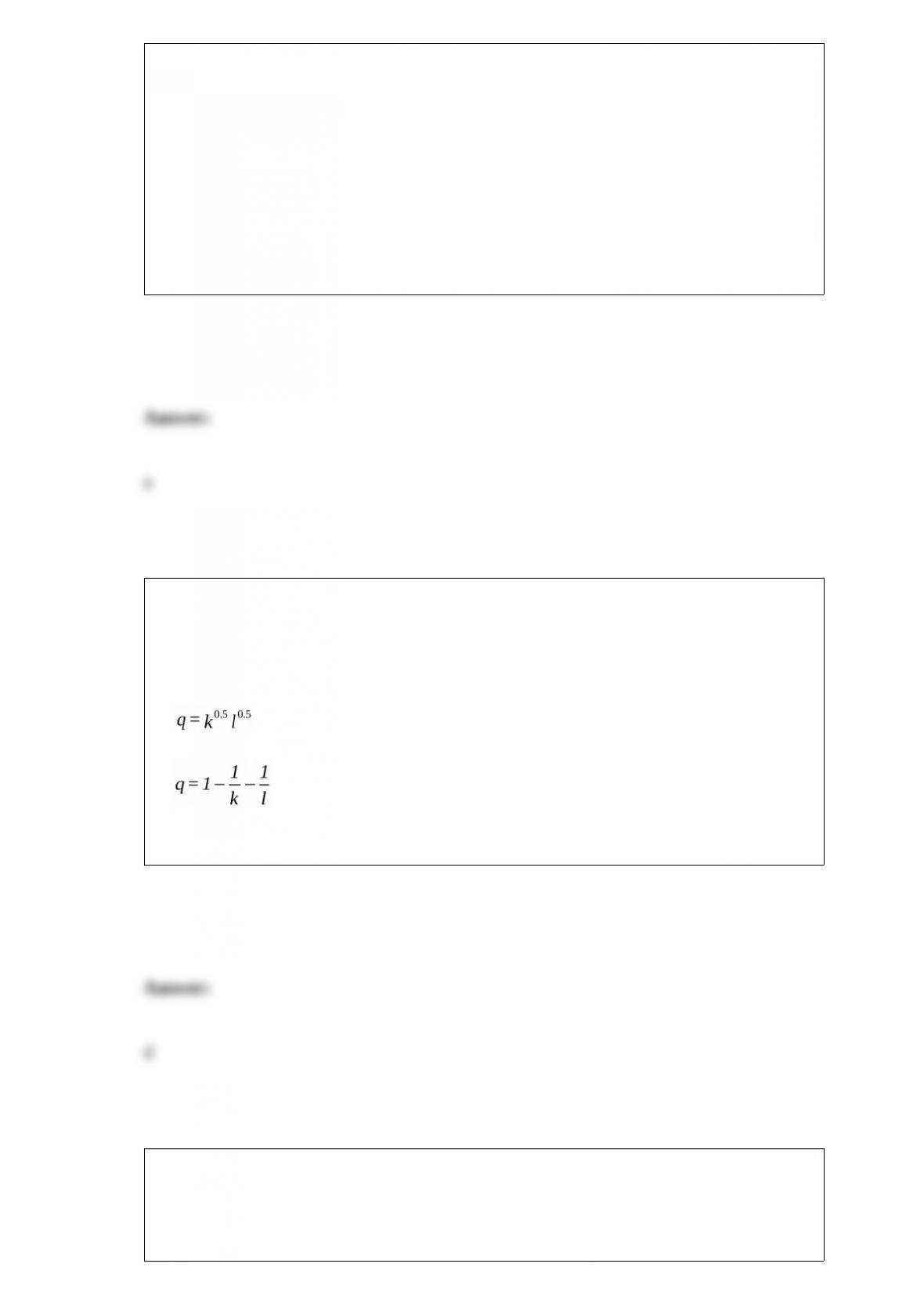
Which of the following production functions exhibits a constant elasticity of
substitution?
a. q = 3k + 2l.
b. .
c. .
d. All of these production functions have a constant elasticity of substitution.
Suppose that the price elasticity of demand for a product is -1 and that the price
elasticity of supply is +1. Assume also that the income elasticity of demand is +2. Then
an increase in income of 10% will raise equilibrium price by

a. 10%.
b. 5%.
c. 20%.
d. an annual amount that cannot be determined.
If bargaining is costless, the assignment of property rights for an externality
a. has no impact on the possibility of an efficient outcome and no distributional impact.
b. has no impact on the possibility of an efficient outcome but does have a distributional
impact.
c. does have an impact on the possibility of an efficient outcome but has no
distributional impact.
d. does have an impact on the possibility of an efficient outcome and does have a
distributional impact.
Consider a version of the Tragedy of the Commons in which herder 1 and 2
simultaneously choose to graze quantities of sheep and , respectively. If herder
1’s payoff function is , his or her best response function is
a. .

b. .
c. .
d. .
The average fixed cost curve always has a negative slope because
a. marginal costs are below average fixed costs.
b. average variable costs exceed marginal costs.
c. total fixed costs always decrease.
d. total fixed costs do not change as output increases.
All of the following are problems associated with maintaining a cartel except
a. cartels are illegal.
b. a large amount of information is needed to coordinate a cartel.
c. profits are not maximized by a cartel so it will evolve into a monopoly.
d. each member of the cartel has an incentive to “chisel” by expanding output.