1) when a firm is maximizing profit it will necessarily be:
a.maximizing profit per unit of output.
b.maximizing the difference between total revenue and total cost.
c.minimizing total cost.
d.maximizing total revenue.
2) Which of the following statements is incorrect?
A.Given the economy’s MPS, a $15 billion reduction in government spending will
reduce the equilibrium GDP by more than would a $15 billion increase in taxes.
B.Other things unchanged, a tax reduction of $10 billion will increase the equilibrium
GDP by $25 billion when the MPS is 0.4.
C.If the MPC is 0.8 and GDP has declined by $40 billion, this was caused by a decline
in aggregate expenditures of $8 billion.
D.A government surplus is anti-inflationary; a government deficit is expansionary.
3) all else equal, u.s. imports from germany create a:
a.demand for german marks.
b.supply of german marks.
c.demand for american dollars.
d.surplus of german marks.
4) There must always be a balance of a nation’s:
A.goods exports and gold imports.
B.total international payments.
C.imports and exports of goods and services.
D.net transfers and net investment income.
5) In a mixed open economy the equilibrium GDP exists where:
A.Ca + Ig + Xn intersects the 45-degree line.
B.Ca + Ig = Sa + T + X.
C.Ca + Ig + Xn + G = GDP.
D.Ca + Ig + Xn = Sa + T.
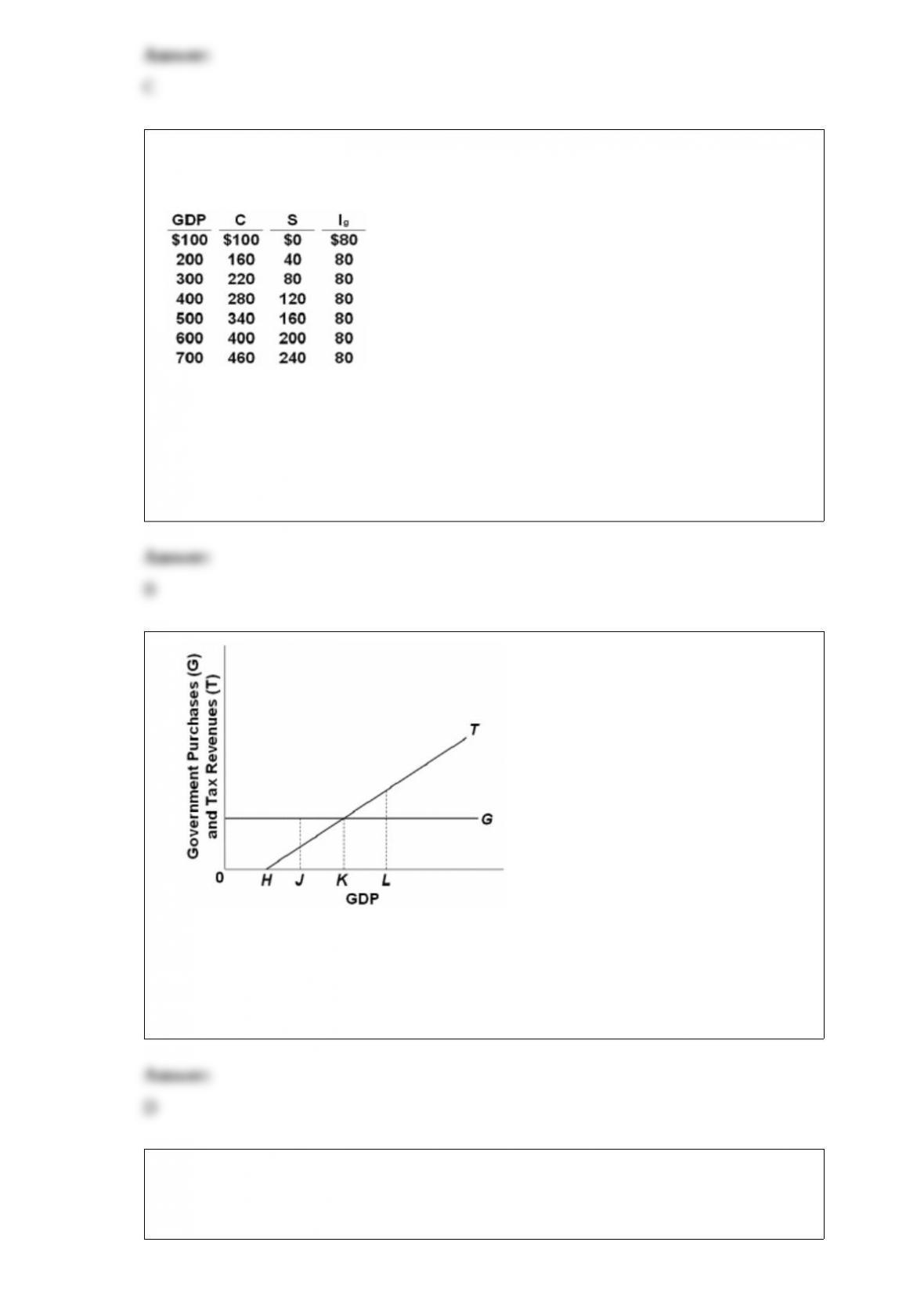
6) The following information is for a closed economy:
Refer to the above information. If both government spending and taxes are zero, the
equilibrium level of GDP is:
A.$200.
B.$300.
C.$400.
D.$500.
7)
If the full-employment GDP for the above economy is at L, the:
A.actual budget will have a deficit.
B.standardized budget will have a deficit.
C.actual budget will have a surplus.
D.standardized budget will have a surplus.
8) If there is a widespread bias against African-American workers, an increase in the
collective discrimination coefficients of employers will:
A.reduce the African-American wage rate, increase African-American employment, and
lower the actual African-American-white wage ratio.
B.reduce the African-American wage rate, decrease African-American employment,
and lower the actual African-American-white wage ratio.
C.increase the African-American wage rate, increase African-American employment,
and increase the actual African-American-white wage ratio.
D.increase the African-American wage rate, reduce African-American employment, and
increase the actual African-American-white wage ratio.
9) Coins held in commercial banks are:
A.included in M1, but not in M2.
B.included both in M1 and in M2.
C.included in M2, but not in M1.
D.not part of the nation’s money supply.
10) In countries like Botswana and Zimbabwe, local villages have been given property
rights over local elephants with the result that elephant populations:
A.have been decimated as villagers try to maximize short-run profit.
B.have grown as villagers have protected the elephants to support their tourist industry.
C.have grown exponentially, with adverse environmental impacts.
D.are in serious decline as ivory prices have risen.
11) which of the following congressional proposals relating to health care was recently
enacted?
a.establishment of health maintenance organizations to reduce health care costs.
b.establishment of deductibles and copayments in health insurance policies.
c.provision of prescription drug coverage under medicare.
d.establishment of fixed medicare payment to hospitals based on one of several hundred
diagnostic categories.
12) the total amount of u.s. tax revenue needed to finance the public sector:
a.has been a declining percentage of the domestic output in this century.
b.equals about 40 percent of domestic output.
c.equals about 15 percent of domestic output.
d.is larger today, as a percentage of total output, than in 1960.
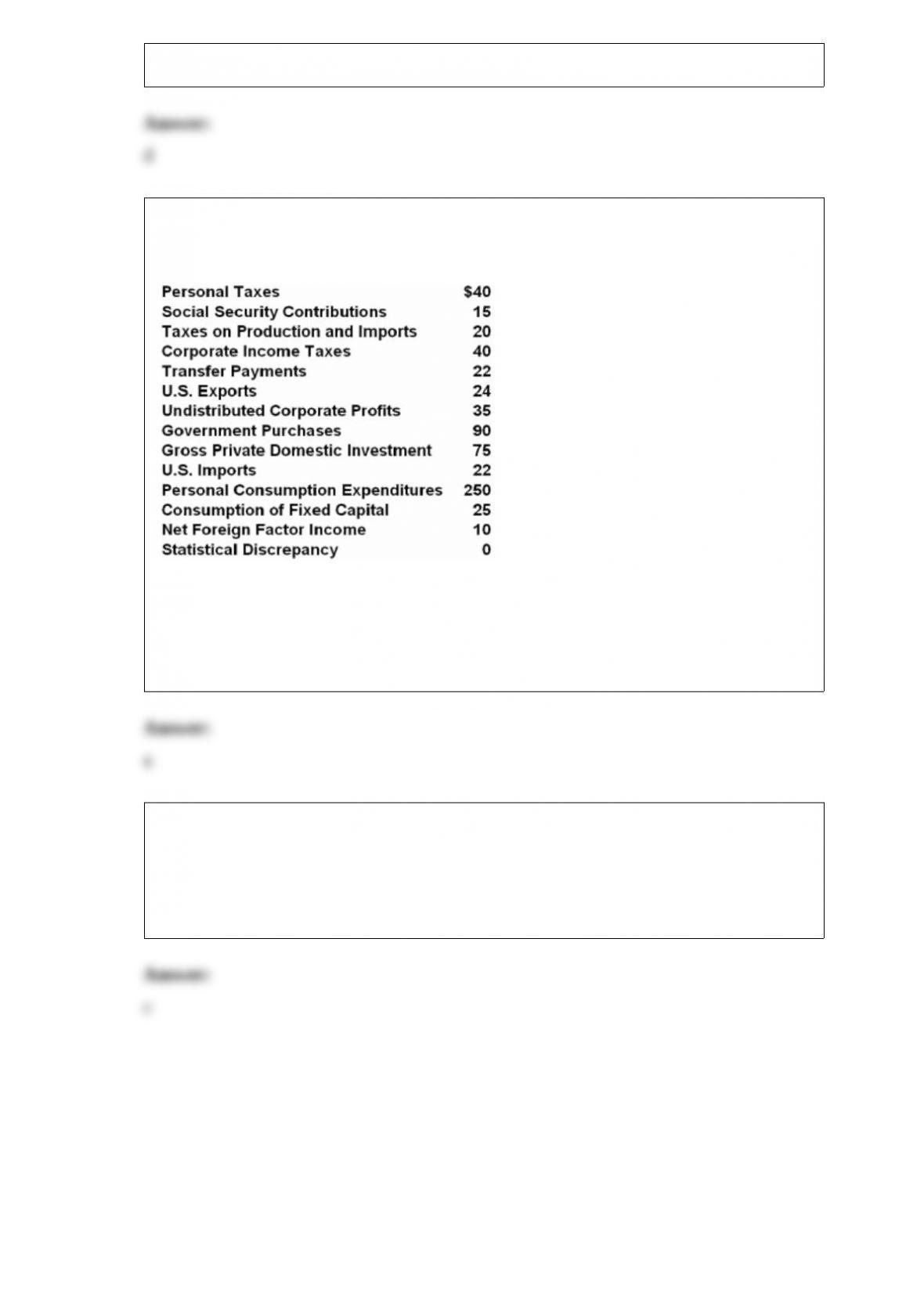
13) answer the next question(s) on the basis of the following data. all figures are in
billions of dollars.
refer to the above data. pi is:
a.$314.
b.$346.
c.$408.
d.$437.
14) which of the following is a normative statement?
a.the temperature is high today.
b.the humidity is high today.
c.it is too hot to play tennis today.
d.it will cool off later this evening.
15)
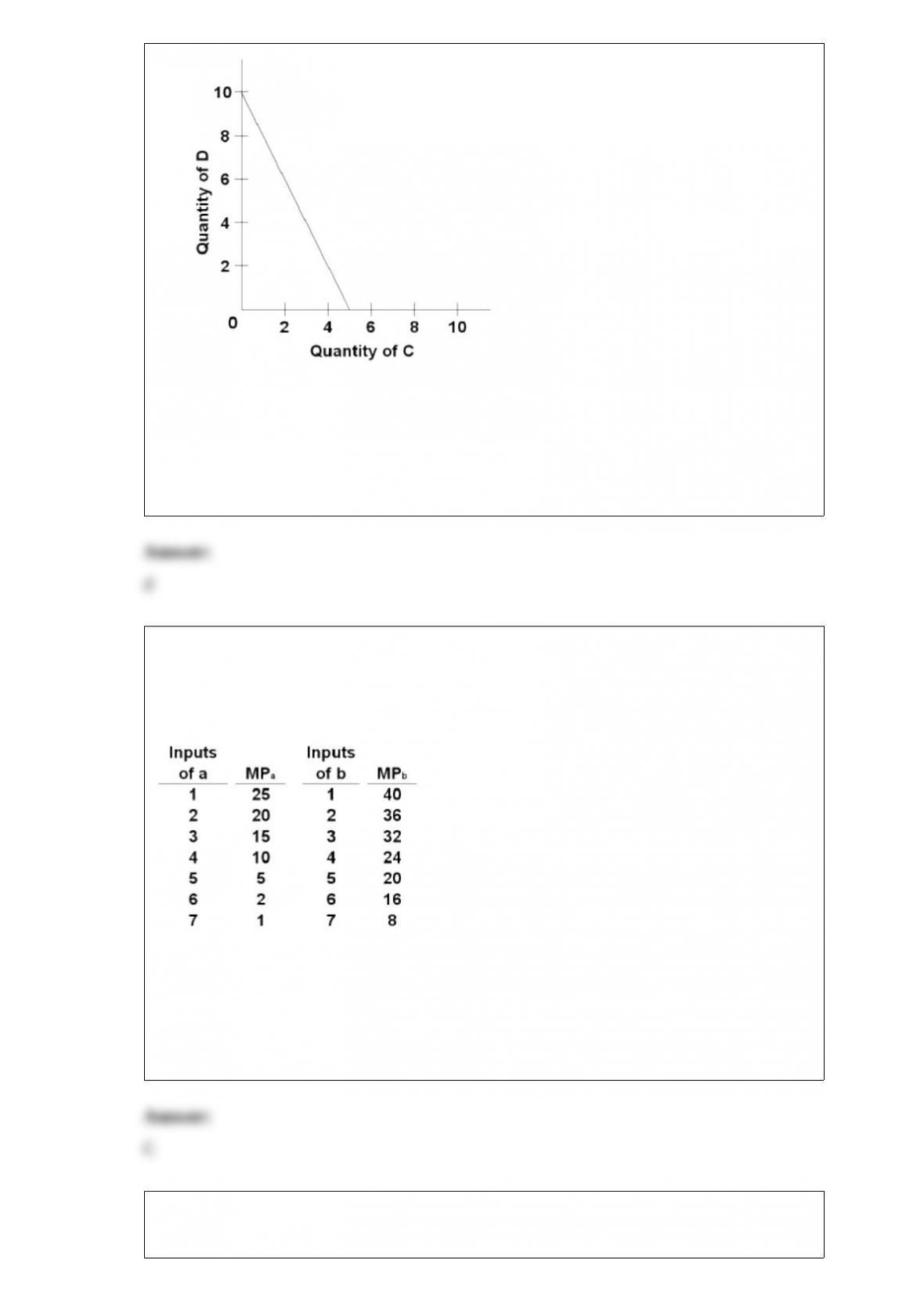
refer to the budget line shown in the diagram above. if the consumer’s money income is
$20, the:
a.prices of c and d cannot be determined.
b.price of c is $2 and the price of d is $4.
c.consumer can obtain a combination of 5 units of both c and d
d.price of c is $4 and the price of d is $2.
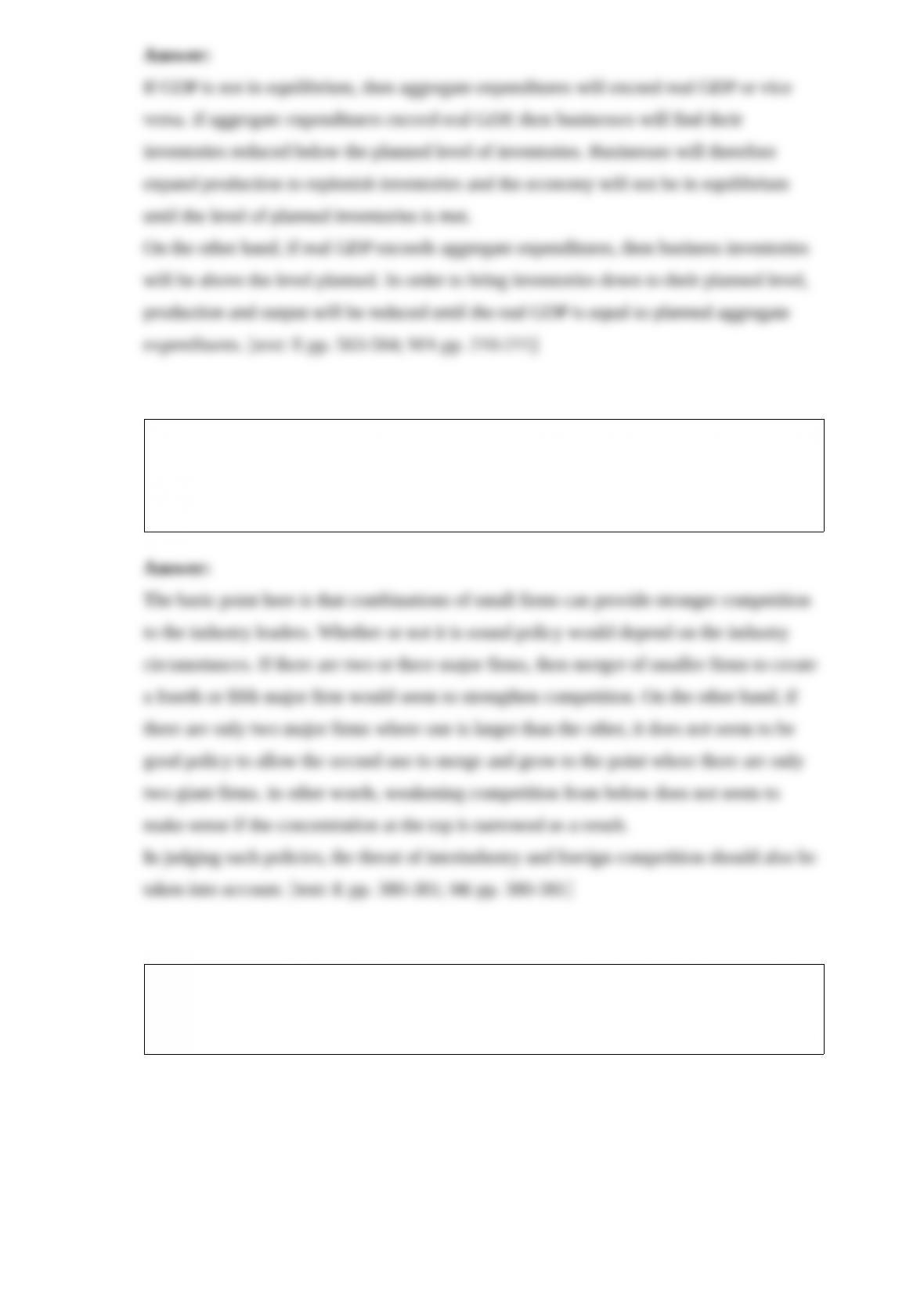
16) Answer the question on the basis of the following marginal product data for
resources a and b. The output of these independent resources sells in a purely
competitive market at $1 per unit.
Refer to the above data. Assuming the prices of resources a and b are $5 and $8
respectively, what is the profit-maximizing combination of resources?
A.7 of a and 7 of b
B.6 of a and 4 of b
C.5 of a and 7 of b
D.4 of a and 4 of b
17) Explain the difference between an equilibrium level of GDP and a level of GDP
which is in disequilibrium.
18) On occasion the government has approved the merging of certain smaller firms in
oligopolistic industries (such as steel and automobiles) on the grounds that the net result
would strengthen competition. Do you think that this is sound policy? Justify your
answer.
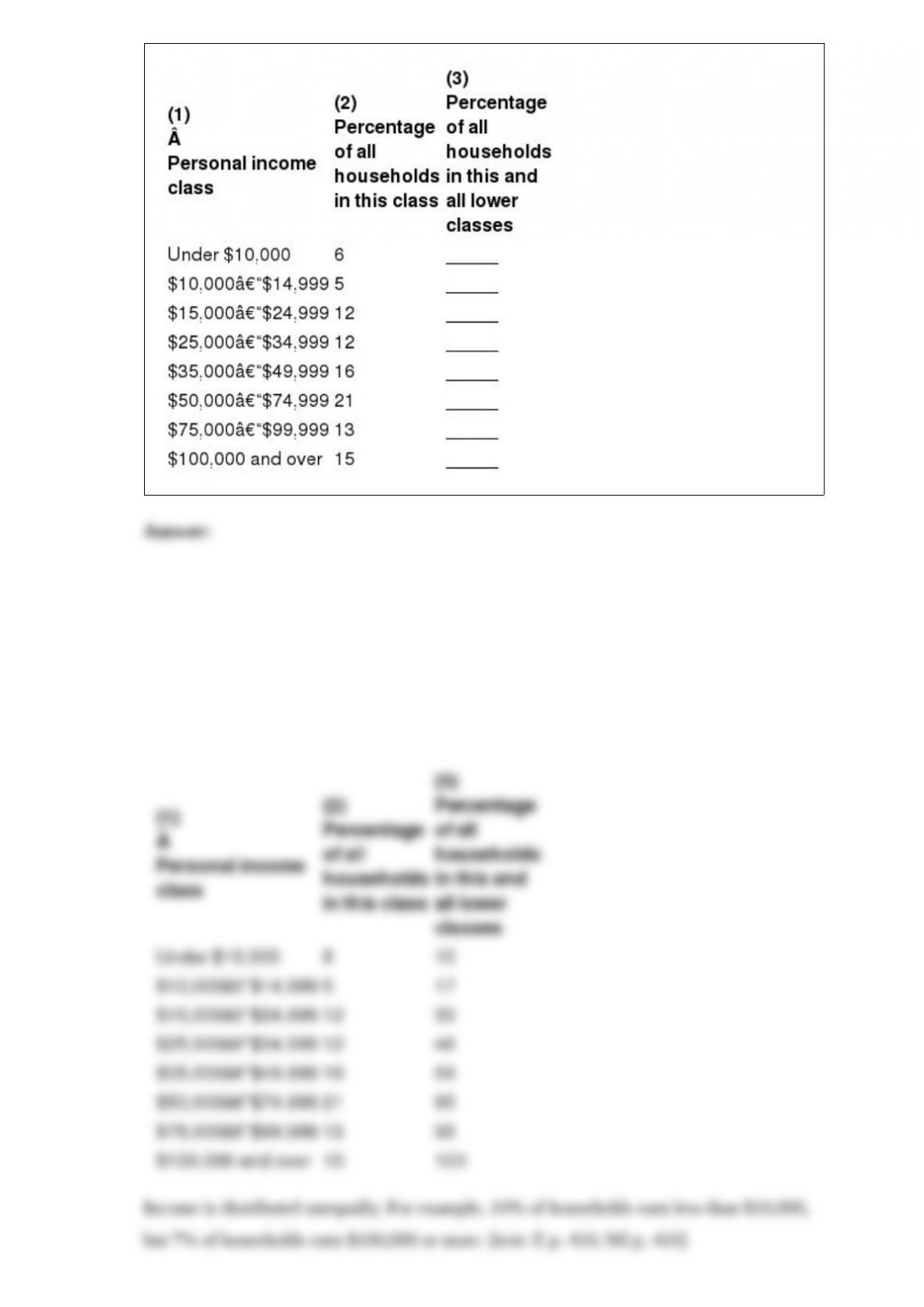
19) Complete the following table of the distribution of personal income by households
in a recent year. What does the data indicate about the equality of income distribution in
the United States?
20) How do the consumer and producer surpluses in the monopolistic case differ from
those in the competitive case?
21) Explain the basic conclusions from inverted-U theory of R&D. What will be the
optimal market structure for technological progress? What does the evidence suggest
about its validity?
22) Suppose an increase in aggregate demand raises the price level. What would be the
effect on the total money demand curve?
23) Briefly describe the historical background that gave rise to antitrust and regulation
in the United States.