The budget deficit increases during wars and recessions.
In a market with positive externalities, the market equilibrium quantity will be less than
the efficient equilibrium quantity.
Increasing the federal budget deficit will contribute to increasing the federal
government debt.
Insurance companies use deductibles and coinsurance to reduce moral hazard.
Physical capital refers to stocks and bonds.
The unemployment rate is too high is an example of a positive economic statement.
A tariff is a tax imposed by a government on imports.
Corporate managers and shareholders always have the same goals.
An increase in disposable income will shift the aggregate demand curve to the right.
Political stability is not a prerequisite to economic growth.
In most circumstances, employees pay taxes on the value of health insurance their
employers provide them.
A decrease in the level of cyclical unemployment will shift the long-run Phillips curve.
Innovations, including new products and services, in financial markets and institutions
have made the job of defining the money supply easier.
All economic questions arise from the fact that resources are scarce.
If the demand for a product increases and the supply of the same product decreases, the
equilibrium price will increase.
Figure 4-10
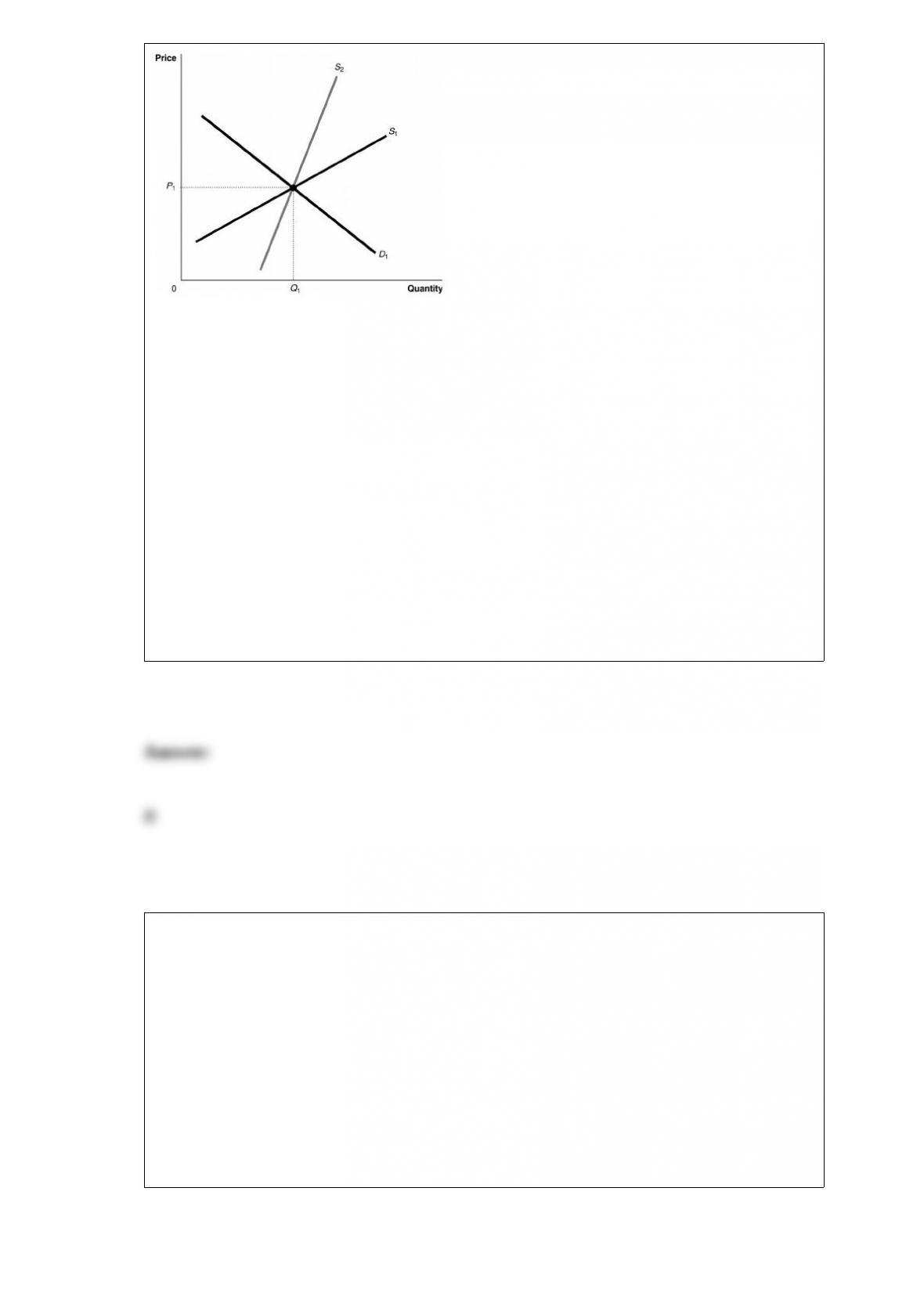
Refer to Figure 4-10. Suppose the market is initially in equilibrium at price P1 and now
the government imposes a tax on every unit sold. Which of the following statements
best describes the impact of the tax? For demand curve D1
A) the producer bears a smaller share of the tax burden if the supply curve is S2.
B) the producer bears a smaller share of the tax burden if the supply curve is S1.
C) the producer’s share of the tax burden is the same whether the supply curve is S1or
S2.
D) the producer bears the entire burden of the tax if the supply curve is S2 and the
consumer bears the entire burden of the tax if the supply curve is S1.
In the United States, the bulk of health care spending is paid by health insurance
companies. Such a system is also called ________ where consumers of health care pay
a nominal fee and the rest are paid by the health insurance provider.
A) universal health care system
B) third-party payer system
C) socialized medicine system
D) single=payer system
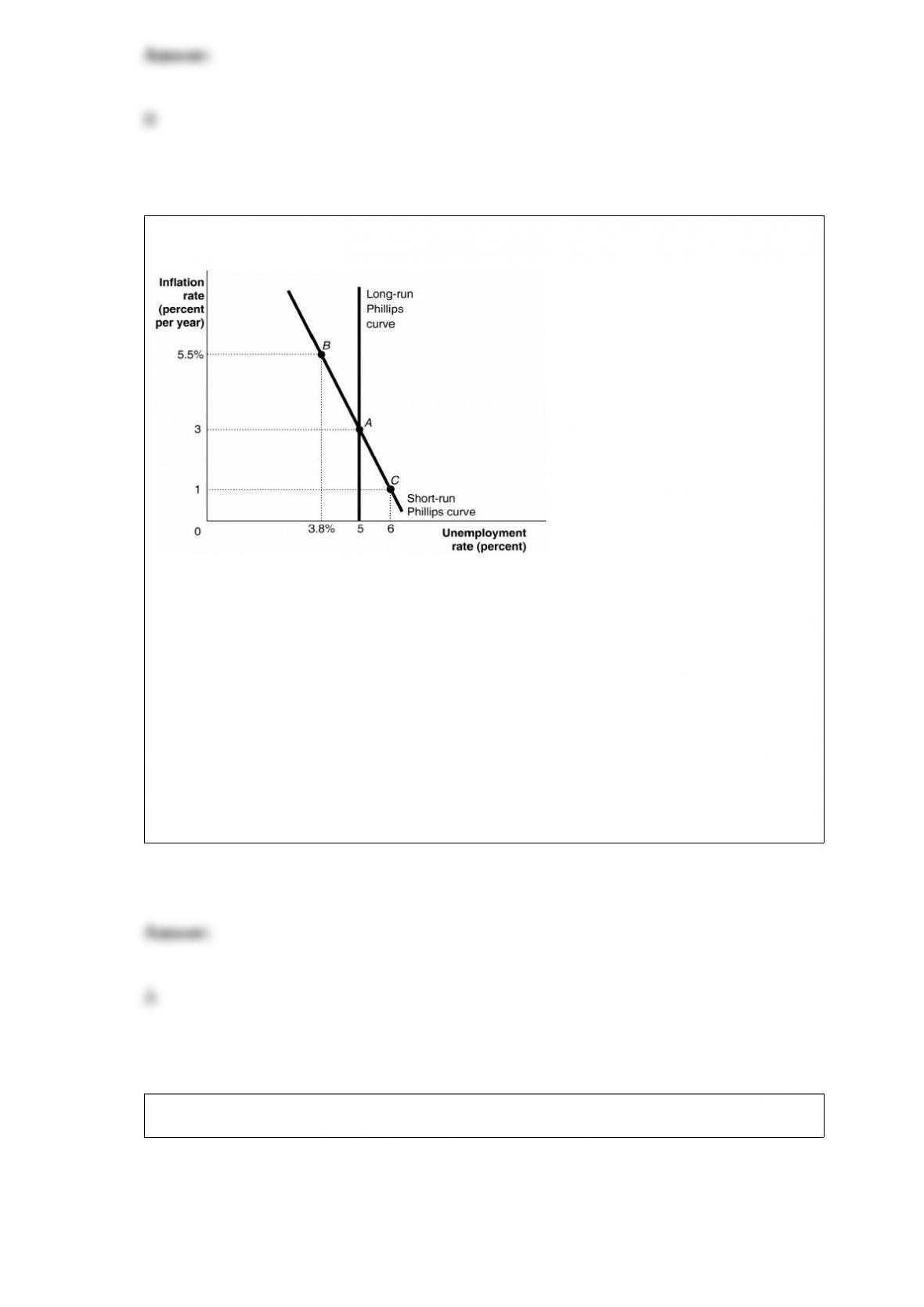
Figure 17-2
Refer to Figure 17-2. Suppose the economy is at point B in the figure above. Which of
the following is true?
A) The expected rate of inflation is 3%.
B) The natural rate of unemployment is 3.8%.
C) The current unemployment rate is 5%.
D) The economy is producing at potential GDP.
E) Expected inflation and actual inflation are the same.
Table 3-2
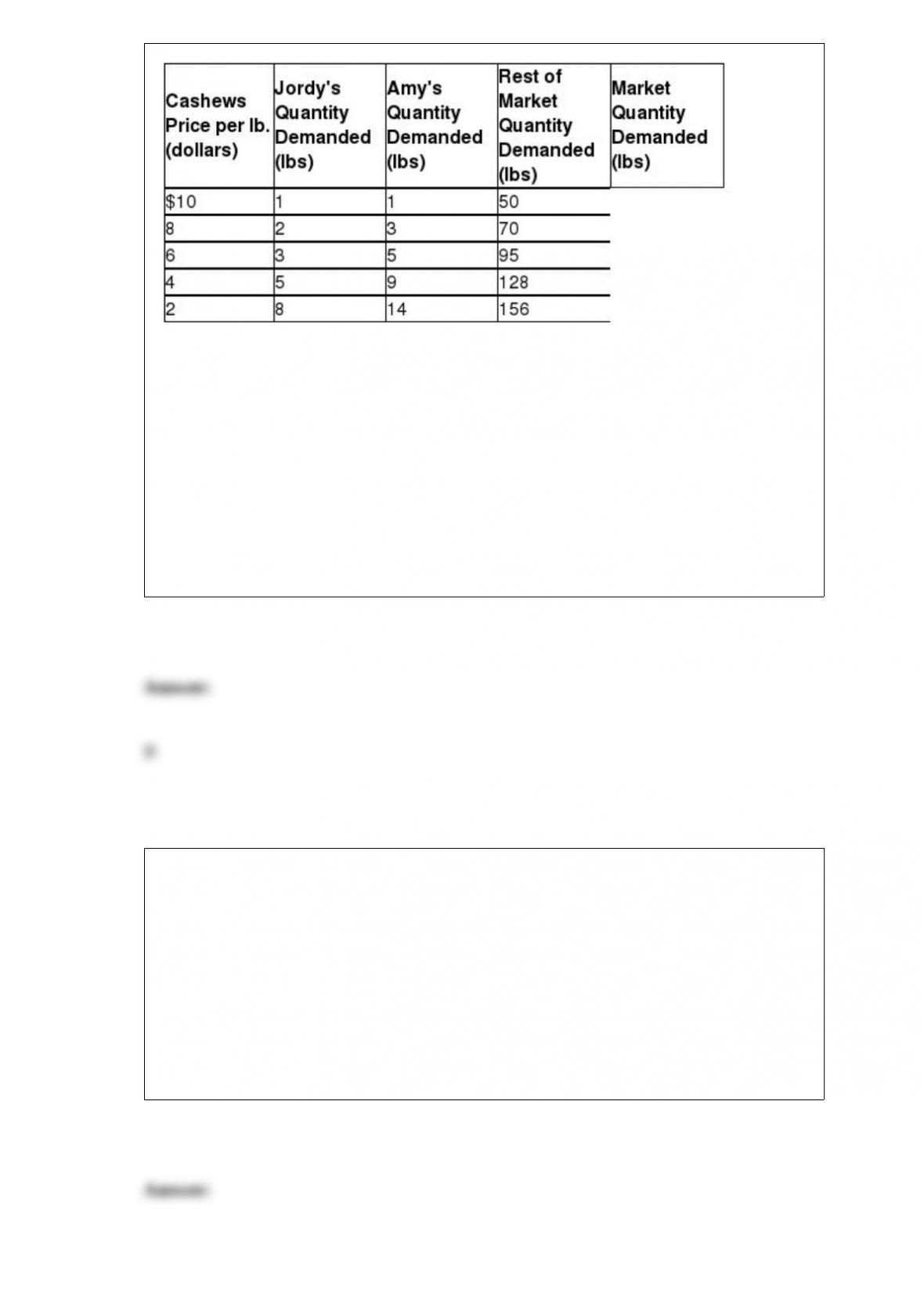
Refer to Table 3-2. The table above shows the demand schedules for cashews of two
individuals (Jordy and Amy) and the rest of the market. If the price of cashews falls
from $4 to $2, the market quantity demanded would
A) decrease by 28 lbs.
B) increase by 36 lbs.
C) increase by 28 lbs.
D) decrease by 36 lbs.
If the demand for the yen increases relative to the dollar, which of the following would
occur?
A) The dollar will appreciate.
B) The yen will depreciate.
C) The dollar will depreciate.
D) The demand for the dollar will increase.
A tax imposed by a government on imports of a good into a country is called
A) an import levy.
B) an import fine.
C) a tariff.
D) an import quota.
The new classical model has as its central idea that
A) wage and price stickiness explains fluctuations in real GDP.
B) workers and firms have rational expectations.
C) the Federal Reserve should adopt a monetary growth rule.
D) shifts in aggregate demand have no impact on real GDP.
The increased generosity of unemployment insurance programs in Canada as compared
to the United States should
A) decrease the duration of unemployment in Canada as compared to the United States.
B) increase the duration of unemployment in Canada as compared to the United States.
C) have no impact on the duration of unemployment in Canada.
D) raise the duration of unemployment in the United States.
Donnie’s Donuts incurs $450,000 per year in explicit costs and $200,000 in implicit
costs. The bakery earns $800,000 in revenues and has $2 million in net worth. Based on
this information, what is the economic profit for Donnie’s Donuts?
A) $150,000
B) $350,000
C) $600,000
D) $1.2 million
If weak aggregate demand is pushing the economy into recession, which of the
following must be true?
A) The economy is at an equilibrium that is on the long-run aggregate supply curve.
B) The economy is at an equilibrium that is on the long-run Phillips curve.
C) The economy is at an equilibrium that is not on the long-run Phillips curve.
D) Contractionary monetary policies will push the economy back to the long-run
Phillips curve.
Which of the following explains why purchasing power parity does not completely
explain long-run fluctuations in exchange rates?
A) Some goods and services produced in any country are not traded internationally.
B) Consumer preferences for goods and services across countries are very similar.
C) Most countries do not impose barriers to trade.
D) Most countries have free markets with little, if any, government regulation.
What’s the difference between foreign direct investment and foreign portfolio
investment?
A) Foreign direct investment involves purchases of foreign stock or bonds by
individuals or firms, while foreign portfolio investment involves a firm purchasing or
building a facility in a foreign country.
B) Individuals engage in foreign portfolio investment, but only firms can engage in
foreign direct investment.
C) Foreign direct investment only takes place when governments make official
purchases or foreign investments, while foreign portfolio investment takes place when
firms, individuals, or the government purchase foreign investments.
D) Foreign direct investment can give a low-income country access to funds and
technology it would not otherwise have, but foreign portfolio investment does not
expand that access.
What explains the appreciation of the Japanese yen relative to the U.S. dollar from 1970
to the early 1990s?
A) Japanese productivity rose faster than U.S. productivity.
B) Japanese inflation rose faster than U.S. inflation.
C) U.S. consumers reduced their preferences for Japanese goods.
D) High tariffs and restrictive quotas in the United States caused the value of the dollar
to decline.
Monetary policy refers to the actions the Federal Reserve takes to manage
A) the money supply and income tax rates to pursue its economic objectives.
B) the money supply and interest rates to pursue its economic objectives.
C) income tax rates and interest rates to pursue its economic objectives.
D) government spending and income tax rates to pursue its economic objectives.
Since 1948, the labor force participation rate for adult men has ________ and for adult
women has ________.
A) increased; increased
B) increased; decreased
C) decreased; increased
D) decreased; decreased
A final good is one that
A) is used in the production of another good.
B) is a natural resource used to produce a good.
C) is purchased as an input in the production process.
D) is purchased by its final user.
Would the Federal Reserve respond more aggressively with interest rate cuts in a
recession caused by a decrease in spending, as in the 2001 recession, than in a recession
caused by an increase in oil prices, as in the 1974-75 recession?
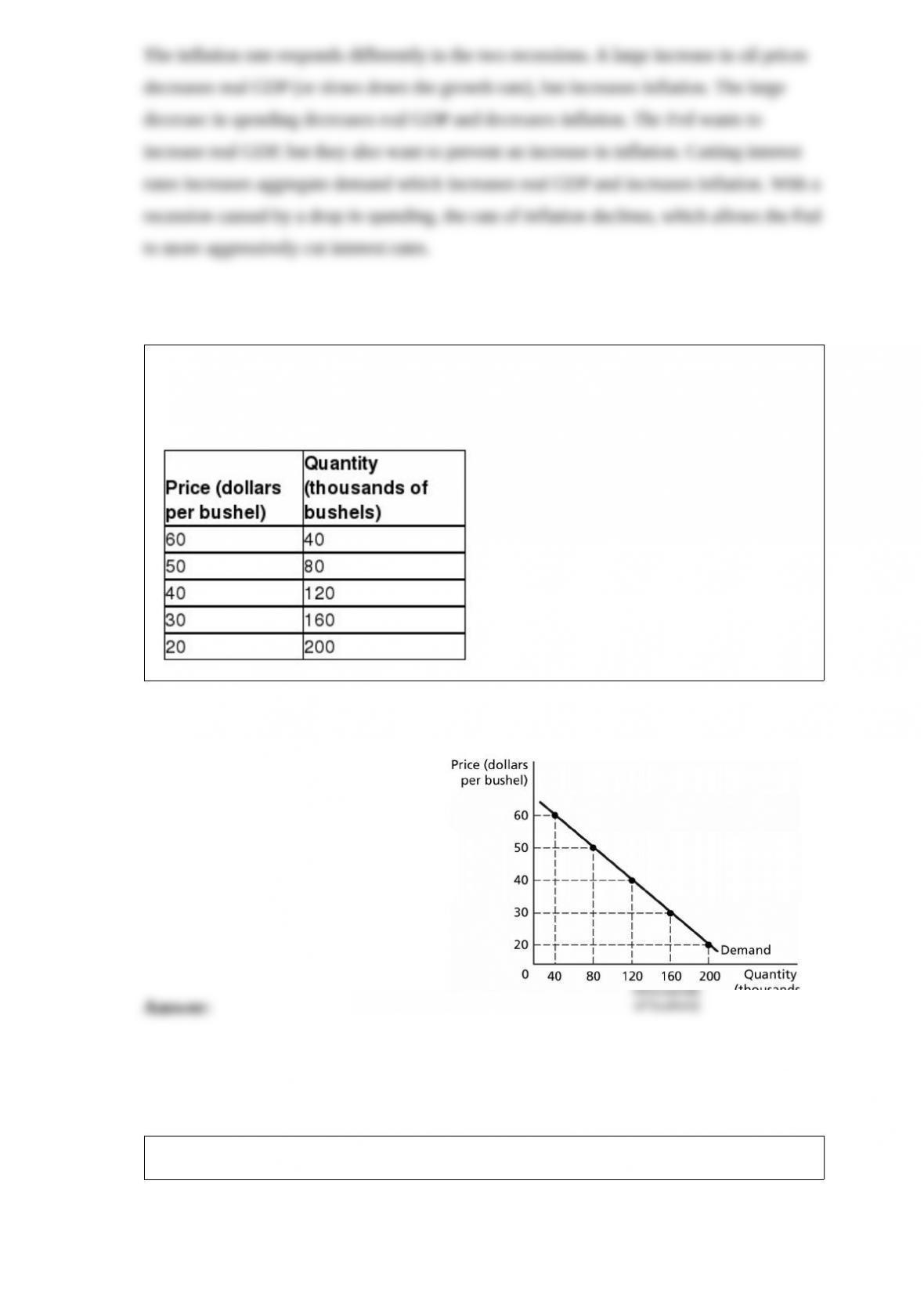
Use the following demand schedule for cherries to draw a graph of the demand curve.
Be sure to label the demand curve and each axis, and show each point on the demand
curve.
What is marginal cost? Which curve is also referred to as the marginal cost curve?
Suppose Political Party A proposes a tax cut on business income to stimulate the
economy. Political Party B opposes the tax cut on business income asserting that it
would only help businesses, not the average working man and woman. If you were
hired as an economist for Political Party A, explain how the tax cut on business income
would help the average working man and woman.
What is the difference between a market equilibrium and a competitive market
equilibrium?
Define a sole proprietorship.
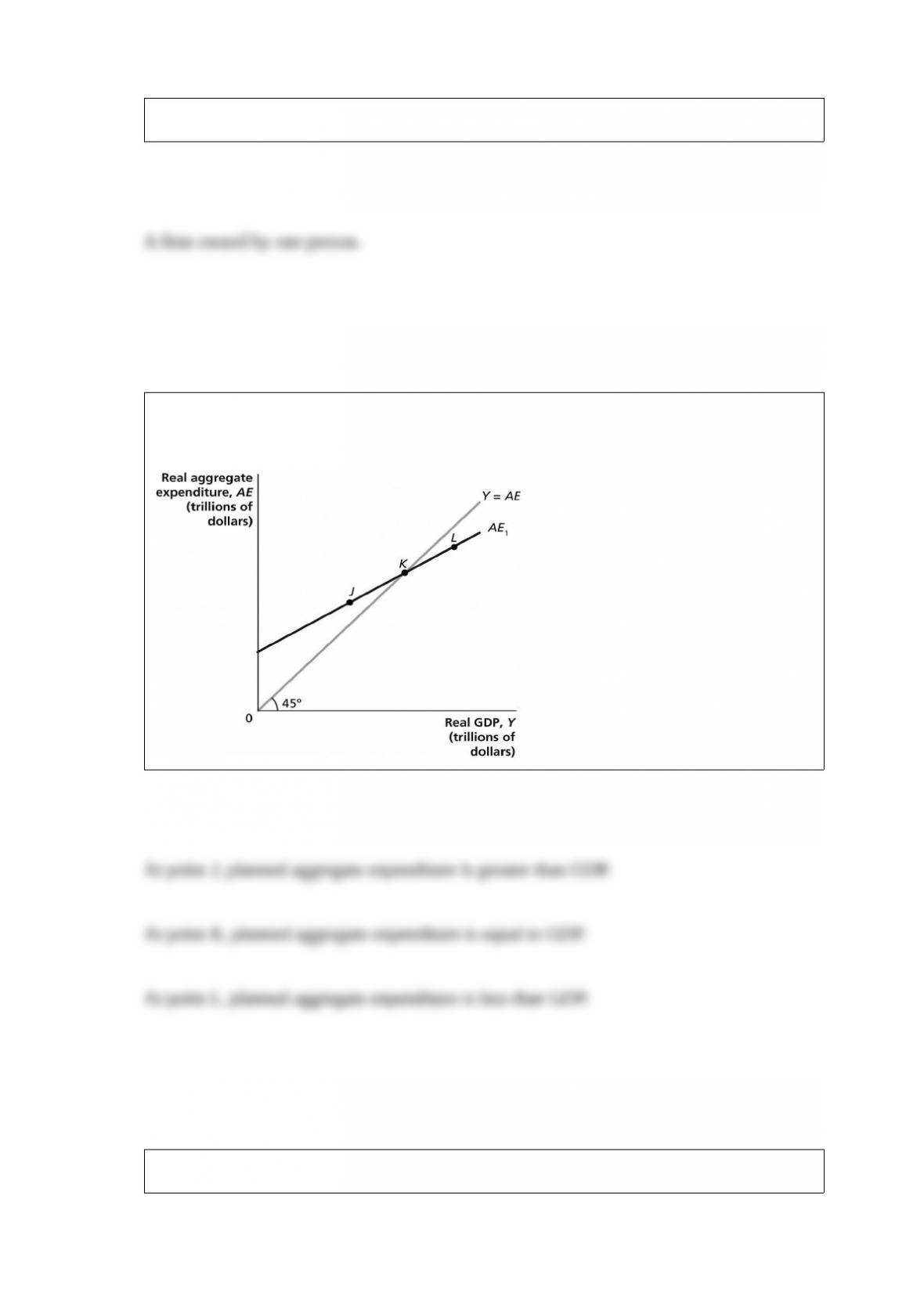
At each of the three points in the following graph, indicate whether planned aggregate
expenditure is greater than, equal to, or less than GDP?
What is the relationship between the balance of trade and the current account balance?