
Demand-side and supply-side inflations differ in that, in one case
a. total real output rises, and in the other, it falls.
b. the price level rises, and in the other, it falls.
c. borrowers benefit, and in the other, savers benefit.
d. businesses benefit, and in the other, householders benefit.
e. inflation is temporary, and in the other, it is permanent.
A tax structure under which an individual is taxed $1,000 per year regardless of income
is
a. unconstitutional.
b. progressive.
c. proportional.
d. regressive.
e. biased against higher-income groups.
The 45-degree line represents points of equality between

a. saving and investment.
b. intended spending and GDP.
c. consumption and saving.
d. unemployment and inflation.
e. price levels and intended spending.
In employer-employee relationships, informal understandings NOT found in writing are
called
a. illegal.
b. sidebars.
c. cartels.
d. constitutional.
e. implicit contracts.
The rate of growth in real per capita GDP is deficient as a measure of the rate of
economic growth because
a. it does not account for the rate of inflation.

b. per capita GDP has no relation to per capita income.
c. the rate of increase of per capita GDP does not measure the degree of inequality in
output distribution.
d. large differences in the rate of increase of current per capita GDP make little
difference in living standards in the future.
e. it underestimates the rate of growth in real GDP.
The Golden Rule of Output Determination for a perfectly competitive firm is to
a. choose the output rate at which price is greatest.
b. choose the output rate at which price equals marginal cost.
c. produce to the point of diminishing marginal returns.
d. produce until total revenue exceeds total cost.
e. choose the output rate at which total cost is the lowest.
A legal form of business organization that is easily established and yet has improved
opportunities for greater financial resources and specialized know-how without being
subject to double taxation of its income is the

a. corporation.
b. cartel.
c. simple proprietorship.
d. consortium.
e. partnership.
If a perfectly competitive, constant-cost industry is monopolized, the market supply
curve becomes the monopolist’s ________ curve.
a. demand
b. marginal cost
c. average cost
d. marginal revenue
e. total revenue
Economic rent is a
a. payment above the minimum necessary to make an input available to the economy.

b. price of an apartment or other leased building.
c. tax imposed by the government on property.
d. payment for free resources such as air and water.
e. payment for an input that has many close substitutes readily available.
The 1973 abandonment of the Bretton Woods system was largely brought about by the
a. bankruptcy of the International Monetary Fund.
b. reestablishment of the gold exchange standard.
c. appreciation of the U.S. dollar.
d. growing U.S. dollar glut in foreign exchange markets.
e. aftermath of Watergate.
Under a gold standard, if a country exported more than it imported, its gold supply
would
a. rise and its price level would fall.
b. fall and its price level would rise.

c. rise and so would its price level.
d. fall and so would its price level.
e. fall but its price level would remain unchanged.
If government revenues fall short of expenditures, the difference can be financed by
a. reducing taxes.
b. reducing the national debt.
c. declaring bankruptcy.
d. borrowing or creating new money.
e. buying gold.
If both the supply and demand for a good decrease, we can predict with certainty that
a. the quantity sold will fall.
b. the price will fall.
c. the price will rise.
d. the quantity sold will rise.

e. neither the price nor the quantity sold will be affected.
The basic argument against wage and price controls is that
a. they can be used only during periods of all-out war.
b. as a solution to inflation, they are popular with economists, not with politicians or the
general public.
c. they require labor to take wage reductions before firms can reduce their prices.
d. they are not helpful as a short-run remedy, although they do work effectively over the
long run.
e. they necessitate implementing other allocation schemes that often impair economic
efficiency.
The goal of an export subsidy is to
a. increase exports.
b. reduce domestic employment in the subsidized industry.
c. shift the demand curve for the exported good to the left.
d. raise the domestic price of goods produced abroad.

e. make it impossible for an importing country to keep out foreign goods.
When resource prices reflect true social costs
a. external diseconomies must be present.
b. profit-maximizing firms will tend to produce socially desirable amounts of output.
c. firms will not use any air or water in their production processes.
d. production will cease.
e. firms realize no net benefits from continued production.
The law of diminishing marginal returns CANNOT predict the effect of an additional
unit of input when
a. all other inputs are fixed.
b. it is possible to vary the proportion in which the various inputs are used.
c. technology is changing.
d. output rises.
e. marginal product is falling.

The profit the producer makes using this minimum cost technique is
a. $4.
b. $9.
c. $10.
d. $12.
e. $14.
John Maynard Keynes shocked the economic world with his theory that the Great
Depression could continue in a never-ending downward spiral unless government
intervened. According to Keynes, the reason the economy could NOT pull itself out of
the Depression was that
a. the government continued to insist on high tax rates.
b. price controls precluded business expansion.
c. we no longer had a balanced budget.
d. the lack of income had reduced aggregate demand.
e. wages and prices were much too flexible.

In the market diagram, excess demand is best represented by triangle
a. ABE.
b. ABD.
c. BCE.
d. AED.
e. CED.
Small differences in the annual rate of economic growth can make substantial
differences in living standards a few decades later because
a. each year the increase in output is added to a larger base, thus compounding its
impact.
b. increases in output create surplus labor, keeping costs low.
c. the more rapid the rate of growth, the higher the rate of inflation.
d. increases in output lead to greater increases in population, lowering overall standards
of living.
e. expanding economies use up national resources at a rapid rate and create substantial
amounts of pollution.

The statement ‘supply creates its own demand” is often referred to as
a. value added.
b. the general theory of employment.
c. hysteresis.
d. the natural rate of employment.
e. Say’s law.
A straight line fitted to an upward-sloping scatter of points in a graph represents
a. the upper turning point.
b. economic growth.
c. the average relationship.
d. a long-run equilibrium.
e. an inverse function.
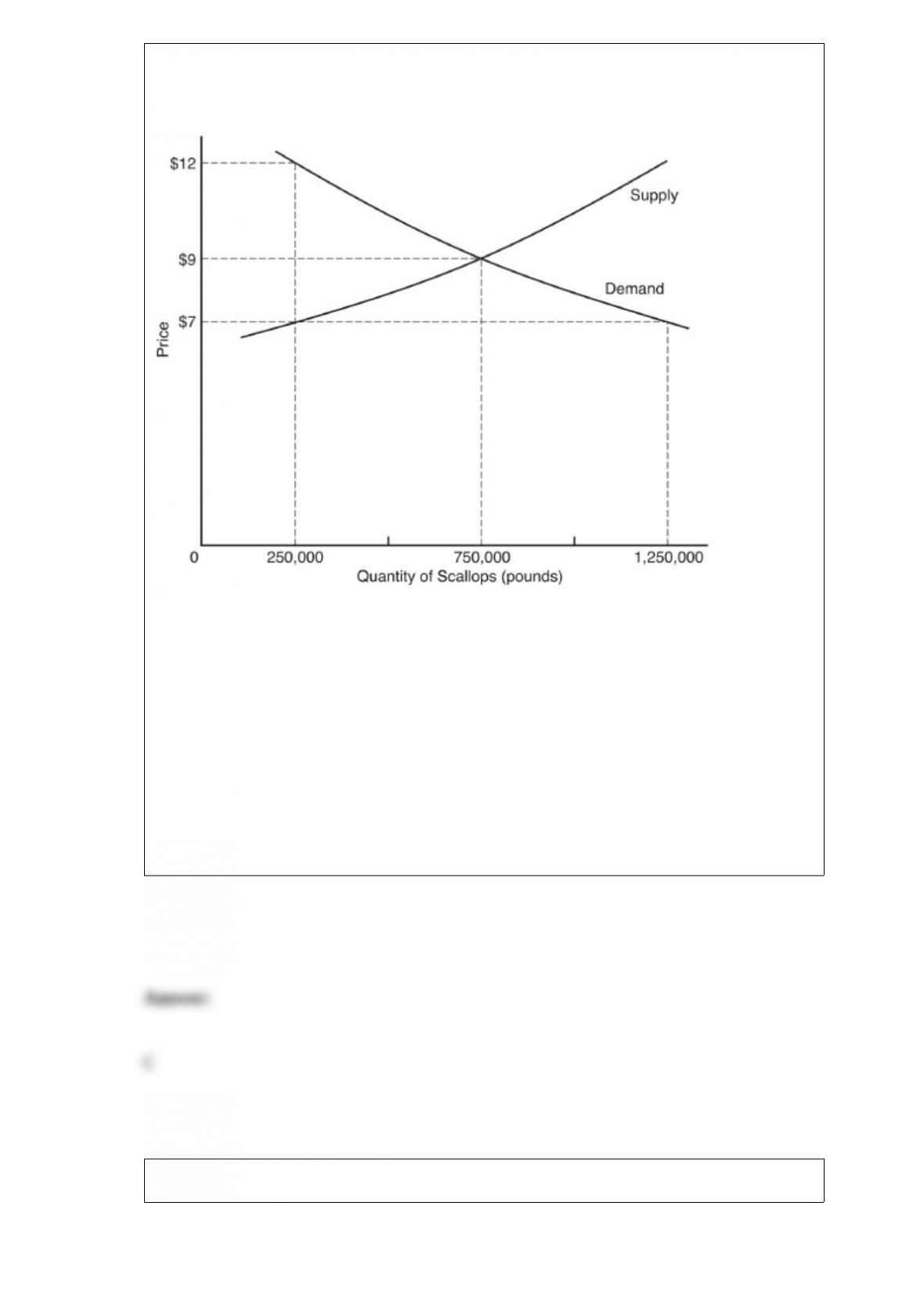
The following questions are based on the following graph illustrating the market for
scallops:
The equilibrium price is ________ per pound.
a. more than $12
b. $12
c. $9
d. $7
e. less than $7
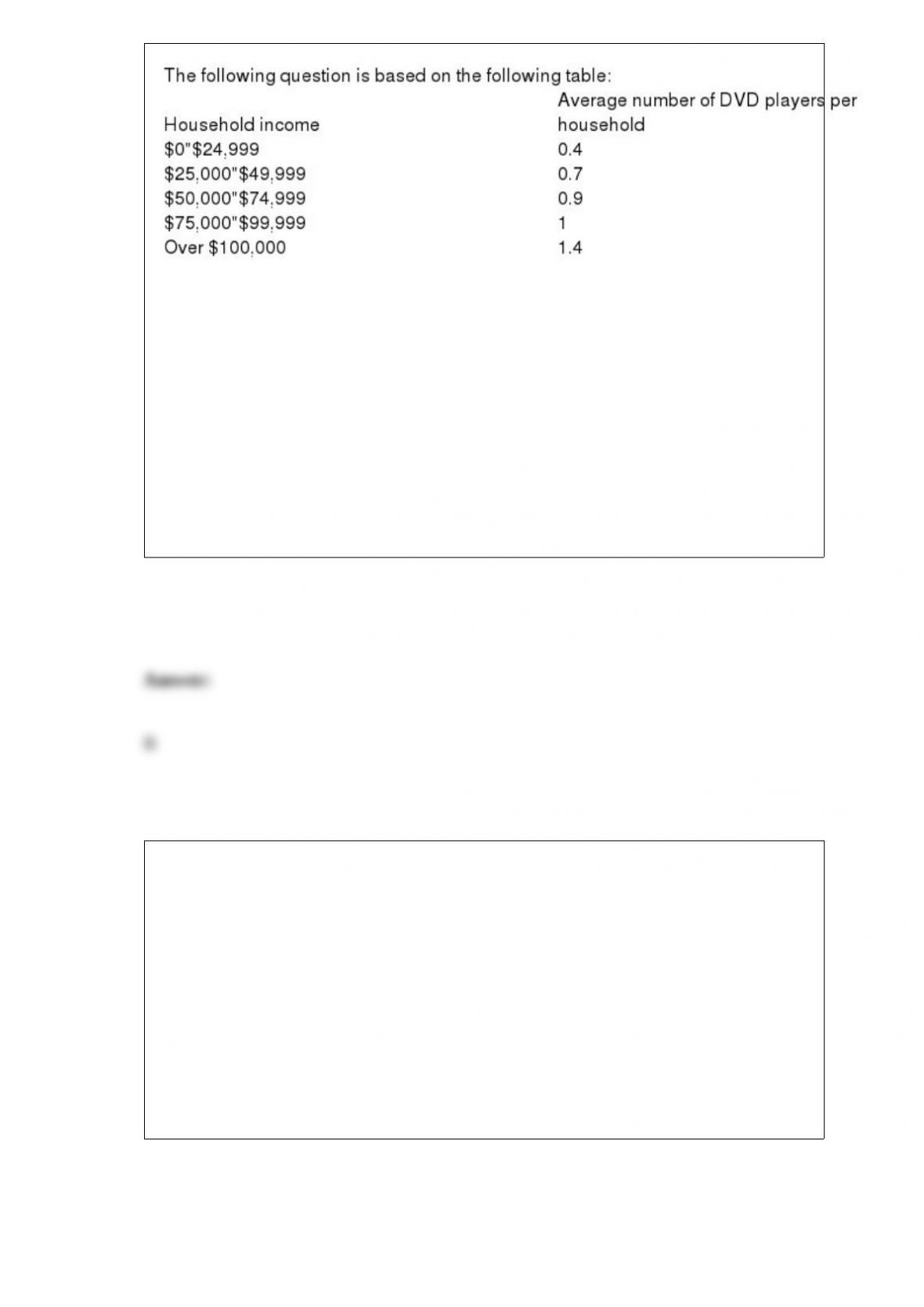
The relationship between household income and number of DVD players is
a. nonexistent.
b. direct.
c. negative.
d. fluctuating.
e. terminal.
When a demand curve is price inelastic
a. a reduction in price increases the amount spent on the good.
b. the quantity demanded will increase even if price remains constant.
c. a 1 percent increase in price will result in a less than 1 percent decrease in the
quantity demanded.
d. the change in quantity will always be greater than the change in price.
e. demand must be falling.
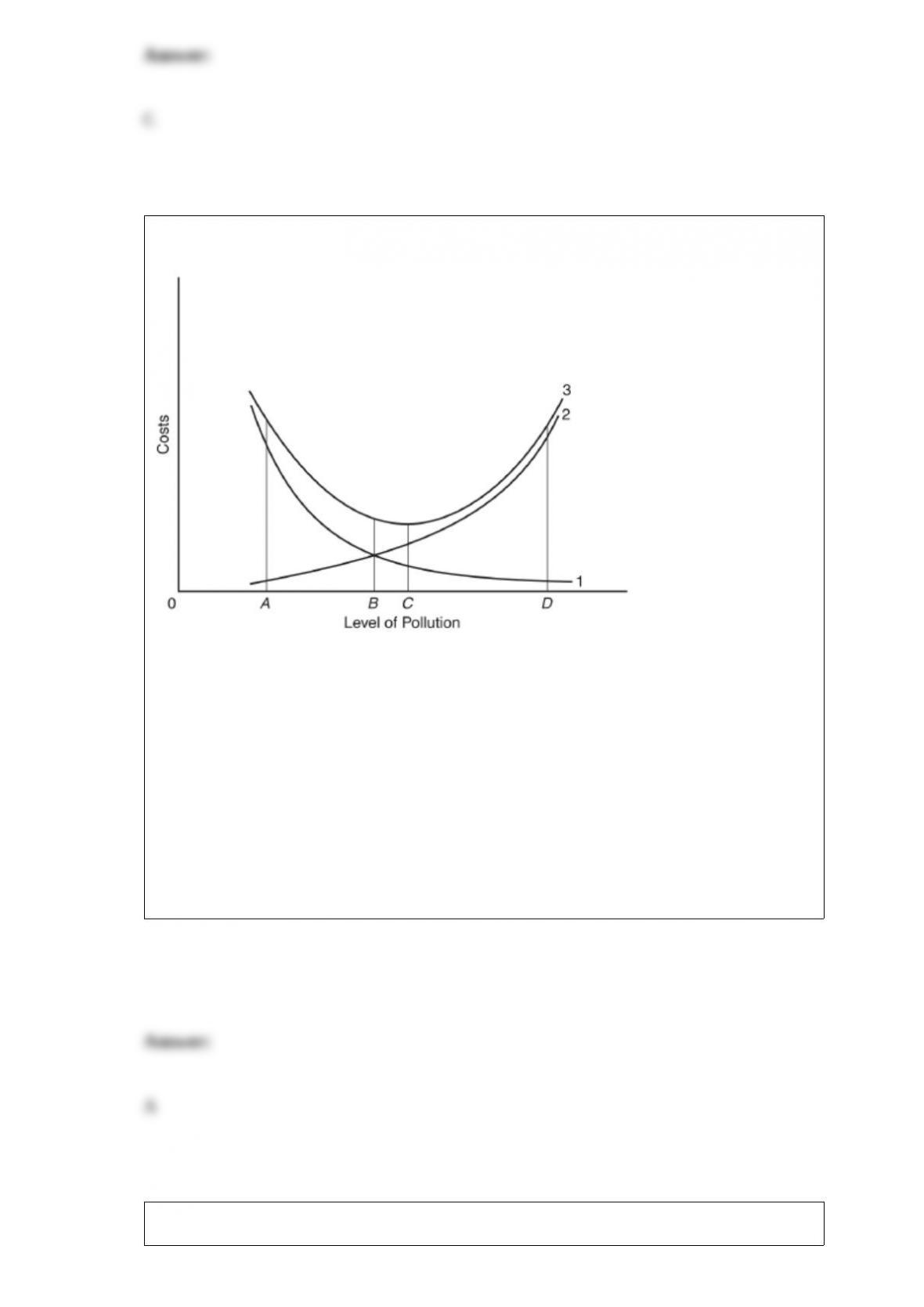
The following questions are based on the following diagram:
Curve 2 represents the
a. cost of pollution to society.
b. cost of pollution control to society.
c. difference between the cost of pollution and the cost of pollution control.
d. sum of the costs of pollution and of pollution control.
e. cost of pollution divided by the cost of pollution control.
The measurement of GDP is useful to business executives because it

a. aids in forecasting the future health of their firms.
b. represents the dollar value of all their economic transactions for the year.
c. enables businesses to estimate depreciation.
d. illustrates the social costs that arise from the production of private goods and
services.
e. discourages businesses from cheating on their income taxes.
The relevant cost for making short-run production decisions is the ________ cost.
a. variable
b. fixed
c. sunk
d. reproduction
e. historic
Which of the listed policy rules tends to be supported by the new classical
macroeconomists?

a. feedback
b. golden
c. marginal
d. discretionary
e. rigid
The central questions in economics
a. pertain solely to centrally planned economies.
b. reflect concerns arising from the problem of relative scarcity.
c. are statements about what ought to be.
d. eliminate the necessity of computing opportunity costs.
e. represent economic theories that become obsolete with the rise of capitalism.
The price ratio of two internationally traded goods
a. is biased in favor of the country having an absolute advantage in the production of
both goods.

b. is established by international law in favor of the less efficient country.
c. is such that only one country can benefit from trade.
d. is somewhere between the separate domestic cost ratios of the two goods.
e. fluctuates randomly and has little effect on the specialization of trade of the two
goods.
Periods of inflation are generally characterized by a decline in
a. the value of money.
b. the price level.
c. total intended spending.
d. nominal GDP.
e. the supply of money.
Antitrust action against the American Telephone and Telegraph Company, begun by the
Justice Department in 1974
a. led to the 1982 Supreme Court decision to break up AT&T.
b. was an unsuccessful effort by the Justice Department to reestablish the rule of reason

doctrine.
c. resulted in an out-of-court settlement in which AT&T divested itself of its 22 local
telephone companies.
d. ensured that AT&T would continue to have a monopoly position in local but not
long-distance telephone service.
e. resulted in a denial of the proposed conglomerate merger of AT&T and IBM.