
The rate of interest written on a contract between a borrower and a lender is the
a. nominal interest rate.
b. real interest rate.
c. implied interest rate.
d. expected interest rate.
Economist John Maynard Keynes wrote that the economy naturally gravitates toward
smooth growth and high levels of employment.
a. True
b. False
A true public good is characterized by
a. depletability but not excludability.
b. excludability but not depletability.
c. both depletability and excludability.
d. neither depletability nor excludability.

Economic theory would lead us to suspect that deep sea oil reserves would be accessed
before those located in the Middle East or on the U.S. mainland.
a. True
b. False
Total profit of a competitive firm can be found by multiplying profit per unit times units
sold.
a. True
b. False
The perfectly competitive firm has no influence over price because
a. its output is so insignificant relative to the market as a whole.

b. anti-trust laws constrain perfectly competitive firms.
c. consumers establish the prices of products.
d. it doesn’t know its demand curve.
Economists oppose limiting economic growth possibilities because such limits would
inevitably involve
a. some expansion of private sector production.
b. an increase in government spending.
c. some form of mandatory controls on economic activity.
d. mandated balanced federal budgets.
Economic analysis requires both mathematical reasoning and historical study.
a. True
b. False

A cold winter will increase the quantity of heating fuel demanded at every price.
a. True
b. False
The law of increasing relative costs, depicted by the concavity of the production
opportunities frontier, is most closely related to the
a. downward slope of the demand curve.
b. upward slope of the demand curve.
c. downward slope of the supply curve.
d. upward slope of the supply curve.
In a simple macroeconomic model, only one component of expenditures is allowed to
change:

a. investment.
b. consumption.
c. net exports.
d. government spending.
e. transfer payments.
A change in the price of a good has no effect on the supply schedule.
a. True
b. False
Which of the following attitudes will be held by a typical firm in a typical cartel?
a. If I alone cheat, I’m better off; if everyone cheats, I’m worse off.
b. I can never do better for myself than by following agreed-upon cartel policies.
c. If everyone cheats, I’m better off and so is everyone else in the cartel.
d. If I suspect others are planning to cheat, I’ll do best for myself by deciding not to
cheat.

Why is it that only a small percentage of American firms are incorporated?
a. Corporate debt as stockholder’s liability.
b. Small size of firms.
c. Unlimited liability.
d. Inability to outlast associated individuals.
Monetizing deficits has lead to serious inflation in
a. the United States.
b. Canada.
c. the United Kingdom.
d. Russia, Latin America, and Israel.
e. All of the above are correct.

Low inflation rates tend to accelerate into higher and higher rates of inflation.
a. True
b. False
Management gets two numbers (price and quantity) from one decision because
a. the marginal utility of goods is fixed.
b. producers use both technical and financial information.
c. the demand curve consists of price and quantity pairs.
d. the average cost curve has only one low point.
Banks that are managed in a very safe and conservative manner can be expected to earn
a. high, steady profits.
b. high but volatile profits.

c. low and consistent profits.
d. low profits with occasional major losses.
Officially, the payroll tax is referred to as
a. the trust fund tax.
b. Social Security tax.
c. contributions for social insurance.
d. investment in Social Security.
Figure 11-1
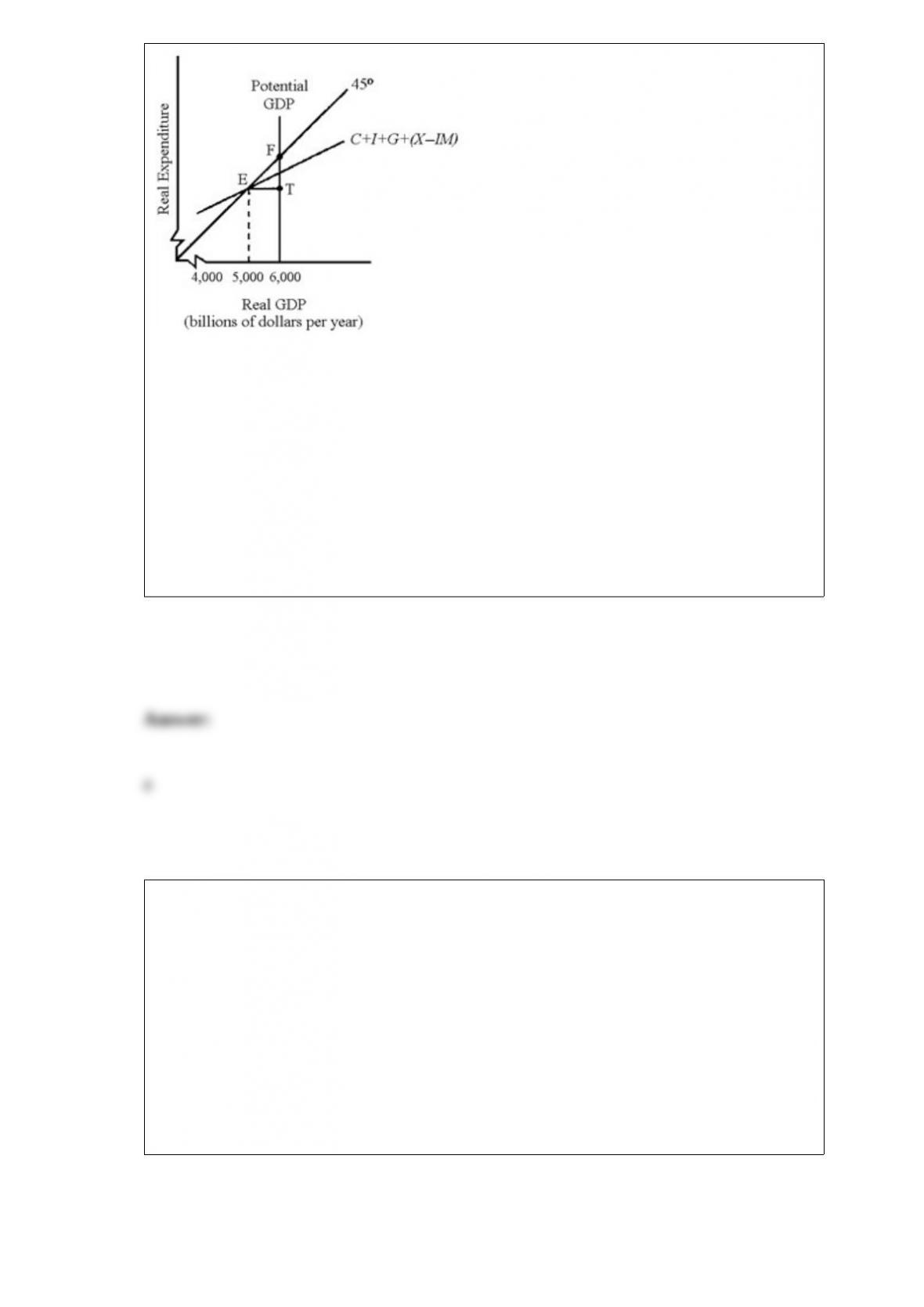
In Figure 11-1, to reach the level of potential GDP, the administration of President
Obama would most likely advocate
a. increasing Social Security payments.
b. decreasing defense spending.
c. decreasing personal income taxes.
d. All of the above are correct.
The basic organizing framework for both microeconomic and macroeconomic models is
a. purely competitive markets.
b. government planning of the economy.
c. demand and supply.
d. democratic socialism.
e. all of the above.

Many experts on the nursing shortage insist that, in addition to higher money wages,
other ways will have to be found to make the nursing profession more attractive,
including, for example, more respect from physicians and administrators, more flexible
schedules, and more secure parking lots. These facts illustrate the concept of
a. exploitation.
b. pecuniary principles.
c. economic rent.
d. nonmonetary attractiveness.
If money raised in the issue of new stocks and bonds is used effectively,
a. the income from them is not subject to double taxation.
b. a firm need not meet SEC requirements.
c. the stock is being “watered.”
d. they generate the means of repayment.

Direct controls have traditionally been used heavily to control pollution in the U.S.
a. True
b. False
Long-term productivity growth trends have resulted in the
a. increased predominance of the British economy.
b. relative decline of the U.S. relative to the U.K.
c. relative decline of the Japanese economy.
d. relative growth of the Japanese economy.
Using the standard 45-degree line diagram, how does an increase in investment
spending effect the expenditure schedule?
a. It shifts the expenditure schedule downward.
b. It shifts the expenditure schedule upward.
c. It increases the slope of the expenditure schedule.

d. It decreases the slope of the expenditure schedule.
Favorable supply shocks should produce rapid economic growth with falling inflation.
a. True
b. False
Speculation in exchange markets is often thought of as conducive to wild fluctuations in
exchange rates. In practice it appears that speculators
a. have destabilized several currencies that were at sustainable equilibrium levels.
b. have no effect in fixed rate systems.
c. in fact tend to stabilize exchange rates rather than destabilize them.
d. All of the above are correct.

The term “dirty float” is used to describe a
a. black market in foreign currencies.
b. floating currency that is “managed” by central bank authorities.
c. nation that switches from free to fixed exchange rates.
d. currency system used only in inflationary periods.
If the rate of interest increases, firms will most likely respond by
a. increasing investment.
b. decreasing investment.
c. not changing investment.
d. increasing capital stock.
Revenue sharing is usually a means of
a. making states transfer money to the federal government.
b. equalizing expenditures per pupil made by school districts.

c. splitting the revenue earned from excise taxes between states and the federal
government.
d. making grants to state and local governments.