
Suppose that in 2014, all prices in the economy double and that all wages and salaries
also double. In 2014 you
A) are worse off than you were in 2013 as you can no longer afford to buy as many
goods and services.
B) are better off than you were in 2013 as your salary is higher than it was in 2013 and
you can now buy more goods and services.
C) are no better off or worse off than you were in 2013 as the purchasing power of your
salary has remained the same.
D) cannot determine whether you are better off or worse off than you were in 2013,
because the purchasing power of your salary cannot be determined.
The quantity theory of money predicts that, in the long run, inflation results from the
A) velocity of money growing at a faster rate than real GDP.
B) velocity of money growing at a lower rate than real GDP.
C) money supply growing at a lower rate than real GDP.
D) money supply growing at a faster rate than real GDP.
Figure 11-17
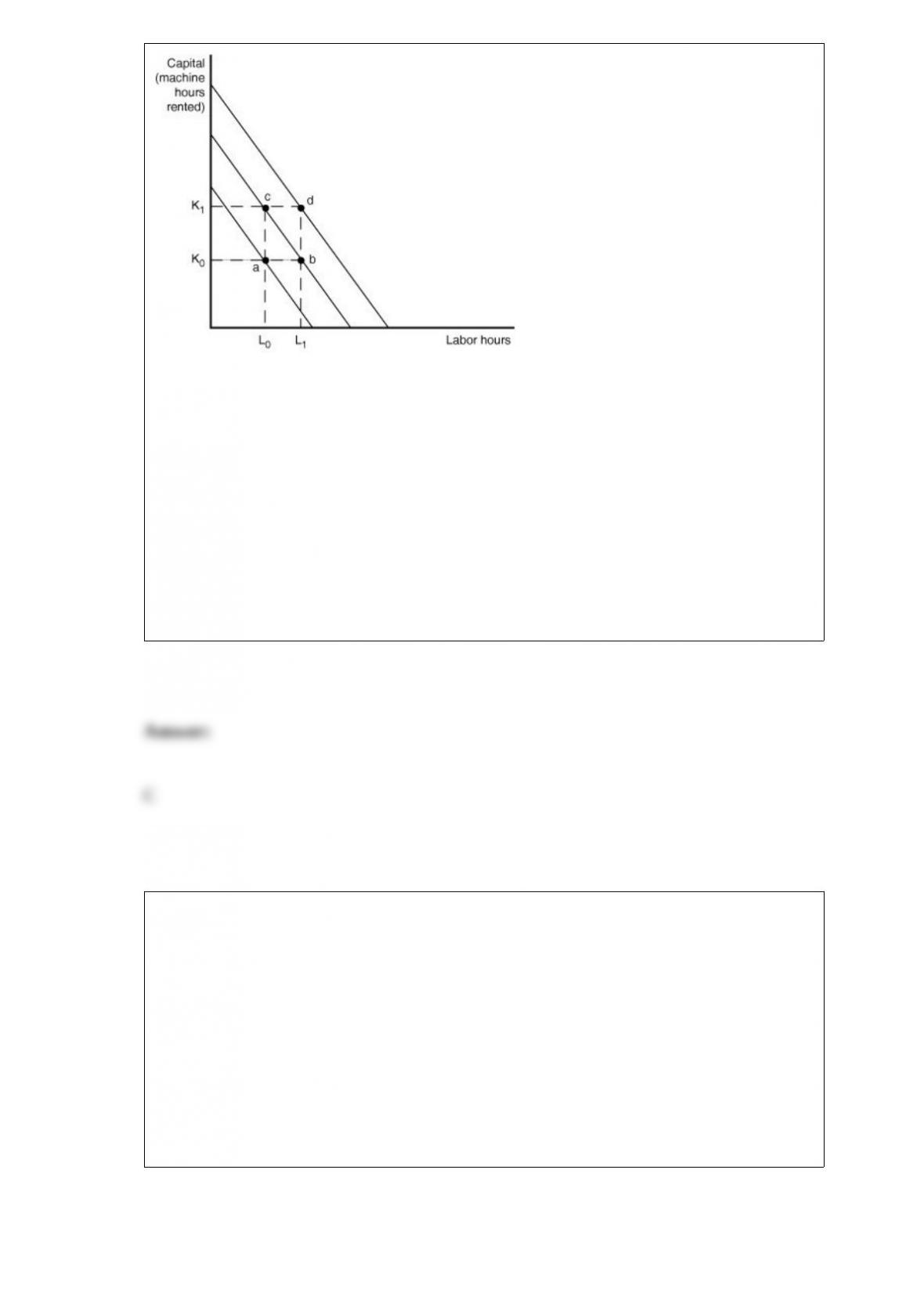
Assume that production isoquants are convex. Total cost and output produced must
increase for each of the following movements except one. Which movement is the
exception?
A) point a to point
B) point a to point c
C) point to point c
D) point to point d
According to a study of the price elasticities of products sold in supermarkets, the price
elasticity of demand for toothpaste is estimated at -0.45. Which of the following could
explain why the price elasticity of demand for toothpaste is so low?
A) The toothpaste industry is highly competitive.
B) Toothpaste is relatively inexpensive.
C) Toothpaste is heavily endorsed by dentists.
D) There are few close substitutes for toothpaste.
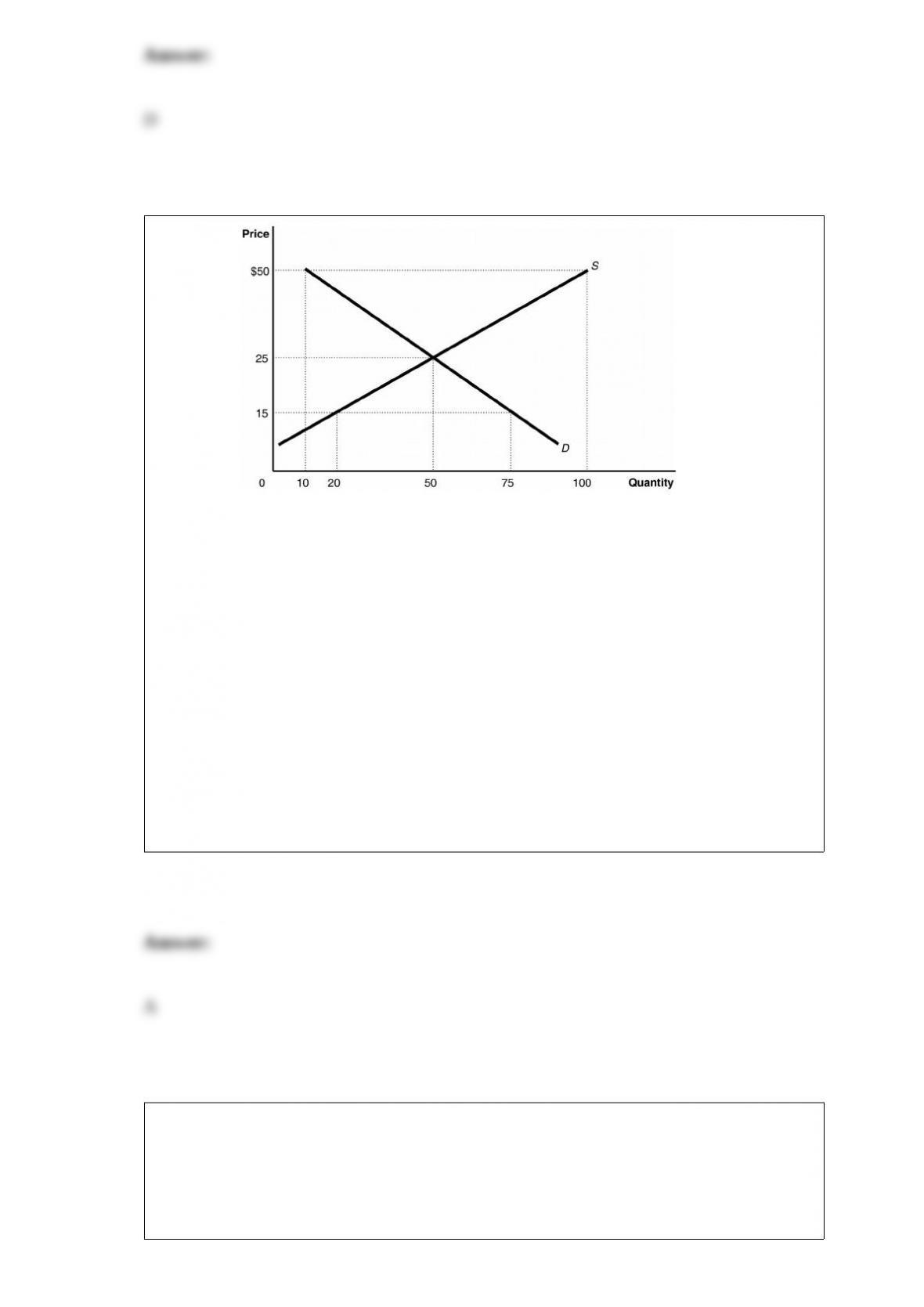
Figure 3-6
The figure above represents the market for coffee grinders. Assume that the market
price is $21. Which of the following statement is true?
A) There is a shortage that will cause the price to increase; quantity demanded will then
decrease and quantity supplied will increase until the price equals $25.
B) There is a shortage that will cause the price to increase; quantity supplied will then
decrease and quantity demanded will increase until the price equals $25.
C) There will be a shortage that will cause the price to increase; demand will then
decrease and supply will increase until the price equals $25.
D) There is a shortage that will cause the price to decrease; quantity demanded will then
increase and quantity supplied will decrease until the price equals $25.
Ordinarily, governments attempt to promote competition in markets. Why do
governments use patents to block entry into some markets when this prohibits
competition?
A) Patents encourage firms to spend money on research necessary to create new

products.
B) Politicians sometimes succumb to pressure from lobbyists to grant favors to
businesses for political reasons.
C) Patents are an important source of government revenue.
D) Patents are justified because they are an important means for creating network
externalities.
An equilibrium in a game in which players pursue their own self-interests and do not
cooperate is called a
A) cartel equilibrium.
B) noncooperative equilibrium.
C) prisoner’s dilemma equilibrium.
D) dominant strategy equilibrium.
In October 2013, General Motors (GM) posted a price-earnings ratio of 10.13. If the
price of the stock at that time was $36 per share, which of the following must have been
true?
A) GM’s revenues that month were $364.68 million.
B) GM’s earnings per share was $3.55.
C) GM’s coupon payment was $36 per year.

D) GM’s dividend yield for the year was 36.5%.
The demand for labor is described as a derived demand because
A) it is derived by workers seeking to earn income to fund the consumption of goods
and services.
B) it is derived by producers seeking to make profits by starting new businesses.
C) it is derived from the demand for products that use labor in the production process.
D) it is derived from government institutions which rely on labor markets for the
purpose of raising tax revenue.
Monopolistically competitive firms can differentiate their products
A) by producing at minimum efficient scale.
B) by producing where marginal revenue equals marginal cost.
C) by equating price and average total cost.
D) through marketing.
During 1970-1997, the U.S. federal government was
A) in surplus every year.
B) balanced every year.
C) in deficit every year.
D) in deficit most of those years.