1)
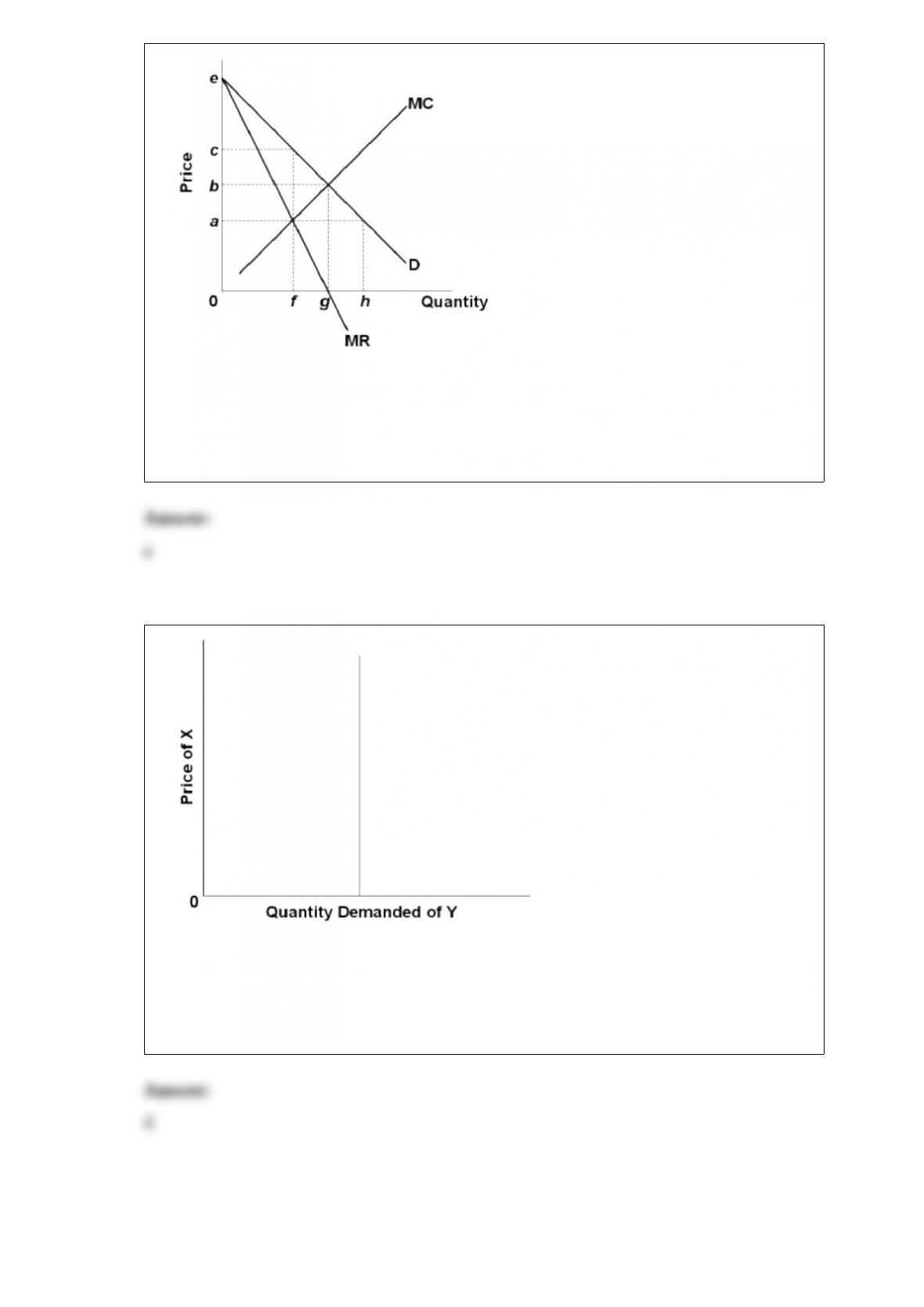
refer to the above diagram for a pure monopolist. monopoly profit:
a.cannot be determined from the information given.
b.will be ae per unit sold.
c.will be bc per unit sold.
d.will be ac per unit sold.
2)
the above diagram suggests that:
a.x and y are both inferior goods.
b.x and y are both normal goods.
c.x and y are substitute goods.
d.x and y are independent goods.
3)
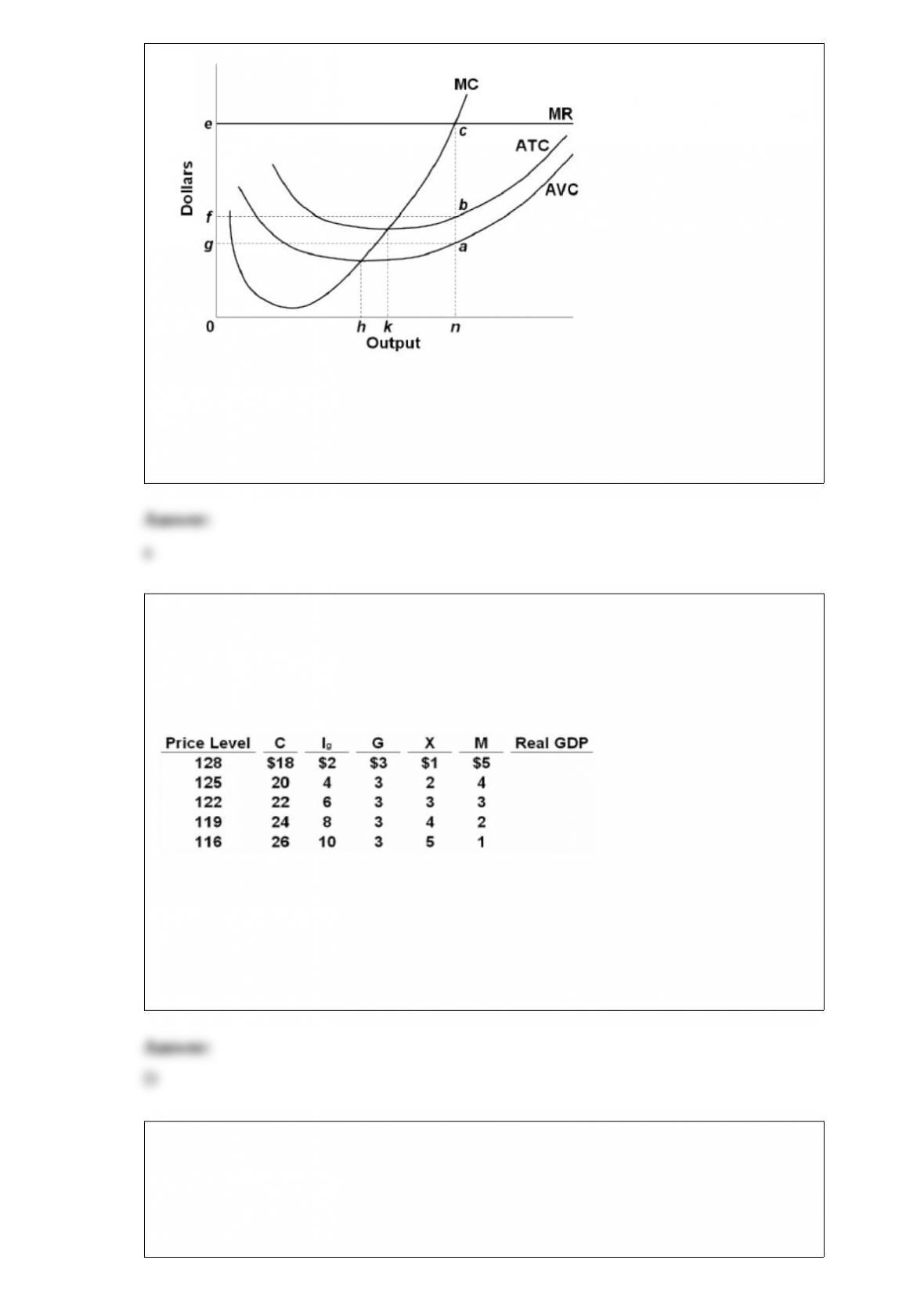
refer to the above diagram. at the profit-maximizing output, total profit is:
a.efbc
b.fgab
c.egac
d.0fbn
4) Answer the next question(s) on the basis of the following table for a particular
country in which C is consumption expenditures, Ig is gross investment expenditures, G
is government expenditures, X is exports, and M is imports. All figures are in billions of
dollars. Each question is independent of the other questions.
Refer to the above table. If the equilibrium level of real GDP is $43 billion, its level of
consumption will be:
A.$20 billion.
B.$22 billion.
C.$24 billion.
D.$26 billion.
5) The Group of Eight (G8) nations which periodically have jointly intervened to
influence the value of the dollar include:
A.Canada, U.S., France, Britain, Russia, Mexico, Germany, and Brazil.
B.Canada, U.S., France, Japan, Italy, Germany, Russia, and Great Britain.
C.Canada, U.S., Mexico, Brazil, Argentina, Peru, Uruguay, and Chile.
D.Italy, France, Britain, Germany, Netherlands, Norway, Russia, and Sweden.
6) gross investment refers to:
a.private investment minus public investment.
b.net investment plus investment in replacement capital.
c.net investment after it has been “inflated” for changes in the price level.
d.net investment plus net exports.
7) The TANF program:
A.is a form of social insurance.
B.has been found to be unconstitutional by the Supreme Court.
C.limits total lifetime welfare benefits to 5 years and requires people to work after
receiving benefits for 2 years.
D.perpetuates the so-called culture of poverty.
8) the stabilization function of government involves government’s efforts to:
a.alter the output of specific goods when external costs or benefits are present.
b.reduce the after-tax incomes of the rich and increase the after-tax incomes of the poor.
c.deal with the problems of substantial unemployment and rapid inflation.
d.provide the socially desired output of public goods.
9) answer the next question(s) on the basis of the following national income data. all
figures are in billions of dollars.
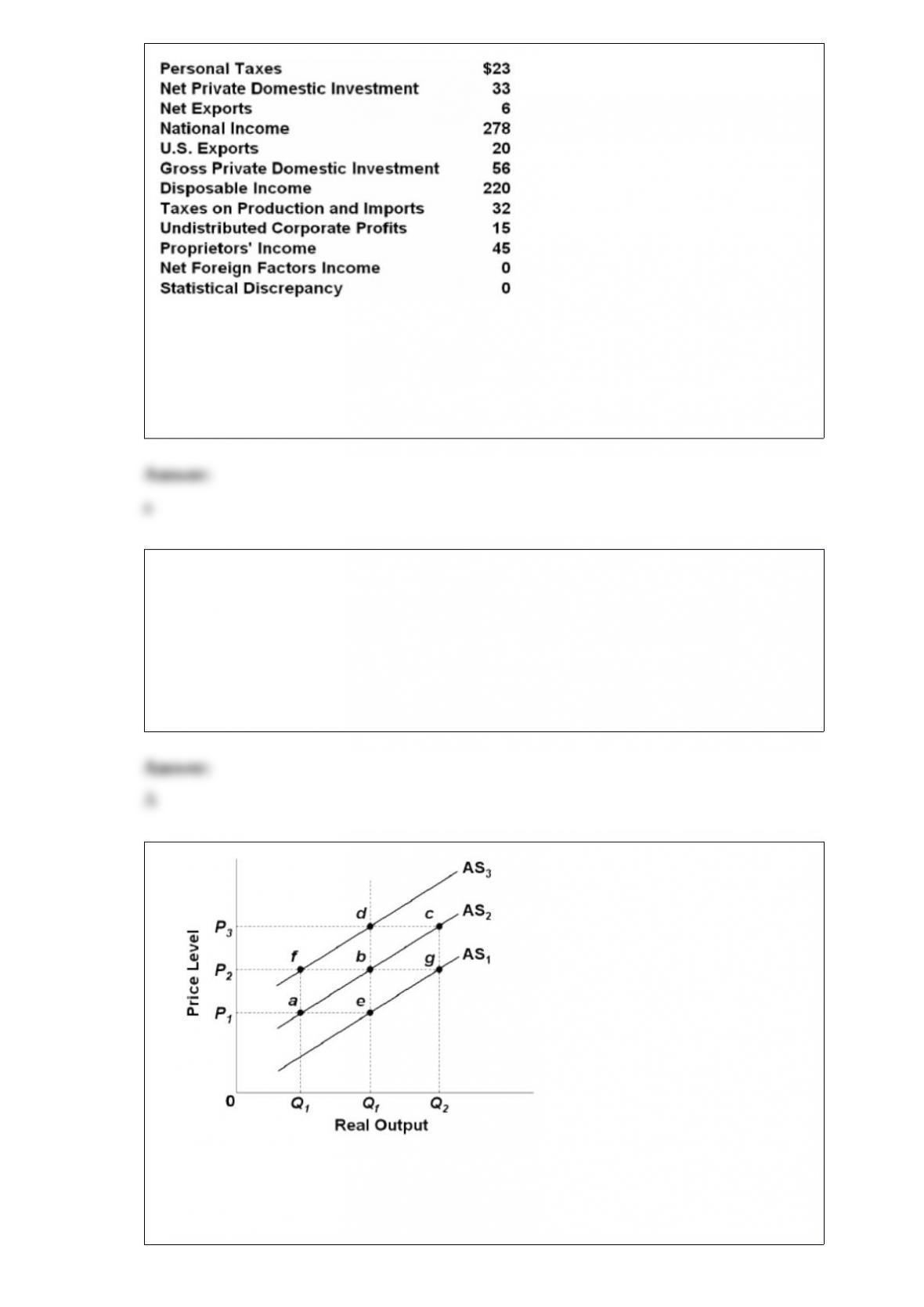
refer to the above data. personal consumption expenditures:
a.cannot be calculated.
b.are $231.
c.are $225.
d.are $205.
10) Suppose that Steve and Susie each perceive $200 of marginal benefit from a
proposed new park, whereas Elizabeth perceives $800. If the proposed tax levied on
each for the park would $300, a majority vote will:
A.defeat this project and resources will be underallocated to it.
B.pass this project and resources will be efficiently allocated.
C.pass the this project and resources will be underallocated to it.
D.pass this project and resources will be overallocated to it.
11)
Refer to the above diagram. Assume that nominal wages initially are set on the basis of
the price level P2 and that the economy initially is operating at its full-employment
level of output Qf. In the long run, an increase in the price level from P2 to P3 will:
A.increase real output from Qf to Q2.
B.change aggregate supply from AS2 to AS1.
C.decrease real output from Q2 to Q1.
D.move the economy from b to d.
12) The primary purpose of the legal reserve requirement is to:
A.prevent banks from hoarding too much vault cash.
B.provide a means by which the monetary authorities can influence the lending ability
of commercial banks.
C.prevent commercial banks from earning excess profits.
D.provide a dependable source of interest income for commercial banks.
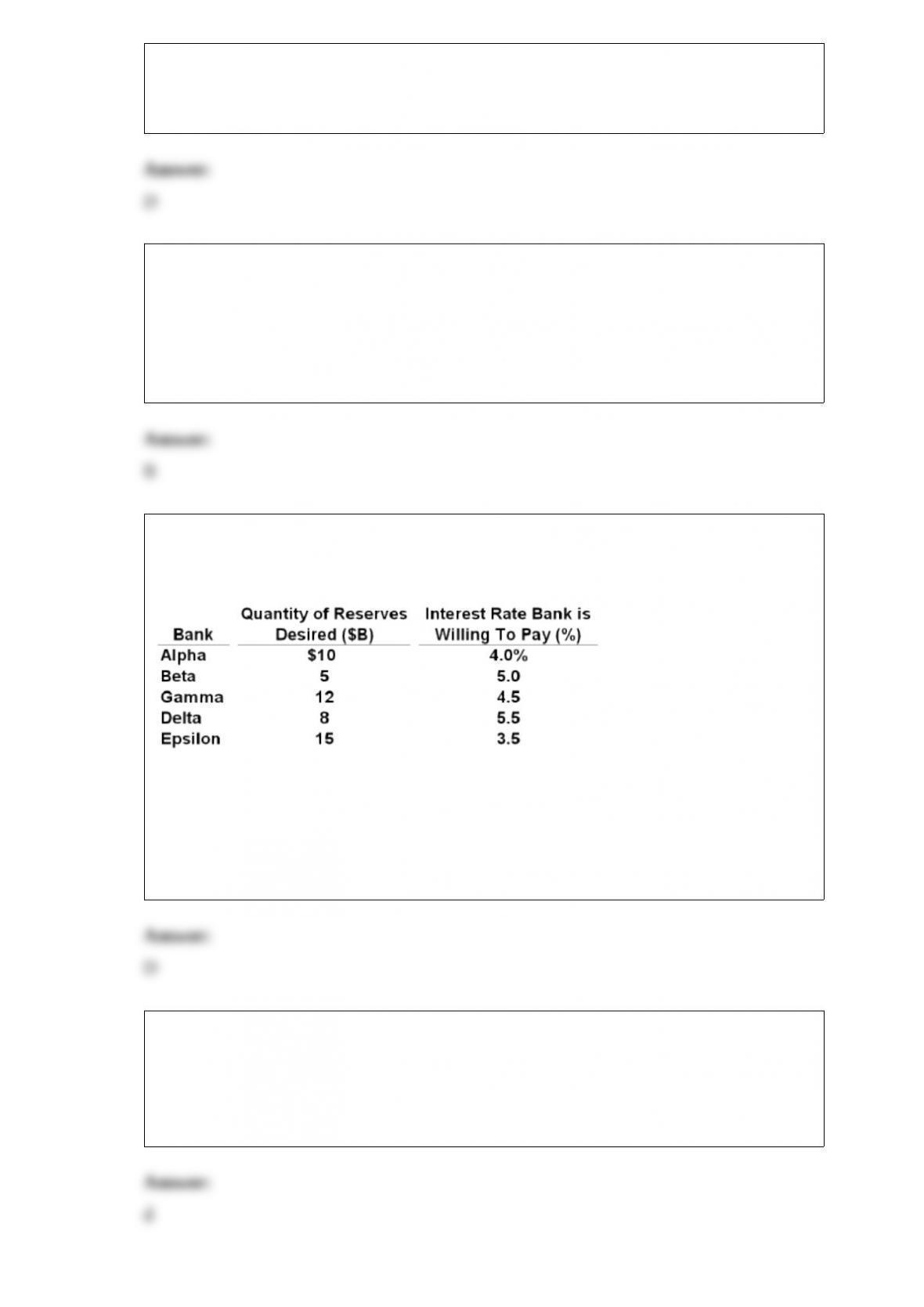
13) The following information: The Fed is going to auction $30 billion in reserves using
the term auction facility. It receives the following bids:
Refer to the above information. As a result of the auction, how much and at what
interest rate will Epsilon bank borrow?
A.$15 billion; 3.5 percent
B.$15 billion; 4 percent
C.$15 billion; 4.5 percent
D.$0; 4 percent (rate charged winning bidders)
14) ideally, value judgments are involved at the:
a.levels of facts, theory, and policy.
b.levels of facts and theory only.
c.level of facts only.
d.level of policy only.
15) In moving from a private closed to a mixed closed economy in the aggregate
expenditures model, taxes:
A.must be added to gross investment.
B.must be added to saving.
C.must be added to consumption and gross investment.
D.have no impact upon the equilibrium GDP.
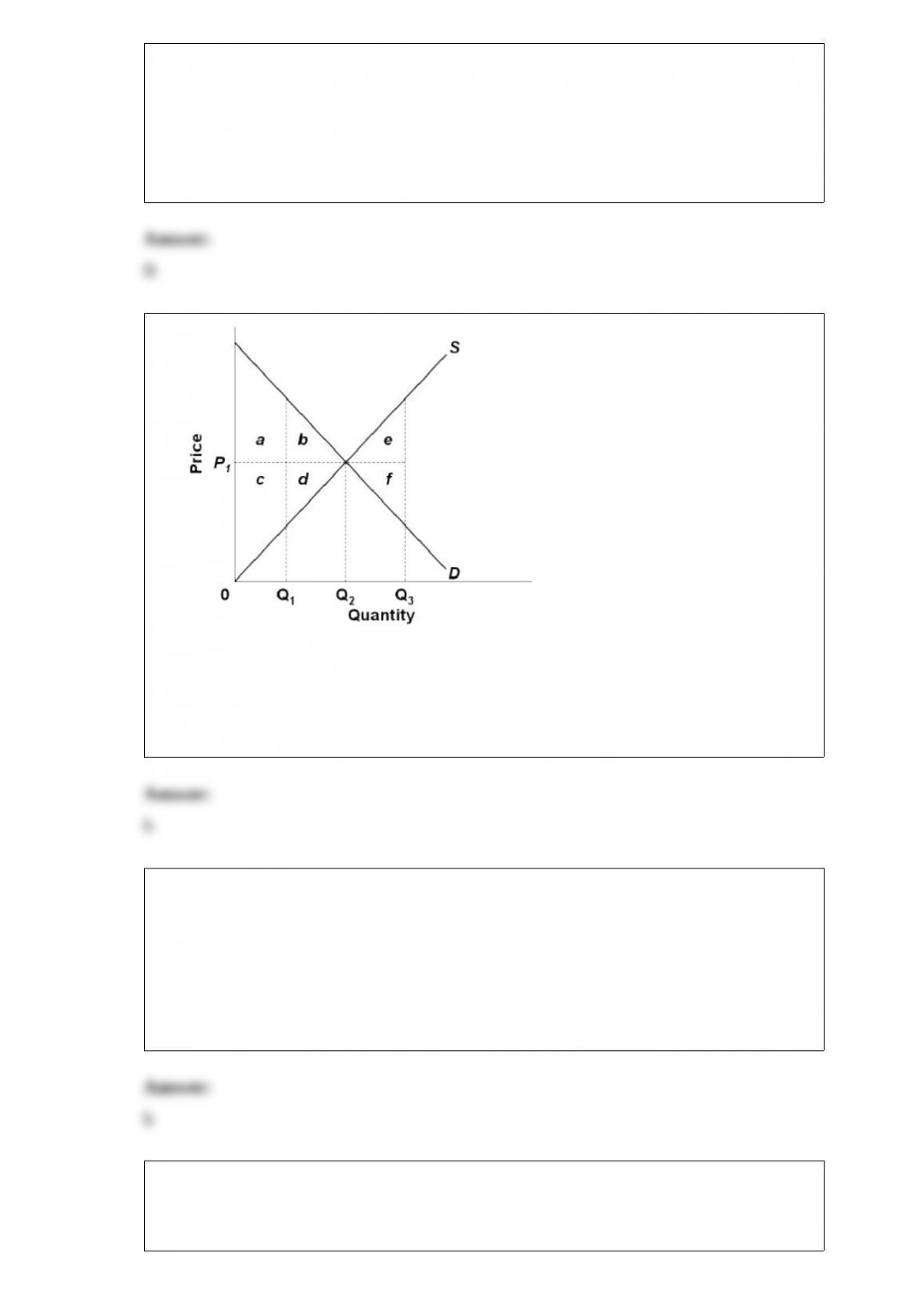
16)
refer to the above diagram. at quantity q2:
a.maximum willingness to pay exceeds minimum acceptable price.
b.the sum of consumer and producer surplus is maximized.
c.minimum acceptable price exceeds maximum willingness to pay.
d.an efficiency loss (or deadweight loss) of b + d occurs.
17) in the short run the sure-screen t-shirt company is producing 500 units of output. its
average variable costs are $2.00 and its average fixed costs are $.50. the firm’s total
costs:
a.are $2.50.
b.are $1,250.
c.are $750.
d.are $1,100.
18) part-time workers are counted as:
a.unemployed and therefore the official unemployment rate may overstate the level of
unemployment.

b.unemployed and therefore the official unemployment rate may understate the level of
unemployment.
c.fully employed and therefore the official unemployment rate may overstate the level
of unemployment.
d.fully employed and therefore the official unemployment rate may understate the level
of unemployment.
19) New classical economists say that an unanticipated decrease in aggregate demand
first:
A.decreases the price level and real output, and then decreases long-run aggregate
supply.
B.decreases long-run aggregate supply, and then decreases the price level and real
output.
C.reduces short-run aggregate supply, and then reduces long-run aggregate supply.
D.decreases the price level and real output, and then increases short-run aggregate
supply such that the economy returns to the full employment level of output.