
Accounting costs exclude implicit costs.
A university must decide if it should stop offering foreign language classes. This
decision involves answering the economic question of “how to produce.”
The division of the burden of a tax between buyers and sellers in a market is called tax
incidence.
Each year, the U.S. exports about 50 percent of its wheat crop.

The larger the marginal propensity to import, the larger the government purchases
multiplier.
Paying efficiency wages are a way for a company to cut costs and become more
efficient, and are therefore lower than market wages.
If demand for a product is perfectly inelastic a change in price will not change total
revenue.
In the United States, the average length of expansions from 1950 to 2009 was more
than twice as long than they were from 1900 to 1950.

If a firm is experiencing diseconomies of scale, its long-run average cost curve is
increasing.
An increase in a firm’s fixed cost will not change the firm’s profit-maximizing output in
the short run.
In many European countries it is much easier than in the United States for unemployed
workers to receive generous wage replacement income from their governments.
Accounting costs exclude implicit costs.

A proprietorship or partnership can raise funds for expansion in all of the following
ways except
A) borrowing from someone or an institution willing to lend the funds.
B) reinvesting profit back into the business.
C) taking on a partner or more partners.
D) issuing stock through financial markets.
Consumers have to make tradeoffs in deciding what to consume because
A) not all goods give them the same amount of satisfaction.
B) the prices of goods vary.
C) they are limited by a budget constraint.
D) there are not enough of all goods produced.
National income equals gross national product minus
A) imports.
B) depreciation.
C) inventories.
D) changes in inventories.
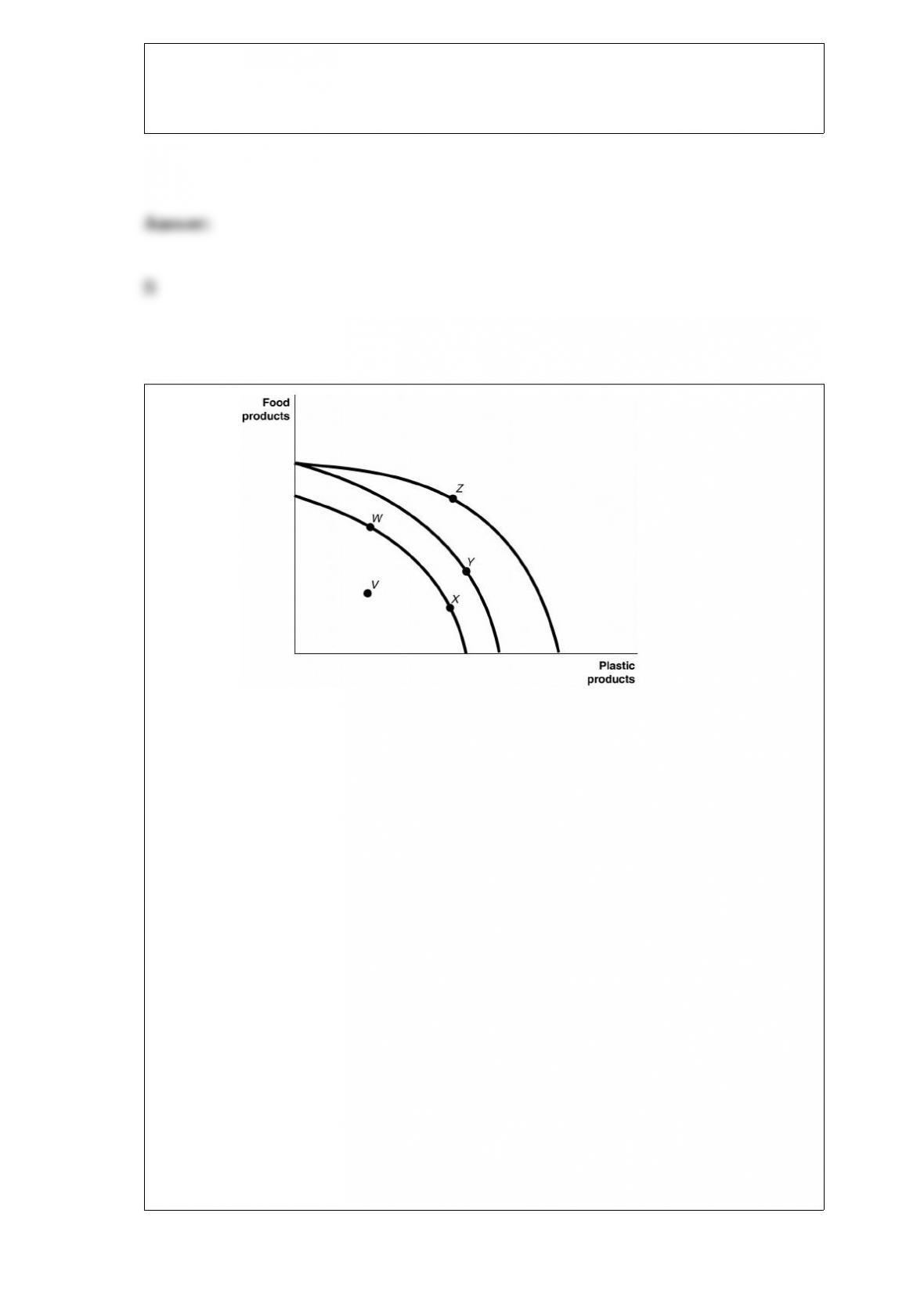
Figure 2-4
Figure 2-4 shows various points on three Different production possibilities frontiers for
a nation.
Consider the following events:
a. a reduction in the patent protection period to no more than 2 years
b. a war that destroys a substantial portion of a nation’s capital stock
c. the lack of secure and enforceable property rights system Which of the events listed
above could cause a movement from W to V?
A) a only
B) a and b only
C) a and c only
D) b and c only
E) a, b, and c
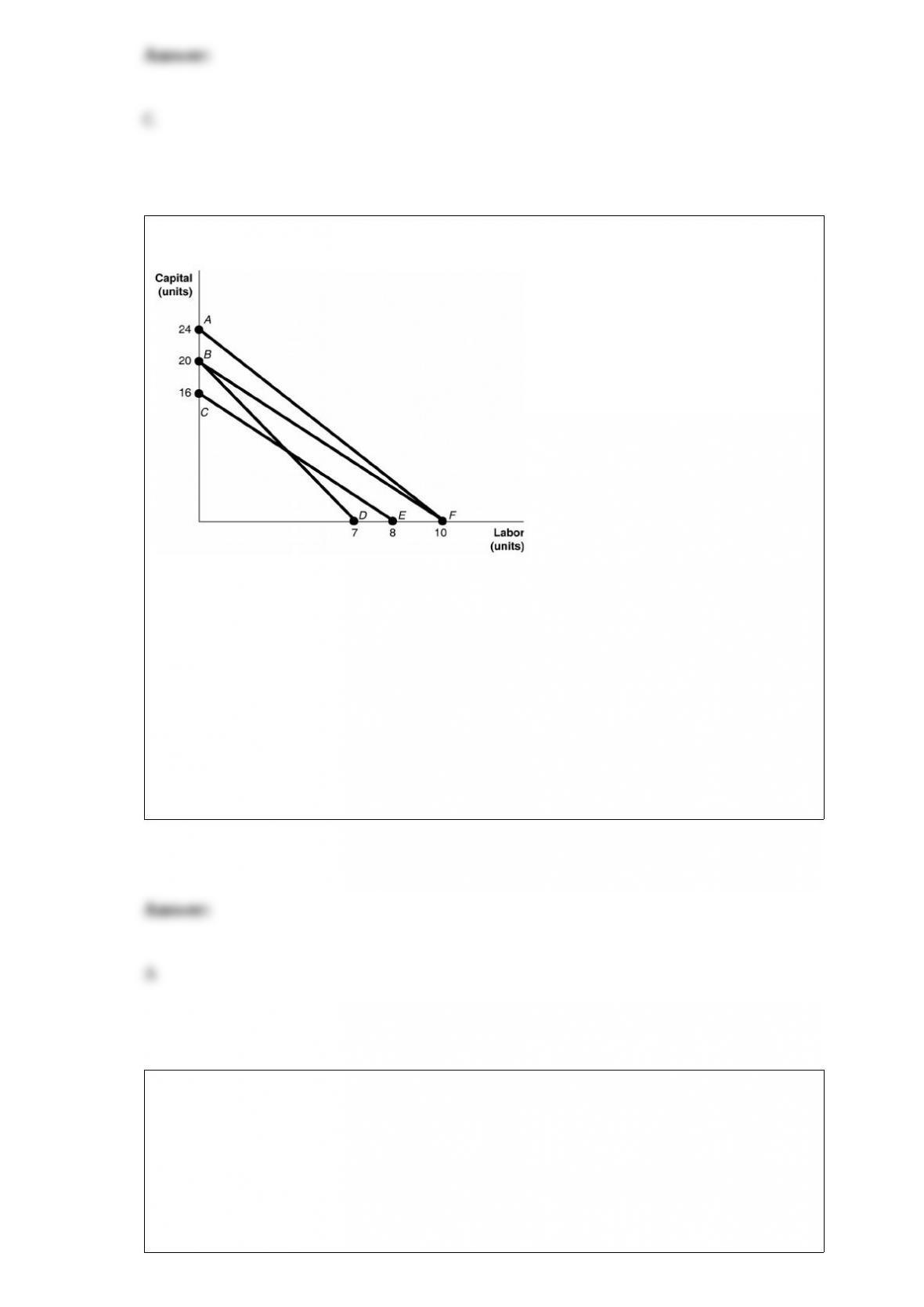
Figure 11-13
The lines shown in the diagram are isocost lines. If the price of labor is $50 per unit,
then along the isocost AF, the total cost
A) is $500.
B) is $750.
C) is $1,250.
D) cannot be determined without the price of capital.
The substitution effect of a price change refers to
A) the change in quantity demanded that results from a change in price making a good
more or less expensive relative to other goods that are substitutes.
B) the shift of a demand curve when the price of a substitute good changes.

C) the movement along the demand curve due to a change in purchasing power brought
about by the price change.
D) the shift in the demand curve due to a change in purchasing power brought about by
the price change.
An agreement among firms to charge the same price or otherwise not to compete is
called
A) a pay-off matrix.
B) a subgame-perfect equilibrium.
C) a Nash equilibrium.
D) collusion.
There are two firms in the residential paint industry, Cool Shades (C) and Warm Hues
(W). They collude to share the market equally. They jointly set a monopoly price and
split the quantity demanded at that price. Here are their options:i. They continue to
collude (no cheating) and make $12 million each in profits.
ii. One firm cheats and the other does not. The firm that cheats makes a profit
of $14 million whereas the firm that doesn’t makes a profit of $9 million.
iii. They both cheat and each firm makes a profit of $7 million.a. Construct a payoff
matrix for these two firms.
b. How does this situation relate to the prisoner’s dilemma?
c. If each firm acted noncooperatively, how much profit would each make?
d. Are the firms better off colluding (with no cheating) or competing? Explain.
An increase in real GDP
A) increases the buying and selling of goods and increases the demand for money as a
medium of exchange.
B) increases the buying and selling of goods and decreases the demand for money as a
medium of exchange.
C) decreases the buying and selling of goods and increases the demand for money as a
medium of exchange.
D) decreases the buying and selling of goods and decreases the demand for money as a
medium of exchange.
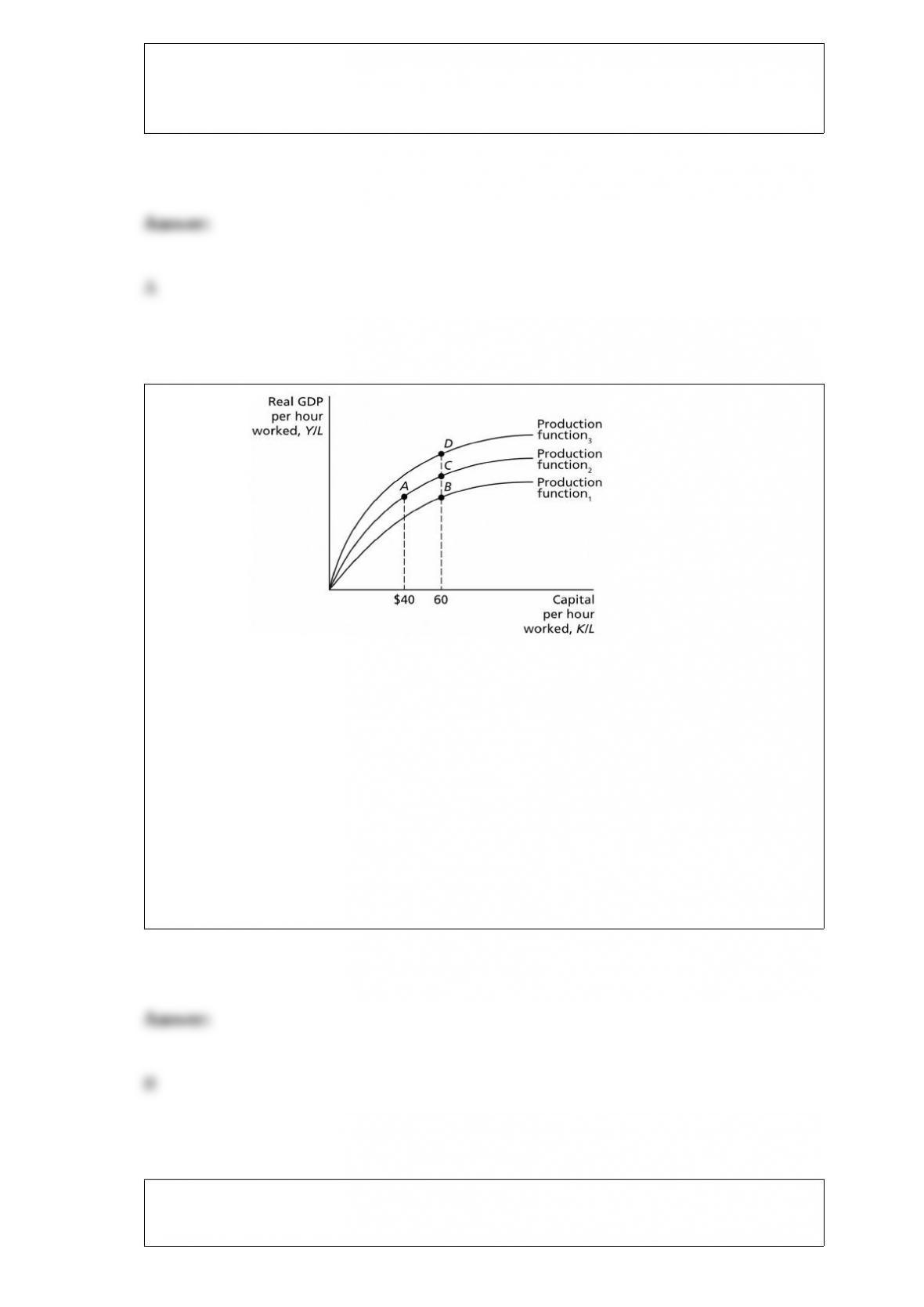
Figure 22-1
Many countries in Africa strongly discouraged and prohibited foreign direct investment
in the 1950s and 1960s. By doing so, these countries were essentially preventing a
moment from
A) A to B.
B) B to C.
C) B to A.
D) D to C.
What is the difference between positive economic analysis and normative economic
analysis? Give one example each of a positive and normative economic issue or
question or statement.
What is the formula for the multiplier? Explain why this formula is considered to be too
simple.
What are the five most important variables that cause the market demand curve for
labor to shift?

What is the difference between net exports and the current account balance?
Why is it necessary for a firm that practices price discrimination be a price maker rather
than a price taker?