
When a tax on output is imposed to internalize the external costs of pollution, the
supply curve shifts down by the amount of the tax.
In the market for factors of production, firms earn income by selling factors of
production to households.
Raising taxes on interest and dividend income will increase the level of investment and
economic growth.
The signaling hypothesis of education states that education is a costly activity that
enhances a worker’s productivity.

In the circular flow model, households demand resources such as labor services in the
factor market.
All economic questions arise from the fact that resources are scarce.
In a market with positive externalities, the market equilibrium price will be greater than
the efficient equilibrium price.
In a perfectly competitive market, in the long run, arbitrage profits will be bid away.

The International Monetary Fund was created to facilitate the borrowing and lending of
dollar reserves to central banks of the countries participating in the Bretton Wood
System.
There are no costs to inflation if it is fully anticipated.
Liquidity increases as we move from the M1 to the M2 definition of the money supply.
Which of the following is not an advantage to a country of choosing to fix its exchange
rate against a major currency, rather than choosing a floating exchange rate?
A) Pegging allows the country more flexibility in conducting monetary policy.
B) Pegging helps avoid inflation in imported goods caused by currency depreciation for
countries with significant levels of imports.
C) Pegging insures that interest payments stemming from foreign loans do not fluctuate
with the value of the currency.
D) Pegging reduces the uncertainty caused by currency fluctuations and thereby
simplifies business planning.
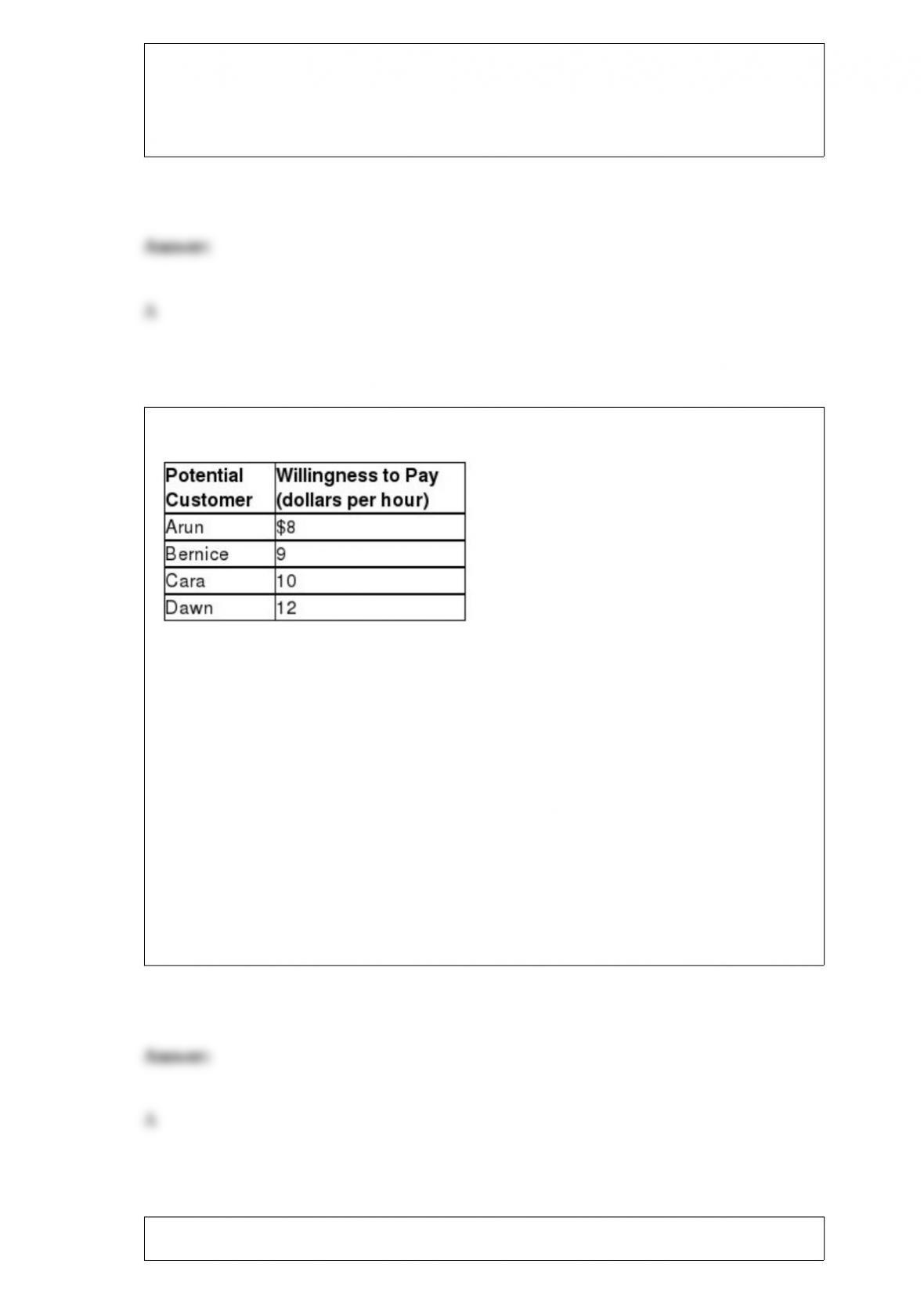
Table 16-3
Julie plans to start a pet-sitting service. She surveyed her neighborhood to determine the
demand for this service. Assume that each person surveyed demands only one hour of
pet sitting services per period. Table 16-3 above shows a portion of her survey results.
If Julie charges $10 per hour, what is the value of the consumer surplus received by
Dawn?
A) $2
B) $10
C) $12
D) $22
If the marginal tax rate is less than the average tax rate as taxable income increases, the

tax structure is
A) regressive.
B) proportional.
C) progressive.
D) unfair.
If a state requires all drivers to purchase auto insurance, insurance companies still face
the problem of
A) correctly pricing their insurance.
B) sunk costs.
C) adverse selection.
D) excess demand for their insurance.
Harvey Morris bought dishes and pitchers made of blue glass during the Great
Depression at a flea market. He later resold these items on eBay. The profits Harvey
earned from these sales are
A) subject to a retail profits tax.
B) are not economic profits because Harvey did not add value to the items but took
advantage of the buyers who were not aware of how much Harvey paid for the items.

C) the result of arbitrage.
D) accounting profits but not economic profits.
If you own a $1,000 face value bond with one year remaining to maturity and a 3
percent coupon rate and new bonds are paying 14 percent, what is the most you can get
for your old bond?
A) $903.51
B) $997.19
C) $1,000
D) $1,140
Which of the following is an example of a “how much” decision?
A) Octavia is debating whether to buy a pair of Jimmy Choo shoes or Steve Madden
boots.
B) Humberto has taken a second job to earn money to buy a Harley-Davidson
SuperLow Sportster.
C) You plan on going to Las Vegas for your birthday and are deciding if you should fly
or drive.
D) Diana is trying to decide if she should open her pet shop on Sundays.
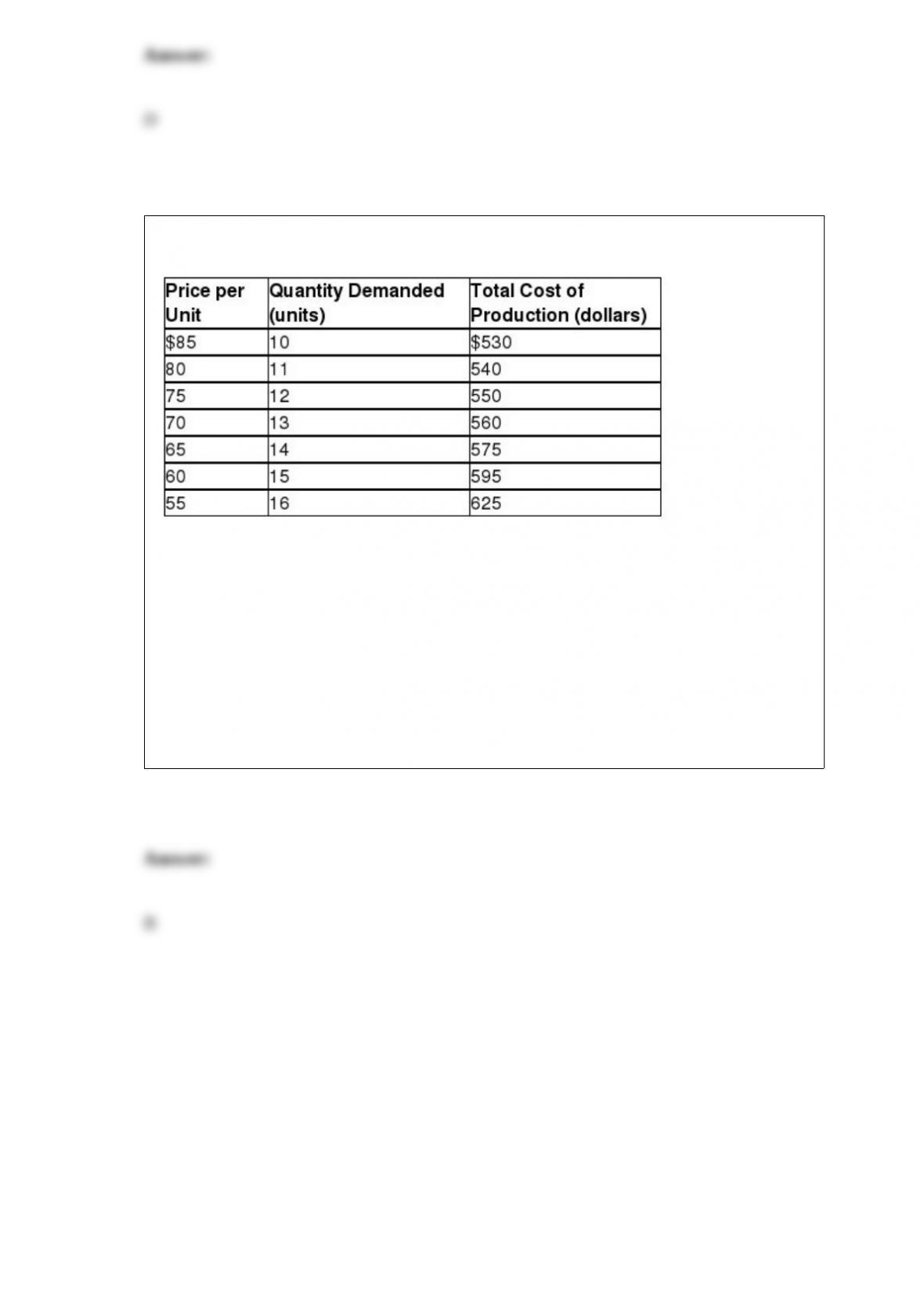
Table 15-1
A monopoly producer of foreign language translation software faces a demand and cost
structure as given in Table 15-1.What is the amount of the firm’s profit?
A) $335
B) $350
C) $880
D) $910
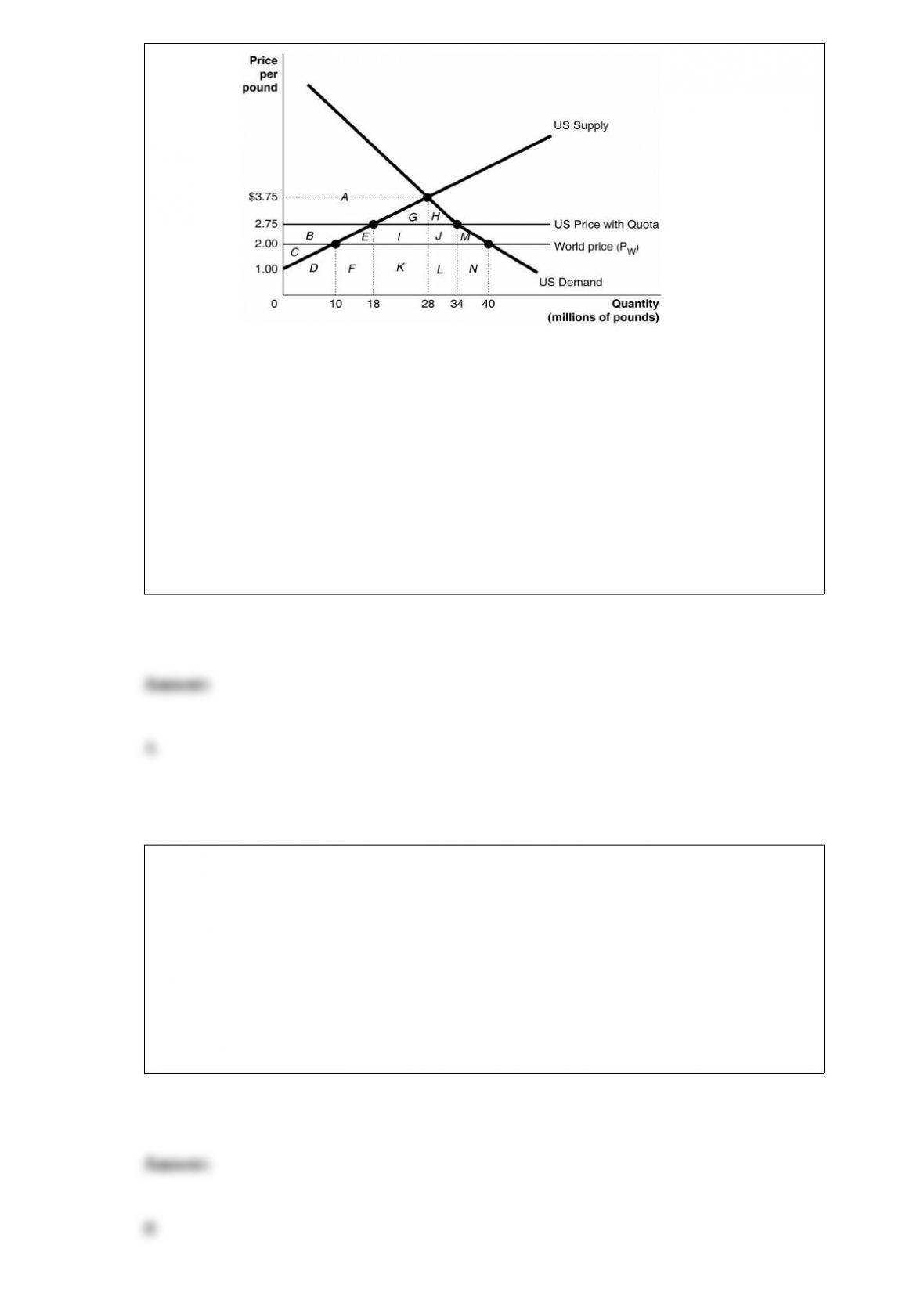
Figure 7-3 Since 1953 the
United States has imposed a quota to limit the imports of peanuts. Figure 7-3 illustrates
the impact of the quota. If there was no quota, how many pounds of peanuts would
domestic producers supply?
A) 10 million
B) 28 million
C) 30 million
D) 40 million
The “terms of trade” refers to
A) the rules and regulations that countries must adhere to when trading.
B) the ratio at which a country can trade its exports for imports from other countries.
C) the role of the government in overseeing international trade.
D) a legal document that specifies the trade quantities agreed to by two countries.

When prices are rising, which of the following will be true?
A) The real interest rate will be lower than the nominal interest rate.
B) The real interest rate will be negative.
C) The real interest rate will be higher than the nominal interest rate.
D) The nominal interest rate will be negative.
If the federal budget has an actual budget deficit of $100 billion and a cyclically
adjusted budget deficit of $75 billion, then the economy
A) must be at potential real GDP.
B) must be below potential real GDP.
C) must be above potential real GDP.
D) could be below or above potential real GDP.
Article Summary. Starting as a Chicago antique store that sold sandwiches on the
side, Potbelly has grown from this 1977 beginning into a company which today
operates approximately 300 sandwich shops in the United States. In October 2013,
Potbelly sold stock for the first time through an initial public offering (IPO), with
shares jumping in price from the initial offering price of $14 to more than $32 on
the same day. Since 2011, Potbelly has seen an increase in in both sales and
revenue, and earned a profit of $2.8 million in the first half of 2013. Source: Matt
Krantz, “Potbelly IPO shares more than double on open,” USA Today, October 4,
2013. When Potbelly sold stock to the public in its IPO, it did so through the NASDAQ
market. This was an example of Potbelly using ________ to raise funds.
A) indirect finance
B) direct finance
C) bonds
D) corporate governance
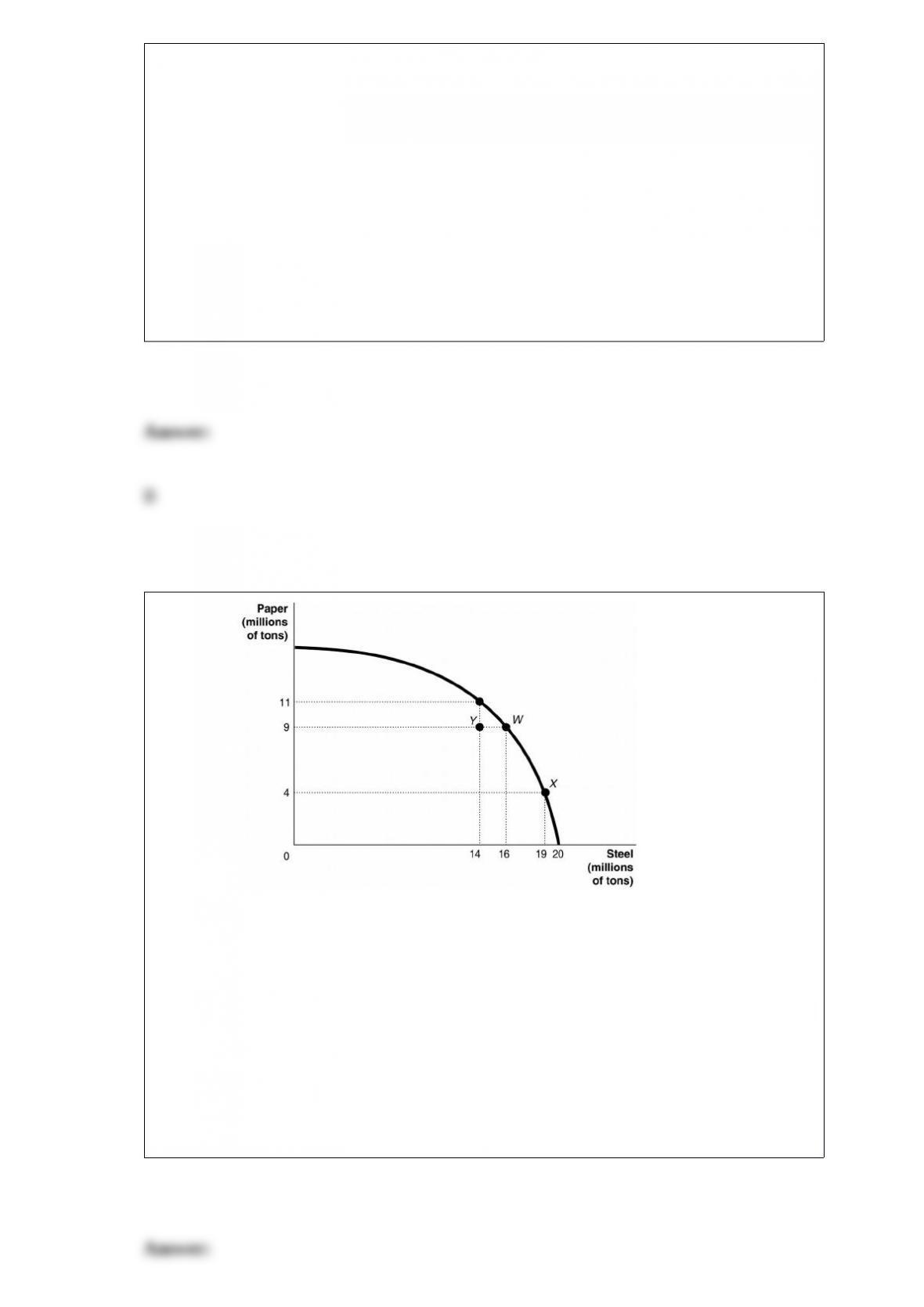
Figure 2-5
If the economy is currently producing at point Y, what is the opportunity cost of moving
to point X?
A) 5 million tons of steel
B) 9 million tons of paper
C) 5 million tons of paper
D) 19 million tons of steel

Article Summary. Brandeis University economist Benjamin Shiller has written a
paper which explains how Netflix could combine demographic data with
customers’ Web browsing habits to more accurately predict how much a customer
would be willing to pay for a Netflix subscription, and how using this method of
first-degree price discrimination would generate higher profits. Shiller explains
that the more information a company has about its customers, the better it is at
being able to set prices to increase profits. As he stated in his paper, “Using all
variables to tailor prices, one can yield variable profits 1.39 percent higher than
variable profits obtained using non-tailored 2nd degree price-discrimination.
Using demographics alone to tailor prices raises profits by much less, yielding
variable profits only 0.14% higher than variable profits attainable under 2nd
degree [price discrimination].”
Source: Brian Fung, “How Netflix could use Big Data to make twice as much
money off you,” Washington Post, September 4, 2013.
The pricing method described in the article is referred to as first-degree price
discrimination. First-degree price discrimination is also known as
A) arbitrage.
B) perfect price discrimination.
C) odd pricing.
D) two-part tariff pricing.
Suppose two countries use different combinations of inputs, such as labor and capital,
to produce the same product. This implies all of the following except that
A) the two countries use different technologies to produce the product.
B) the inputs are not equally productive in the two countries.
C) the prices of the inputs are not the same in the countries.
D) one country is more efficient in the production of the good than the other.
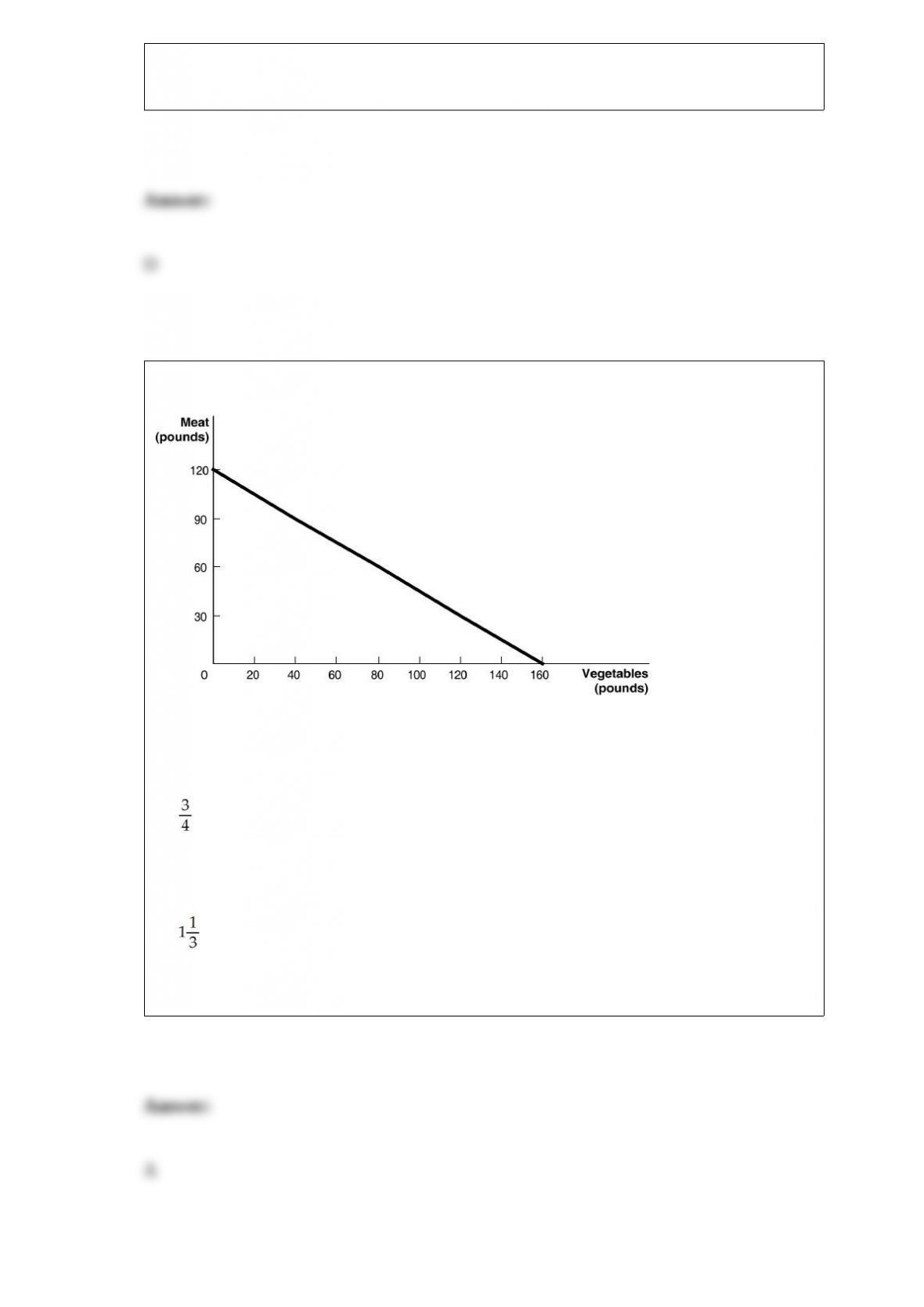
Figure 2-2
Figure 2-2 above
shows the production possibilities frontier for Mendonca, an agrarian nation that
produces two goods, meat and vegetables. What is the opportunity cost of one pound of
vegetables?
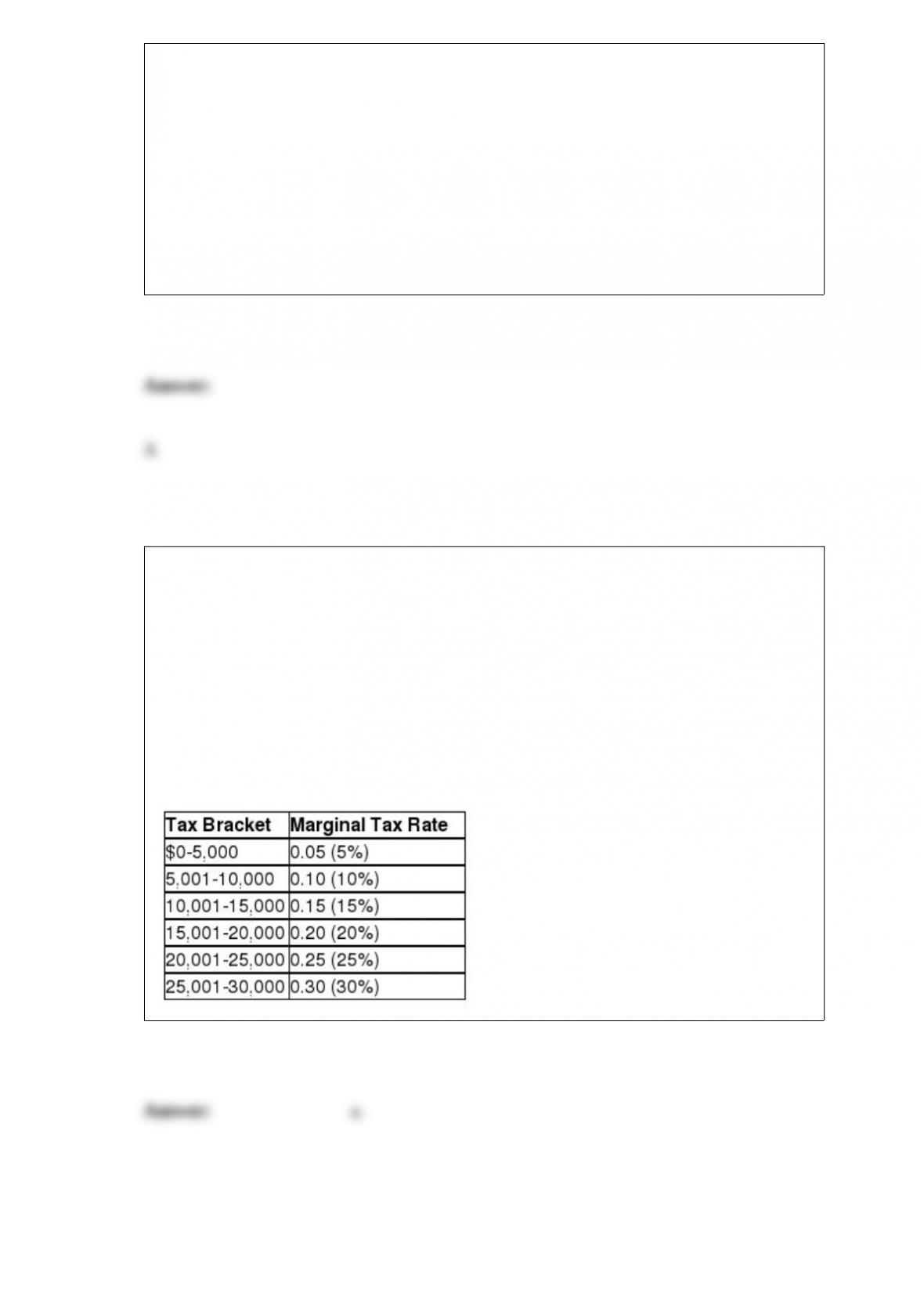
A) pound of meat
B) 1.2 pounds of meat
C) pounds of meat
D) 12 pounds of meat
When the market value of the dollar rises relative to other currencies around the world,
we say that
A) the dollar has appreciated.
B) the dollar has depreciated.
C) the demand for dollars has increased.
D) the supply of dollars has increased.
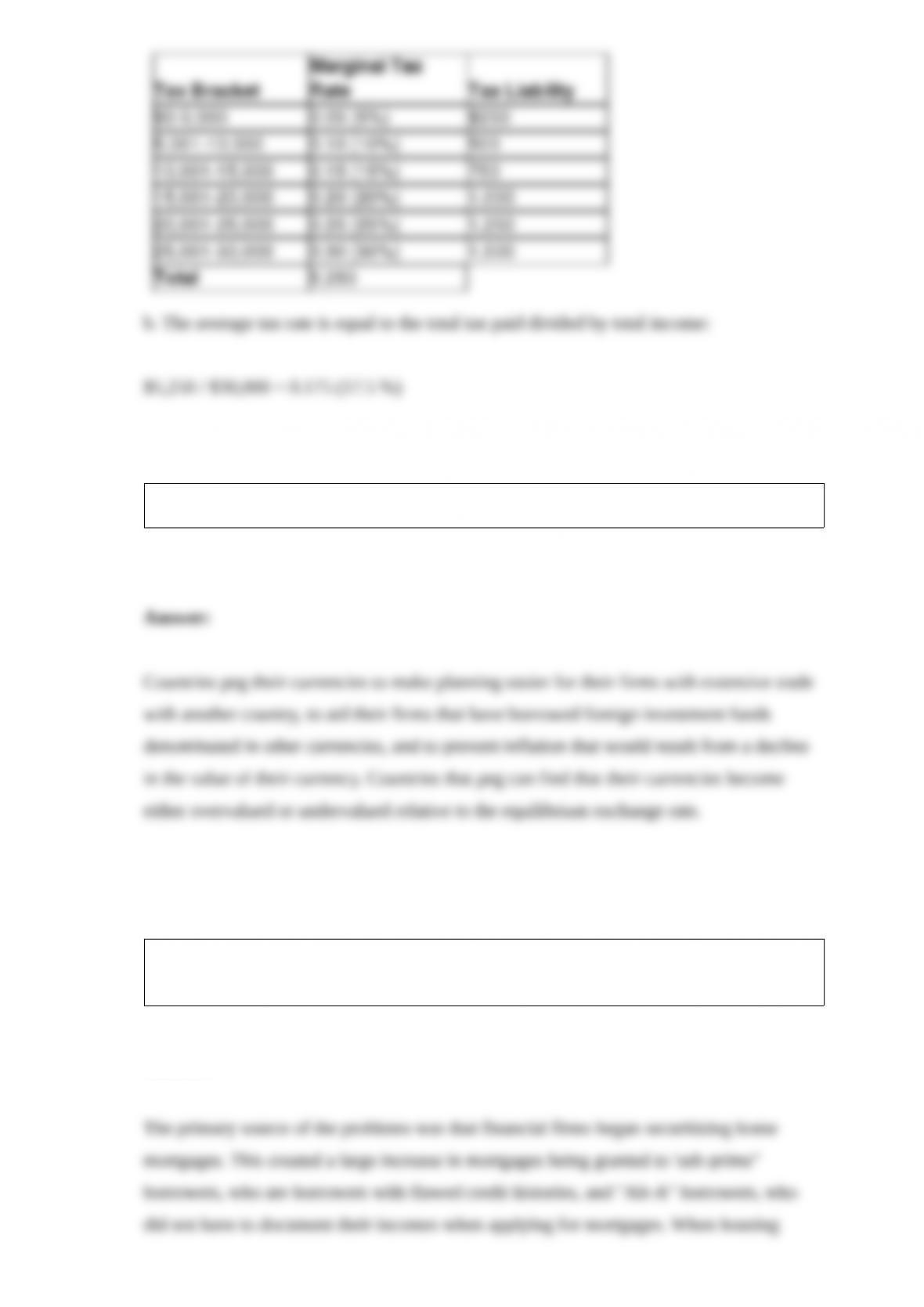
Last year, Anthony Millanti earned exactly $30,000 of taxable income. Assume that the
income tax system used to determine Anthony’s tax liability is progressive. The table
below lists the tax brackets and the marginal tax rates that apply to each bracket.
a. Draw a new table that lists the amounts of income tax that Anthony is obligated to
pay for each tax bracket, and the total tax he owes the government. (Assume that there
are no allowable tax deductions, tax credits, personal exemptions or any other
deductions that Anthony can use to reduce his tax liability).
b. Determine Anthony’s average tax rate.
Why do countries peg their currencies, and what problems can result from pegging?
What was the source of the problems encountered by many financial firms during the
late 2000s?

If American demand for purchases of Mexican goods has increased, how would you
expect the equilibrium exchange rate in the market for dollars to respond? Support your
answer graphically.
Debbie makes porcelain plates in her home and sells them to the Opus gallery. She
spent $400 last month on supplies and made 50 plates. She sold the plates to the gallery
at $25 per plate. The gallery sells all the plates for $40 each. For all of the 50 plates,
what is Debbie’s total value added? For all the 50 plates, what is the gallery’s total value

added?
Show the impact of tax reduction and simplification using the dynamic aggregate
demand and aggregate supply model. Clearly show and identify the impact of the tax
change. Assume that aggregate demand and short-run aggregate supply shift as they
typically do in the dynamic model. Show what happens to the price level and real GDP
because of the tax change.
What are the three main exchange rate systems, and how do they operate?