
An increase in the supply of capital, which is a substitute to labor, will lead to a
decrease in the demand for labor.
The demand for most farm products is relatively inelastic. A drought that reduces the
supply of farm products will also cause farm revenues to fall.
Compared to the previous 20 years, productivity growth in the United States increased
between 1996 and 2012.
Potential GDP is the maximum output a firm is capable of producing.

Roderick received a $100 savings bond for his graduation. The bond pays $100 at
maturity, which is in five years. If the interest rate is 6%, the bond has a present value
of $90.09.
Dell Computers allows potential consumers to customize personal computers to their
desires. Dell’s strategy is successful because offering bundles that more exactly meets a
consumer’s preference allows Dell to extract more consumer surplus.
The demand for The Federalist Papers is likely to be more elastic than the demand for
a best-selling mystery novel.
There will be no deadweight loss if the marginal benefit to consumers is equal to the
marginal cost of production and the sum of consumer surplus and producer surplus is
maximized.

In the United States, corporate profits are taxed at the corporate level and then are taxed
again as personal income in the form of dividend payments.
If the multiplier is 10, the marginal propensity to consume must be 0.1.
Scarcity is defined as the situation that exists when the quantity demanded for a good is
greater than the quantity supplied.
In the United States, partnership profits are taxed at the business level and then are
taxed again as personal income in the form of dividend payments.

One desirable outcome of a market economy is that it leads to a more equitable
distribution of income.
In absolute value, the tax multiplier is greater than the government purchases multiplier.
If a firm charges different consumers different prices for the same product and the
difference cannot be attributed to cost variations, then it is engaging in
A) odd pricing.
B) cost-plus pricing.
C) price discrimination.
D) markup pricing.

The following equations represent the demand and supply for bird feeders.
QD = 35 – P
QS = -5 + 3P What is the equilibrium price (P) and quantity (Q – in thousands) of bird
feeders?
A) P = $10; Q = 25 thousand
B) P = $35; Q = 20 thousand
C) P = $20; Q = 20 thousand
D) P = $5; Q = 30 thousand
To maximize their profits and defend those profits from competitors, monopolistically
competitive firms must
A) lobby government to erect barriers to entry in their industries.
B) limit foreign competition in their markets by encouraging the government to impose
tariffs and other trade restrictions.
C) differentiate their products.
D) achieve economies of scale.

By the 21st century few people purchased printed encyclopedias. Which of the
following competitive forces best explains this?
A) competition from substitutes
B) the bargaining power of buyers
C) the bargaining power of suppliers
D) the threat from potential entrants
By 2012, Iceland’s real GDP ________, and the real GDPs of Italy, Spain, Greece, and
Ireland ________.
A) was still 5 percent lower than its level prior to the financial crisis; were more than 5
percent lower than their precrisis levels
B) had returned to its level prior to the financial crisis; were all higher than their
precrisis levels
C) was still 5 percent lower than its level prior to the financial crisis; had returned to
their precrisis levels
D) had returned to its level prior to the financial crisis; were still 5 percent or more
lower than their precrisis levels
If the marginal propensity to consume is 0.6, the marginal propensity to save is
A) 0.4.

B) 0.6.
C) 1.
D) 1.5.
Which of the following is a factor of production?
A) an acre of forested land
B) a U.S. Treasury bond
C) 20 shares of Ford stock
D) $25,000 in cash
Which of the following is not a requirement for a successful price discrimination
strategy?
A) A firm must have the ability to charge a price greater than marginal cost.
B) Some consumers must have a greater willingness to pay for the product than other
consumers, and the firm must be able to know what prices consumers are willing to pay.
C) The firm must be able to prevent arbitrage.
D) Transactions costs must be the same for all consumers.

A perfectly competitive firm produces 3,000 units of a good at a total cost of $36,000.
The fixed cost of production is $20,000. The price of each good is $10. Should the firm
continue to produce in the short run?
A) No, it should shut down because it is making a loss.
B) Yes, it should continue to produce because its price exceeds its average fixed cost.
C) Yes, it should continue to produce because it is minimizing its loss.
D) There is insufficient information to answer the question.
To have a monopoly in an industry there must be
A) barriers to entry so high that no other firms can enter the industry.
B) a patent or copyright giving the firm exclusive rights to sell a product for 20 years.
C) an inelastic demand for the industry’s product.
D) a public franchise, making the monopoly the exclusive legal provider of a good or
service.

If a typical firm in a perfectly competitive industry is earning profits, then
A) all firms will continue to earn profits.
B) new firms will enter in the long run causing market supply to decrease, market price
to rise and profits to increase.
C) new firms will enter in the long run causing market supply to increase, market price
to fall and profits to decrease.
D) the number of firms in the industry will remain constant in the long run.
Employees at the university have negotiated a 5 percent increase in wages for the next
year, based on their inflation expectations. If inflation is actually 4 percent over the next
year, which of the following will occur?
A) Unemployment of university employees will fall.
B) Real wages for university employees will rise.
C) Inflation will be 5 percent the following year.
D) The decrease in inflation is expected.
Define a partnership.
In Michael Porter’s five competitive forces model, what do the competitive forces
determine?
How is the impact of contractionary monetary policy different in an open economy than
in a closed economy?
Define the tragedy of the commons. Give three examples of common resources. Briefly
explain why common property resources are subject to overuse.
Explain the Difference between a normal good and an inferior good.
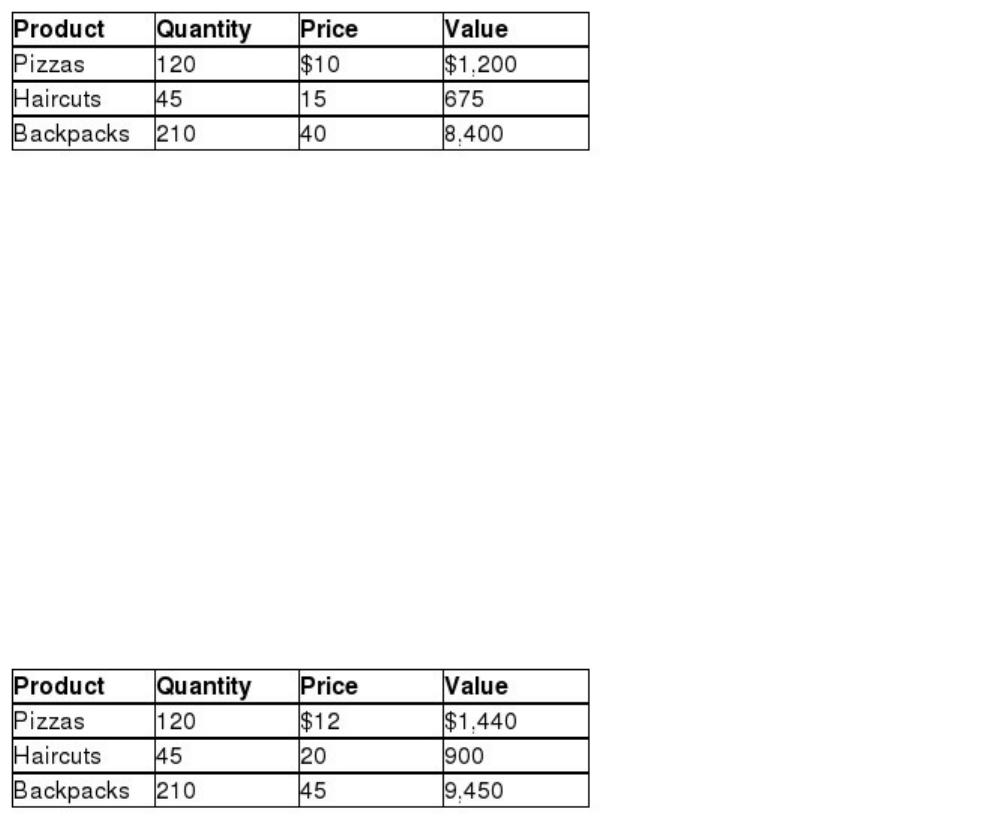
Table 8-24
Suppose that a very simple economy produces three goods: pizzas, haircuts, and
backpacks. Suppose the quantities produced and their corresponding prices for 2007
and 2013 are shown in the table above. Use the information to compute real GDP in the
year 2007 and 2013. Calculate real GDP in 2013 assuming the base year is 2007. Do the
same calculation assuming the base year is 2013. Are the calculations different? Why?

C = 2,800 + 0.9Y
I = 750
G= 1,200
NX = 150 Given the equations for C, I, G, and NX above, what is the equilibrium level
of GDP (Y)?
Briefly describe the Sarbanes-Oxley Act and explain why it was passed.
A firm’s labor demand curve is also its marginal revenue product curve. For both the
perfectly competitive firm and the output price maker, the labor demand curve slopes
downwards. However, there is a difference in the reasons why the labor demand curve
slopes downwards. What is this difference?