
An adequately capitalized bank may obtain brokered deposits without FDIC approval.
Answer:
A borrower making a changing their accountant could be viewed as a negative signal
regarding the borrower’s condition.
Answer:
As more lenders securitize loans, the supply of credit falls.
Answer:
On the cash-based income statement, depreciation is a source of funds.

Answer:
Securitization refers to the process of splitting a single loan into several smaller loans.
Answer:
Vault cash generally satisfies a bank’s liquidity needs.
Answer:
For a given absolute change in interest rates, the percentage increase in an option free
bond’s price will be less than the percentage decrease.
Answer:

Relative to larger banks, smaller banks rely more on non-interest income as a source of
revenue.
Answer:
Most banks have the ability to easily raise new capital by issuing new equity.
Answer:
Before the Great Depression, many U.S. banks operated as universal banks.
Answer:

Financial statements that have been audited are guaranteed to be 100% accurate.
Answer:
Transaction banking emphasizes the personal relationship between the banker and
customer.
Answer:
Foreign branches of U.S. banks are subject to U.S. reserve requirements.
Answer:
Forward contracts rarely require a performance guarantee or collateral.

Answer:
Deposit service charges are a stable source of bank revenue.
Answer:
A long hedge would be appropriate for a bank that wants to reduce its cash market risk
associated with .a decline in interest rates.
Answer:
Duration is an elasticity measure that indicates the relative price sensitivity of different
securities.
Answer:

BMW bank has more financial leverage than its peers.
Answer:
Decreasing capital increases risk by decreasing financial leverage.
Answer:
If a hedger is owns the underlying security, he will be long the futures position.
Answer:

BMW Financial Services is owned by BMW Bank.
Answer:
Offering remote deposit capture is high cost but low risk for a bank.
Answer:
Repurchase agreements generally carry a lower interest rate than comparable maturity
Fed funds.
Answer:
A GAP ratio of less than one is consistent with a negative gap.

Answer:
Community banks relied more on investment banking, relative to larger banks, to
increase non-interest income.
Answer:
When futures prices falls, buyers gain at the expense of sellers.
Answer:
Mortgage defaults were greatest in geographic markets that had experienced the
greatest run-up in real estate prices.
Answer:

The Internet has led to larger spreads for more standardized loan products.
Answer:
Financial holding company and bank holding company are different names for the same
type of entity.
Answer:
Bank regulations can guarantee that bankers will make sound management decisions.
Answer:

Core deposits tend to be more interest elastic than volatile liabilities.
Answer:
Loans that are seasonal in nature should be self-liquidating.
Answer:
The best measure of bank asset liquidity is the core deposits to total asset ratio.
Answer:
When you sell a futures contract, your futures position is:
a. flat.
b. long.

c. short.
d. the same as the cash position.
e. b. and d.
Answer:
Loans typically fall into each of the following categories except:
a. real estate.
b. individual.
c. commercial.
d. agricultural.
e. municipal.
Answer:
A bond has a Macaulay’s duration of 21 years. If rates rise from 5% to 5.5%, the bonds
price will:
a. increase by approximately 1%.

b. decrease by approximately 1%.
c. increase by approximately 10%.
d. decrease by approximately 10%.
e. Not enough information is given to answer the question.
Answer:
Interest expense varies between banks because of:
a. rate effects.
b. composition effects.
c. volume effects.
d. all of the above.
e. a. and c.
Answer:
Which of the following is a disadvantage of using a debit card?
a. The consumer is charged higher finance charges than on a credit card.
b. The consumer loses float.
c. They have higher processing costs than ATMs.
d. They have lower processing costs than checks.
e. They are not widely available.
Answer:
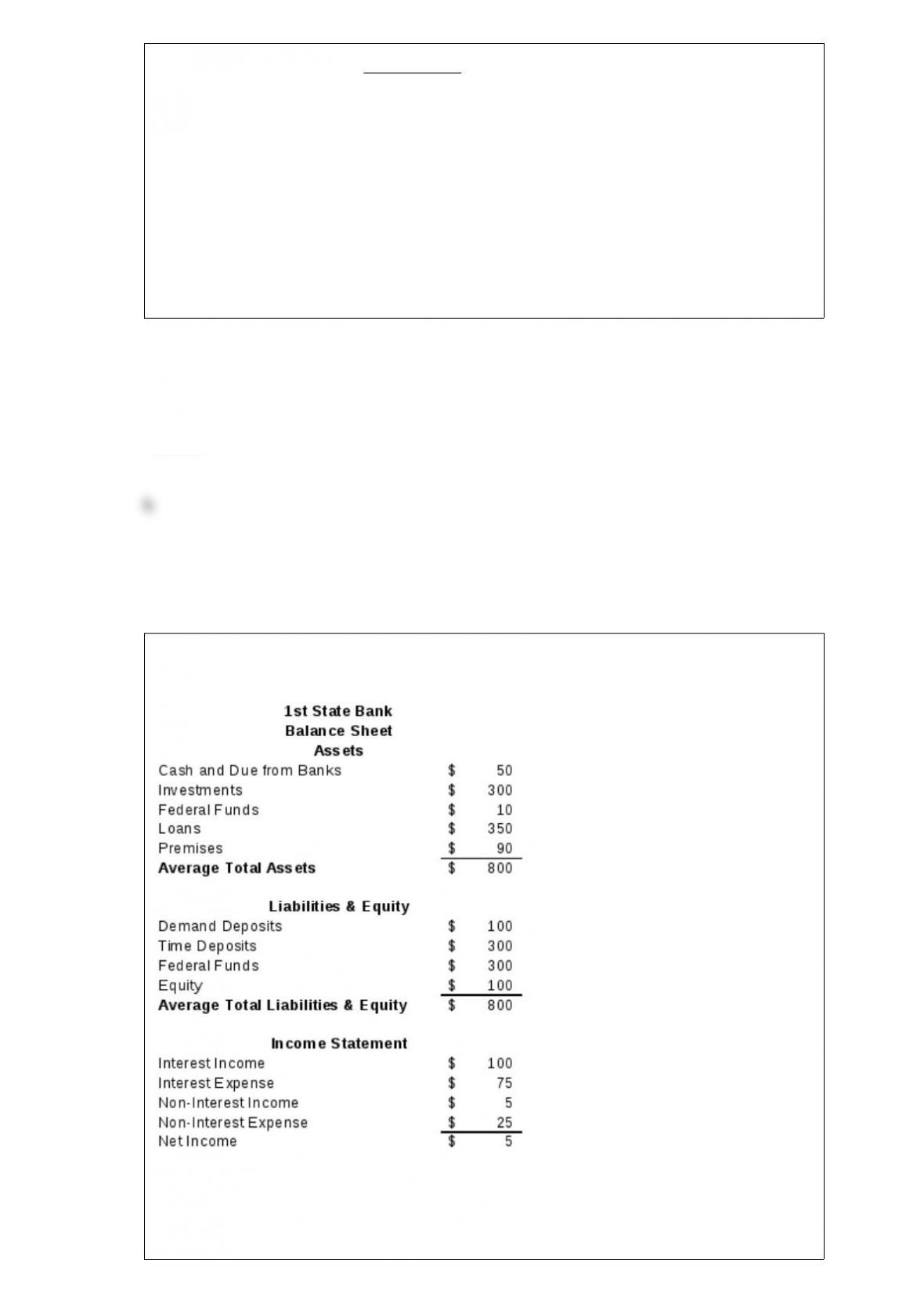
Use the following information.
What is 1st State’s burden ratio?
a. 2.5%

b. 17.5%
c. 25.0%
d. 75.5%
e. 82.5%
Answer:
Use the following information.
A bank customer is granted credit for a $2,000 loan at 10% to be repaid in 12 equal
installments.
If the loan is a discount loan, what is the monthly payment?
a. $200.00
b. $192.35
c. $184.20
d. $173.12
e. $166.67
Answer:

Earnings-at-risk:
a. considers only interest rate “shocks.”
b. is only an effective measure for 90 day intervals or less.
c. examines the change in asset composition, given a change in bank liabilities.
d. examines the variation in net interest income associated with various changes in
interest rates.
e. None of the above.
Answer:
For a bank that has a negative duration gap, a decrease in interest rates will cause a(n)
_______ in the economic value of assets that is _______ than the _______ in the
economic value of liabilities, and a(n) _______ in the economic value of equity.
a. increase, less, increase, decrease
b. increase, greater, increase, decrease
c. increase, less, decrease, increase
d. decrease, less, decrease, increase
e. decrease, greater, decrease, decrease

Answer:
How efficiently a firm is using its assets is measured by:
a. liquidity ratios.
b. market value ratios.
c. profitability ratios.
d. activity ratios.
e. leverage ratios.
Answer:
How many 90-day Eurodollar futures contracts should a bank purchase to hedge the
roll-over of a 1-year, $5 million loan if loan rates and Eurodollar rates have the same
volatility?
a. 1 contract
b. 5 contracts
c. 10 contracts
d. 20 contracts
e. 50 contracts

Answer:
Goldman Group listed all of the following key risk faced by the firm in its 2007 annual
report except:
a. widening credit spreads..
b. an increase in the number of securities underwritings.
c. declines in equity values.
d. declines in the number of mergers and acquisitions.
e. an increase in market volatility.
Answer:
Supplementary or Tier 2 capital does not include:
a. hybrid capital instruments
b. intermediate-term preferred stock
c. cumulative perpetual preferred stock
d. long-term preferred stock

e. noncumulative perpetual preferred stock
Answer:
Why do banks generally prefer lower capital requirements?
a. To minimize the impact shareholders have on management decisions.
b. To increase the influence of bank regulators.
c. To increase a bank’s return on equity.
d. To increase depositor protection.
e. To maximize operating leverage.
Answer:
Which of the following is a hybrid form of equity that effectively pays dividends that
are tax deductible and is considered Tier 1 capital?
a. Common stock
b. Preferred stock
c. Trust preferred stock
d. Leases

e. Trust subordinated debt
Answer:
The _________ gave regulatory responsibility over financial holding companies to the
Federal Reserve..
a. Riegle-Neal Interstate Banking and Branching Efficiency Act
b. Gramm-Leach-Bliley Act
c. Financial Institutions Reform, Recovery and Enforcement Act
d. Federal Deposit Insurance Corporation Improvement Act
e. Depository Institutions Deregulation and Monetary Control Act
Answer:
Which of the following is not a characteristic of jumbo CDs?
a. They have a minimum maturity of 7 days.
b. Interest rates are quoted on a 365-day year.
c. They are generally issued at face value.

d. They are only insured up to $250,000 per individual per institution.
e. All of the above are characteristics of jumbo CDs
Answer:
National and state charters are available for all of the following except:
a. credit unions.
b. commercial banks.
c. savings associations.
d. Federal Reserve banks.
e. National and state charters are available for all of the above.
Answer:
Non-performing international loans do not completely reflect potential losses because:
a. foreign governments have never defaulted on their debts.
b. banks often loan borrowers funds to make payments on existing loans.
c. U.S. banks can easily recover the funds in foreign courts.

d. the U.S. government has strongly discouraged U.S. banks from making international
loans.
e. all of the above
Answer:
Which of the following does not affect net interest income?
a. Changes in the level of interest rates.
b. Changes in the volume of earning assets.
c. Changes in the portfolio mix of earning assets.
d. The yield curve changing from upward sloping to inverted.
e. All of the above affect net interest income.
Answer:
The risk of potential loss of interest and principal on international loans due to
borrowers in a country refusing to make timely payments, as per the loan agreement is
known as what type of risk?
a. International risk
b. Foreign risk

c. Continent risk
d. Country risk
e. Government risk
Answer:
The vast majority of credit card revenues comes from:
a. merchant discounts.
b. net credit gains.
c. advertising revenue.
d. interest income and annual fees.
e. interchange fees.
Answer:
Currently, the Fed sets the discount rate __________ the target fed funds rate.
a. 1% – 1.5% below
b. 2% – 2.5% below

c. 3% – 3.5% above
d. 2% – 2.5% above
e. 1% – 1.5% above
Answer:
The European Community is currently made up of how many member countries?
a. 20
b. 25
c. 29
d. 30
e. 32
Answer:
All of the following would be generally be considered acceptable commercial loan
purposes except:
a. seasonal cash needs.

b. paying off other bank debts.
c. purchasing new equipment.
d. acquiring another firm.
e. expanding plant capacity.
Answer:
Which of the following indicates the potential demand for new loans?
a. Low business growth and activity
b. A relatively large percentage of demand deposits
c. Large, unused commercial credit lines outstanding
d. Large deposits held by a single customer
e. The level of uninsured deposits
Answer:
Banks experience diseconomies of scale when:
a. marginal costs increase as total costs decrease.

b. total costs decrease as output decreases.
c. total costs increase as output increases.
d. average unit costs increase as output increases.
e. average unit costs decrease as output increases.
Answer:
A 20-year zero coupon bond with a face value of $1,000 is currently selling for $214.55
and has a market rate of interest of 8%. Using the bond’s modified duration, what is the
approximate change in the price of the bond if interest rates rise to 9%?
a. Increase of $39.73
b. Increase of $18.52
c. Decrease of $39.73
d. Decrease of $18.52
e. Not enough information is given to answer the question.
Answer:

For the same change in interest rates bondholder’s will realize:
a. a greater capital gain when rates rise than capital loss when rates fall
b. a greater capital gain when rates fall than capital loss when rates rise
c. a greater capital loss when rates rise than capital gain when rates fall
d. a greater capital loss when rates fall than capital gain when rates rise
e. the same capital gain or loss when rates rise or fall
Answer:
A bank’s GAP is defined as:
a. the dollar amount of rate-sensitive assets divided by the dollar amount of
rate-sensitive liabilities.
b. the dollar amount of earning assets divided by the dollar amount of total liabilities.
c. the dollar amount of rate-sensitive assets minus the dollar amount of rate-sensitive
liabilities.
d. the dollar amount of rate-sensitive liabilities minus the dollar amount of
rate-sensitive assets.
e. the dollar amount of earning assets times the average liability interest rate.
Answer:

The lowest rating category for a subprime loan is:
a. A
b. B
c. C
d. D
e. E
Answer:
An interest rate collar consists of:
a. buying an interest rate cap and selling an interest rate floor.
b. buying an interest rate floor and selling an interest rate cap.
c. selling an interest rate floor and buying an interest rate cap.
d. buying a call option and selling a futures contract.
e. selling a put option and buying a futures contract.
Answer:

Which of the following is not a characteristic of a typical commercial bank?
a. Most banks own few fixed assets.
b. Most banks have a high degree of operating leverage.
c. Most banks have few fixed costs.
d. Many bank liabilities are payable on demand.
e. Banks generally operate with less equity capital than non-financial firms.
Answer:
Credit card issuers earn income from:
a. annual fees.
b. interest on outstanding balances.
c. discounting the charges that merchants accept on purchases.
d. All of the above.
e. a. and b. only
Answer:

The section of a contingency plan that assesses the impact of potential adverse events
on the bank’s balance sheet is known as the _________ section?
a. narrative
b. qualitative
c. quantitative
d. summary
e. descriptive
Answer: