
1) The largest factor that raised labor productivity in the U.S. economy since the 1950’s
has been the increased amount of capital available.
2) When a nation is experiencing a balance-of-payments deficit, its treasury or central
bank will engage in a net sale of its official reserves.
3) Malthus’s theory states that living standards could only temporarily rise above
subsistence levels.
4) If the banking system has $20 billion in excess reserves and if the reserve ratio is 10
percent, the system can increase its loans by a maximum of $22 billion.
5) A nation that wants to invest in more newly created capital in the present must be
willing to forgo present consumption.
6) Price discrimination is not viable if consumers can resell the products they purchase.
7) The U.S. has a trade deficit in goods, but a trade surplus in services.
8) If the monetary authority wishes to rein in inflation, it would buy government
securities in the open market.
9) At the inelastic portion of a monopolist’s demand curve, the marginal revenue of each
extra unit of output is positive.
10) One clear effect of labor unions is an increase in the wage rates of their members.
11) An asset’s price and rate of return are directly related.
12) People who engage in mental accounting are more likely to purchase overpriced
warranties.
13) About two-thirds of U.S. electricity is generated at coal and gas plants.
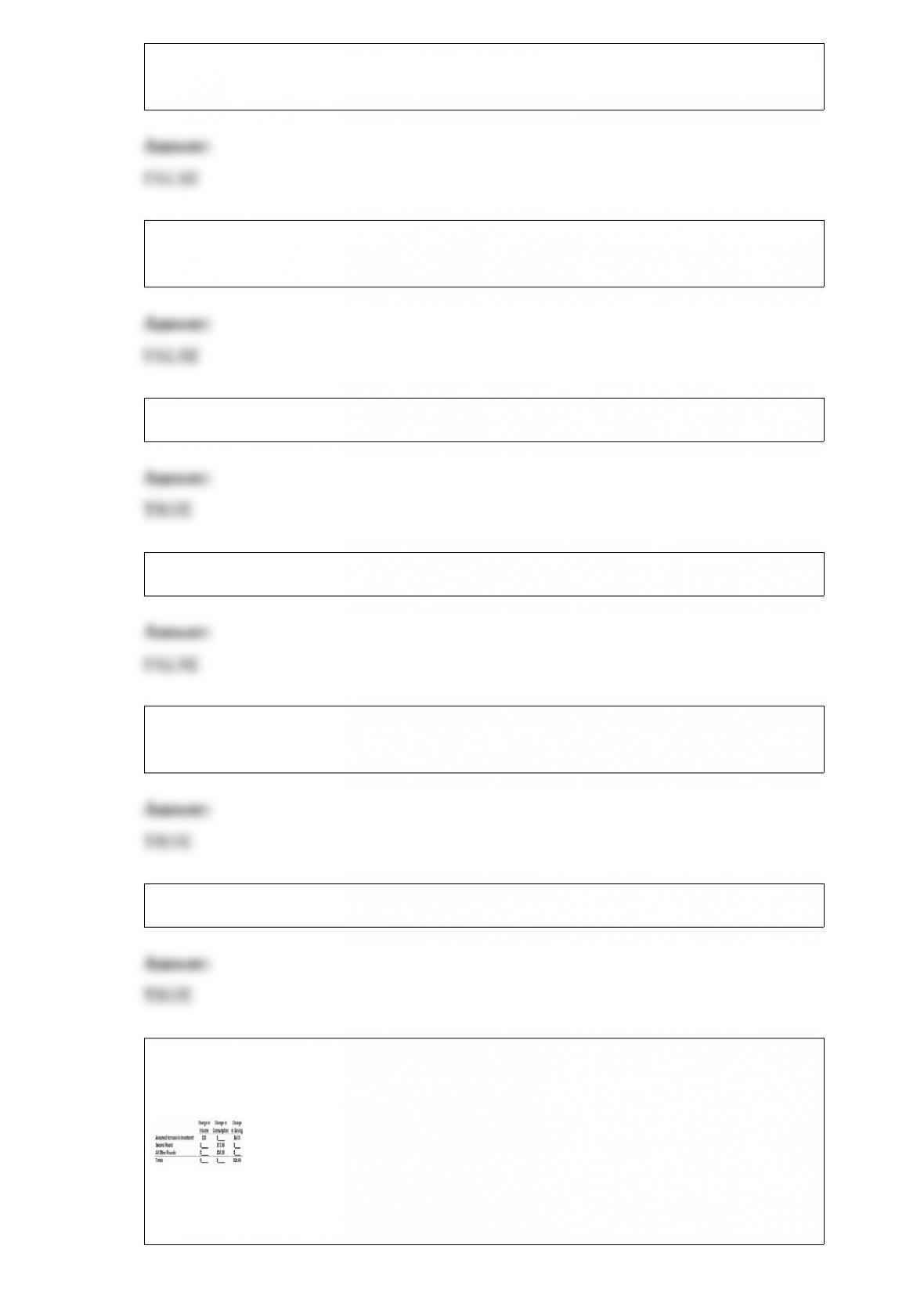
14) Answer the question on the basis of the following table that illustrates the multiplier
process.
Refer to the given table. The total change in income resulting from the initial change in
investment will be:

A.$100.
B.$20.
C.$80.
D.$200.
15) Monopolistically competitive and purely competitive industries are similar in that:
A.both are assured of short-run economic profits.
B.both produce differentiated products.
C.the demand curves facing individual firms are perfectly elastic in both industries.
D.there are few, if any, barriers to entry.
16) Many people do not steal or commit fraud because to them, the resulting feelings of
guilt and uneasiness make the:
A.Marginal utility of the act increase
B.Marginal utility of the act decrease
C.Marginal cost of the act increase
D.Marginal cost of the act decrease
17) Riskier investments tend to sell for:
A.lower prices so they provide a higher expected rate of return to compensate for risk.
B.higher prices so they provide a higher expected rate of return to compensate for risk.
C.higher prices; that is why they are considered to be riskier.
D.prices directly correlated with expected rates of return.
18) Studies generally show that if there is more investment in capital goods in DVCs,
there will be greater:
A.Capital flight
B.Economic growth
C.Underemployment
D.Unemployment

19) Parity prices for agricultural products are based on the relative purchasing power of
farm products during the period of:
A.1910-1914
B.1929-1939
C.1941-1945
D.1960-1970
20) Which of the following is not an assumption of the theory of consumer behavior
described in this chapter?
A.The consumer has make decisions within a given budget constraint
B.The consumer experiences diminishing marginal utility from consuming goods
C.The consumer’s tastes and preferences continually change within the period studied
D.The consumer aims to get maximum total utility out of a given budget
21) Which of the following best explains why total compensation for U.S. workers has
increased significantly over the past several decades, but take-home pay by U.S.
workers has increased by much less?
A.An increased share of total compensation has gone to provide health insurance to
workers.
B.The share of total compensation going to retirement accounts has increased relative to
all other components of compensation.
C.Total compensation is measured in current dollar terms; take-home pay is measured
in inflation-adjusted dollars.
D.Workers are receiving a much larger share of total compensation in the form of goods
and services produced by the firms that employ them.
22) The table below shows four different currencies and how much of each currency
can be purchased with a U.S. dollar.
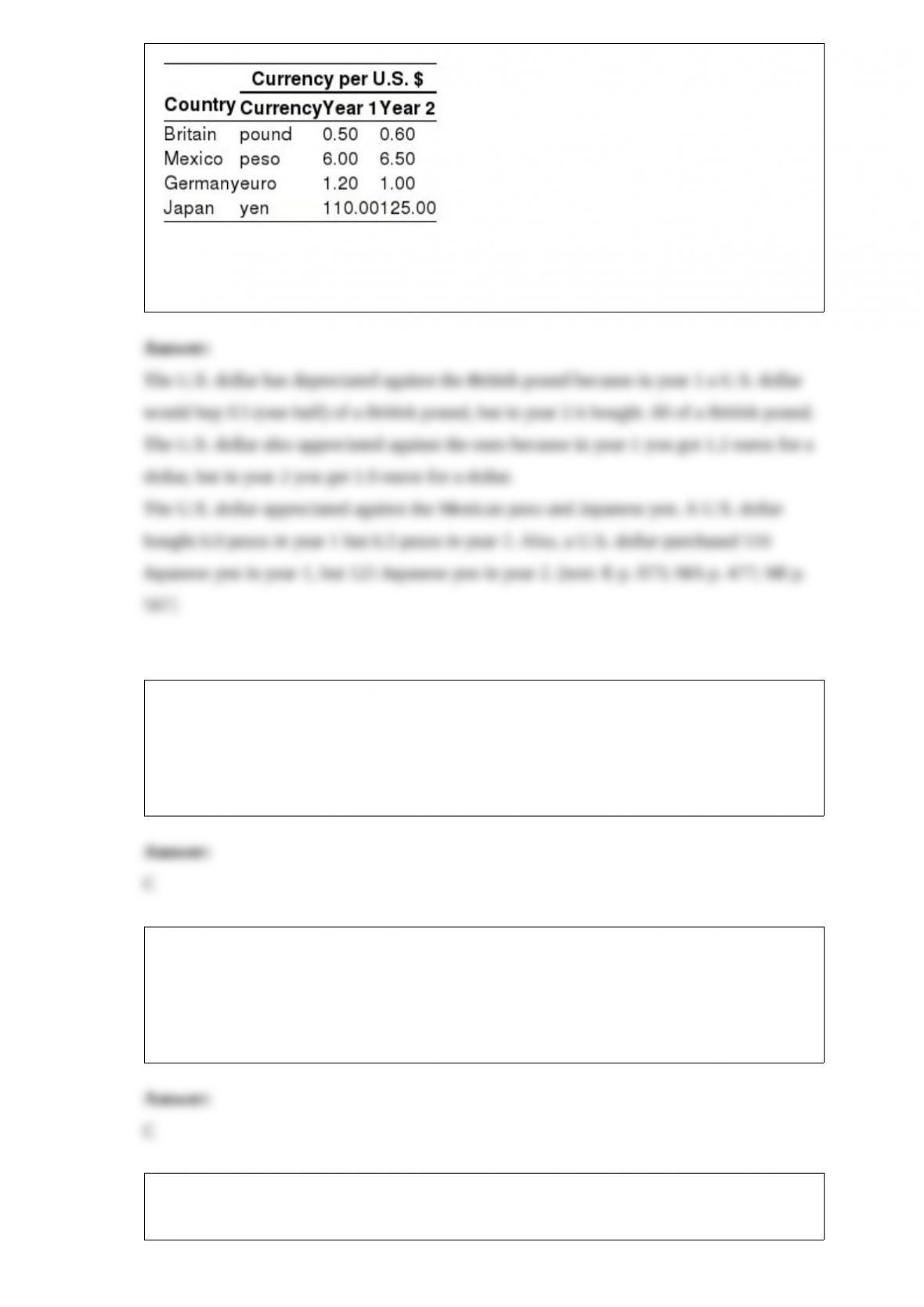
Among which nations has the U.S. dollar appreciated (A) or depreciated (D) from year
1 to year 2? Explain the appreciation or depreciation using the nations and numbers in
the table.
23) In long-run equilibrium, monopolistic competition entails:
A.an efficient allocation of resources.
B.an overallocation of resources due to inadequate capacity.
C.an underallocation of resources due to excess capacity.
D.production at the minimum attainable average total cost.
24) Which among the following countries had the highest GDP per person in 2011?
A.Mexico
B.India
C.Russia
D.China
25) If the dollar appreciates relative to foreign currencies, then:
A.U.S. goods will look cheaper to foreign buyers

B.Foreign goods will look more expensive to U.S. buyers
C.Net exports of the U.S. will increase
D.Foreign buyers will find U.S. goods become more expensive
26) Per se violations in antitrust law refer to:
A.Activities that are illegal in and of themselves
B.Violations that are alleged but not yet proven
C.Cases that are subject to the rule of reason
D.Antitrust cases that are pending resolution
27) The MPC for an economy is:
A.the slope of the consumption schedule or line.
B.the slope of the savings schedule or line.
C.1 divided by the slope of the consumption schedule or line.
D.1 divided by the slope of the savings schedule or line.
28) John’s friend Rosika won a major lottery jackpot. Seeing this, and despite the fact
that millions don’t win and the odds of winning are infinitesimal, John goes out and
buys a bunch of lottery tickets despite struggling financially. John’s decision to buy the
lottery tickets under these circumstances would best be explained by the:
A.hindsight bias.
B.self-serving bias.
C.confirmation bias.
D.availability heuristic.
29)
30) What is shown by the budget line in a two-product (A and B) case? Describe what
happens when there is a change in income or the price of a product.
31) C.
32) “A major reason the economy of the former Soviet Union collapsed was due to a
lack of incentives that are provided by the profit system.” Evaluate.
33) How will a sustained appreciation of the U.S. dollar over time likely affect U.S. net
exports?
34) Why do solutions to the principal€agent problem sometimes produce problems?
Give an example.