
The rules of the international monetary system are enforced by the World Bank.
The substitution effect of a wage decrease examines the effect of the decrease in wage
income on a worker’s ability to consume goods and services.
Corporations are legally owned by their shareholders.
The social cost of a good or service is the cost borne by the producer.

Members of management serving on the board of directors of a corporation are referred
to as outside directors.
An increase in the price of inputs will cause the supply curve for a product to shift to
the right.
The demand for gasoline is perfectly inelastic because most people need gasoline to
drive their cars.
A monopolist currently sells 18 units of a good. If marginal revenue on the last unit sold

is $117, then the price of the good must be less than $117.
Firms in monopolistic competition compete by selling similar, but not identical
products.
NAFTA is the international organization that enforces the rules of international trade
worldwide.
In the long run, all of a firm’s inputs are variable.

An isoquant is a curve that shows all the combinations of two inputs that will produce
the same level of output.
Allocative efficiency is achieved in an industry when firms supply those goods and
services that provide consumers with a marginal benefit equal to the marginal cost of
producing those goods and services.
If, when price changes by 35 percent, the quantity demanded changes by 7 percent, then
the absolute value of the price elasticity of demand is 5.

If the government wants to minimize the welfare loss of a tax, it should tax goods with
more inelastic demands or supplies.
The payment received by suppliers of entrepreneurial skills is called wages.
The Japanese system of universal health insurance requires no co-payments from
residents for health services.
The minimum point on the average variable cost curve is called the loss-minimizing
point.

A perfectly competitive firm breaks even at a price equal to its minimum average total
cost.
Since Poland joined the European Union in 2004, many young and educated Poles have
emigrated to the United Kingdom. As a result, the labor supply curve in the United
Kingdom shifts to the right and the equilibrium wage rises.
In reality, because few markets are perfectly competitive, some loss of economic
efficiency occurs in the market for nearly every good or service.

In the short run, a profit-maximizing firm will shut down if its total revenue is greater
than its variable costs.
Canada has a single-payer health care system in which the government provides
national health insurance to all Canadian residents.
The market demand curve facing a monopolist is more elastic than the market demand
curve facing a monopolistic competitor.
In a centrally planned economy, the households and firms decide how economic
resources will be allocated.

International business is any commercial transaction that crosses the borders of two or
more nations.
An externality refers to economic events outside a market.
Flexible labor markets allow workers to be redeployed rapidly to sectors of the
economy where they are highly valued.

The World Trade Organization’s dispute settlement system has the ability to penalize
offending nations.
Economists believe that cost-plus pricing may be the best way for a firm to determine
its optimal product price when the firm’s marginal cost and average cost are about the
same and when it is difficult to estimate the product’s demand curve.
In many European countries it is much easier than in the United States for unemployed
workers to receive generous wage replacement income from their governments.
A Lorenz curve summarizes the information provided by a Gini coefficient.

The principal-agent problem that exists between shareholders and managers also exists
between managers and workers.
Minimum efficient scale is defined as the level of output at which the short-run average
total cost stops decreasing.
If a firm’s fixed cost exceeds its total revenue, the firm should stop production by
shutting down temporarily.

Moral hazard refers to the actions people take after they have entered into a transaction
that make the other party to the transaction worse off.
In economics, the optimal level of pollution is the level for which the net benefit from
reducing the pollution is the greatest.
Labor demand is considered a derived demand because producers do not demand labor
for itself but only because labor is used to produce output that consumers desire.
Consumer surplus is the difference between the highest price someone is willing to pay
for a product and the price he actually pays for the product.

The ability to engage in product differentiation is one of the factors a manager or owner
of a firm can control in order to create value for consumers.
Suppose that in a market for used cars, there are good used cars and bad used cars
(lemons). Consumers are willing to pay as much as $6,000 for a good used car but only
$1,000 for a lemon. Sellers of good used cars value their cars at $5,000 each and sellers
of lemons value their cars at $800 each. Buyers cannot tell if a used car is reliable or is
a lemon. Based on this information, what is the likely outcome in the market for used
cars?
A) Sellers of good used cars will drop out of the market.
B) Sellers of good used cars will incur losses.
C) Sellers of lemons will drop out of the market.
D) Used cars will sell for $3,000.
When an investor buys a corporate bond, the ________ the bond is a loan to the
corporation.
A) interest on
B) face value of
C) coupon payment on
D) dividend payment on
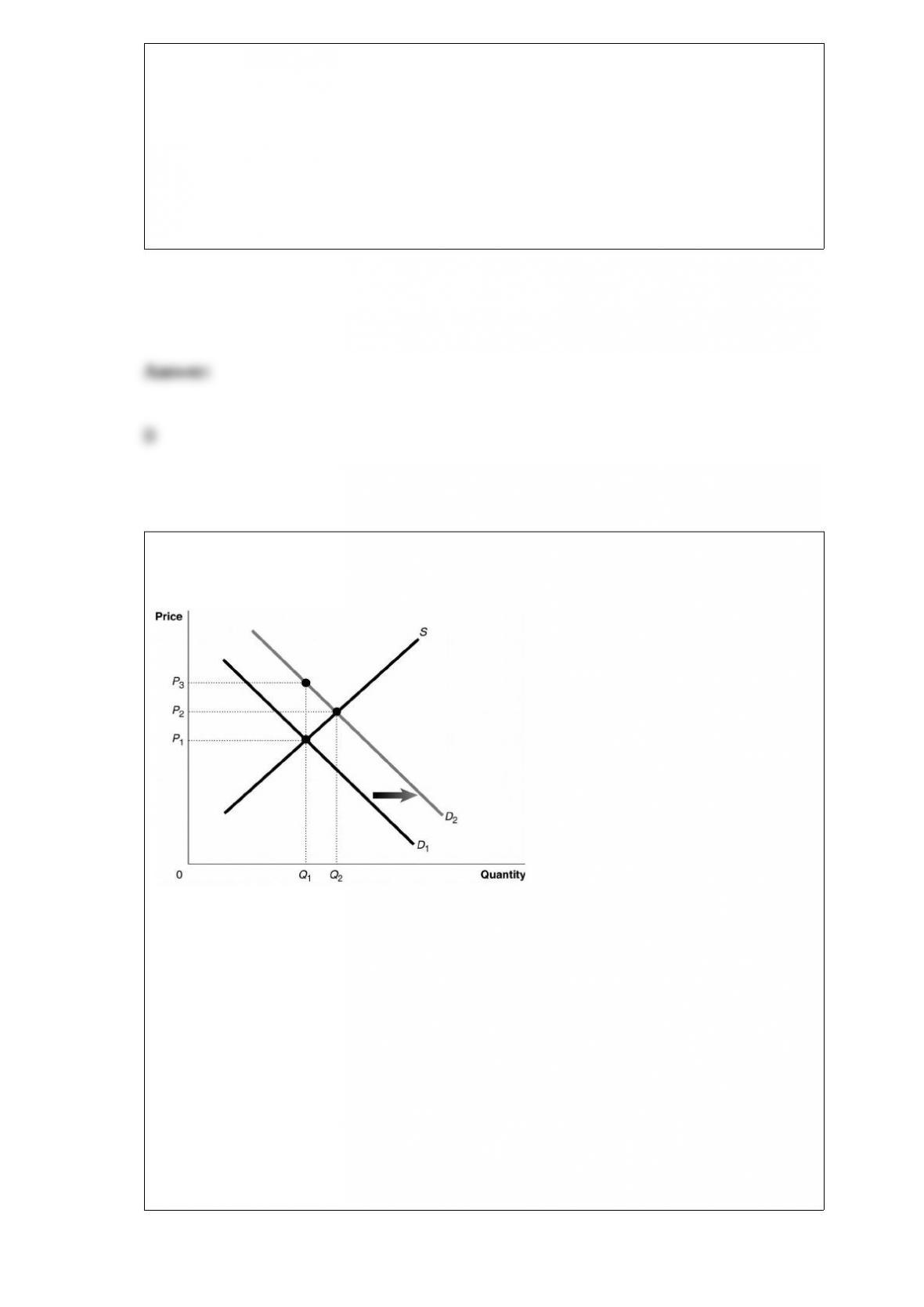
Figure 5-5
Figure 5-5 shows a market with an externality. The current market equilibrium output of
Q1 is not the economically efficient output. The economically efficient output is Q2.
Refer to Figure 5-5. If, because of an externality, the economically efficient output is
Q2 and not the current equilibrium output of Q1, what does D1 represent?
A) the demand curve reflecting external benefits
B) the demand curve reflecting social benefits
C) the demand curve reflecting private benefits
D) the demand curve reflecting the sum of private and social benefits
If the personal assets of the owners cannot be claimed if the business is bankrupt, the
owners are said to have
A) unlimited liability.
B) a proprietorship type of business.
C) limited liability.
D) a partnership type of business.
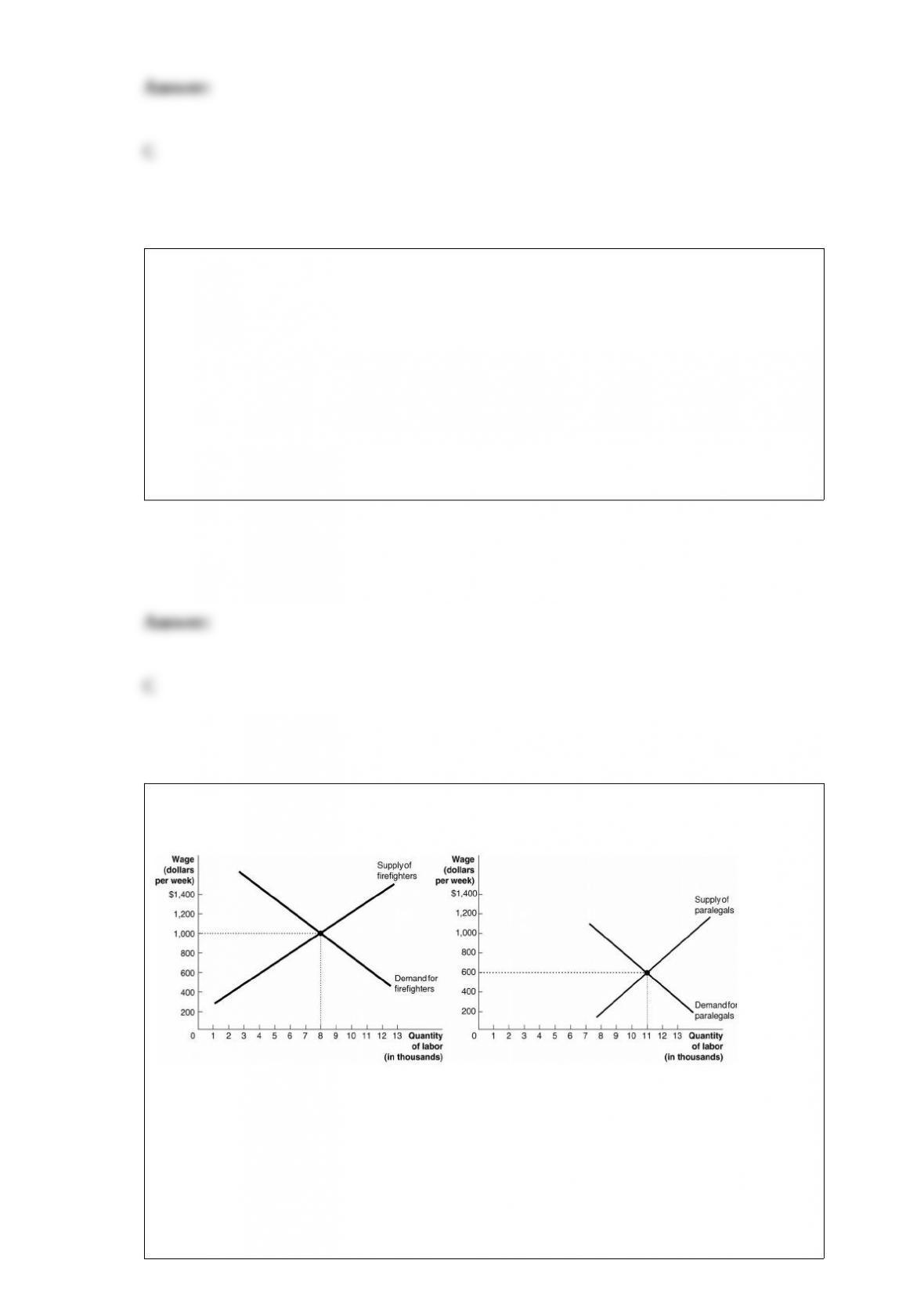
Figure 17-5
Refer to Figure 17-5 to answer the following questions.
a. What is the equilibrium quantity of firefighters hired, and what is the equilibrium
wage?
b. What is the equilibrium quantity of paralegals hired, and what is the equilibrium
wage?

c. Explain why firefighters might earn a higher weekly wage than paralegals.
d. Suppose that comparable worth legislation is passed, and the government requires
that firefighters and paralegals be paid the same wage, $800 per week. Now how many
firefighters will be hired and how many paralegals will be hired?
Compensating differentials are
A) non-monetary benefits from being employed, such as health-care benefits.
B) wages paid to workers where the supply of labor is great relative to demand.
C) higher wages that compensate workers for unpleasant aspects of a job.
D) higher wages that compensate the more experienced workers in a field.
The application of economic analysis to human resources issues is called

A) resource economics.
B) personnel economics.
C) human economics.
D) labor economics.
When there is a positive externality
A) the private benefit received by consumers is greater than the external benefit.
B) the social benefit received by consumers is greater than the private benefit.
C) the private benefit received by consumers is greater than the private cost.
D) the private benefit received by consumers is greater than the social benefit.
Article Summary
In an August 2013 speech from the Lincoln Memorial, President Obama was expected
to emphasize that increased economic equality is needed to improve racial equality.
Economic gaps based on race have endured for 50 years, with the differences in
unemployment rates between blacks and whites remaining virtually unchanged and the
gap in wealth actually increasing. “If you look at 50 years after the 1960s civil rights

movement, the most stubborn and persistent challenge when it comes to the nation’s
racial challenge remains in the areas of economics and wealth,” said Marc Morial,
president of the National Urban League.
Source: Zachary A. Goldfarb, “For Obama, 50 years after historic march, economic
equality the path to racial justice,” Washington Post, August 17, 2013.
Refer to the Article Summary. The article mentions increased economic equality is
needed in terms of wealth, and for some people this means a more equitable distribution
of wealth. Would an equitable distribution of wealth necessarily be the most efficient
distribution of wealth?
A) Yes, equitable and efficient are two different words which have the same definition.
B) Yes, in order for the distribution to be equitable, it must also be efficient.
C) No, it is impossible to have an economically efficient distribution which is also an
equitable distribution.
D) No, an economically efficient distribution of wealth would not necessarily be
equitable.
An example of a factor of production is
A) a bottle of wine produced by a vineyard.
B) a vintner hired by a vineyard.
C) a loan granted to a vineyard.
D) the wine exported by a vineyard.
Which of the following statements about rent seeking is false?
A) Rent seeking often involves governments because governments transfer huge
amounts of funds that economic agents must compete for.
B) A person is engaging in rent seeking behavior when he uses the political process to
acquire ownership of a resource that belongs to the public.
C) Because rent seeking redistributes society’s resources, anyone engaging in such
behavior is violating the law.
D) If a firm can benefit from government intervention in the economy, it is more likely
to spend resources attempting to secure this intervention than toward innovating its
product to gain a competitive edge in the market.
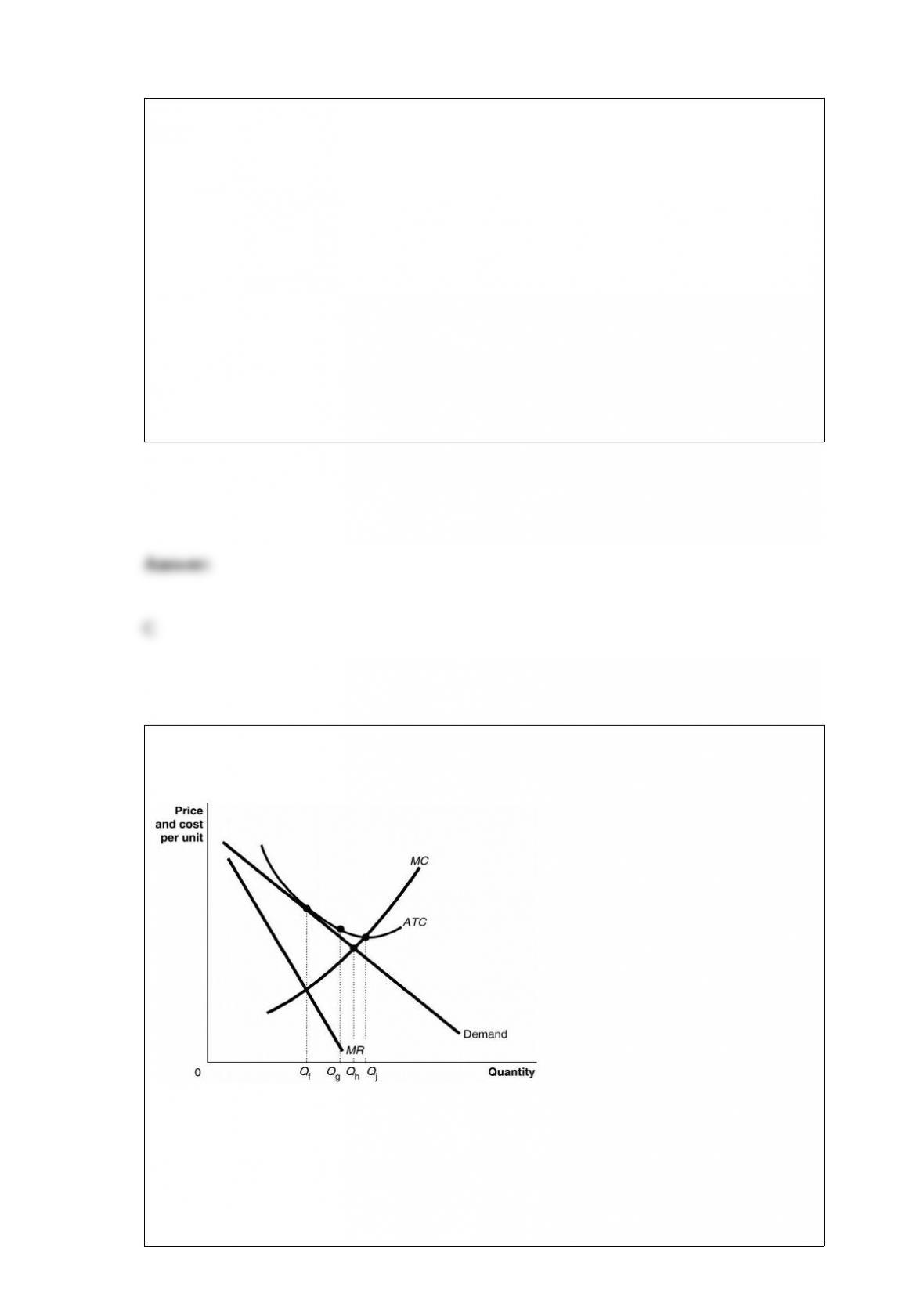
Figure 13-17
Refer to Figure 13-17. What is the amount of excess capacity?
A) Qh – Qf units
B) Qj – Qf units

C) Qj – Qh units
D) Qh – Qg units
A game in which each player adopts its dominant strategy
A) will not lead to an equilibrium.
B) must be a cooperative game.
C) could result in a Nash equilibrium.
D) can never result in a Nash equilibrium.
A successful compensation scheme
A) must pay workers with comparable skills a comparable wage.
B) must induce effort from workers and ensure that both employer and employees
benefit.
C) must enable workers to enjoy a certain standard of living and must enable employers
to earn a normal rate of return.
D) must allow employees to participate in a firm’s profits.

“Free riding” is a characteristic of which type of good?
A) a private good
B) a common resource
C) a public good
D) a good that is both rival and excludable
Which of the following antitrust laws forbade firms to engage in price discrimination if
the effect would lessen competition or create a monopoly?
A) the Sherman Act
B) the Clayton Act
C) the Robinson-Patman Act
D) the Cellar-Kefauver Act

An increase in the demand for lobster due to changes in consumer tastes, accompanied
by a decrease in the supply of lobster as a result bad weather reducing the number of
fishermen trapping lobster, will result in
A) a decrease in the equilibrium quantity of lobster and no change in the equilibrium
price.
B) an increase in the equilibrium price of lobster and no change in the equilibrium
quantity.
C) an increase in the equilibrium price of lobster; the equilibrium quantity may increase
or decrease.
D) a decrease in the equilibrium quantity of lobster; the equilibrium price may increase
or decrease.
How will an increase in labor productivity affect equilibrium in the labor market?
A) The supply of labor will increase and the equilibrium wage and quantity of labor
will increase.
B) The demand for jobs will increase and the equilibrium wage and quantity of labor
will increase.
C) The demand for labor will increase and the equilibrium wage and quantity of labor
will increase.
D) The demand for labor will decrease because fewer workers will be needed to
produce the same output. The equilibrium wage and quantity of labor will decrease.

Which of the following statements is true about profit?
A) Profit refers to the revenue received from the sale of a quantity of goods.
B) Profit is calculated by multiplying price and quantity sold.
C) The terms “accounting profit” and “economic profit” can be used interchangeably.
D) Profit is the difference between revenue and cost.
When a monopolistically competitive firm lowers it price one bad thing happens to the
firm. What is this “one bad thing” called?
A) the output effect
B) the income effect
C) the substitution effect
D) the price effect
In contrast with perfect competition, excess capacity characterizes monopolistic
competition. Excess capacity is due to which of the following?
A) Monopolistically competitive firms produce at the minimum point on their average
total cost curves.
B) Monopolistically competitive firms face downward-sloping demand curves. In the
long run, firms produce where their demand curves are tangent to their long-run
average total cost curves.
C) Monopolistically competitive firms produce where marginal revenue is equal to
marginal cost.
D) Monopolistically competitive markets have low barriers to entry.
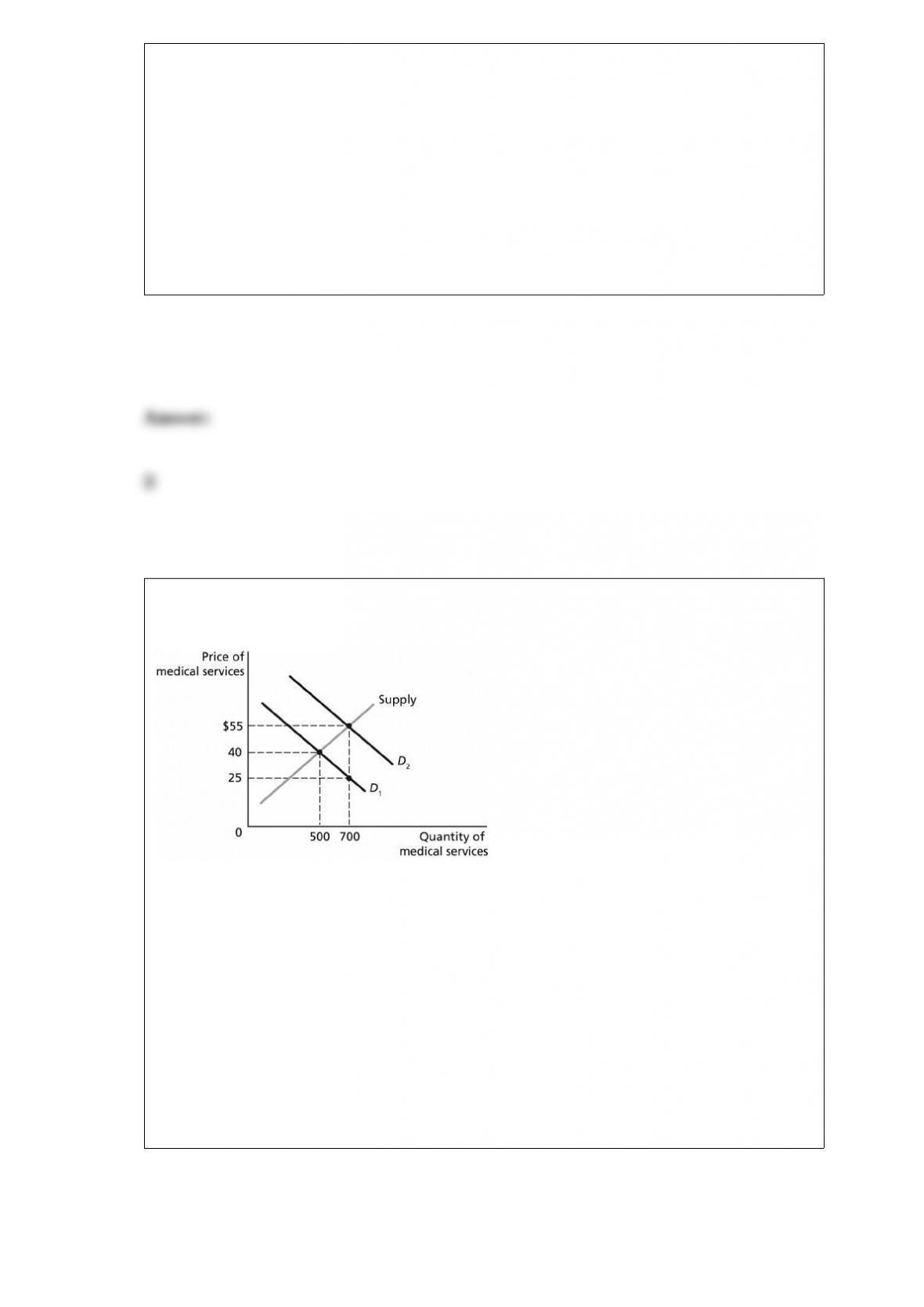
Figure 7-2
Figure 7-2 represents the market for medical services with and without insurance, and
the effect of a third-party payer system on the demand for medical services.
Refer to Figure 7-2. The efficient quantity of medical services is
A) 200.
B) 500.
C) 700.
D) >700.

Is a monopolistically competitive firm productively efficient?
A) No, because it does not produce at minimum average total cost.
B) Yes, because it produces where marginal cost equals marginal revenue.
C) No, because price is greater than marginal cost.
D) Yes, because price equals average total cost.
If the United States placed an embargo on Swedish products, what would happen in the
U.S. market for Swedish furniture?
A) The supply curve would shift to the left.
B) The supply curve would shift to the right.
C) The demand curve would shift to the right.
D) The demand curve would shift to the left.
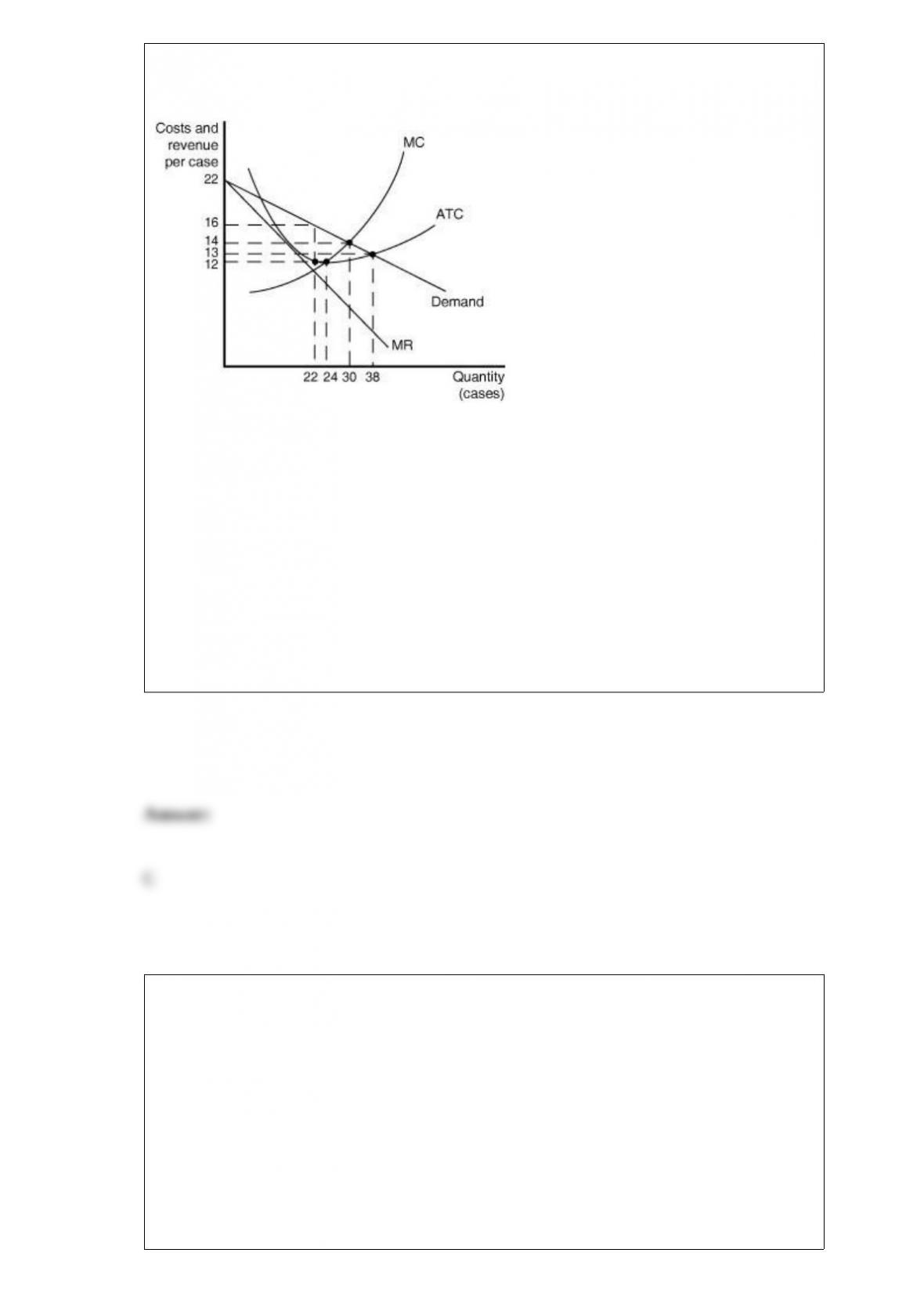
Figure 13-8
Figure 13-8 shows cost and demand curves for a monopolistically competitive producer
of iced tea.
Refer to Figure 13-8. At the profit-maximizing output level the firm will
A) earn a profit of $176.
B) break even.
C) earn a profit of $88.
D) earn a profit of $60.
The demand and supply equations for the apple market are:
Demand: P = 12 – 0.01Q
Supply: P = 0.02Q
where P= price per bushel, and Q=quantity.
a. Calculate the equilibrium price and quantity.
b. Suppose the government guaranteed producers a price of $10 per bushel. What would

be the effect on quantity supplied? Provide a numerical value.
c. By how much would the $10 price change the quantity of apples demanded? Provide
a numerical value.
d. Would there be a shortage or surplus of apples?
e. What is the size of this shortage or surplus? Provide a numerical value.
Many airlines have not reduced or eliminated fuel surcharges despite the price of oil
dropping. A logical reason for this is that the decline in fuel prices
A) shifted the supply curve for airline tickets to the left, and at the same time an
increase in demand for airline tickets shifted the demand curve to the right, so prices
did not decline.
B) shifted the supply curve for airline tickets to the right, and at the same time a
decrease in demand for airline tickets shifted the demand curve to the left, so prices still
increased.
C) shifted the supply curve for airline tickets to the right, and at the same time an
increase in demand for airline tickets shifted the demand curve to the right, so prices
still increased.
D) shifted the supply curve for airline tickets to the left, and at the same time a decrease
in demand for airline tickets shifted the demand curve to the left, so prices did not
decline.

A market comprised of only two firms is called a
A) competitive market.
B) duopoly.
C) monopoly.
D) monopolistically competitive market.
The person hired by a corporation’s board of directors to run the day-to-day operations
of the corporation is known as the
A) chairman of the board.
B) chief executive officer.
C) owner-manager.
D) corporate governor.
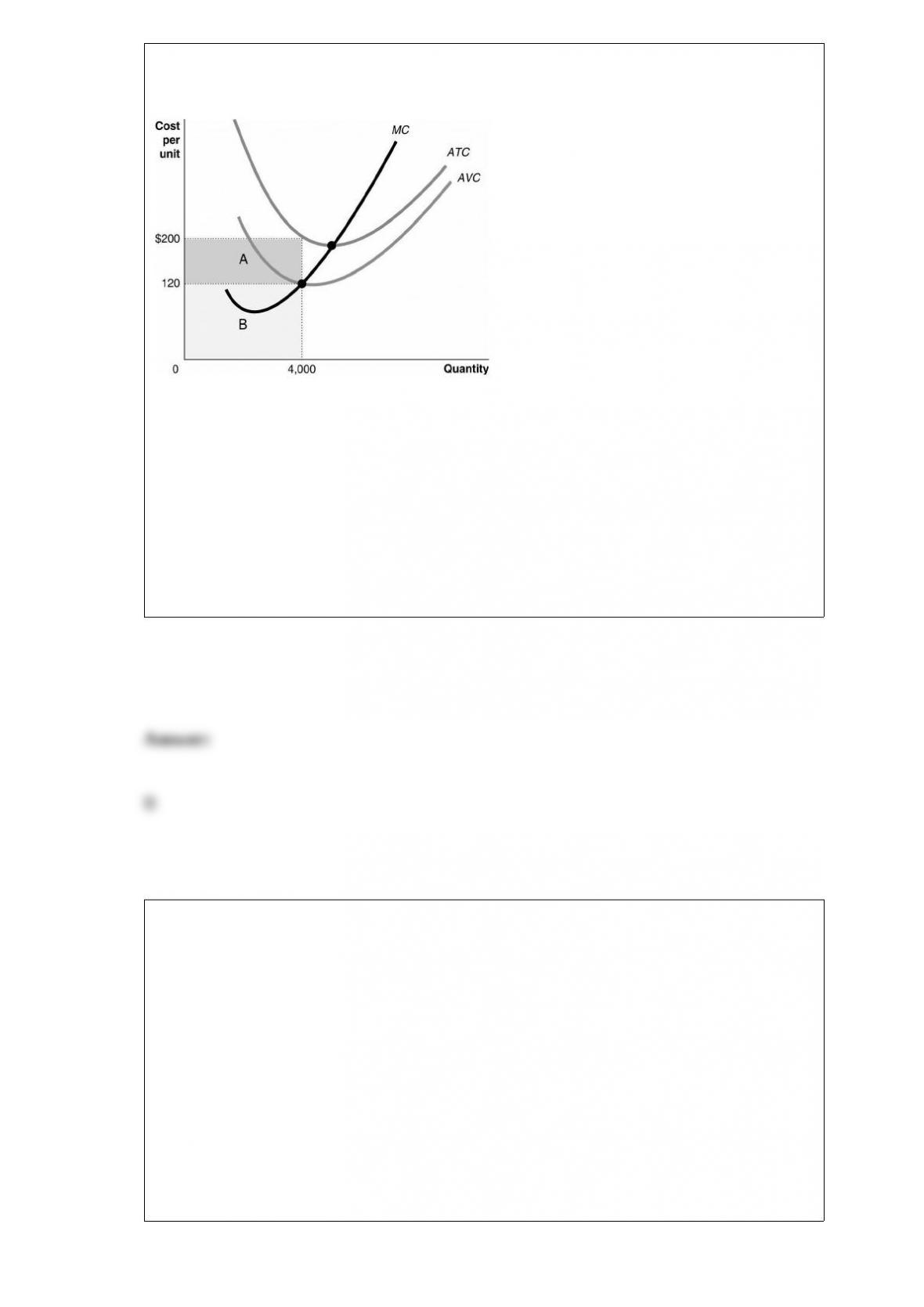
Figure 12-8
Refer to Figure 12-8. Suppose the firm produces 4,000 units. What does the shaded
area labeled B represent?
A) the firm’s economic loss
B) total variable cost
C) average variable cost
D) total fixed cost
Some economists argue that Microsoft become a monopoly in the market for computer
software by developing MS-DOS, an operating system used for the first IBM personal
computers. The more people who used MS-DOS-based programs, the greater the
usefulness of a using a computer with an MS-DOS operating system. The explanation
for Microsoft’s monopoly is
A) the development of new technology that other firms could not copy.
B) control of a key resource which, in this case, is the MS-DOS operating system.
C) network externalities.
D) patents Microsoft obtained when it developed the MS-DOS operating system.

Table 2-8
Table 2-8 shows the number of labor hours required to produce a digital camera and a
pound of wheat in China and South Korea.
Refer to Table 2-8. Does either China or South Korea have an absolute advantage and if
so, in what product?
A) South Korea has an absolute advantage in wheat.
B) China has an absolute advantage in wheat.
C) South Korea has an absolute advantage in both products.
D) China has an absolute advantage in digital cameras.
Congressman Flack votes for a program that will benefit the constituents of
Congressman Walpole. Which of the following explanations for Flack’s vote is most
consistent with the public choice model?
A) Congressman Flack did not have time to read and understand all of the legislation he
voted on. Members of Congress often depend on their staffs to read proposed legislation
and recommend how they should vote.
B) Legislators such as Congressman Flack are similar to other decision-makers in that
they sometimes make irrational choices.
C) Congressman Flack will support programs of legislators from his own party,
regardless of who benefits from these programs.
D) Congressman Flack expects Congressman Walpole’s support for programs that will
benefit Flack’s constituents.
Explain whether a monopoly that maximizes profit will also be maximizing revenue
and production.
What is the relationship between market failure and government failure?
In equilibrium, what determines the price of capital and what determines the price of
natural resources?
List the competitive forces in the five competitive forces model.
When the price of Starbucks coffee increased by 8 percent, the quantity demanded of
Peets coffee increased by 10 percent. Calculate the cross price elasticity of demand
between Starbucks coffee and Peets coffee. What is the relationship between the two
products?
What are the three most important variables that cause the market supply curve of labor
to shift?
What is a private cost of production? What is a social cost of production? When is the
private cost of production equal to the social cost of production?
Explain how technological innovation has benefitted entrepreneurs.
“Being the only seller in the market, the monopolist can choose any price and quantity
it desires.” Evaluate this statement: is it true or false? Explain your answer.
Suppose that a perfectly competitive industry becomes a monopoly. What effect will
this have on consumer surplus, producer surplus, and deadweight loss?
Describe each of the principles governments consider when deciding which taxes to
use.
If the labor demand curve shifts to the left and the labor supply curve remains
unchanged, what will happen to the equilibrium wage and the equilibrium level of
employment? Illustrate your answer with a graph.
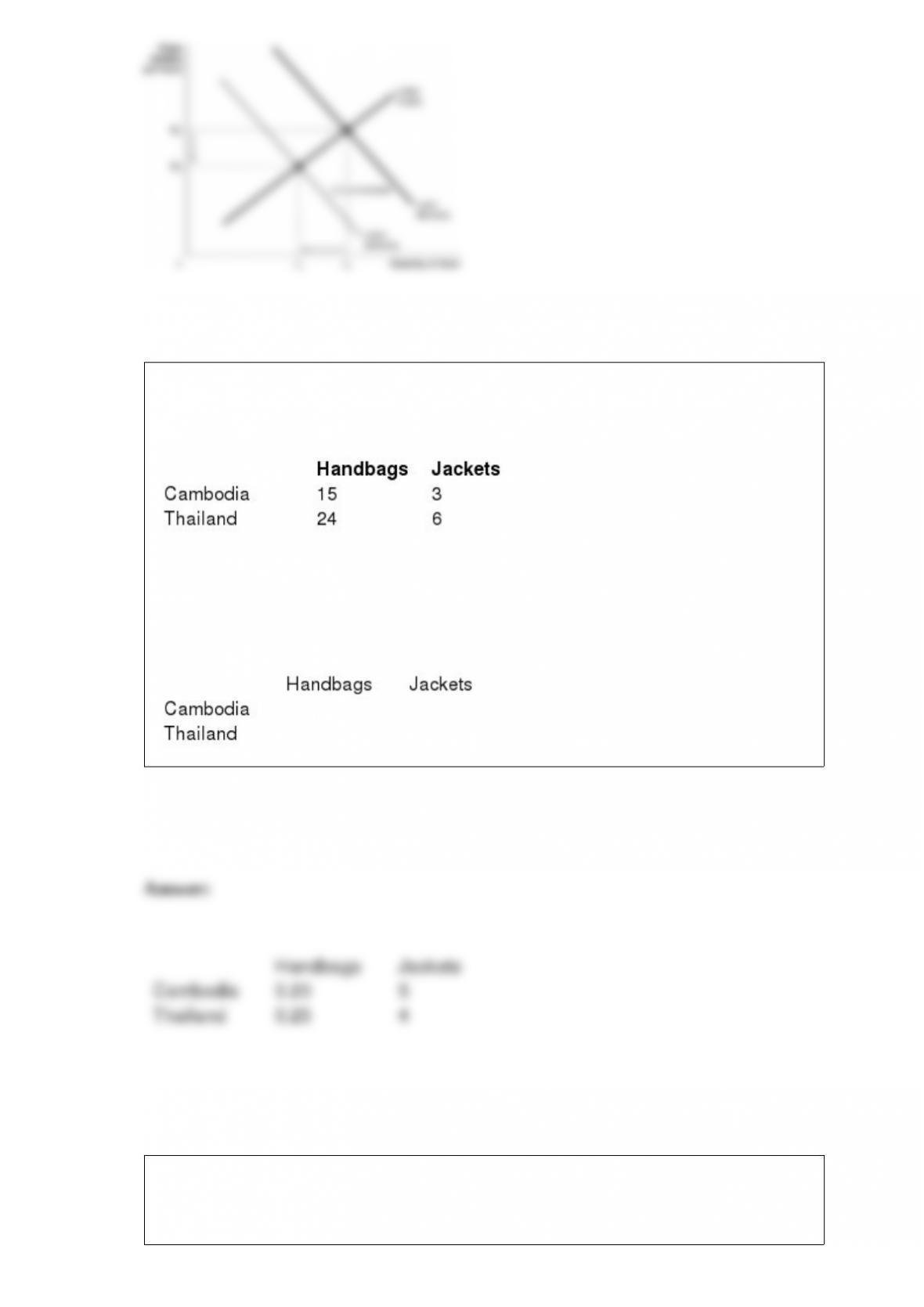
Table 9-4
Output Per Hour of Work
Table 9-4 shows the output per hour of work for handbags and jackets in Cambodia and
in Thailand.
Refer to Table 9-4. Fill in the following table with the opportunity costs of producing
handbags and jackets for Cambodia and Thailand.
The breakfast cereal industry has a four-firm concentration ratio of 78 percent. Is this
enough information to classify the industry as an oligopoly? Is a high concentration
ratio evidence that an industry is not competitive?

What is the difference between total cost and variable cost in the long run?
The total amount of copper in the earth is not increasing. Does this mean that in the
market for copper, the supply curve is perfectly inelastic? Explain.
What is the difference between ‘straight-time pay,” “commission pay,” and “piece-rate
pay”?