1) Which of the following is not an example of a compensating differential? Job A pays
more than Job B because Job A requires
a.more international travel to dangerous locations.
b.two night shifts per month.
c.careful handling of toxic chemicals.
d.an advanced degree.
2) Tom walks Bethany’s dog once a day for $50 per week. Bethany values this service
at $60 per week, while the opportunity cost of Tom’s time is $30 per week. The
government places a tax of $35 per week on dog walkers. After the tax, what is the total
surplus?
a.$50
b.$30
c.$25
d. $0
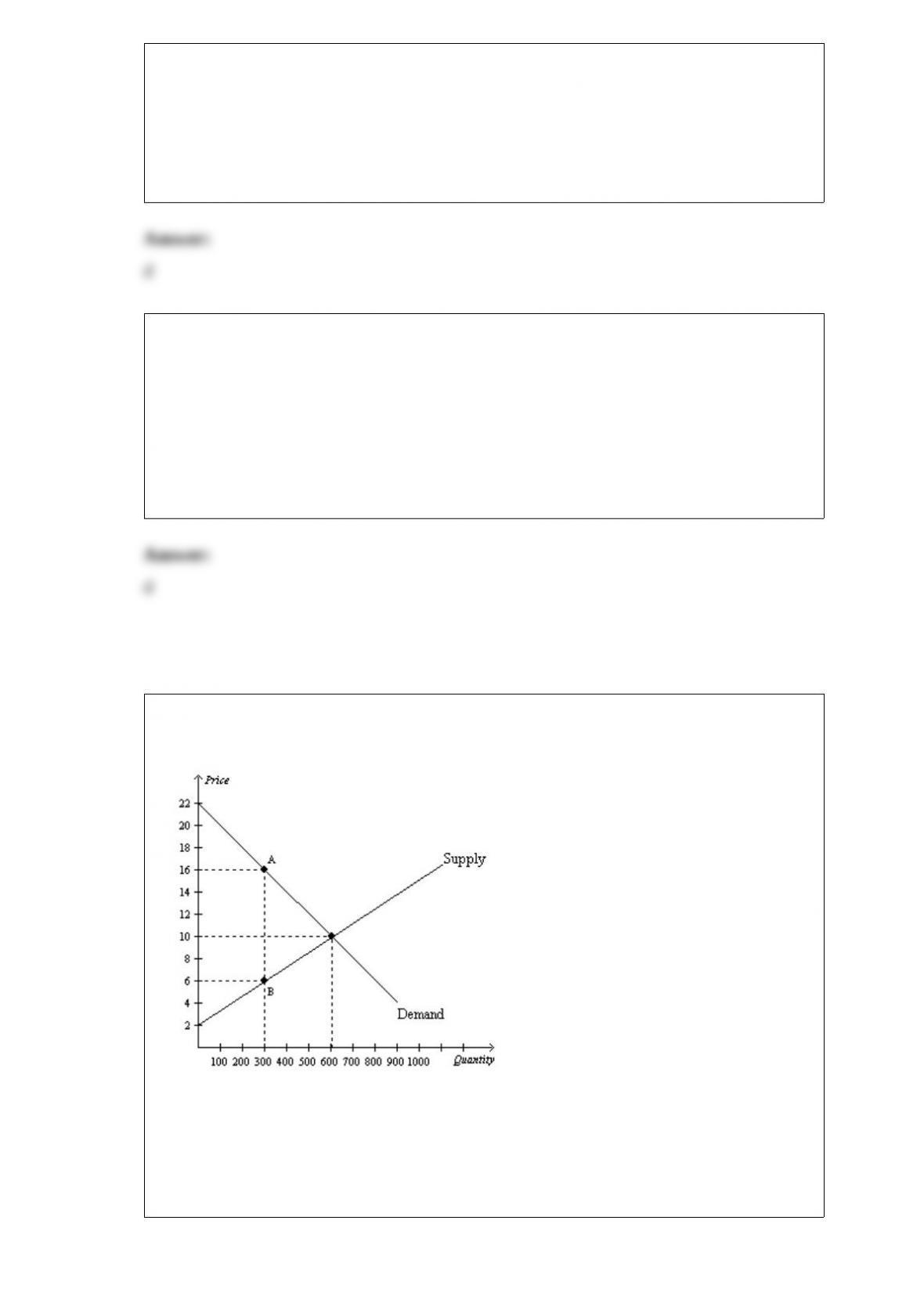
3) Figure 8-6
The vertical distance between points A and B represents a tax in the market.
When the tax is imposed in this market, producer surplus is
a. $450.
b. $600.
c. $900.
d. $1,500.

4) When firms in a perfectly competitive market face the same costs, in the long run
they must be operating
a.under diseconomies of scale.
b.with small, but positive, levels of profit.
c.at their efficient scale.
d.where price is equal to average fixed cost.
5) Table 14-12
Bill’s Birdhouses
What is the total revenue from selling 7 units?
a. $80
b. $382
c. $540
d. $560
6) Figure 18-11
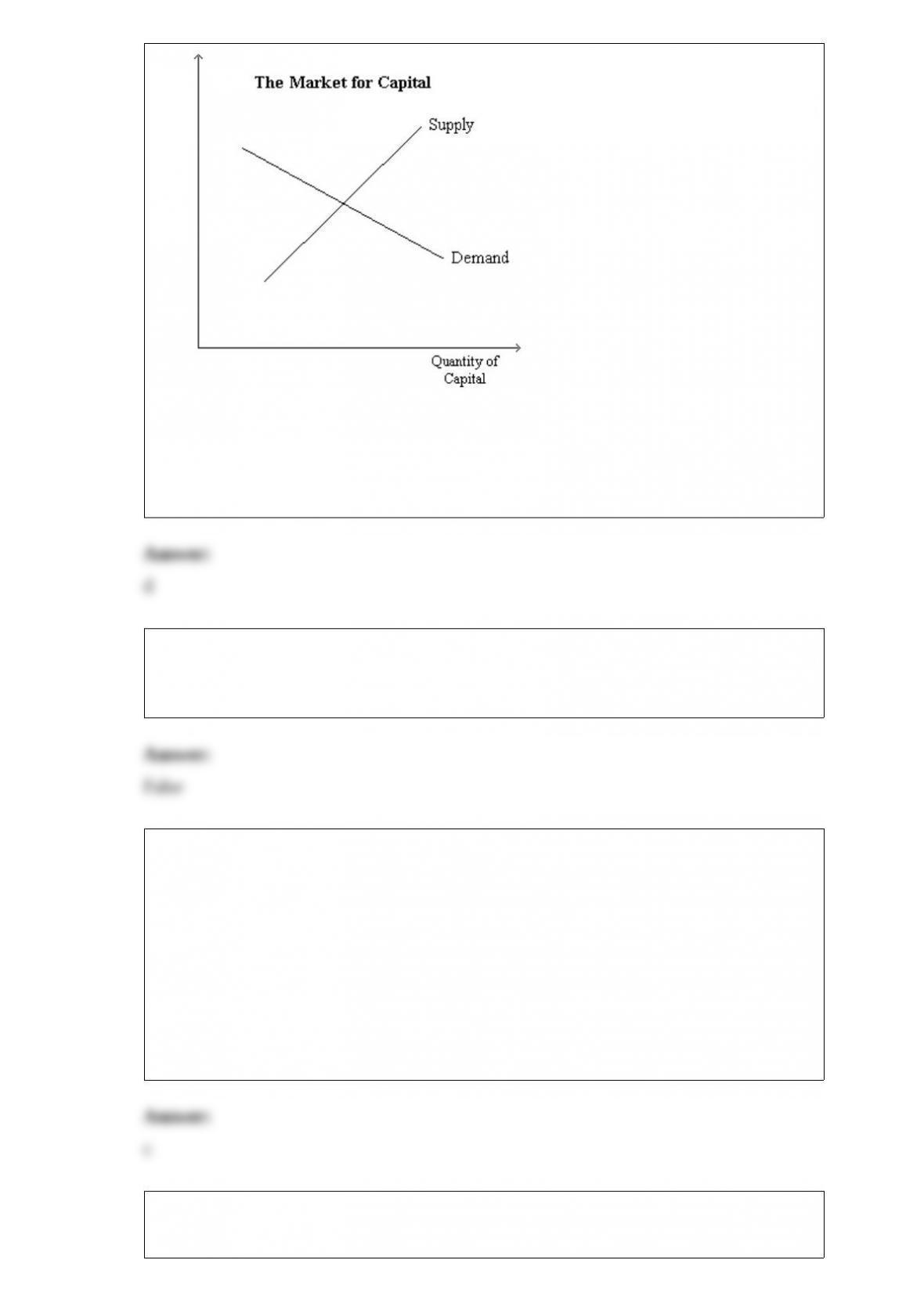
Refer to Figure 18-11. What is measured on the vertical axis of the graph?
a.the rate of technological progress
b.wages paid to workers in markets where capital goods are produced
c.wages paid to workers in markets where capital goods are not produced
d.the rental price of capital
7) Monopolistic competition is the only market structure that features many sellers.
a.True
b.False
8) Jake and Zach are identical twins who attended grammar school through college
together. Jake took a job as an engineer who does not have to travel out of the state.
Zach took a job as an engineer who must travel out of state once a week. Jake earns
$125,000 a year, and Zach earns $155,000 a year. Select the best explanation for this
wage difference.
a.Zach puts in less effort than Jake.
b.Zach has less human capital than Jake.
c.Zach receives a higher wage to compensate for the disagreeable nature of business
travel.
d.Jake’s lower salary supports the signaling theory of education.
9) The founders of utilitarianism include
a.A. C. Pigou and John Maynard Keynes.

b.Jeremy Bentham and John Stuart Mill.
c.Augustin Cournot and Jean B. Say.
d.A. Kondratieff and Thomas Malthus.
10) Narrative 22-1
Katie owns a boutique that sells highend women’s clothing and accessories. Shana
works part-time at the boutique and frequently is the only employee in this small store.
Katie pays Shana a wage that is higher than the market wage for this type of job. When
the store is not full of customers, Shana diligently works on displays and cleans to keep
the store looking its best. Magda is a customer in the store who asks Shana’s opinion on
the quality of some jeans she is considering purchasing. Even though she’s had several
other customers return them due to flaws, Shana tells Magda the quality is great.
Belinda is another customer who is returning a necklace without revealing that she lost
a gem from it while wearing it.
Refer to Narrative 22-1. Which of the ladies is a principal?
a.Shana
b.Katie
c.Belinda
d.Magda
11) A monopoly
a.can set the price it charges for its output and earn unlimited profits.
b.takes the market price as given and earns small but positive profits.
c.can set the price it charges for its output but faces a downward-sloping demand curve
so it cannot earn unlimited profits.
d.can set the price it charges for its output but faces a horizontal demand curve so it can
earn unlimited profits.
12) A monopoly creates a deadweight loss to society because it earns both short-run and
long-run positive economic profits.
a.True
b.False

13) Suppose that the equilibrium price in the market for widgets is $5. If a law
increased the minimum legal price for widgets to $6, producer surplus
a.would necessarily increase even if the higher price resulted in a surplus of widgets.
b.would necessarily decrease because the higher price would create a surplus of
widgets.
c.might increase or decrease.
d.would be unaffected.
14) Governments can grant private property rights over resources that were previously
viewed as public, such as fish or elephants. Why would governments want to do so?
a.to prevent overuse
b.to decrease taxes
c.to fight poverty
d.to increase consumption
15) Melody decides to spend three hours working overtime rather than going to the park
with her friends. She earns $20 per hour for overtime work. Her opportunity cost of
working is
a.the $60 she earns working.
b.the $60 minus the enjoyment she would have received from going to the park.
c.the enjoyment she would have received had she gone to the park.
d.nothing, since she would have received less than $60 worth of enjoyment from going
to the park.
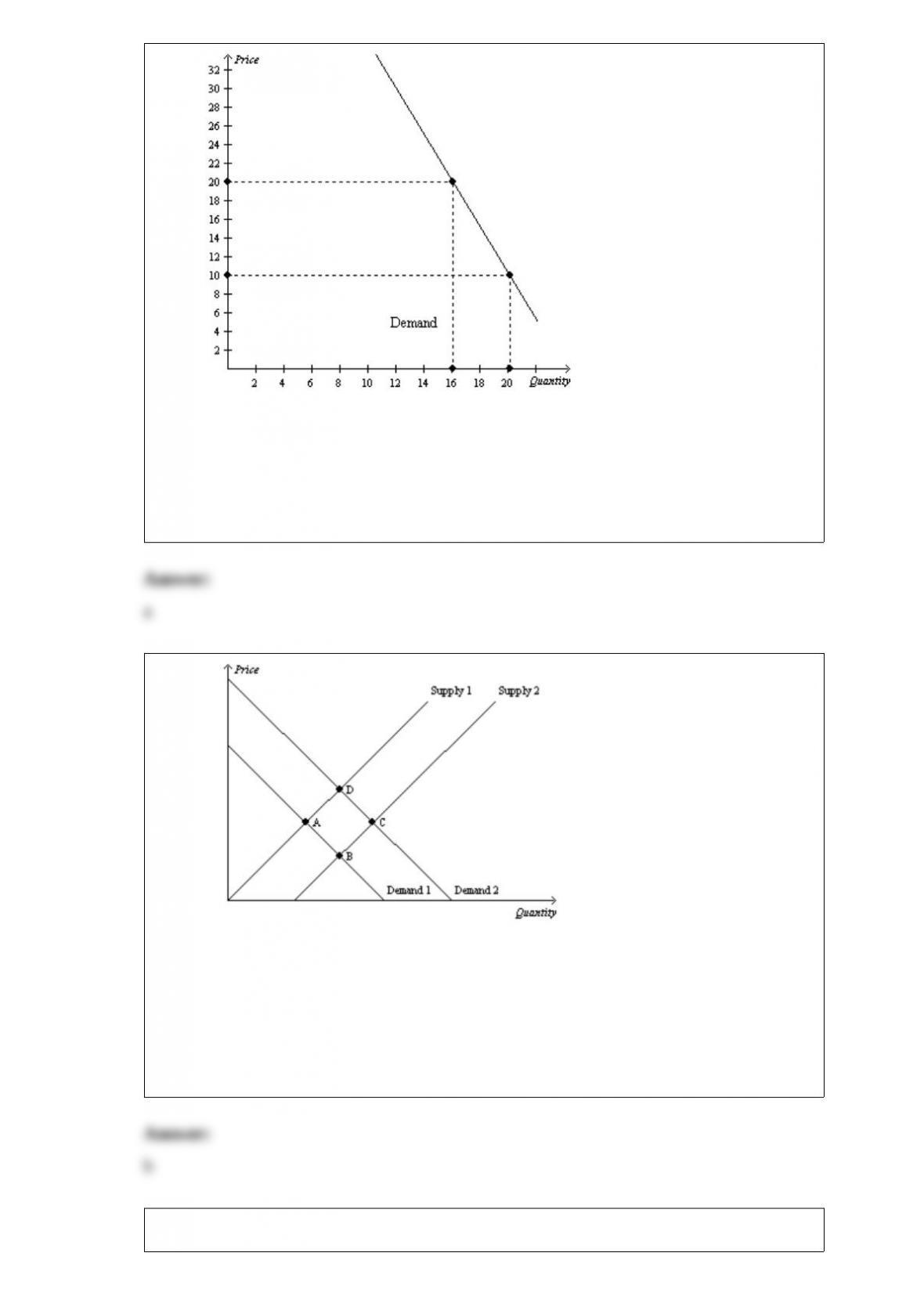
16)
If price increases from $10 to $20, total revenue will
a.increase by $120, so demand must be inelastic in this price range.
b.increase by $320, so demand must be inelastic in this price range.
c.decrease by $120, so demand must be elastic in this price range.
d.decrease by $320, so demand must be elastic in this price range.
17) Which of the following
movements would illustrate the effect in the market for paper napkins as a result of a
“Go Green” advertising campaign encouraging people to use cloth napkins?
a.Point A to Point B
b.Point C to Point B
c.Point C to Point D
d.Point A to Point D
18) If the tax on a good is tripled, the deadweight loss of the tax

a.remains constant.
b.triples.
c.increases by a factor of 9.
d.increases by a factor of 12.
19) A deadweight loss is a consequence of a tax on a good because the tax
a.induces the government to increase its expenditures.
b.induces buyers to consume less, and sellers to produce less.
c.increases the equilibrium price in the market.
d.imposes a loss on buyers that is greater than the loss to sellers.