1) Refer to the above diagrams. A decline in aggregate expenditures from AE2 to AE1
resulting from the real-balances, interest-rate effect, and foreign purchases effects
would be depicted as:
A.a movement from A to C along aggregate demand curve AD1.
B.a movement from C to A along aggregate demand curve AD1.
C.a shift of aggregate demand from AD1 to AD2.
D.a shift of aggregate demand from AD2 to AD1.
2) for a linear demand curve:
a.elasticity is constant along the curve.
b.elasticity is unity at every point on the curve.
c.demand is elastic at low prices.
d.demand is elastic at high prices.
3)
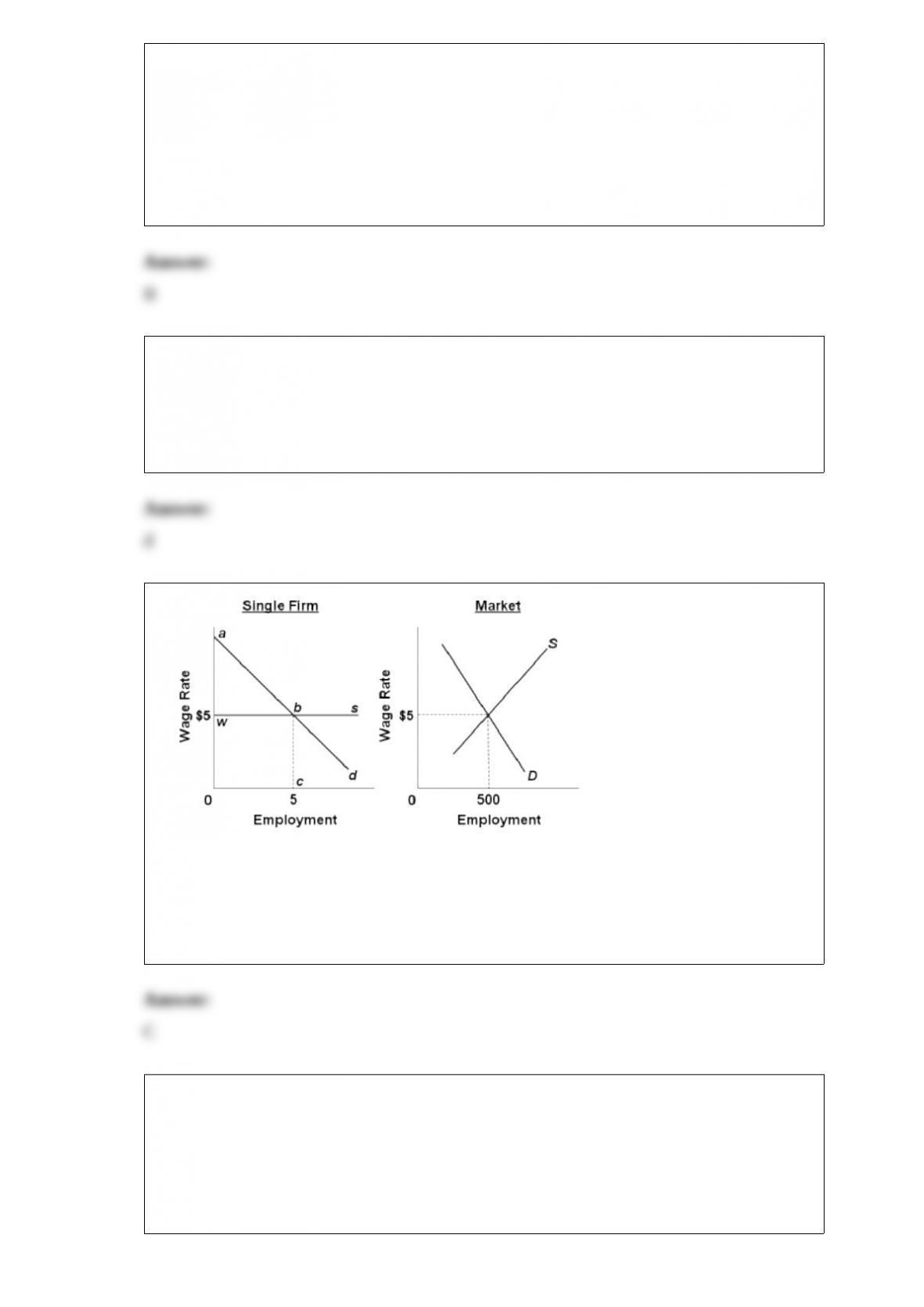
Refer to the above diagrams. The firm:
A.is a monopsonist in the hiring of labor.
B.must be selling its product in an imperfectly competitive market.
C.is a “wage taker.”
D.must pay a higher marginal resource cost for each successive worker.
4) (Last Word) According to economists Aryes and Levitt, the total benefits of Lojack
and other car retrieval system are divided:
A.90 percent to the owners and 10 percent to other car owners in the community.
B.50 percent to the owners and 50 percent to other car owners in the community.
C.0 percent to the owners and 100 percent to other car owners in the community.
D.10 percent to the owners and 90 percent to other car owners in the community.
5) assume initially that the price of x (measured on the horizontal axis) is $9 and the
price of y (measured on the vertical axis) is $4. if the price of x now declines to $6, the
budget line will:
a.be unaffected.
b.shift outward on the vertical axis.
c.shift inward on the horizontal axis.
d.shift outward on the horizontal axis.
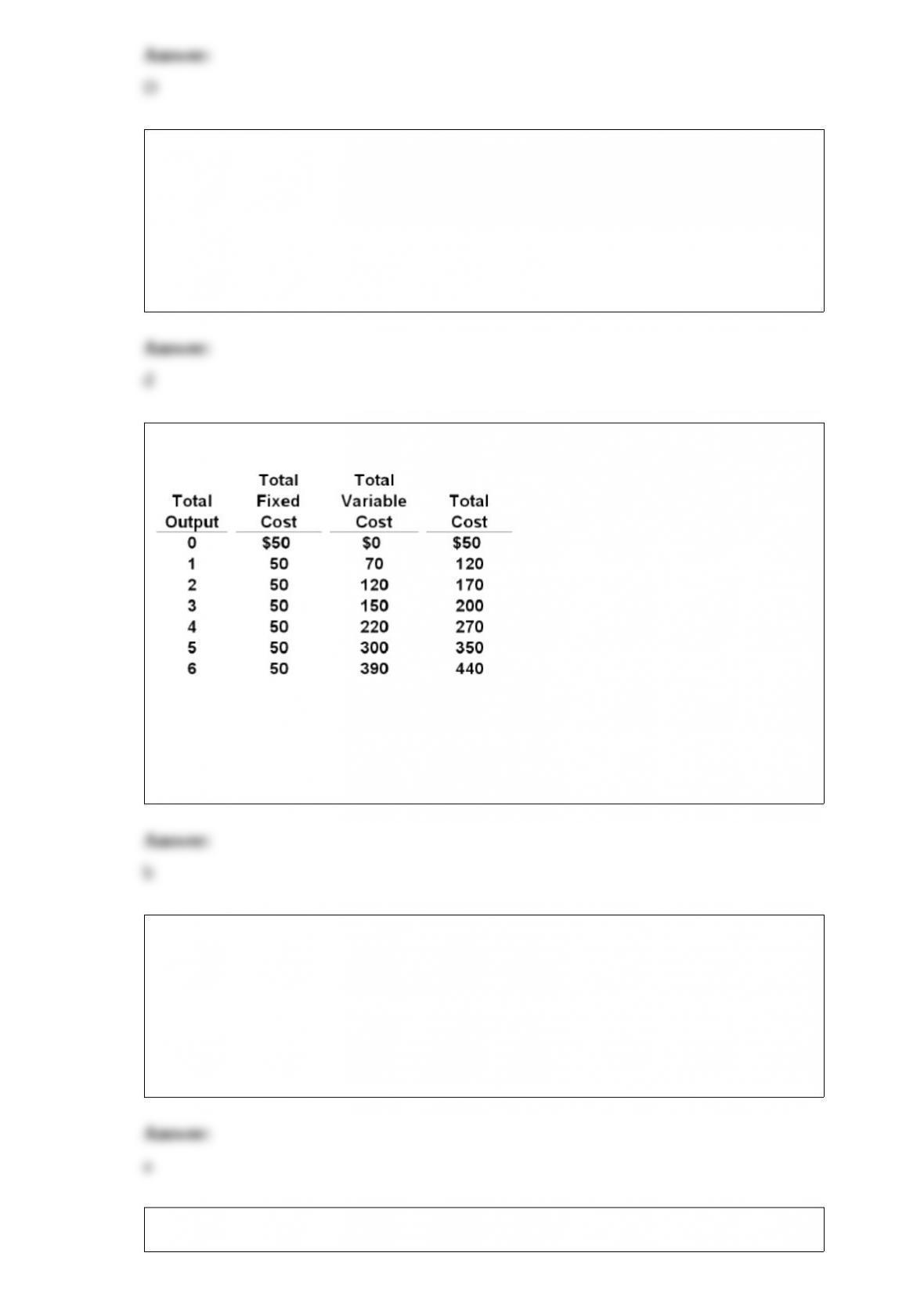
6) the following cost data for a purely competitive seller:
refer to the above data. given the $75 product price, at its optimal output the firm will:
a.realize a $25 economic profit.
b.realize a $30 economic profit.
c.incur a $25 loss.
d.realize a $30 loss.
7) north korea’s command economy:
a.is one of the few remaining command economies.
b.has grown much faster than south korea since the two countries were divided after
world war ii.
c.produces a per capita gdp of nearly $25,000.
d.has undergone significant market reforms and is now one of the fastest growing
economies.
8) the fact that the slope of the production possibilities curve becomes steeper as we
move down along the curve indicates that:
a.the principle of increasing opportunity costs is relevant.
b.society’s resources are limited.
c.the opportunity cost of producing each product is constant.
d.resources are perfectly shiftable between alternative uses.
9)
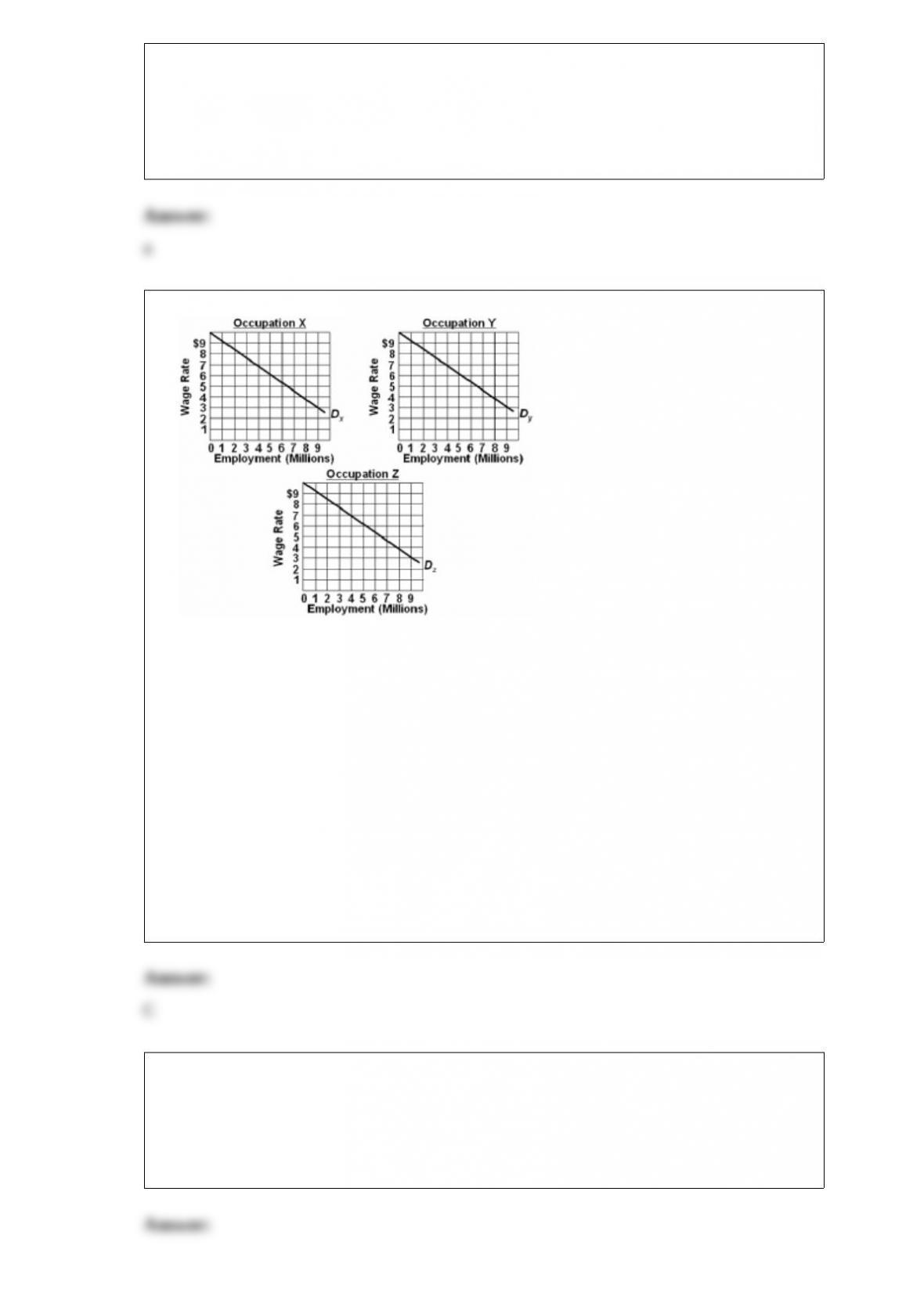
Assumptions: (1) the labor force is comprised of 9 million men and 9 million women
workers; (2) the economy has 3 occupations, X, Y, and Z, each having identical demand
curves for labor; (3) men and women workers are homogeneous with respect to their
labor-market capabilities; (4) women are discriminated against by being excluded from
occupations X and Y and are confined to Z; and (5) aside from discrimination, the
economy is competitive.
Refer to the above diagram and list of assumptions. If discrimination is ended:
A.men will leave occupations X and Y and enter occupation Z.
B.4 million women will leave occupation Z, with 2 million entering occupation X and 2
million entering occupation Y.
C.3 million women will leave occupation Z, with 1.5 million entering occupation X and
1.5 million entering occupation Y.
D.3 million women will leave occupation Z, all of whom will enter industry X.
10) If an unintended increase in business inventories occurs:
A.we can expect aggregate production to be unaffected.
B.we can expect businesses to increase the level of production.
C.we can expect businesses to lower the level of production.
D.aggregate expenditures must exceed the domestic output.