
The ________ problem of public goods occurs because people can enjoy the benefits of
these goods even when they do not have to pay for them.
A) moral hazard
B) free-hand
C) free-rider
D) external cost
The threat of punishment in a repeated game tends to:
A) reduce the incentive to break a pricing agreement.
B) anger the other firms, resulting in a price war.
C) maintain prices at the duopoly price level.
D) deter entry.
Table 10.2 contains price, demand, and cost data for the Capri Theater, the only first-run
movie theater in a small town. What is its profit from non-students under the student
discount policy?
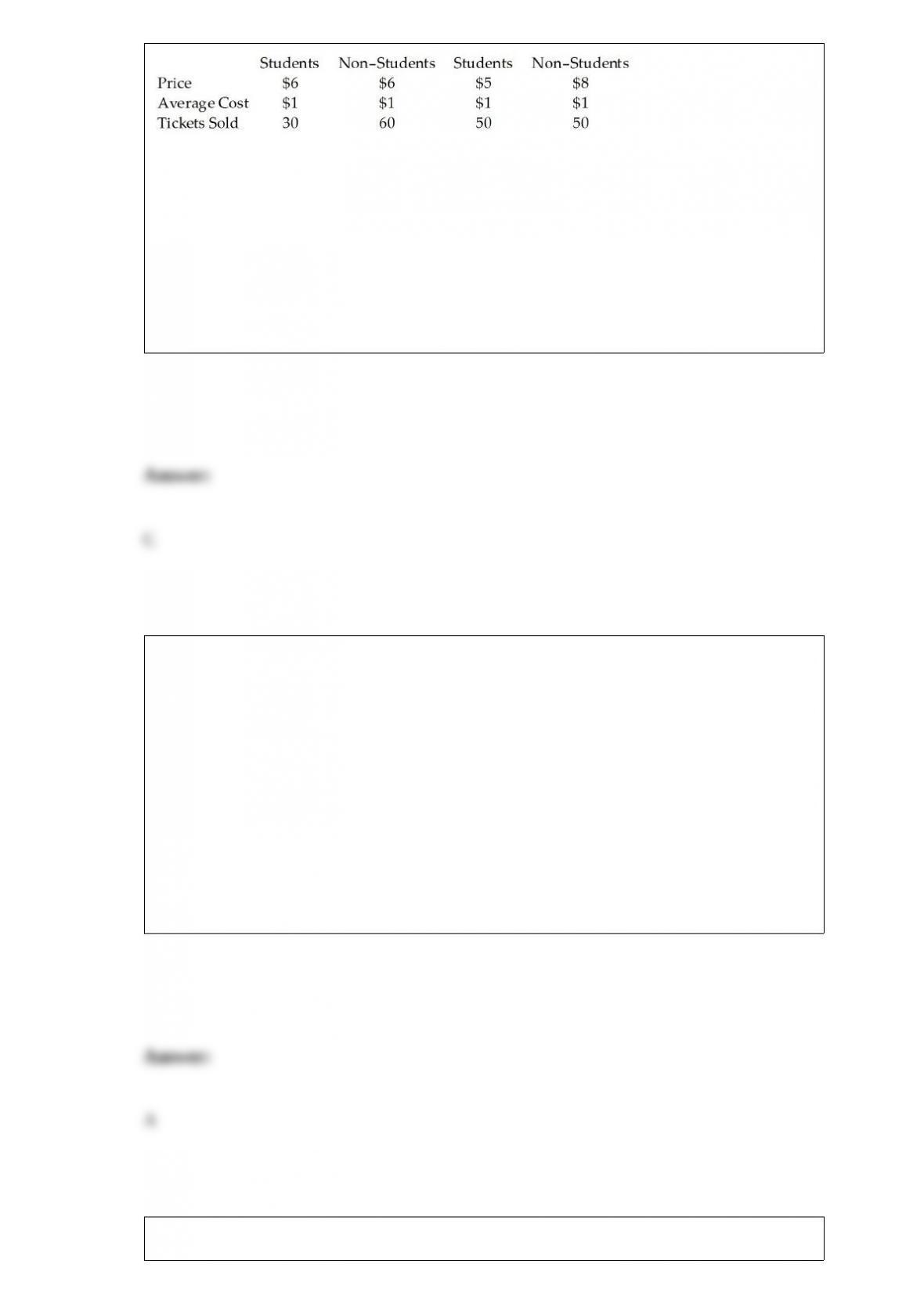
Table 10.2
A) $200
B) $250
C) $350
D) $400
Suppose the U.S. imposes a ban on imported steel from China because the Chinese steel
was made with factories that pollute the environment. If China complains to the WTO
regarding the U.S. ban, the WTO will side with:
A) China, because the pollution in China does not harm the U.S. directly.
B) China, because the WTO is in favor of industries that generate pollution.
C) the U.S., because a country can determine what goods can and cannot enter its
borders.
D) the U.S., because US factories have to comply with U.S. environmental standards.
Moral hazard is more likely to arise when:

A) one side of an economic relationship cannot observe the behavior of those on the
other side.
B) adverse selection is present.
C) insurance policies have high deductibles.
D) people are uninsured.
If the supply of a good is relatively elastic, changing the price causes:
A) a relatively large change in the amount that consumers want to buy.
B) a relatively large change in the amount that sellers want to sell.
C) a relatively small change in the amount that sellers want to sell.
D) a relatively small change in the amount that buyers want to buy.
Which of the following statements represents the signaling effect of a college
education?
A) A person who is naturally more productive is likely to invest in education.
B) Education can turn an unproductive person into an productive person.

C) The information gained in a college classroom increases the productivity of
graduates.
D) all of the above
Microeconomics is best described as the study of:
A) the choices made by individual households, firms, and governments.
B) inflation, unemployment, gross national product, and the nation’s economy as a
whole.
C) how markets interact in the aggregate economy.
D) marginal changes in the economy.
Juan is consuming 3 sandwiches and 6 sodas. If a sandwich costs twice as much as a
soda then:
A) Juan should buy more sodas.
B) Juan should buy more sandwiches.
C) Juan is maximizing his utility if he derives twice as much utility from the last soda
as from the last sandwich.
D) Juan is maximizing his utility if he derives twice as much utility from the last

sandwich as from the last soda.
Recall Application 2, “How Fast to Sail?” to answer the following questions:
Based on the Application, the marginal benefit of sailing a ship faster is:
A) more cargo delivered per year.
B) more fuel cost incurred.
C) less fuel costs incurred.
D) less cargo delivered per year.
If crude-oil prices increase as the total amount of gasoline increases, the supply curve
for gasoline will be relatively steep and the price of elasticity of supply of gasoline will
be:
A) relatively large.
B) perfectly vertical.
C) perfectly horizontal.
D) relatively low.

Which of the following could lead to an increase in labor supply?
A) more people retire at a younger age
B) an increase in labor force participation
C) tighter restrictions on immigration policy
D) an increase in the wage rate
Suppose a new use for aluminum has been discovered, making aluminum more
expensive. In a market system:
A) the aluminum roof producers may choose to look for other substitutes for aluminum.
B) aluminum producers will choose to increase production of aluminum.
C) auto manufacturers will find it in their best interest to use more aluminum.
D) A and B are correct.
If the number of beer producers decreases:
A) the demand for beer increases.
B) the demand for beer decreases.
C) the supply of beer increases.
D) the supply of beer decreases.
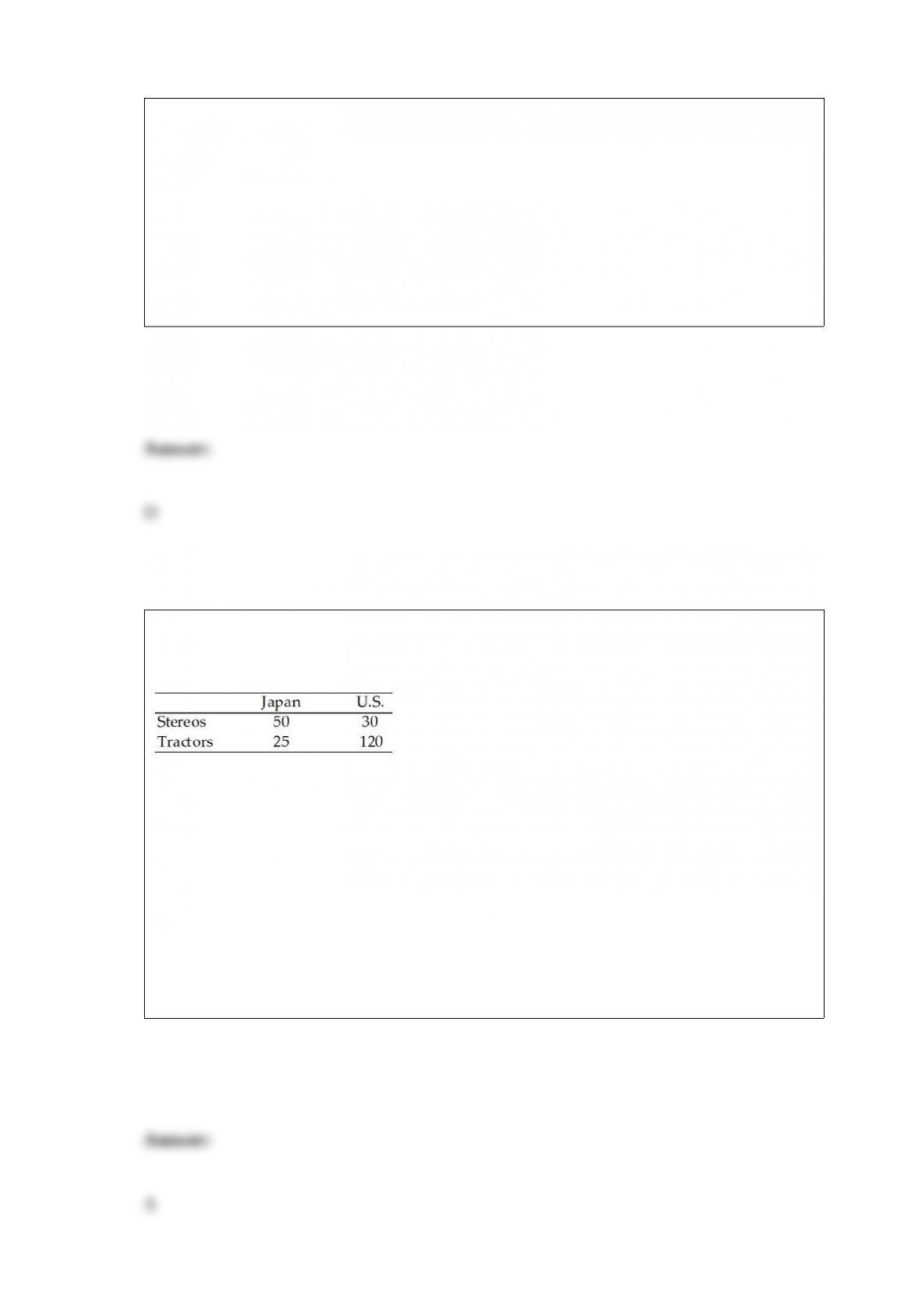
Daily Output of Japan and U.S.
Table 18.2
Refer to Table 18.2. Japan has a comparative advantage in the production of:
A) stereos.
B) tractors.
C) both stereos and tractors.
D) neither stereos nor tractors.
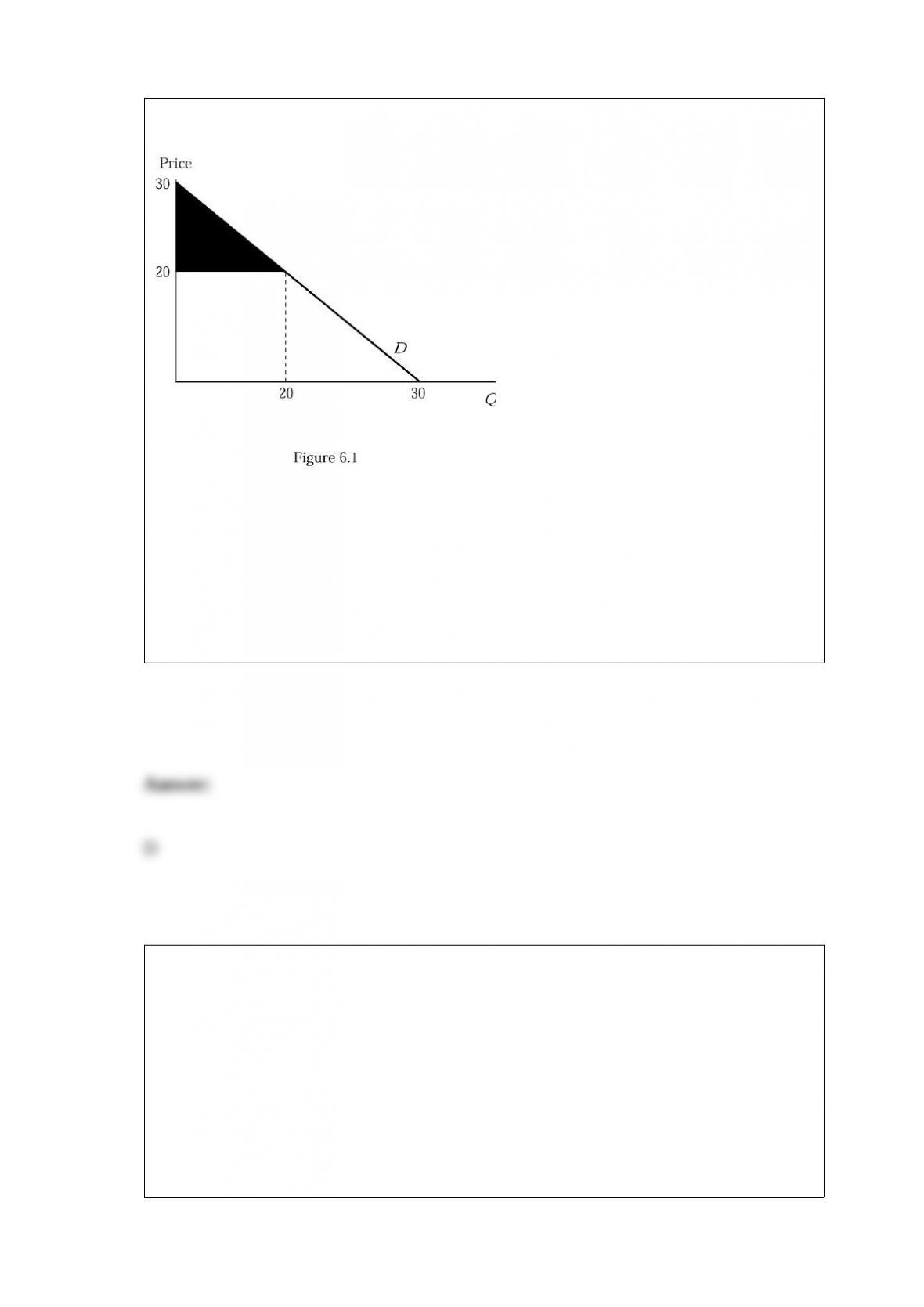
In Figure 6.1, the consumer surplus is equal to:
A) $400.
B) $300.
C) $200.
D) $100.
The market supply curve for labor is the relationship between the wage and the quantity
of labor that:
A) all workers are willing to provide.
B) any given worker is willing to provide.
C) all firms are willing to employ.
D) any given firm is willing to employ.

Recall the application about invisible inputs and the cost of fake killer whales, Sea lions
off the Washington coast eat steelhead and other fish, depleting some species threatened
with extinction and decreasing the harvest of the commercial fishing industry. Rick
Funk is a plastics manufacturer who has offered to build a life-sized fiberglass killer
whale, mount it on a rail like a roller coaster, and send the whale diving through the
water to scare off the sea lions, whales’ natural prey. According to Funk, it would cost
about $16,000 to make the first whale, including $11,000 for the mold and $5,000 for
labor and materials. Once the mold is made, each additional whale would cost an
additional $5,000. Why is the mold an invisible input?
A) because it cannot be scaled down and still produced the whales
B) because the cost of producing the mold is not visible in the total cost
C) because it can be scaled down and still produce the whales
D) both B and C
The production possibilities curve shows the combinations of goods that can be:
A) consumed by a nation before trade begins.
B) produced by a nation before trading begins.
C) produced by a nation after trade begins.
D) all of the above.
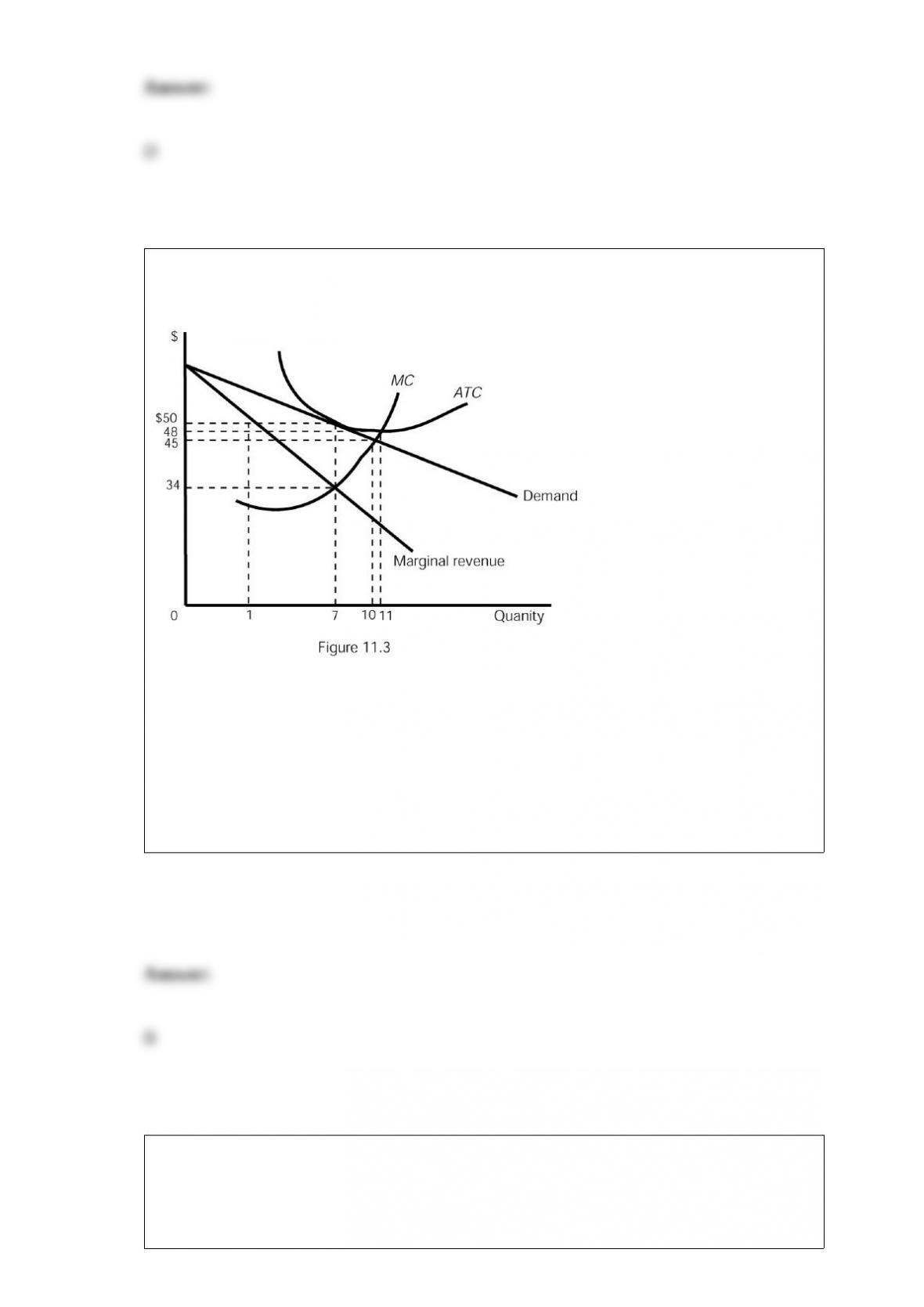
In the long run, a perfectly competitive firm facing the same costs as in Figure 11.3
would generate $________ of total revenue.
A) 350
B) 528
C) 450
D) 238
In the U.S. health care market, the uninsured typically receive health care for:
A) emergencies, but not for preventative care.

B) preventative care, but not for emergencies.
C) both emergencies and preventative care.
D) neither emergencies nor preventative care.
Adam Smith taught that individual buyers and sellers who act in their own self-interest
frequently promote society’s interest. What assumption is needed for society’s interest to
be promoted?
A) Buyers and sellers can make informed decisions.
B) Markets are perfectly competitive.
C) There are no external benefits or costs.
D) all of the above
Suppose that there are only three consumers of a product. At a price of $3 per unit, the
first consumer would buy 6 units of the product, the second consumer would buy 5
units, and the third consumer would buy 7 units of the product. If you drew a market
demand curve for this product, the quantity demanded at a price of $3 would be:
A) 18 units.
B) 11 units.

C) 13 units.
D) unable to be determined based on the information provided.
Suppose that ramen noodles are an inferior good. When income increases, the
equilibrium quantity of ramen noodles will ________ and the equilibrium price of
ramen noodles will ________.
A) rise; rise
B) rise; fall
C) fall; rise
D) fall; fall
Once the tradable pollution permits have been issued to firms:
A) each firm will reduce the level of pollution it generates.
B) the government determines the price of the permits.
C) firms with the highest cost of pollution abatement will have the greatest willingness
to pay for the permits.
D) firms with very low pollution abatement costs can purchase more permits.
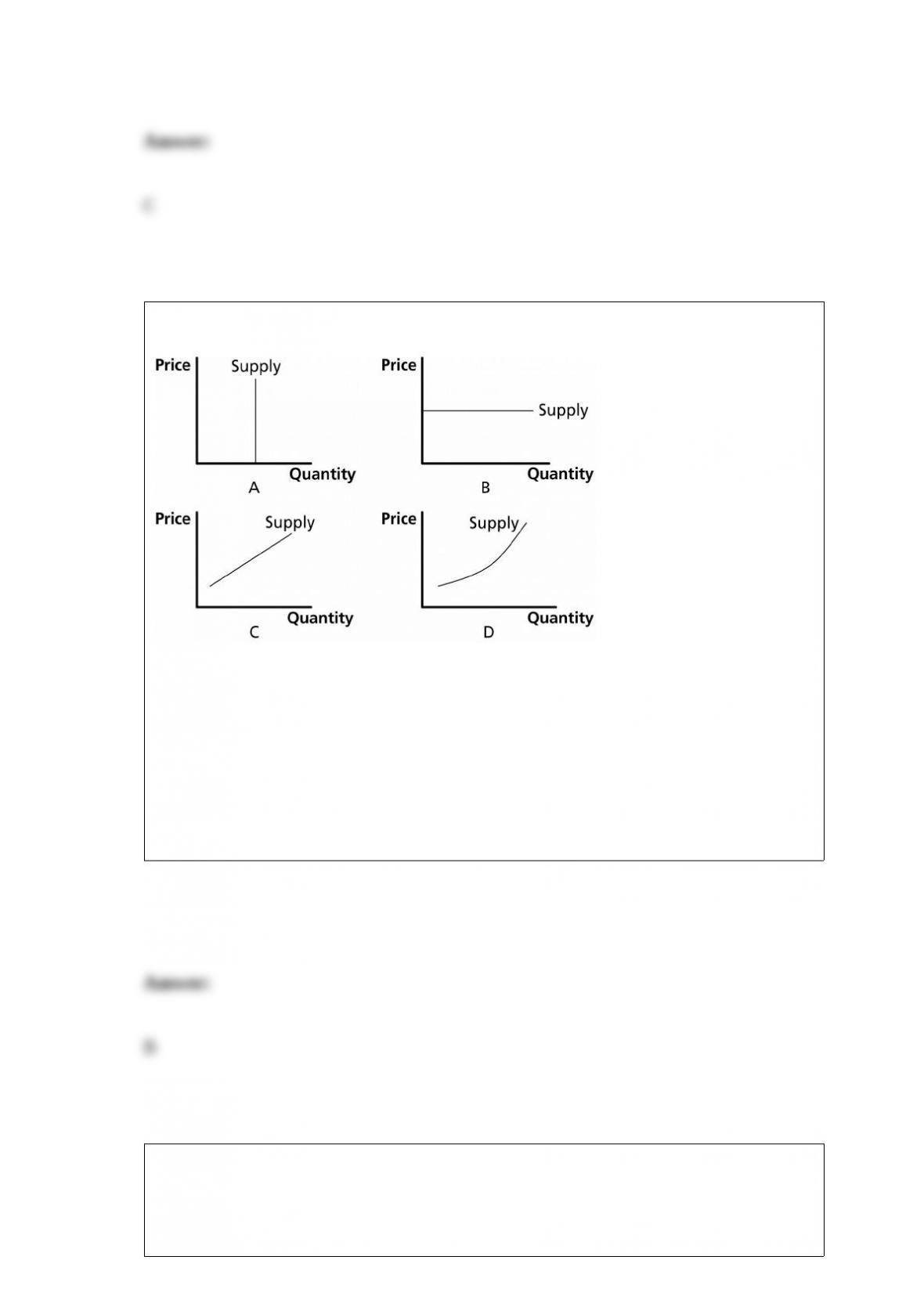
In Figure 5.4 supply is perfectly elastic in graph:
Figure 5.4
A) A.
B) B.
C) C.
D) D.
If we observe a firm engaging in price discrimination, it must be true that:
A) the firm is enjoying higher total profits than it would have earned if it charged a
single price for the product.

B) the firm can identify the preferences of every customer it serves.
C) the firm earns higher profits per unit than it would have earned if it charged a single
price for the product.
D) All of the above are correct.
Assume Edward considers eating out to be a normal good. The income effect of a wage
increase for Edward implies that Edward’s demand for eating out will be ________ and
Edward’s labor supply will be ________.
A) lower; higher
B) higher; lower
C) higher; higher
D) lower; lower
Additional Application
For the first seven months of 2006 Stockholm, Sweden has been testing a possible
solution to the city’s traffic congestion. It is called “congestion pricing” and their system
includes ‘small transponder boxes, laser detectors and a network of cameras to track the
path of every car” They want to reduce problems associated with smog and gridlock

and, in turn, improve the quality of life.
The experiment recorded each car’s registration, the date and time of day, as it passed
through specific electronic tolls and calculated a fee that was charged to the car’s owner.
During the rush hour the fee could be as high as $2.75. But in the evenings the toll
would be zero. The expectation is that people will respond to these varying tolls, change
their driving habits to be more efficient, and take more public transportation.
The next step is to put a referendum to the voters to decide whether this system will
become a permanent feature in the life of Stockholm drivers.
Leila Abboud and Jenny Clevstrom, “Stockholm’s Syndrome: Hostages to Traffic,
Swedes Will Vote on High-Tech Plan To Untangle Snarls With Tolls,” Wall Street
Journal, August 29, 2006, http://infoweb.newsbank.com, accessed 11/22/06.
As the cost of driving during specific times increases, people will drive less during
those times. This supports the basic economic notion that:
A) supply equals demand.
B) people respond to incentives.
C) marginal returns will diminish.
D) people are irrational.
Refer to Table 8.2, which gives a firm’s production function. Assume that all non-labor
inputs are fixed. The marginal product is maximized when the firm hires:

Table 8.2
A) 2 workers.
B) 3 workers.
C) 4 workers.
D) 5 workers.
When a second firm enters a market, the original firm’s profits decline because:
A) the original firm’s price decreases.
B) the original firm’s ATC increases.
C) the original firm’s quantity decreases.
D) All of the above are correct.
A maximum price set below the equilibrium price will:
A) cause excess demand and increase total surplus.
B) cause excess demand and decrease total surplus.
C) cause excess supply and increase total surplus.

D) cause excess supply and decrease total surplus.