
1) Marginal resource (labor) cost will always exceed the wage rate when the employer
is selling its product in an imperfectly competitive market.
2) if you pay a $2000 tax on $10,000 of taxable income and a $4000 tax on a taxable
income of $16,000, the tax is progressive.
3) as a percentage of gdp, u.s. health care spending is higher than any other major
industrial country.
4) The operational lag of fiscal policy refers to the time that elapses between the
beginning of a recession or inflation and the certain awareness that it is actually
happening.
5) nafta is an international accord that will eliminate all tariffs and quotas worldwide by
the year 2025.
6) the following production possibilities tables for countries alpha and beta:
refer to the above tables. which one of the following terms of trade would be acceptable

to both countries?
a.1 unit of x for 3 units of y
b.1 unit of x for 5 units of y
c.1 unit of x for 12 units of y
d.1 unit of x for 1 unit of y
7) which of the following is an example of a sunk cost, as it relates to a firm?
a.an expenditure on raw materials used in the production process.
b.an expenditure on a nonrefundable, nontransferable airline ticket.
c.an expenditure to buy a delivery van.
d.an expenditure for a new factory.
8) Suppose a firm anticipates that a R&D expenditure of $100 million will result in a
new production process that will reduce costs and thus create a one-time added profit of
$112 million a year later. The firm’s expected rate of return is:
A.0.12 percent.
B.112 percent.
C.12 percent.
D.2 percent.
9) In an aggregate expenditures diagram, a lump-sum tax (T) will:
A.not affect the C + Ig + Xn line.
B.shift the C + Ig + Xn line upward by an amount equal to T.
C.shift the C + Ig + Xn line downward by an amount equal to T.
D.shift the C + Ig + Xn line downward by an amount equal to T MPC.
10) a shift to the right in the demand curve for product a can be most reasonably
explained by saying that:
a.consumer incomes have declined and they now want to buy less of a at each possible
price.
b.the price of a has increased and, as a result, consumers want to purchase less of it.
c.consumer preferences have changed in favor of a so that they now want to buy more
at each possible price.
d.the price of a has declined and, as a result, consumers want to purchase more of it.
11) Assume a DVC has a real per capita output of $1,000 as compared to $20,000 for an
IAC. If both nations realize a 4 percent growth of their real per capita outputs, the
absolute real per capita output gap will:
A.remain unchanged at $19,000.
B.increase by $760.
C.decrease by $1,000.
D.increase by $19,760.
12) If a lump-sum income tax of $25 billion is levied and the MPS is 0.20, the:
A.saving schedule will shift upward by $5 billion.
B.consumption schedule will shift downward by $25 billion.
C.consumption schedule will shift downward by $20 billion.
D.consumption schedule will shift upward by $25 billion.
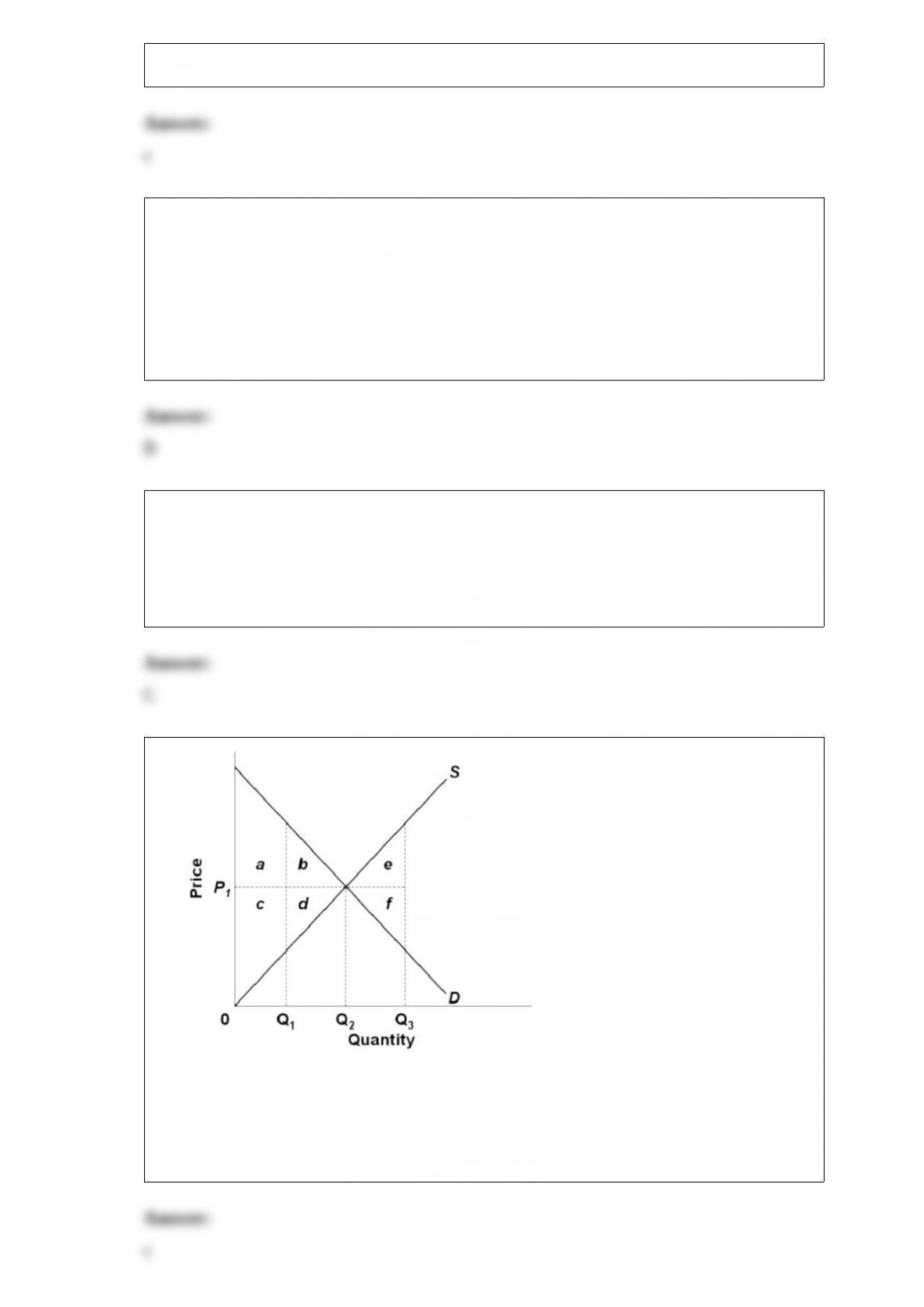
13)
refer to the above diagram. if actual production and consumption occur at q1:
a.efficiency is achieved.
b.consumer surplus is maximized.
c.an efficiency loss (or deadweight loss) of b + d occurs.
d.an efficiency loss (or deadweight loss) of e + d occurs.

14) In the Alcoa case of 1945 the courts held that:
A.the mere possession of monopoly power is a violation of the antitrust laws.
B.only contracts and combinations that unreasonably restrain trade are in violation of
the Sherman Act.
C.retail and wholesale firms are exempt from antitrust legislation.
D.firms which sell more than one-half of their output overseas are exempt from
antitrust.
15) suppose that inventories were $80 billion in 2007 and $70 billion in 2008. in 2008,
accountants would:
a.add $10 billion to other elements of investment in calculating total investment.
b.subtract $10 billion from other elements of investments in calculating total
investment.
c.add $75 billion (= $150/2) to other elements of investment in calculating total
investment.
d.subtract $75 billion (= $150/2) from other elements of investment in calculating total
investment.
16) Patent laws are controversial because:
A.they are in legal conflict with the provisions of the Federal Trade Commission Act.
B.they are at the core of the problem of whether monopoly is based on industry
structure or behavior.
C.while patents encourage innovation, they are also a source of monopoly power.
D.any firm whose monopoly power is based on patents is automatically exempt from
the antitrust laws.
17) which of the following factors has contributed to rising health care prices in the
united states?
a.the supply of physicians per 100,000 people has decreased since 1975.
b.productivity growth in the health care industry has been negative in recent years.
c.improvements in medical technology have significantly increased the number of
patients that can be treated each year.
d.the supply of physicians per 100,000 people has risen since 1975, but not as fast as
the increase in the demand for physicians’ services.
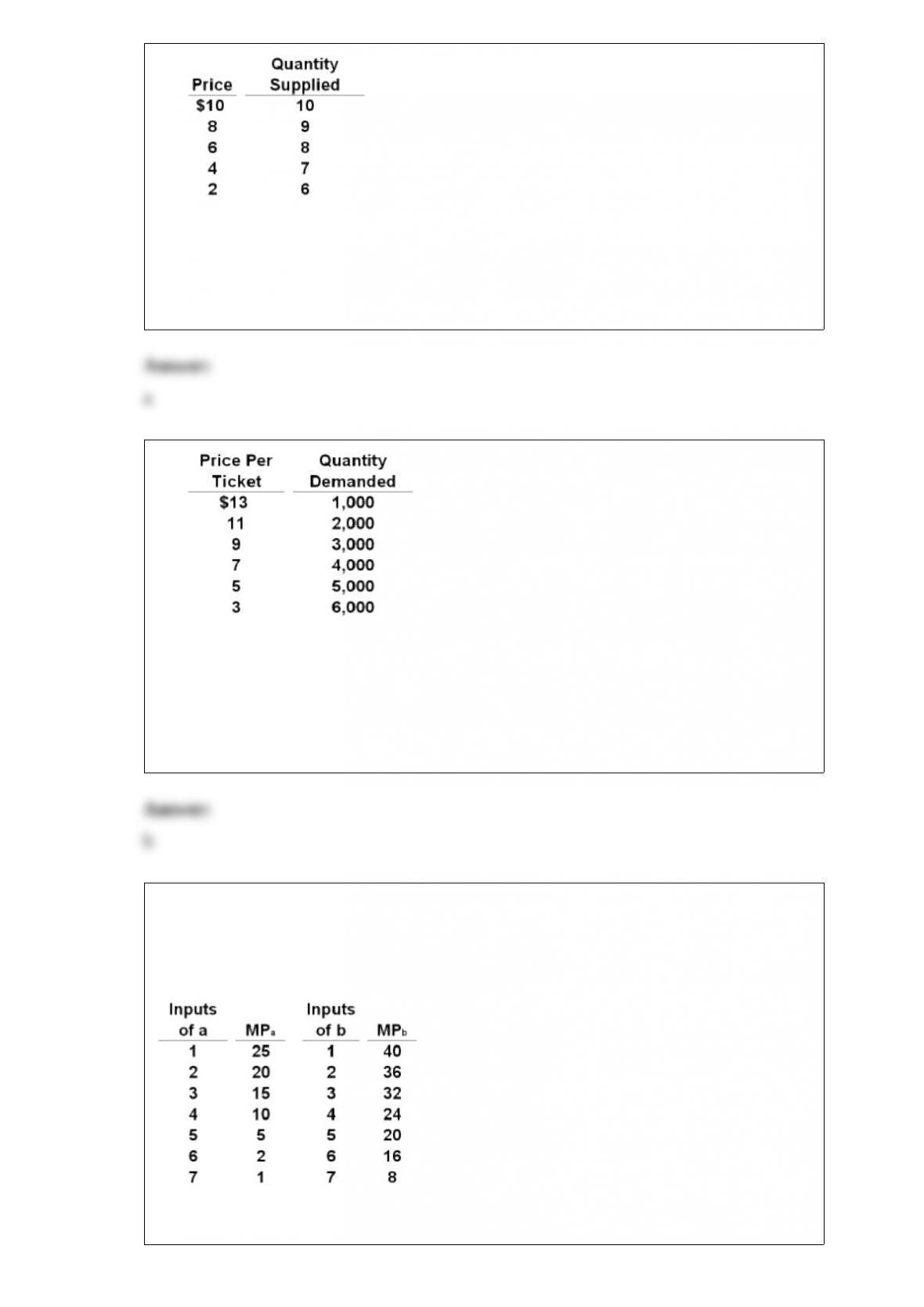
18)
refer to the above table. over the $8-$6 price range, supply is:
a.inelastic.
b.elastic.
c.perfectly inelastic.
d.perfectly elastic.
19)
refer to the above information. if the mudhens’ management wanted to maximize total
revenue from the game, it would set the ticket price at:
a.$5.
b.$7.
c.$9.
d.$13.
20) Answer the question on the basis of the following marginal product data for
resources a and b. The output of these independent resources sells in a purely
competitive market at $1 per unit.
Refer to the above data. Assuming the prices of resources a and b are $5 and $8
respectively, when the firm hires the profit-maximizing combination of resources, its
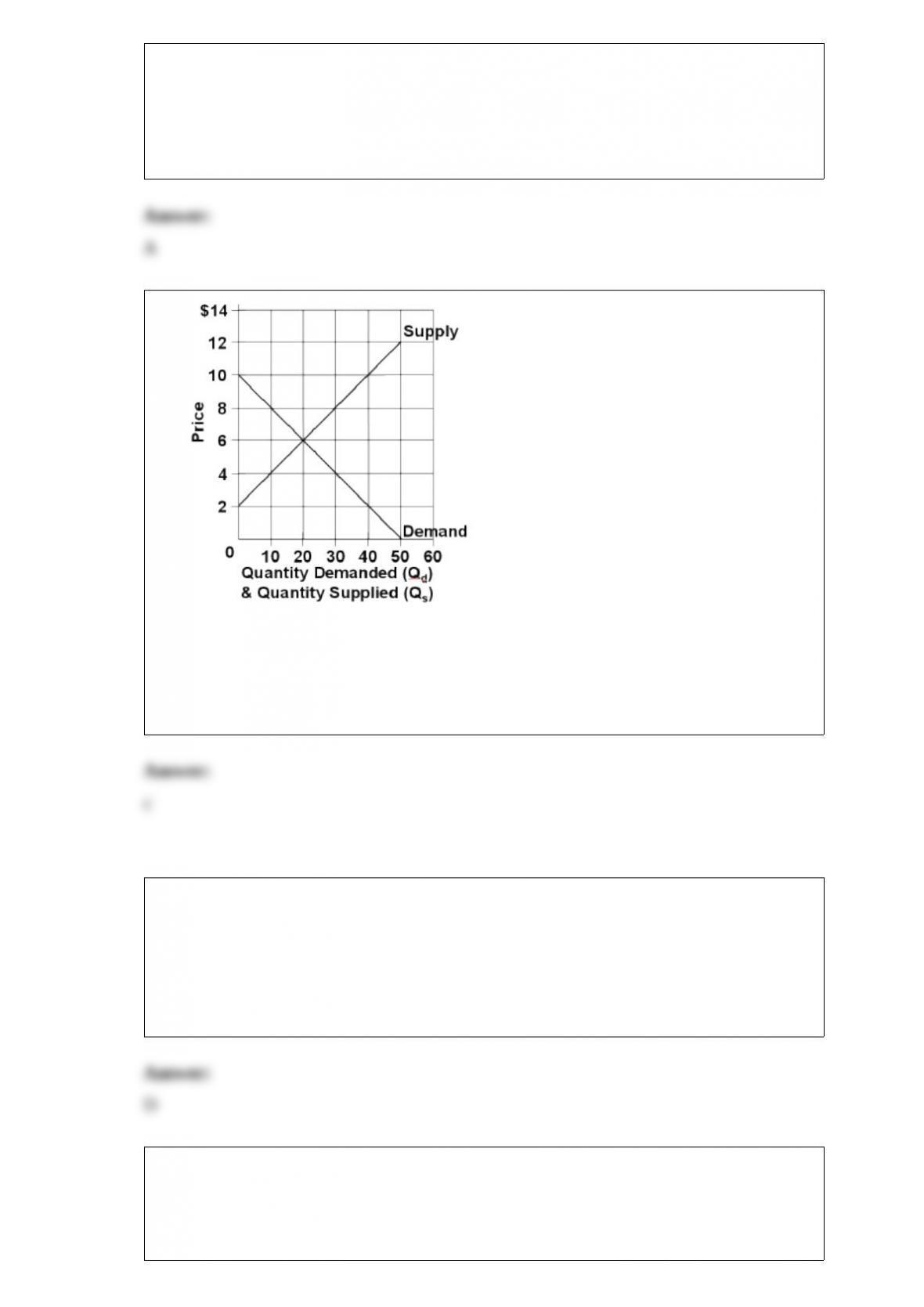
economic profit will be:
A.$170.
B.$76.
C.$145.
D.$138.
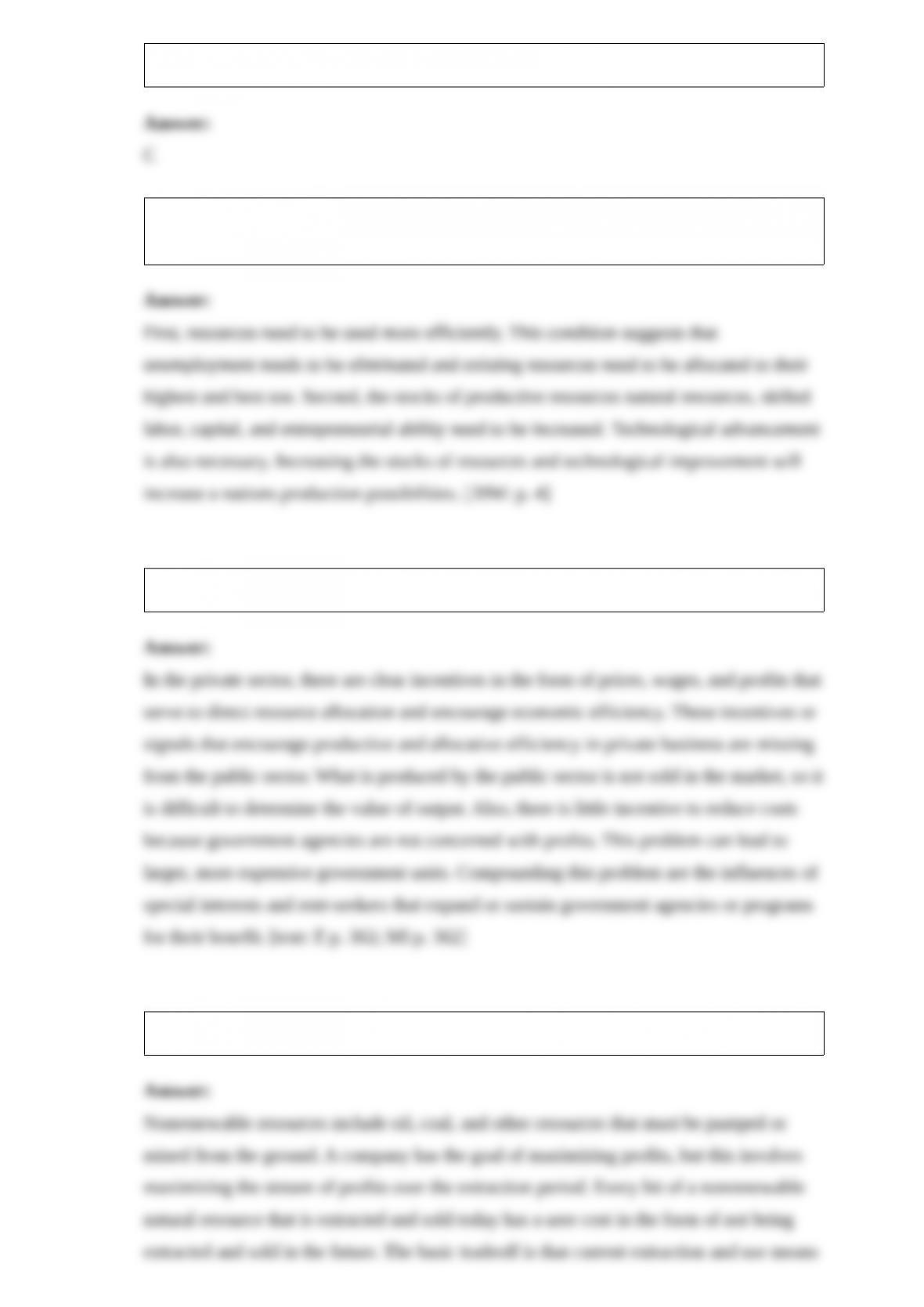
21)
refer to the above graph. which of the following statements is correct?
a.quantity demanded and quantity supplied are independent of price.
b.price and quantity demanded are directly related.
c.price and quantity supplied are directly related.
d.price and quantity supplied are inversely related.
22) Which one of the following is presently a major deterrent to bank panics in the
United States?
A.the legal reserve requirement
B.the fractional reserve system
C.the gold standard
D.deposit insurance
23) A profit-maximizing firm will:
A.expand employment if marginal revenue product equals marginal resource cost.
B.reduce employment if marginal revenue product equals marginal resource cost.
C.reduce employment if marginal revenue product is less than marginal resource cost.
D.expand employment if marginal revenue product is less than marginal resource cost.
24) It is stated that the avenues of economic growth are essentially the same for both
industrially advanced and developing nations. What are the two basic avenues?
25) Why would private business be considered more efficient than public agencies?
26) What is the tradeoff in the extraction of nonrenewable resources?
27) Describe the graph for a long-run supply curve in a decreasing-cost industry. Why
does it have this slope?
28) What is the difference between an economic investment and a financial investment?