Productive efficiency is achieved when firms produce goods and services
A) most desired by society.
B) at the highest profit margin.
C) at the lowest cost.
D) of the highest quality.
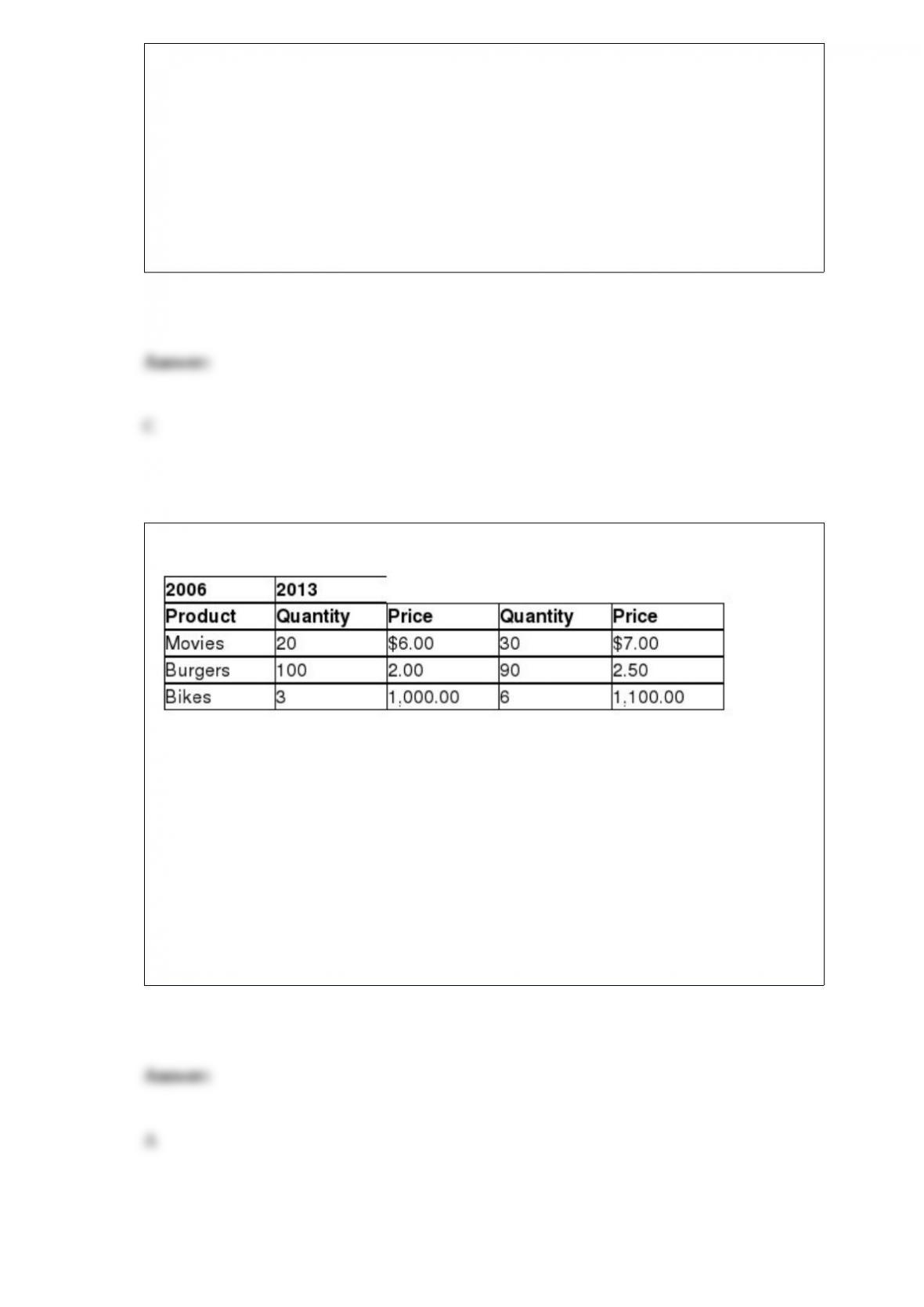
Table 19-17
A very simple economy produces three goods: movies, burgers, and bikes. The
quantities produced and their corresponding prices for 2006 and 2013 are shown in the
table above. What is nominal GDP in 2006?
A) $3,320
B) $3,690
C) $6,360
D) $7,035
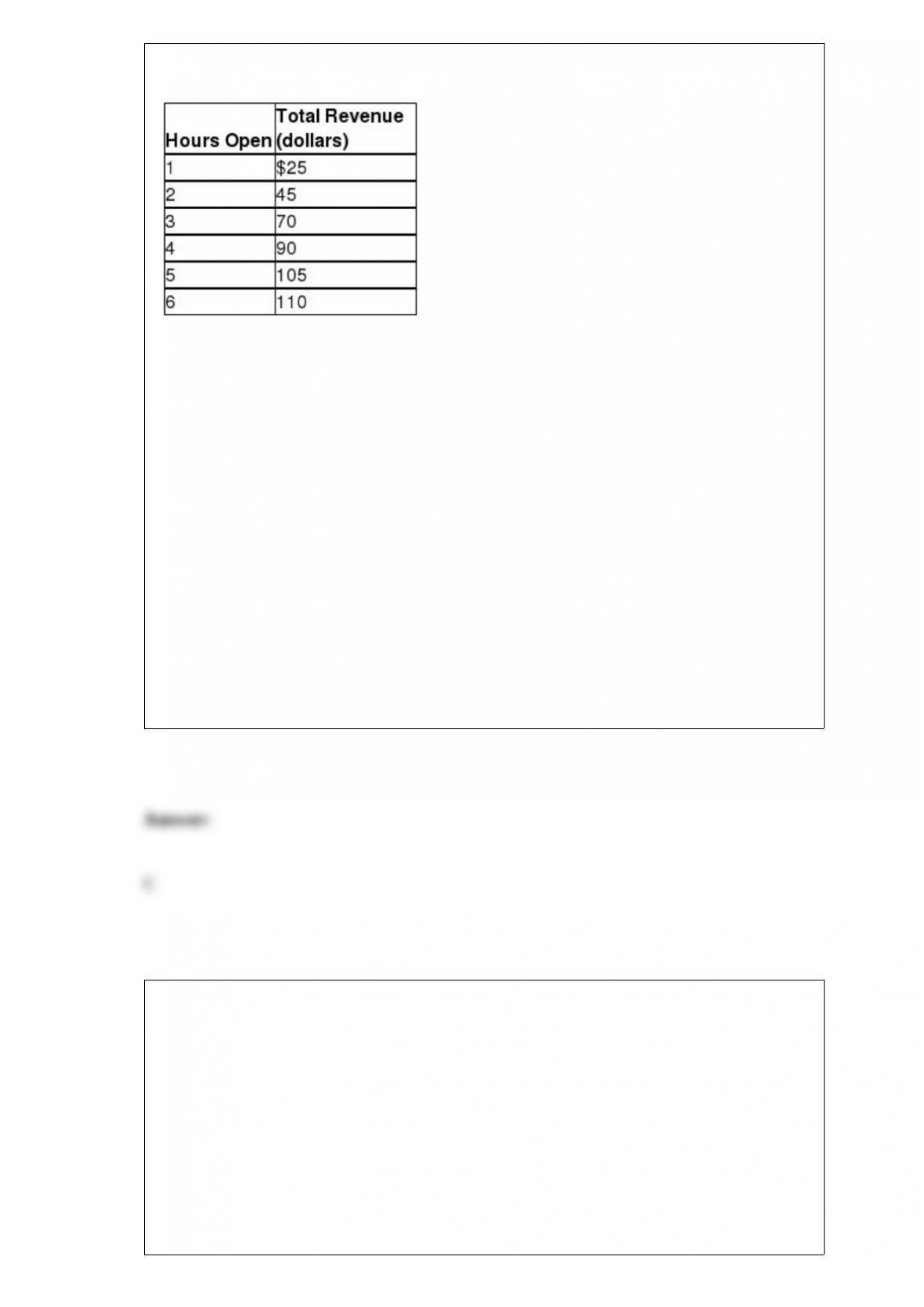
Table 1-2
Thuy Anh runs a small flower shop in the town of Florabunda. She is debating whether
she should extend her hours of operation. Thuy Anh figures that her sales revenue will
depend on the number of hours the flower shop is open as shown in the table above.
She would have to hire a worker for those hours at a wage rate of $16 per hour.
Using marginal analysis, how many hours should Thuy Anh extend her flower shop’s
hours of operations?
A) 2 hours
B) 3 hours
C) 4 hours
D) 5 hours
E) 6 hours
Suppose a monopolistically competitive firm sells 25 units at a price of $10. Calculate
its marginal revenue per unit of output if it sells 5 more units of output when it reduced
its price to $9.
A) $270
B) $20
C) $4
D) $2.50

Arnold Marion, a first-year economics student at Fazer College, was given an
assignment to find an example of price discrimination and present it to his class. When
asked for his example Arnold said “I went to a Milwaukee Brewers baseball game with
my cousin last week. We paid $25 each for our seats in left field. My aunt and uncle
paid $50 each for their tickets; they sat five rows behind the first base dugout. This is an
example of price discrimination since we paid different prices for the same product, and
the differences were not due to differences in costs.” How would Arnold’s economics
instructor assess Arnold’s example?
A) He would agree with Arnold that he had found an example of price discrimination,
but would add that arbitrage would occur if ticket scalpers sold Brewers tickets for
more than the prices Arnold and his uncle paid.
B) He would disagree with Arnold’s example because the $25 seats and the $50 seats
were not the same products.
C) He would agree with Arnold that he had found an example of price discrimination
and would explain that the elasticity of demand for Brewers tickets is different for
Arnold and his uncle.
D) He would disagree with Arnold’s example because there were differences in
transactions costs for the $50 tickets and the $25 tickets.
In comparing China to Canada, China’s relatively ________ growth rate in GDP would
make you more likely to take a job in China, and China’s relatively ________ level of
GDP would make you less likely to take a job in China.
A) high; low
B) high; high
C) low; low
D) low; high
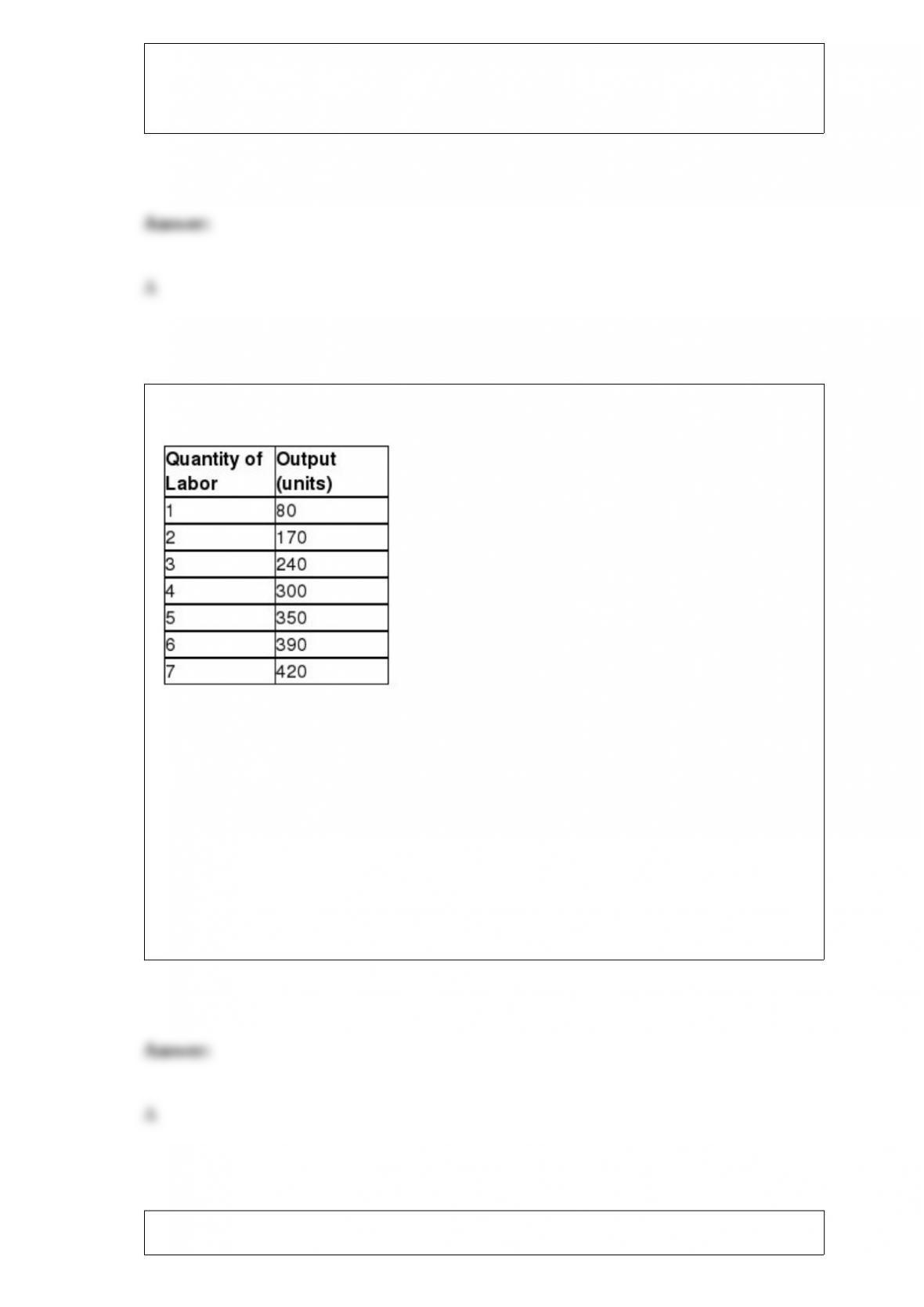
Table 17-1
Suppose the output price is $3. If the firm represented in the table is maximizing its
profit by hiring six workers, what is the wage rate?
A) $120
B) $65
C) $40
D) There is insufficient information to answer the question.
A nonmonetary opportunity cost is called a(n) ________, while a cost that involves

spending money is called a(n) ________.
A) accounting cost; explicit cost
B) implicit cost; explicit cost
C) accounting profit; economic profit
D) normal rate of return; asset
Jill Borts believes that the price elasticity of demand for her economics textbook is
relatively inelastic. She argues “I was told I had to purchase a book written by Hubbard
and O’Brien that is required by my instructor. If I wanted to buy a mystery novel I
would have many authors to choose from. Therefore, the demand for mystery novels is
more elastic than the demand for my textbook.” Is Jill correct?
A) The demand for the textbook is more inelastic, but Jill’s reasoning is incorrect. The
reason the textbook has an inelastic demand is that it is more expensive than any novel.
B) She is correct.
C) She is confused. She should have concluded that the textbook has a more elastic
demand than a novel.
D) She is correct that the textbook has a more inelastic demand, but that is because
most students pay for their textbooks with credit or debit cards. Most people pay for
novels and other books with cash or by check.
In 1913, Congress established the Federal Reserve system with the intention of putting
an end to

A) high interest rates.
B) high unemployment rates.
C) inflation.
D) bank panics.
If a dollar a year from now will likely have less purchasing power because of inflation,
then a dollar today ________ a dollar a year from now.
A) is more valuable than
B) is less valuable than
C) has the same value as
D) may be more valuable or less valuable than
Which of the following is not a characteristic of monopolistic competition?
A) There are many buyers and sellers.
B) There are low barriers to entry.
C) Average revenue is equal to price.
D) The products sold by all firms are identical.
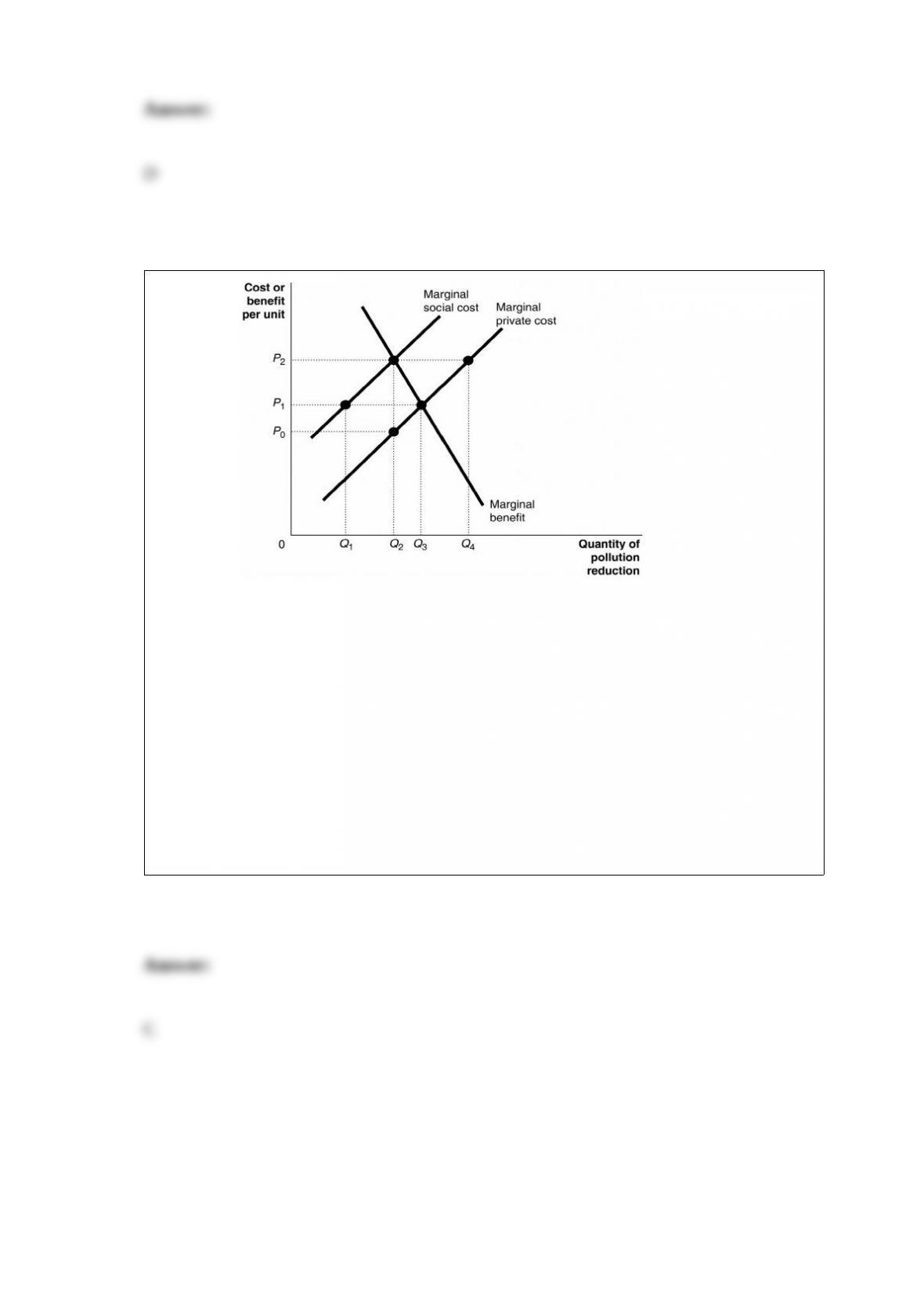
Figure 5-9 Companies producing
toilet paper bleach the paper to make it white. The bleach is discharged into rivers and
lakes and causes substantial environmental damage. Figure 5-9 illustrates the situation
in the toilet paper market.The private profit-maximizing output level is
A) Q1.
B) Q2.
C) Q3.
D) Q4.