1)
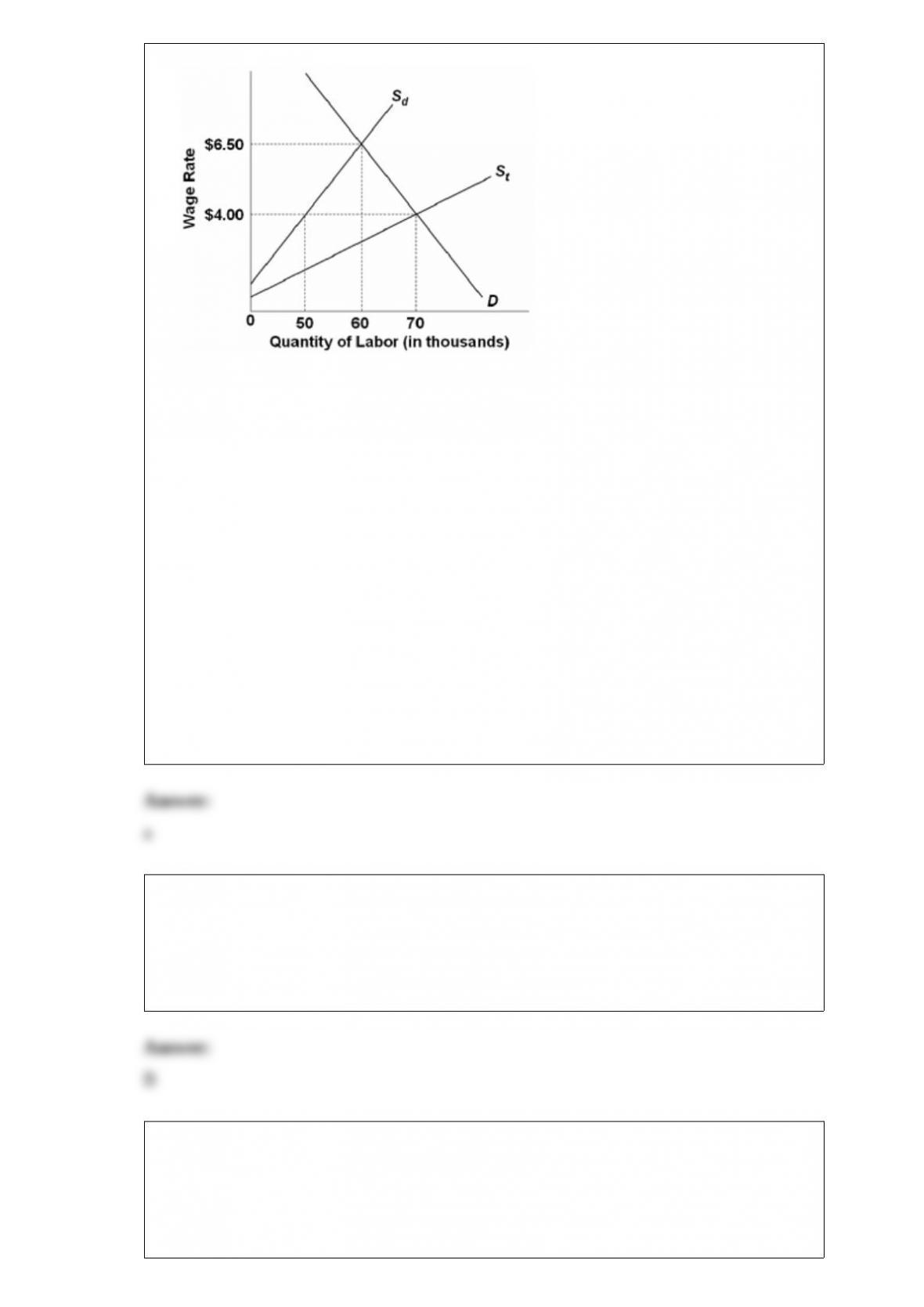
assumptions: 1) employers in this market are willing and able to ignore minimum wage
laws; 2) sd represents the supply of domestically-born (and legal immigrant) workers;
3) st represents the total supply of workers in this labor market (sd plus illegal
immigrants); and 4) unless otherwise stated, illegal immigration is not effectively
blocked by the government.
refer to the above figure. assume initially that government does not effectively block
illegal immigration. if the government then finds a way to prevent all illegal immigrants
from working in this labor market:
a.10,000 domestically-born workers will gain employment at the expense of 20,000
illegal immigrants.
b.20,000 domestically-born workers will gain employment at the expense of 20,000
illegal immigrants.
c.10,000 domestically-born workers will gain employment at the expense of 70,000
illegal immigrants.
d.10,000 domestically-born workers will gain employment at the expense of 50,000
illegal immigrants.
2) Federal Reserve Notes in circulation are:
A.an asset as viewed by the Federal Reserve Banks.
B.a liability as viewed by the Federal Reserve Banks.
C.neither an asset nor a liability as viewed by the Federal Reserve Banks.
D.part of M1, but not of M2.
3) A firm is likely to be a natural monopoly:
A.when the demand for its product or service is inelastic.
B.if it is producing an inferior good.
C.if economies of scale are experienced over the full range of output.
D.because government grants it an exclusive franchise.

4) The Fed can change the money supply by:
A.changing bank reserves through the sale or purchase of government securities.
B.changing the quantities of required and excess reserves by altering the legal reserve
ratio.
C.changing the discount rate so as to encourage or discourage commercial banks in
borrowing from the central banks.
D.doing all of these.
5) an example of a quasi-public good is:
a.public higher education.
b.an automobile.
c.a dvd player.
d.national defense.
6) The total fertility rate:
A.measures the average number of children that a woman is expected to have during
her lifetime.
B.measures the average number of children that each couple is expected to have during
their lifetime.
C.equals the rate of population change over time.
D.rises as income rises.
7) Which of the following statements best illustrates the time-value of money concept?
A.Bob is willing to forgo receiving $100 today in order to receive $110 next month.
B.Tom is indifferent between receiving $50 now and receiving $50 six months from
now.
C.Terry works for an hourly wage instead of a fixed salary.
D.Jeff would prefer to receive $200 at the end of the year instead of $220 now.
8) Capital flight from the DVCs may be caused by:
A.a fear of government privatization efforts.
B.slow domestic inflation.
C.low rates of domestic taxation.
D.risks of severe fluctuations in exchange rates.
9) ticket scalping:
a.imposes economic losses on both buyers and sellers.
b.creates economic gains for both buyers and sellers.
c.imposes losses on buyers, but creates gains for sellers.
d.imposes losses on sellers, but creates gains for buyers.
10) If M is $300, P is $4, and Q is 200, then V must be:
A.4.
B.2 2/3.
C.1.
D.3.
11)
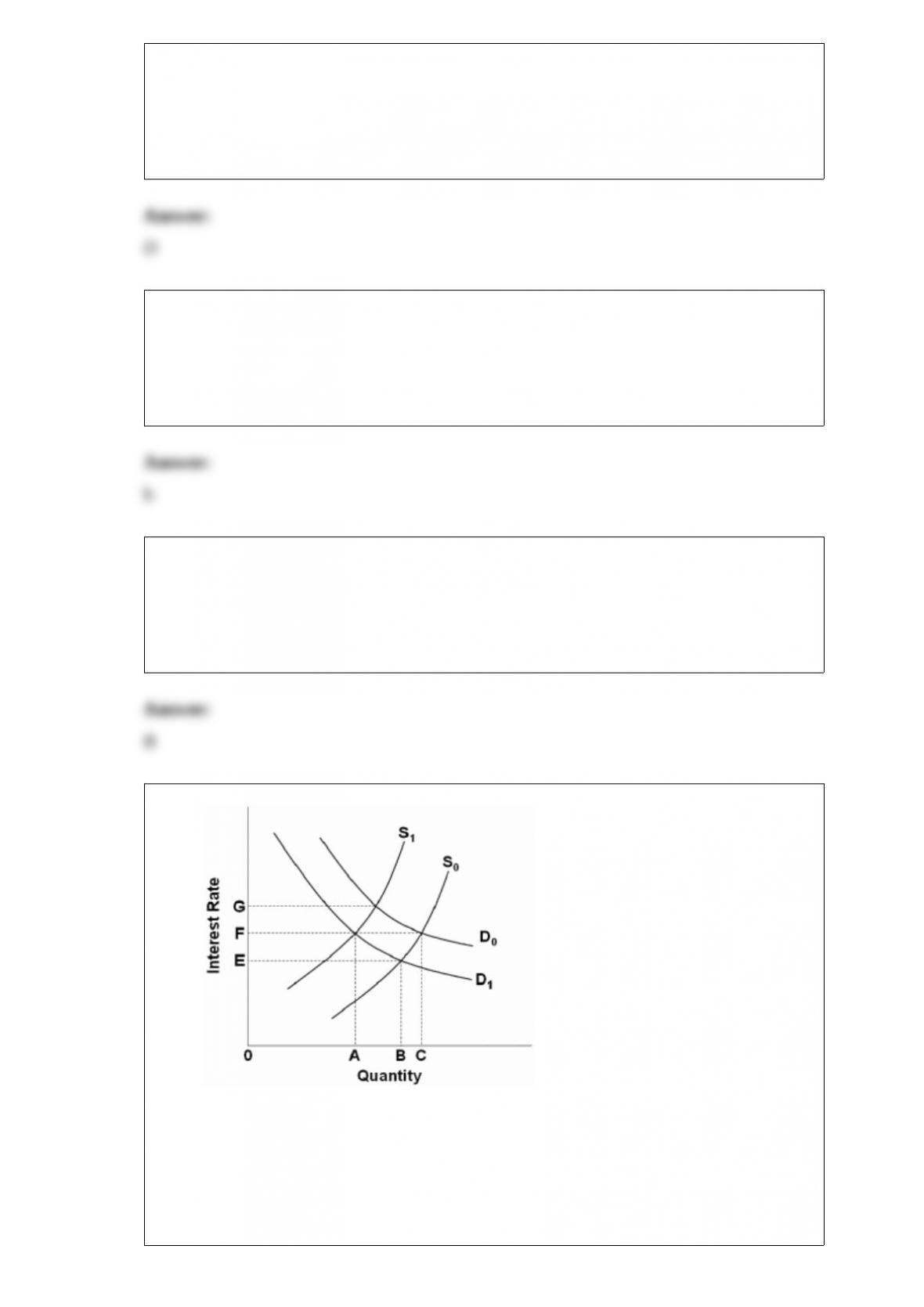
Refer to the above diagram. Suppose that the demand for loanable funds is D0 and the
supply of loanable funds initially is S0. If the supply of loanable funds declines to S1,
the equilibrium interest rate will:
A.decline from G to F.
B.increase from E to F.
C.decline from F to E.

D.increase from F to G.
12) Generally, the prime interest rate:
A.moves in the opposite direction as the Federal funds rate.
B.remains constant over long periods of time.
C.is highly inflexible downward.
D.moves in the same direction as the Federal funds rate.
13) Per capita incomes must first grow for birth rates to decline. This statement
describes the:
A.human capital view of population growth.
B.traditional view of population growth.
C.capricious universe view.
D.demographic transition view of population growth.
14) In an effort to avoid recession, the government implements a tax rebate program,
effectively cutting taxes for households. We would expect this to:
A.affect neither aggregate supply nor aggregate demand.
B.increase aggregate demand.
C.reduce aggregate demand.
D. reduce aggregate supply.
15)
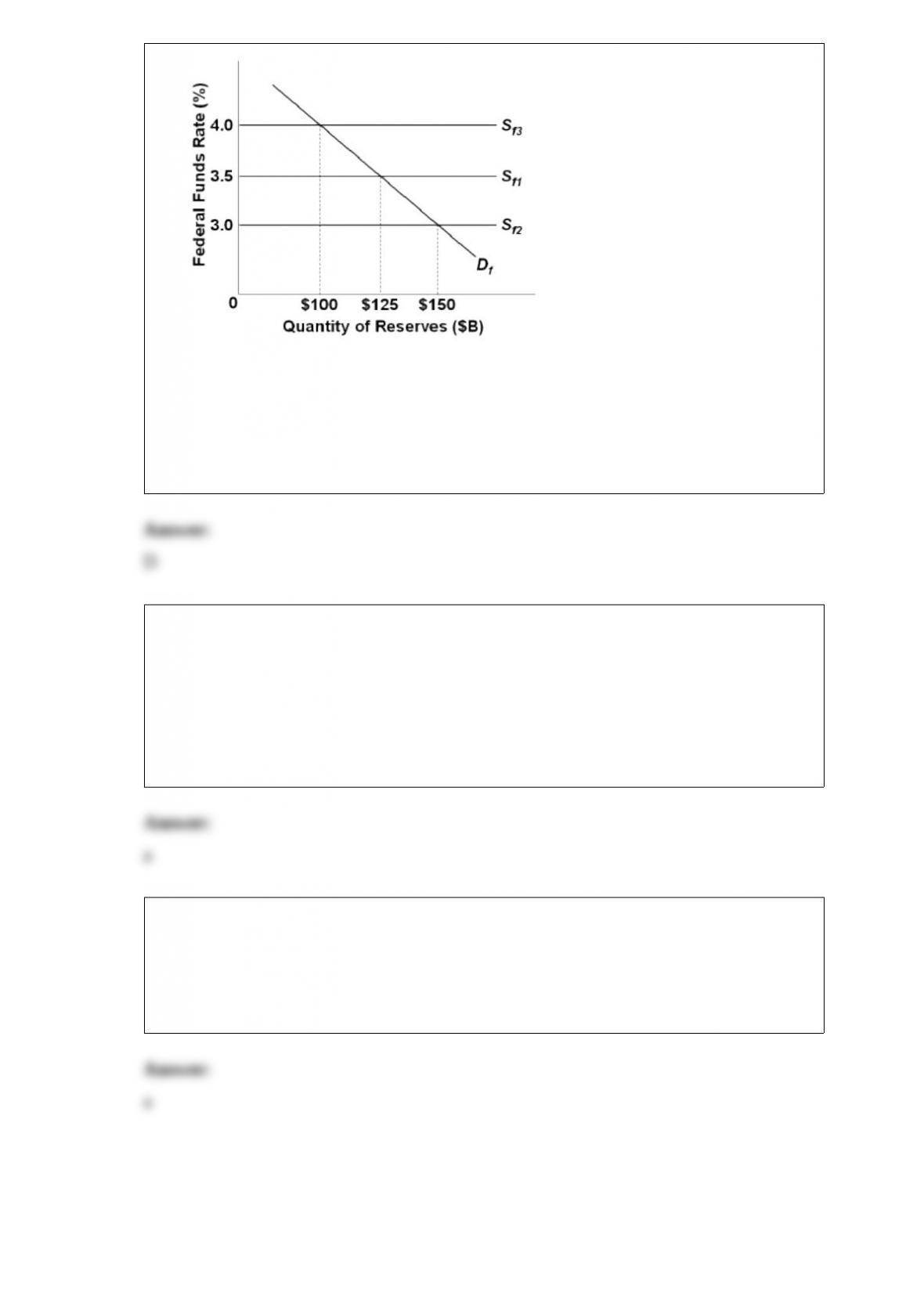
Refer to the above diagram for the Federal funds market. A $25 billion increase in
reserves will change the interest rate to:
A.3.0 percent.
B.3.5 percent.
C.4.0 percent.
D.an indeterminate level.
16) suppose that at prices of $5, $4, $3, $2, and $1 for product z, the corresponding
quantities supplied are 3, 4, 5, 6, and 7 units, respectively. which of the following would
increase the quantities supplied of z to, say, 6, 8, 10, 12, and 14 units at these prices?
a.improved technology for producing z
b.an increase in the prices of the resources used to make z
c.an increase in the excise tax on product z
d.increases in the incomes of the buyers of z
17) an increasing-cost industry is the result of:
a.higher resource prices which occur as the industry expands.
b.a change in the industry’s minimum efficient scale.
c.x-inefficiency.
d.the law of diminishing returns.