
Studies show that as real income has been rising in the United States, the per-capita
demand for food has been increasing by
a. much less, which means the demand for food is income inelastic.
b. much more, which means the demand for food is income elastic.
c. much more, which means the demand for food is income inelastic.
d. as much, which means the demand for food is unit elastic.
e. none of the above
For a normal good, __________ falls as income __________; for an inferior good,
__________ rises as income __________.
a. demand; falls; demand; falls
b. demand; rises; demand; rises
c. supply; falls; demand; falls
d. supply; rises; supply; falls
In the case of a positive externality, in order to achieve efficiency the government must
set the _________________ equal to the marginal ____________________.
a. tax; external costs
b. tax; external benefits

c. subsidy; external costs
d. subsidy; external benefits
e. subsidy; private costs
The Herfindahl index for a monopoly is 1,000.
a. True
b. False
A mandatory seatbelt law ends up raising the number of traffic fatalities if it lowers
fatalities per accident from 0.10 to 0.07 while raising the number of accidents per
period from 35,000 to any more than
a. 35,000.
b. 38,500.
c. 37,450.
d. 50,000.

Generally, positive externalities result in
a. too much of a good being produced.
b. the socially optimal output of a good being produced.
c. too little of a good being produced.
d. either a or c
e. any of the above
When a new word processing software program is released, companies that might use it
must consider not only the cost of buying it, but the costs of retraining all their
employees to use it, and of training their support staff to install and operate it. These
additional costs beyond the purchase price are known as __________ costs.
a. implicit
b. innovation
c. switching
d. transformation

At 100 units of output, total cost is $22,000 and total variable cost is $14,000. At 100
units of output, what is the value of average total cost, average variable cost, and
average fixed cost, respectively?
a. $22; $14; $8
b. $220; $140; $80
c. $740; $340; $400
d. $340; $740; $60
e. $400; $340: There is not enough information provided to determine the average fixed
cost.
One of the consequences of an agricultural price support program is
a. a surplus.
b. more exchanges made at the price support.
c. lower prices paid by consumers.
d. lower taxes for taxpayers.
e. a and c

Variables A and B are inversely related. If we plot A on the horizontal axis and B on the
vertical axis, the line that connects combinations of A and B in a two-variable diagram
is
a. parallel to the horizontal axis.
b. downward-sloping (left to right).
c. parallel to the vertical axis.
d. upward-sloping (left to right).
e. a or c
As the interest rate rises, the opportunity cost of
a. future consumption rises.
b. present consumption rises.
c. investing in roundabout methods of production rises.
d. lending money rises.
Suppose for a consumer the marginal utility (MU) of bread is 20 utils and the MU of
milk is 10 utils; the price of bread is $3 and the price of milk is $1. Given this,
a. more utility per dollar is gained from consuming bread than milk.
b. more utility per dollar is gained from consuming milk than bread.

c. the same amount of utility per dollar is gained from consuming milk as bread.
d. the consumer is in consumer equilibrium.
Research conducted by Nicholas Epley and his colleagues at Harvard showed that
people will spend a _________________ percentage of money given to them if it
is________________ rather than
a. smaller; cash; a rebate check.
b. greater; termed a rebate; a bonus.
c. greater; termed a bonus; a rebate.
d. smaller; a rebate check; cash.
As the price of a good falls from $5 to $3, the quantity supplied of the good falls from
550 units to 400 units. Price elasticity of supply is
a. 0.95.
b. 1.20.
c. 1.58.
d. 0.63.
A low price-earnings ratio usually indicates that people believe that this corporation
will have lower than average growth in earnings.
a. True
b. False
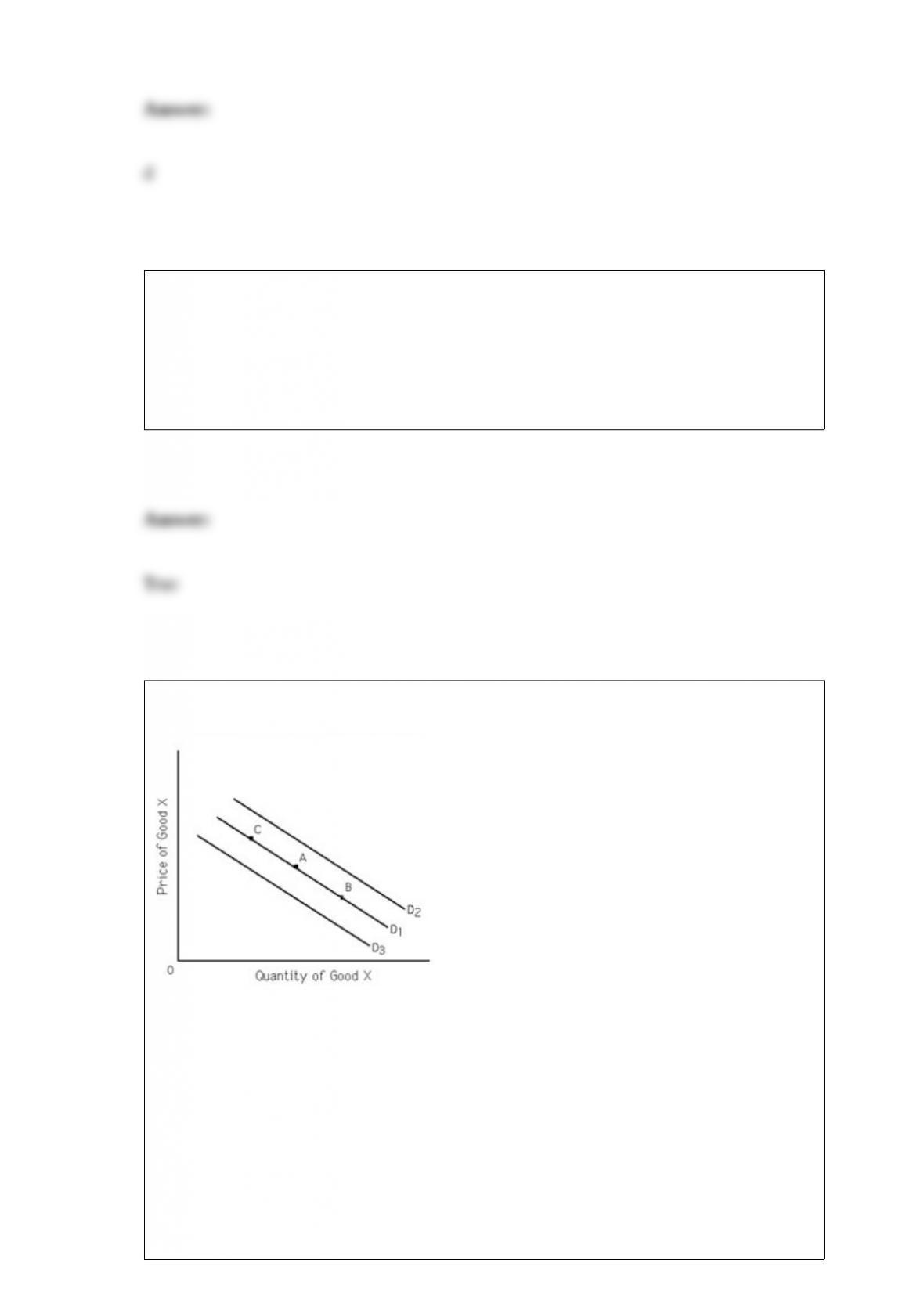
Exhibit 3-6
If a decrease in income causes the demand for good X to shift from D1 to D2, then good
X is
a. a normal good.
b. an inferior good.
c. a substitute good.
d. a complementary good.

e. a neutral good.