
If the Fed lowers the reserve requirement, then this
A) increases excess reserves, encourages banks to make more loans, and increases the
money supply.
B) decreases excess reserves, causes banks to reduce their loans, and decreases the
money supply.
C) decreases excess reserves, causes banks to reduce their loans, and increases the
money supply.
D) increases excess reserves, causes banks to reduce their loans, and increases the
money supply.
German automobile exports were hurt in 2008 as a result of the recession. How would
this decrease in exports have affected Germany’s aggregate demand curve?
A) The aggregate demand curve would have shifted to the right.
B) The aggregate demand curve would not have shifted, but there would have been a
movement up the aggregate demand curve.
C) The aggregate demand curve would not have shifted, but there would have been a
movement down the aggregate demand curve.
D) The aggregate demand curve would have shifted to the left.
Frictional unemployment is the result of
A) a persistent mismatch between the skills and characteristics of workers and the

requirements of the jobs.
B) the search process of matching workers with jobs.
C) the ups and downs in inflation.
D) a slowdown in the economy.
Because Whirlpool produces durable goods, the demand for their goods
A) is likely to increase during recession.
B) declines when incomes in the economy are rising.
C) is consistently high, regardless of the state of the economy.
D) tends to follow the business cycle.
If the number of unemployed workers is 19 million, the number in the working-age
population is 500 million, and the unemployment rate is 4%, how many workers are in
the labor force?
A) 1 million
B) 20 million
C) 475 million
D) 481 million
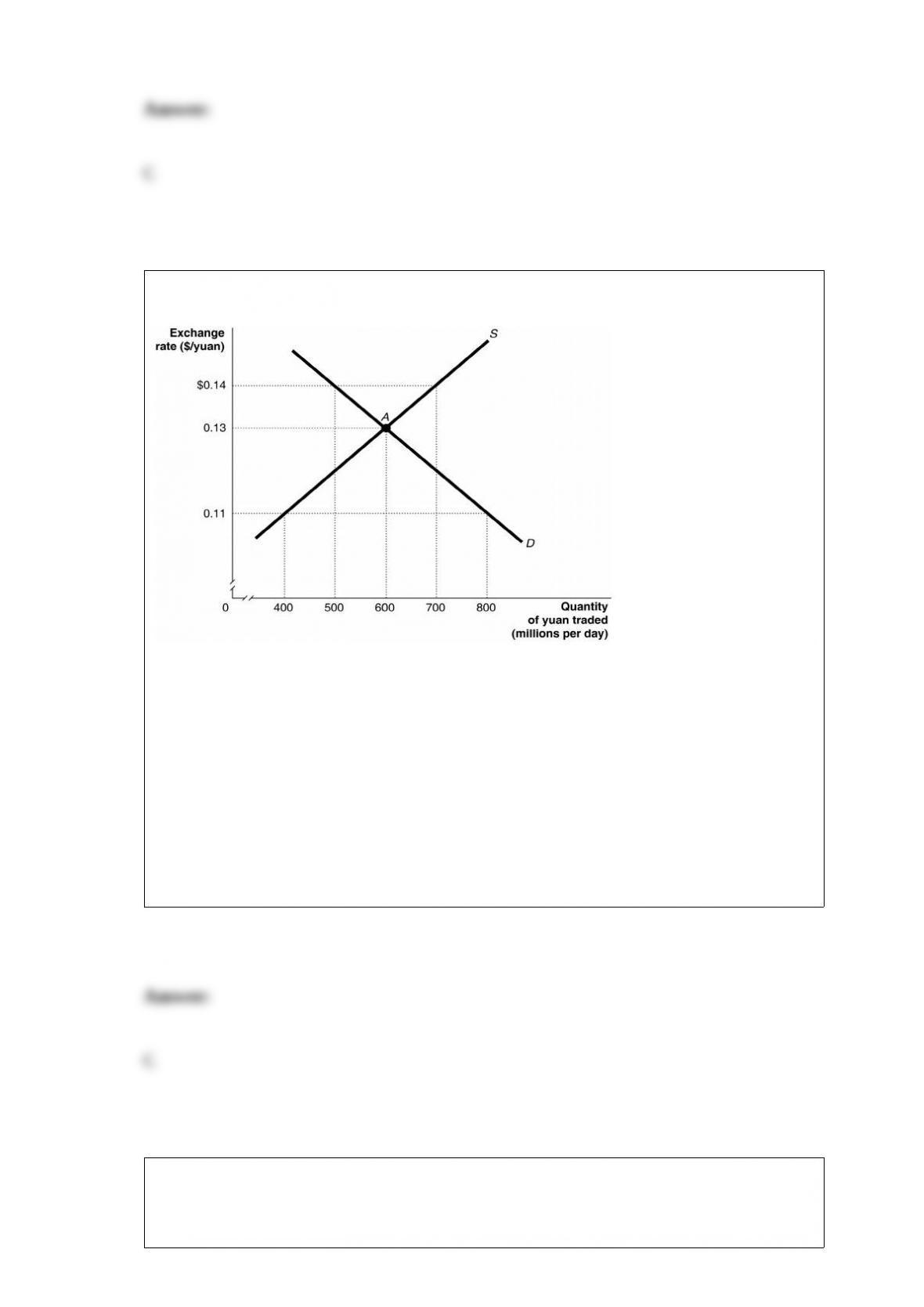
Figure 19-5
Refer to Figure 19-5. Suppose the pegged exchange rate is $0.11/yuan. Because of
safety concerns and numerous product recalls, U.S. consumers lower their demand for
Chinese products. Using the figure above, this would
A) increase the surplus of Chinese yuan.
B) decrease the surplus of Chinese yuan.
C) decrease the shortage of Chinese yuan.
D) increase the shortage of Chinese yuan.
In the United States, the annual growth rate of real GDP per hour worked between 1996
and 2012 averaged

A) -0.3%.
B) 1.9%.
C) 6.9%.
D) 10.2%.
If real GDP per capita measured in 2009 dollars was $6,000 in 1950 and $48,000 in
2013, we would say that in the year 2013, the average American could buy ________
times as many goods and services as the average American in 1950.
A) 1/8
B) 4
C) 8
D) 12
At macroeconomic equilibrium, total ________ equals total ________.
A) spending; production
B) investment; inventories
C) consumption; production
D) taxes; transfers

The government purchases multiplier equals the change in ________ divided by the
change in ________.
A) government purchases; equilibrium real GDP
B) equilibrium real GDP; government purchases
C) government purchases; consumption spending
D) consumption spending; government purchases
If the exchange rate changes from $2.00 = 1 euro to $1.98 = 1 euro then
A) the dollar has depreciated.
B) the dollar has appreciated.
C) the euro has appreciated.
D) the euro has stayed constant in value.
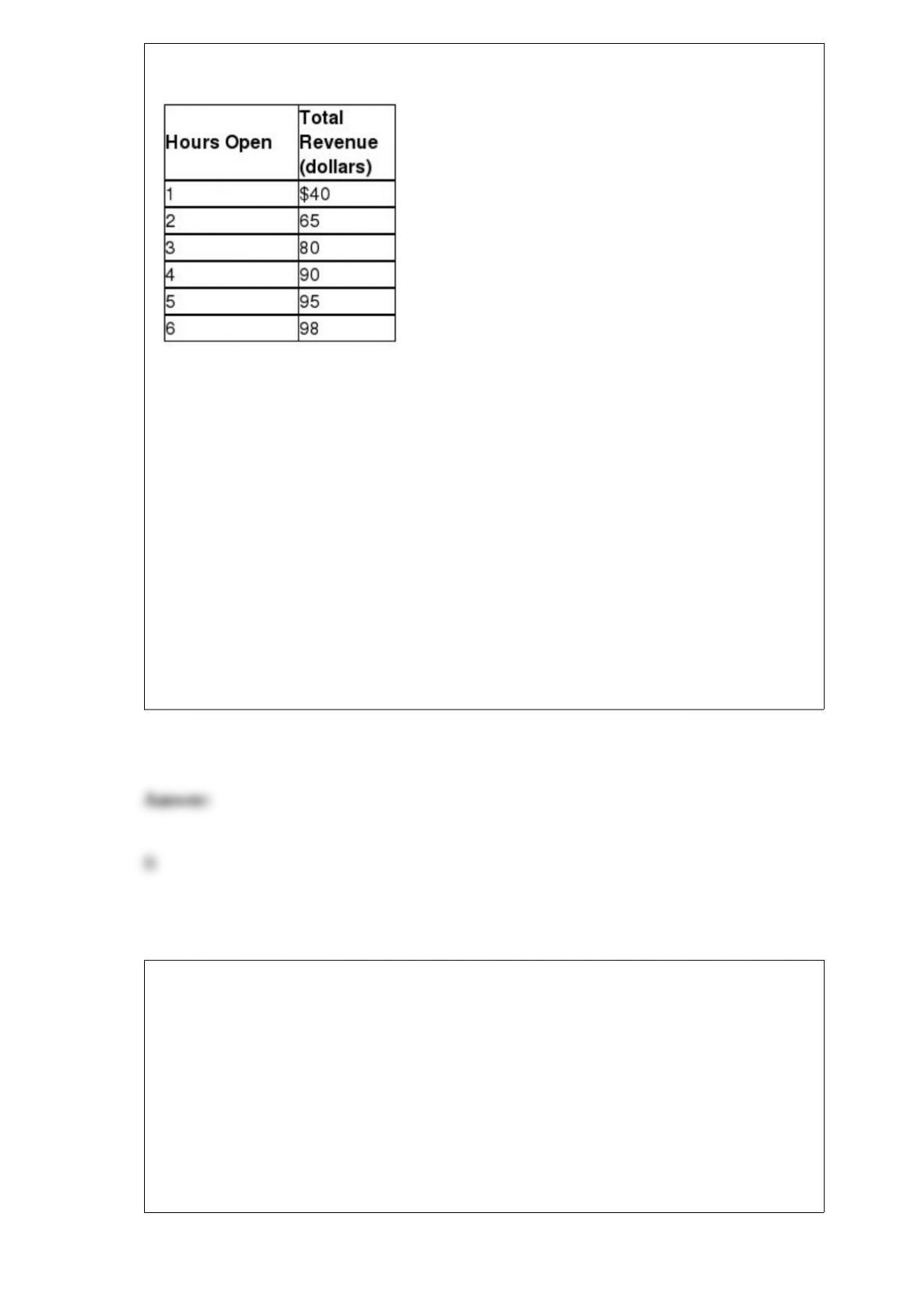
Table 1-2
Julius runs a small tailor shop in the city of Bloomfield. He is debating whether he
should extend his hours of operation. Julius figures that his sales revenue will depend
on the number of hours the tailor shop is open as shown in the table above. He would
have to hire a worker for those hours at a wage rate of $18 per hour.
Refer to Table 1-2. What is Julius’s marginal cost if he decides to stay open for three
hours instead of two hours?
A) $0
B) $18
C) $54
D) $65
Assuming the United States is the “domestic” country, if the real exchange rate between
the United States and Russia decreases from 28 to 23,
A) the prices of U.S. goods and services have decreased by 5% relative to Russia.
B) the prices of U.S. goods and services have increased by 25.5% relative to Russia.
C) the prices of U.S. goods and services have decreased by 18% relative to Russia.
D) the prices of U.S. goods and services have increased by 22% relative to Russia.
Which of the following models advocate that the quantity of money should be increased
at a constant rate?
A) the monetarist model
B) the new classical model
C) the real business cycle model
D) the new Keynesian model
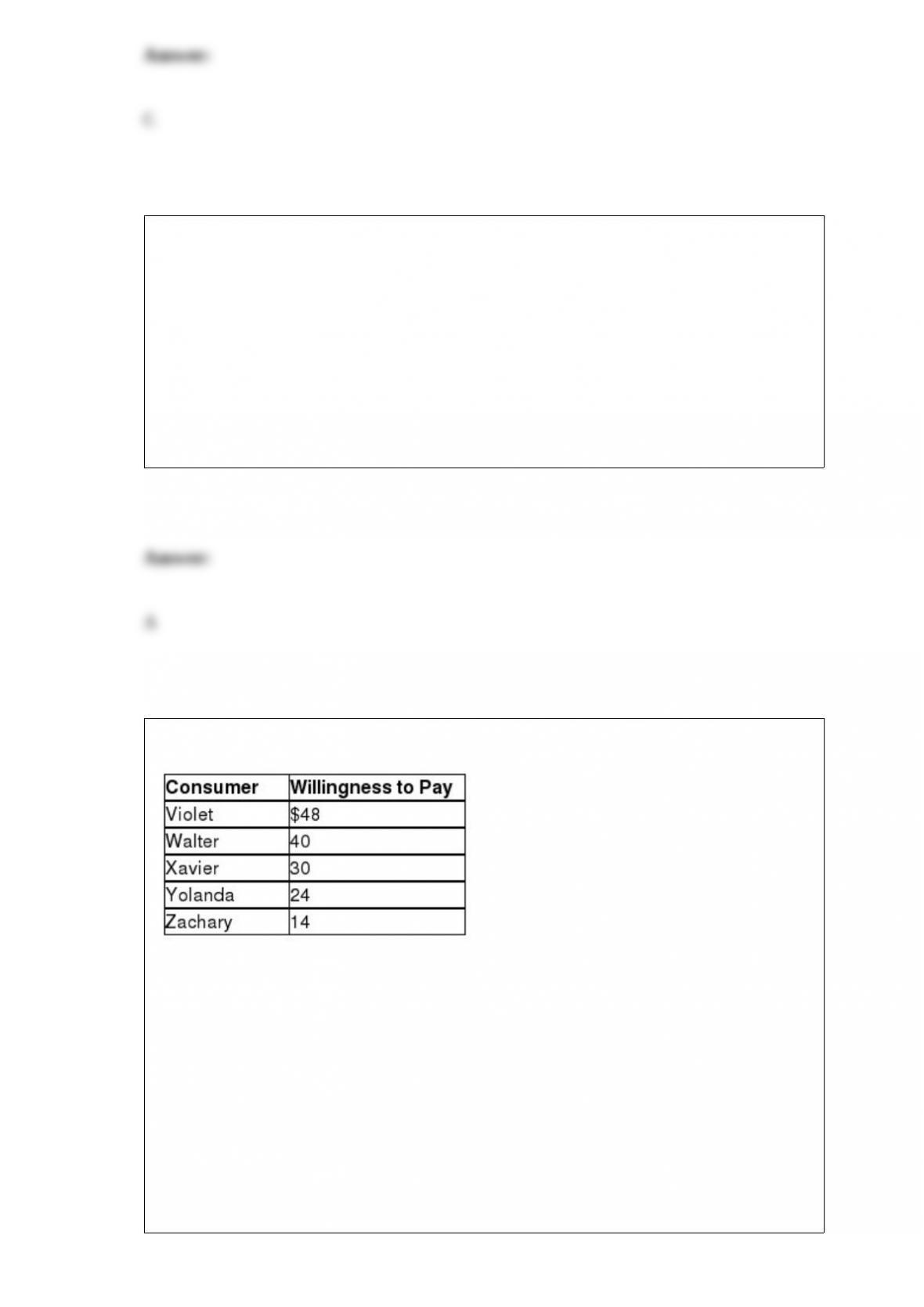
Table 4-2
Refer to Table 4-2. The table above lists the highest prices five consumers are willing to
pay for a concert ticket. If the price of one of the tickets is $36
A) Violet and Walter will each buy two tickets.
B) Walter will receive $4 of consumer surplus from buying one ticket.
C) Violet and Walter receive a total of $52 of consumer surplus from buying one ticket
each. No one else will buy a ticket.
D) Xavier, Yolanda, and Zachary will receive a total of $68 of consumer surplus since
they will buy no tickets.

Studies have shown that drinking one glass of red wine per day may help prevent heart
disease. Assume this is true, and a fungal disease destroys a large portion of the grape
harvest of California vineyards. In the market for red wine, these two developments
would
A) increase demand and increase supply, resulting in an increase in the equilibrium
quantity and a decrease in the equilibrium price of red wine.
B) increase demand and decrease supply resulting in a decrease in both the equilibrium
quantity and the equilibrium price of red wine.
C) increase demand and decrease supply, resulting in an increase in the equilibrium
price and an uncertain effect on the equilibrium quantity of red wine.
D) increase demand and decrease supply, resulting in an increase in both the
equilibrium price and the equilibrium quantity of red wine.
Article Summary
Since 2008, the United States has been involved in trade negotiations over the
Trans-Pacific Partnership (TPP), a free trade agreement with 11 other countries on both
sides of the Pacific Ocean. One area of the negotiations involves patents and intellectual
property rights in the pharmaceutical industry. A number of developing countries have
ignored international agreements concerning patents and intellectual property rights as a
way to benefit their domestic pharmaceutical industries, to the detriment of those
companies which have spent considerable time and money developing new medicines.
For every 5,000 to 10,000 experimental drugs contemplated, only one will typically
gain FDA approval, and this occurs only after up to 15 years of research at an average
cost of more than $1 billion. Also, 30 percent of the U.S. workforce is either directly or
indirectly employed in the pharmaceutical industry, so protection of these intellectual
property rights is very important for the U.S. economy.

Source: Doug Schoen, “Intellectual Property Rights Matter,” Forbes, September 24,
2013.
Refer to the Article Summary. If these developing countries continue to ignore the
international agreements which protect intellectual property rights, all of the following
would most likely occur except
A) pharmaceutical companies would decrease investment in the development of more
experimental drugs.
B) pharmaceutical companies would consider expanding operations to these developing
countries.
C) fewer patents would be issued to pharmaceutical companies.
D) fewer dollars would be spent on the development of new medicines.