
The world’s largest financial company (as of September 2013) is:
a. Industrial & Commercial Bank of Chia
b. J.P. Morgan Chase & Co.
c. Citigroup
d. HSBC Holdings
e. BNP Paribas
Answer:
The _________ authorized money market deposit accounts.
a. Depository Institutions Act (Garn-St. Germain)
b. Competitive Equality Banking Act
c. Financial Institutions Reform, Recovery and Enforcement Act
d. Federal Deposit Insurance Corporation Improvement Act
e. Depository Institutions Deregulation and Monetary Control Act
Answer:

Which of the following officially designates a bank as insolvent?
a. Office of the Comptroller of the Currency
b. Federal Reserve
c. Office of Thrift Supervision
d. Office of National Charters
e. Resolution Trust Corporation
Answer:
What does a bank’s duration gap measure?
a. The duration of short-term buckets minus the duration of long-term buckets.
b. The duration of the bank’s assets minus the duration of its liabilities.
c. The duration of all rate-sensitive assets minus the duration of rate-sensitive liabilities.
d. The duration of the bank’s liabilities minus the duration of its assets.
e. The duration of all rate-sensitive liabilities minus the duration of rate-sensitive assets.
Answer:

Use the following information.
A bank customer is granted credit for a $2,000 loan at 10% to be repaid in 12 equal
installments.
If the loan quoted has an add-on rate, what are the net proceeds of the loan?
a. $2,200
b. $2,100
c. $2,000
d. $1,800
e. Cannot be determined
Answer:
The Federal Reserve may prevent the formation of a financial holding company if one
of its insured depository institution subsidiaries:
a. received an unsatisfactory in its most recent Community Reinvestment Act exam.
b. has branches across state lines.
c. is part of a bank holding company.
d. makes subprime loans.
e. is well capitalized.
Answer:

Which of the following is not a Category 1 (Risk Rate = 0%) balance sheet asset?
a. Currency in transit.
b. U.S. Treasury securities.
c. Cash items in the process of collection.
d. Claims unconditionally guaranteed by the U.S. government.
e. All of the above are Category 1 (Risk Rate = 0%) assets.
Answer:
Use the following bank information.
What is the bank’s expected economic net interest income?
a. $34.5
b. $32.3
c. $39.5
d. $44.0
e. $120.5
Answer:

Banks prefer money market deposit accounts to demand deposits for all of the
following reasons except:
a. required reserves on money market deposit accounts are lower.
b. money market deposit accounts are less interest rate sensitive than demand deposit
accounts.
c. demand deposit accounts have fewer checks written each month.
d. average demand deposit balances are higher than money market deposit account
balances.
e. money market deposits accounts are not limited to the $250,000 deposit insurance
limit like demand deposit accounts.
Answer:
Use the following information.
A bank currently just meets its total capital requirements of 8%. The bank currently has
a dividend payout ratio of 35%. Assets are expected to grow at 5%.
If the bank expects its ROA to be .45% and the bank does not wish to change its
dividend payout ratio from 35%, how much new equity capital (as a percent of total
assets) must the bank issue to support the growth in assets?
a. 0.2925%
b. 2.935%

c. 0.1075%
d. 1.075%
e. 1.367%
Answer:
In 2010, Congress passed the ______________ which addressed a wide range of
problems associated with the financial crisis, including Too Big to Fail banks.
a. Sarbanes-Oxley Act
b. Troubled Asset Relief Program
c. Glass-Steagall Act
d. Gramm-Leach-Bliley Act
e. Dodd-Frank Act

Answer:
A bank quotes you an effective annual rate of 10% on a semi-annual investment. What
is the annual simple interest rate?
a. 9.76%
b. 10.00%
c. 10.25%
d. 10.79%
e. 10.96%
Answer:

S-corps must have no more than ___ shareholders.
a. 10
b. 50
c. 100
d. 500
e. 1,000
Answer:
The GAP ratio:
a. is always greater than one for bank’s with a negative periodic GAP.
b. is equal to the volume of rate-sensitive liabilities times the volume of rate-sensitive
assets.
c. is equal to the volume of rate-sensitive liabilities divided by the volume of
rate-sensitive assets.
d. is equal to the volume of rate-sensitive assets divided by the volume of rate-sensitive
liabilities.
e. is always less than one for bank’s with a positive cumulative GAP.

Answer:
Most repurchase agreements are:
a. riskier than fed funds loans.
b. unsecured short-term loans.
c. secured overnight loans.
d. secured loans of reserves.
e. secured Fed funds loans.
Answer:
Use the following information.
A bank currently just meets its total capital requirements of 8%. The bank currently has
a dividend payout ratio of 35%. Assets are expected to grow at 5%.
What is the required ROA to support the growth in assets?
a. 0.62%
b. 0.65%
c. 0.68%
d. 0.72%
e. 0.75%

Answer:
Positive working capital for a firm implies:
a. the firm has no short-term debt.
b. the firm has no seasonal cash flow needs.
c. that current assets are completely financed by current liabilities.
d. the firm has no long-term debt.
e. that current assets are partially financed by long-term debt and equity.
Answer:

A bond that has an annual coupon rate of 15% has two years to maturity. If the current
discount rate is 8%, what is the bond’s Macaulay’s duration?
a. 2.00 years
b. 1.99 years
c. 1.88 years
d. 1.77 years
e. 1.66 years
Answer:
To perfectly immunize a bank’s economic value of equity from changes in interest rate
risk, it should:
a. adjust assets and liabilities such that its duration gap is equal to one.
b. adjust assets and liabilities such that its duration gap is greater than zero.
c. adjust assets and liabilities such that its duration gap is equal to zero.
d. adjust assets and liabilities such that its GAP is equal to zero.
e. adjust assets and liabilities such that its GAP is less than one.

Answer:
A bond has a Macaulay’s duration of 56 years. If rates rise from 6.25% to 6.50%, the
bonds price will:
a. increase by approximately 6.25%.
b. decrease by approximately 6.25%.
c. increase by approximately 6.50%.
d. decrease by approximately 6.50%.
e. Not enough information is given to answer the question.
Answer:
International loans originate from:
a. offices of foreign subsidiaries.
b. Edge Act corporations.
c. international departments of domestic banks.

d. all of the above
e. a. and c. only
Answer:
When you buy a futures contract, your futures position is:
a. flat.
b. long.
c. short.
d. the same as the cash position.
e. a. and d.
Answer:
EVE analysis: is essentially a _____________ analysis.
a. profitability
b. quality
c. liquidity

d. liquidation
e. earnings
Answer:
Which of the following adjustments are made to gross loans and leases to obtain net
loans and leases?
a. The loan and lease loss allowance is subtracted from gross loans
b. Unearned income is subtracted from gross interest received
c. Investment income is added to gross interest received
d. a. and b.
e. a. and c.
Answer:
A bank quotes you a rate of 7% on a CD, compounded quarterly. What is the effective
annual rate?
a. 6.79%
b. 6.81%

c. 6.87%
d. 7.13%
e. 7.19%
Answer:
All of the following are basic sources of cash flows except:
a. liquidating assets.
b. cash flows from operations.
c. issuing new equity.
d. liquidating liabilities.
e. issuing new debt.
Answer:

When an interest-bearing security is the underlying asset for a futures contract, it is
called:
a. a forward contract.
b. an interest rate futures.
c. a commission futures.
d. a speculative futures.
e. an interest rate swap.
Answer:
Use the following information on Dylan Enterprises.
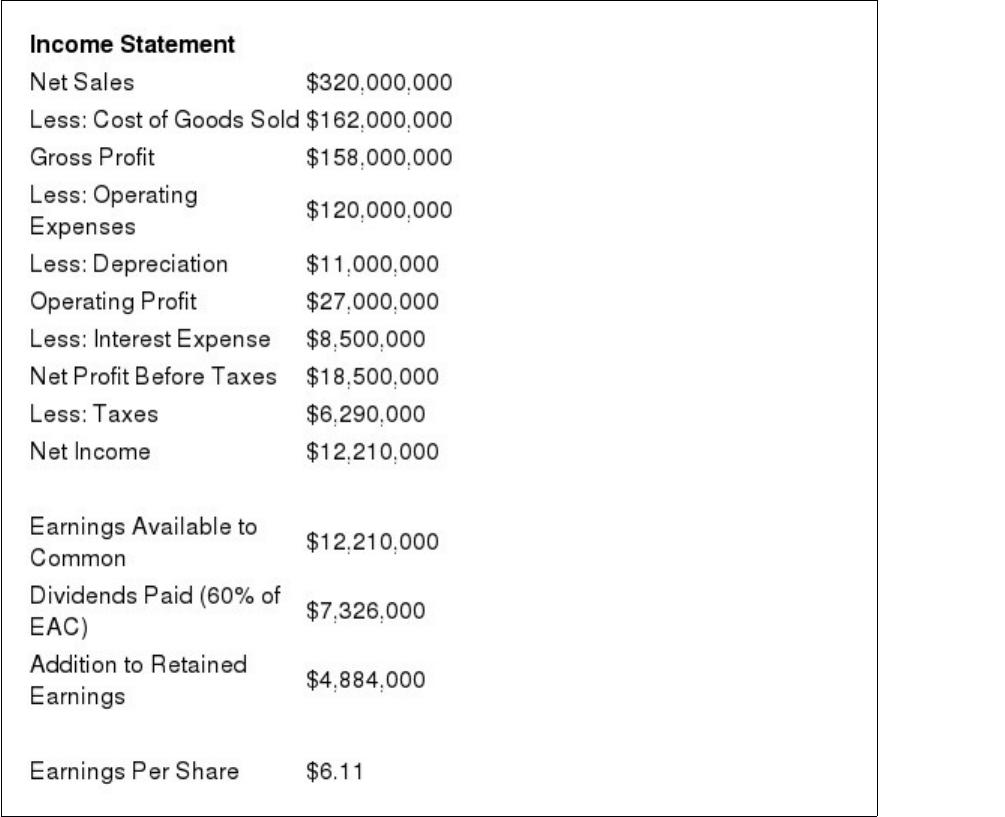
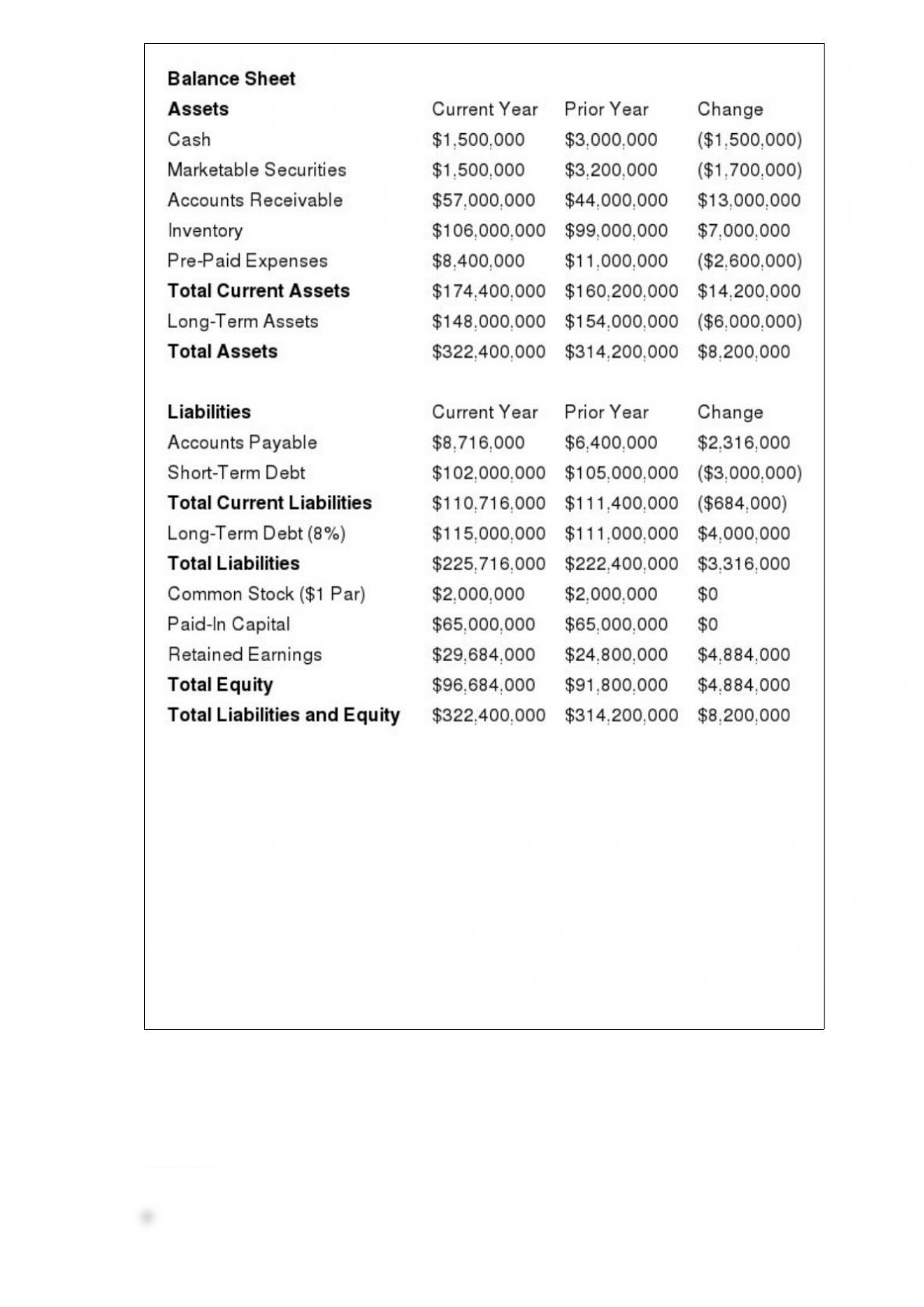
What is Dylan’s equity multiplier for the current year?
a. 0.30
b. 0.63
c. 1.52
d. 2.67
e. 3.33
Answer:

All of the following are loan classifications under the Uniform Bank Performance
Report except:
a. real estate loans.
b. automobile loans.
c. individual loans.
d. commercial loans.
e. agricultural loans.
Answer:
Which of the following is NOT a weakness of duration gap analysis?
a. It is difficult to accurately compute duration.
b. Each future cash flow must be discounted by the appropriate future interest rate.
c. The duration of a portfolio must be constantly monitored.
d. It is difficult to estimate the duration on zero coupon bonds.
e. All of the above are weaknesses of duration gap analysis.
Answer:

Which of the following was not part of the Basel Agreement?
a. Bank’s required capital was linked to its composition of assets.
b. Banks are required to operate with a minimum level of equity.
c. The ownership of equity by banks was prohibited.
d. Capital requirements across countries were standardized.
e. The minimum total capital requirements were set to 8% of risk-adjusted assets.
Answer:
Which financial ratio measures a firm’s ability to pay current interest and lease
payments with current earnings?
a. Fixed charge coverage ratio
b. Return on equity
c. Current ratio
d. Inventory turnover
e. Debt to total assets ratio
Answer:
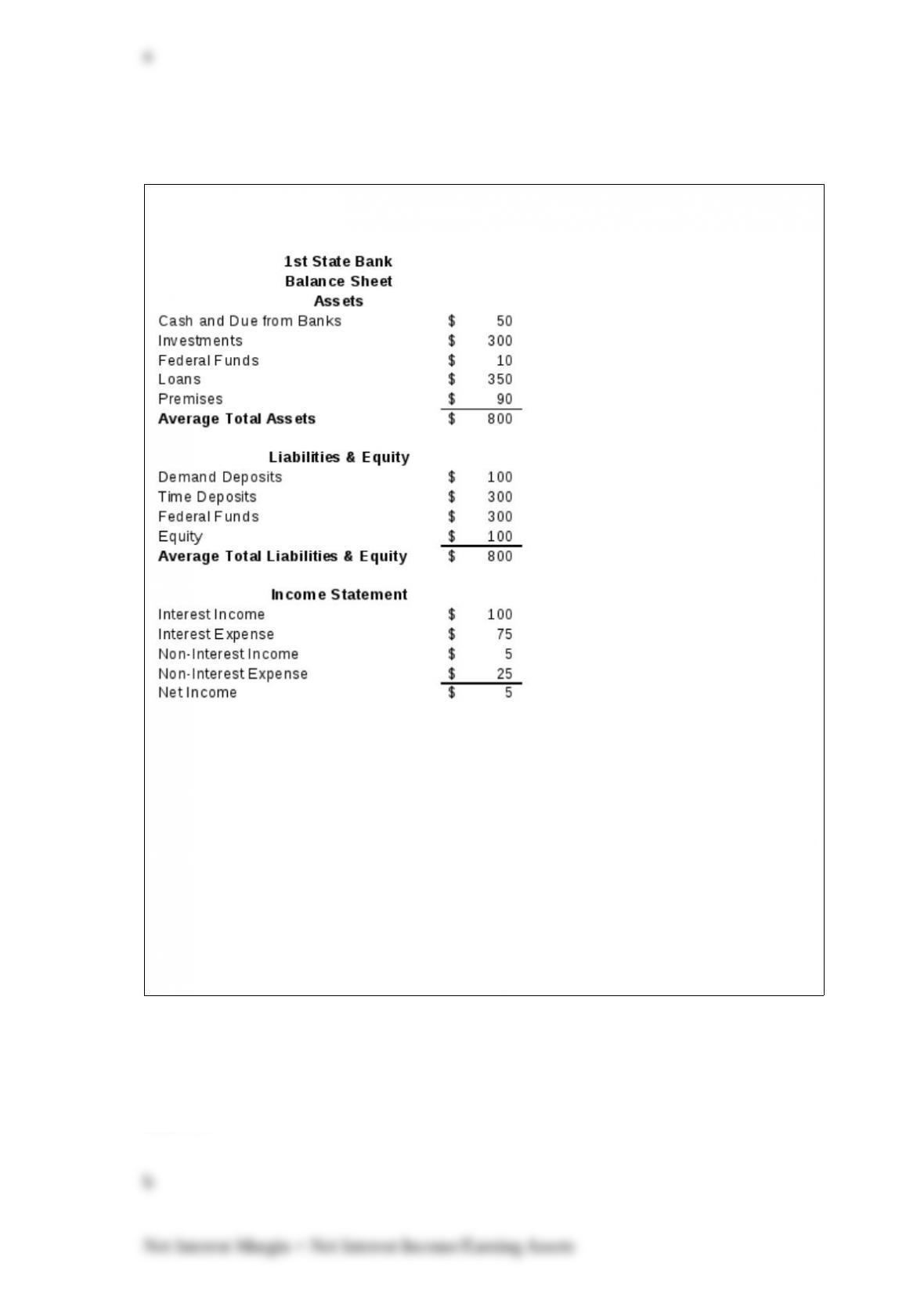
Use the following information.
What is 1st State’s net interest margin?
a. 0.6%
b. 3.8%
c. 5.0%
d. 8.2%
e. 9.8%
Answer: