One of the ways in which some monopolistic competitors try to become more like
monopolists is through the use of designer labels.
a. True
b. False
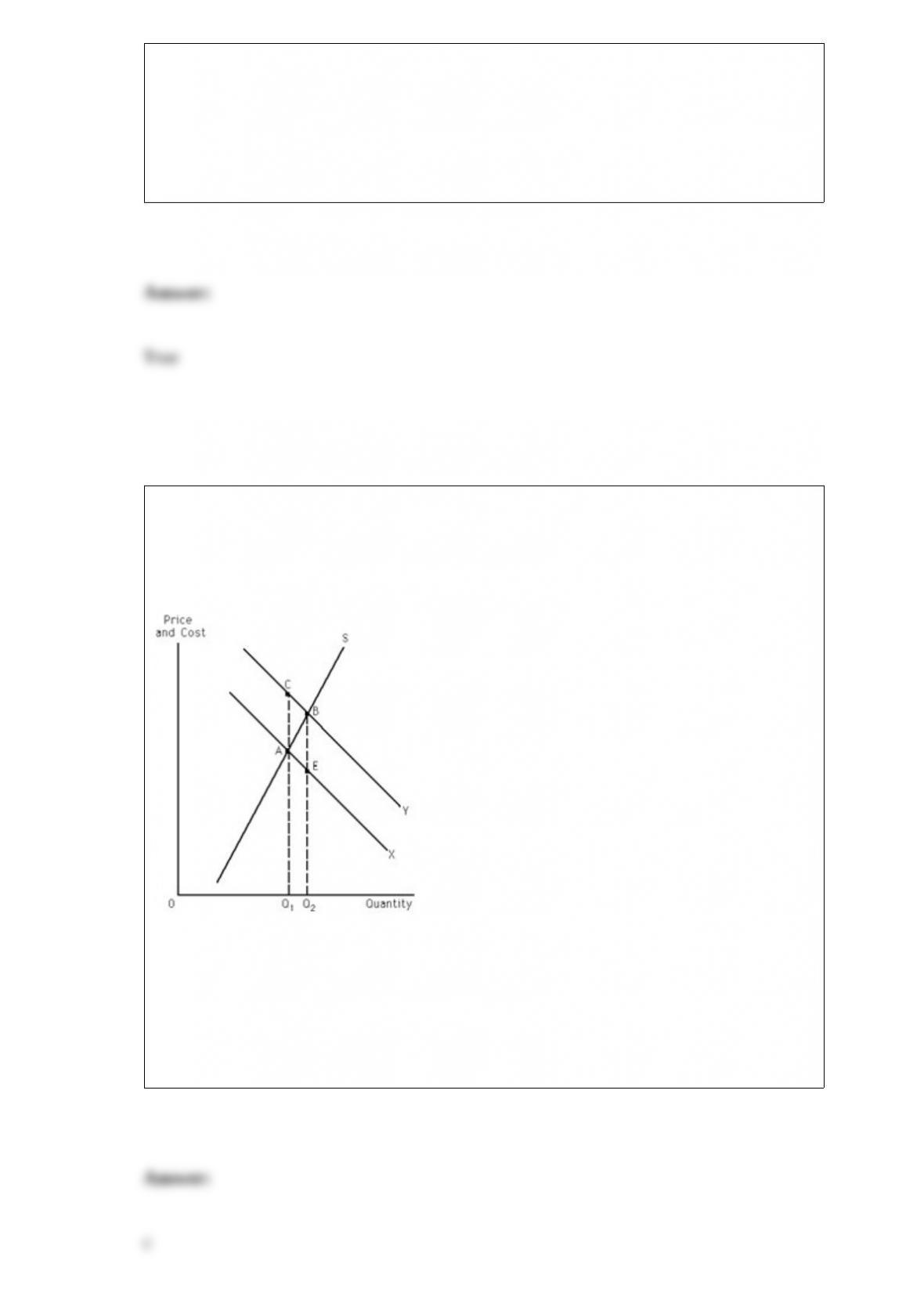
Refer to Exhibit 31-2. If the exhibit represents a positive externality situation, the social
benefit of expanding output from Q1 to Q2 is the area of
Exhibit 31-2
a. Q1ABQ2.
b. Q1AEQ2.
c. Q1CBQ2.
d. ABE.

If the price for loanable funds is greater than the return on capital, then firms will
a. borrow in the loanable funds market and invest in capital goods, and as this happens,
the quantity of capital decreases and its return rises.
b. borrow in the loanable funds market and invest in capital goods, and as this happens,
the quantity of capital increases and its return falls.
c. not borrow in the loanable funds market, and over time the capital stock will decrease
and the return on capital will fall.
d. not borrow in the loanable funds market, and over time the capital stock will decrease
and the return on capital will rise.
A positive externality is internalized when
a. demand shifts to the right until the socially optimum level of output is obtained.
b. demand shifts to the left until the socially optimum level of production is obtained.
c. supply shifts to the left until the socially optimum level of production is obtained.
d. b and c
e. none of the above

Economists use the terms resource and input as synonyms.
a. True
b. False
The public interest theory of regulation holds that regulators will
a. make regulatory decisions that benefit them at the expense of the special interests
they are regulating.
b. be slow to adopt sound economic principles to guide their regulatory
decision-making.
c. do through regulation what is in the public’s best interest.
d. say they are doing what is right for the public, but in reality they are doing what is
right for themselves.
e. often take vacations at taxpayer’s expense.
If a firm has no variable costs, the profit-maximizing price is also the
revenue-maximizing price.
a. True

b. False
Both country 1 and country 2 are located on their respective production possibilities
frontiers (PPFs) for consumer goods and capital goods, but country 1 produces twice
the output of both types of goods compared to country 2. It follows that
a. country 1’s PPF lies further to the right than country 2’s PPF.
b. country 1 has a smaller population than country 2.
c. country 1 has a bigger population than country 2.
d. country 1 is efficient and country 2 is inefficient.
e. none of the above
The perfectly competitive firm charges a price equal to __________ while the
monopolist charges a price __________.
a. marginal revenue; equal to marginal cost
b. marginal cost; greater than marginal cost
c. marginal revenue; greater than marginal revenue
d. average total cost; greater than average total cost
e. b and c
The law of diminishing marginal returns
a. is a short run concept.
b. is a long run concept.
c. is both a short run and a long run concept.
d. does not hold in the real world.
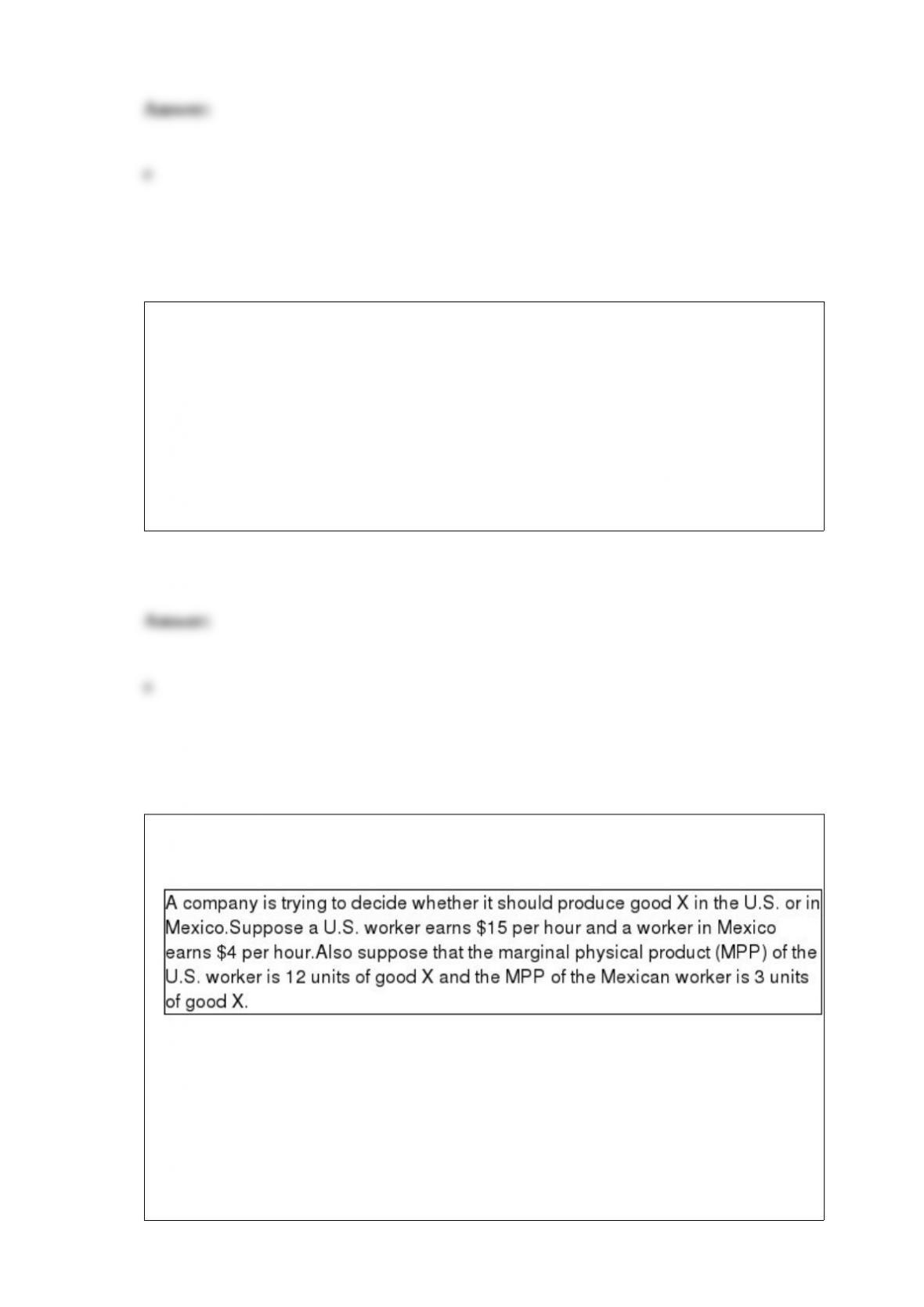
Refer to Situation 27-1. The output produced per $1 of cost in Mexico is
Situation 27-1
a. 12.0 units of good X.
b. 1.0 units of good X.
c. 1.33 units of good X.
d. 0.75 units of good X.

The point where the PPF intersects the vertical axis is
a. unattainable.
b. attainable and productive efficient.
c. attainable but productive inefficient.
d. attainable and neither productive efficient nor productive inefficient.
In the early 19th century, the main lobbyists behind passage of the Factory Acts were
the women and children who were being exploited.
a. True
b. False
Suppose that an American-made pair of blue jeans has a price of $80. If the exchange
rate is $0.095 = 1 peso, then a Mexican consumer would have to pay approximately

__________ pesos to purchase the blue jeans, but if the exchange rate is $0.085 = 1
peso, then a Mexican consumer would have to pay _________ pesos to purchase the
blue jeans.
a. 7.6; more
b. 842; more
c. 7.6; fewer
d. 842; fewer
e. 8,444; fewer
Marginal revenue product is
a. the additional cost of employing a factor.
b. the additional revenue generated by employing an additional factor unit.
c. marginal revenue multiplied by price of the factor unit.
d. price of the good that is sold multiplied by unit cost.
e. none of the above
If it is assumed that people vote for the candidate who comes closer to matching their
own views, to win votes in a two-person race

a. one candidate will move to the far right of the political spectrum while the other
moves to the far left.
b. one candidate will move between the middle and far right end of the political
spectrum while the other moves between the middle and the far left end.
c. both candidates will move to the far right end of the political spectrum.
d. both candidates will move to the far left end of the political spectrum.
e. both candidates will move toward the middle of the political spectrum.
If, under a fixed exchange rate system, the dollar price of a Mexican peso is below its
equilibrium level, then the
a. dollar is overvalued.
b. peso is overvalued.
c. dollar has depreciated.
d. peso has appreciated.
Sometimes labor unions try to increase the demand for the product they produce. They
do so because the demand for labor is derived; and the __________ the demand for the
product labor produces, the __________labor and the __________ wages will be,
ceteris paribus.
a. higher; greater the supply of; lower

b. higher; lower the demand for; higher
c. higher; higher the demand for; higher
d. lower; higher the demand for; higher
If fewer cigarettes are consumed with symmetric information than asymmetric
information, it follows that
a. with asymmetric information the demand for cigarettes is lower than with symmetric
information.
b. with symmetric information the demand for cigarettes is lower than with asymmetric
information.
c. the demand for cigarettes is the same with or without asymmetric information.
d. there are more free riders with asymmetric information than symmetric information.
e. There is not enough information to answer the question.
In the acreage allotment program, a farmer’s acreage allotment is sometimes based on a
farmer’s
a. history of production.

b. income.
c. location.
d. b and c
e. none of the above
If a price-discriminating monopoly charges a lower price to individuals in city X, it is
likely that the firm
a. believes that the demand of individuals in city X is relatively inelastic.
b. believes that the demand of individuals in city X is relatively elastic.
c. wants to shift the demand of individuals in city X.
d. cares about the well-being of the individuals in city X.
A production possibilities frontier separates an attainable region from an unattainable
region.
a. True
b. False