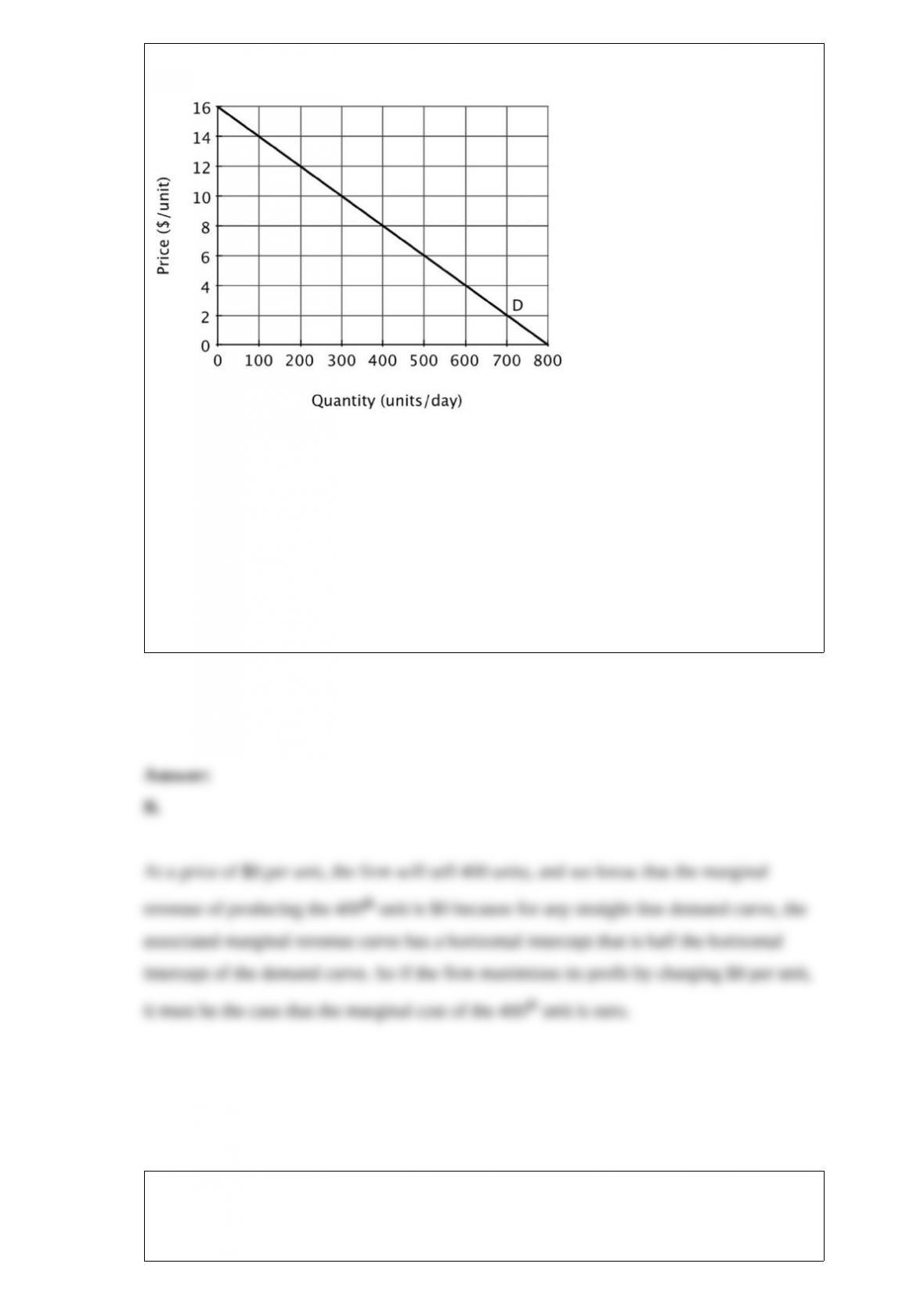
Suppose the figure below illustrates the demand curve facing a monopolist.
Suppose this firm maximizes its profits by charging a price of $8 per unit. This implies
that the firm’s:
A. marginal cost is $8.
B. marginal cost is $0.
C. average total cost is $8.
D. marginal cost is less than $8.
A commitment problem exists when people cannot achieve their goals because:
A. they cannot make credible threats or promises.
B. they cannot play their dominant strategy.
C. the payoff matrix is unknown.
D. they do not have the first-mover advantage in a sequential move game.
If all firms in a perfectly competitive industry are experiencing economic losses, then:
A. some firms will exit the industry, until economic profits are positive.
B. some firms will exit the industry, until accounting profits equal zero.
C. all existing firms will stay in the industry, hoping for better times.
D. some firms will exit the industry, until economic profits equal zero.
If demand for the product you make were to suddenly decline, you would expect the

equilibrium price of the product to fall, which would lead to
A. an increase in the VMP of each worker.
B. a decrease in the VMP of each worker.
C. no change the VMP of each worker because product prices don’t affect worker
productivity.
D. a decrease in the marginal productivity of each worker.
Jack has a ticket to see Bo Bice for which he paid $30 yesterday. He takes an unpaid
day off from work to get ready for the concert. When he arrives at the concert, five
different people offer him $70 for his ticket. Jack decides to keep his ticket. At the time
he makes this decision, his opportunity cost of seeing Bo Bice is:
A. $30 plus his forgone earnings.
B. $40.
C. $70.
D. $70 plus his forgone earnings.

If Al has an absolute advantage over Beth in preparing meals, then:
A. it takes Al more time to prepare a meal than Beth.
B. the problem of scarcity applies to Beth but not to Al.
C. Al’s opportunity cost of preparing a meal is lower than is Beth’s.
D. Al can prepare more meals in a given time period than Beth.
Suppose that there is only one small clothing store in the remote village of Green Acres,
and until recently the townspeople bought their shirts there. As more people in Green
Acres become connected to the Internet, the price elasticity of demand for shirts at the
Green Acres store will:
A. increase because the Internet offers more substitutes.
B. decrease because the Internet offers more substitutes.
C. remain the same, but the quantity demanded will decrease as more people shop
online.
D. remain the same, but the demand will decrease as more people shop online.
An implication of scarcity is that:
A. people will never be happy.
B. making trade-offs becomes unnecessary as wealth increases.
C. some people will always be poor.
D. people must make trade-offs.
A trade deficit occurs when:
A. exports exceed imports.
B. imports exceed exports.
C. tariffs exceed quotas.
D. quotas exceed tariffs.
In an economy without international trade, investment must equal ______ saving.
A. national
B. private
C. public
D. life-cycle
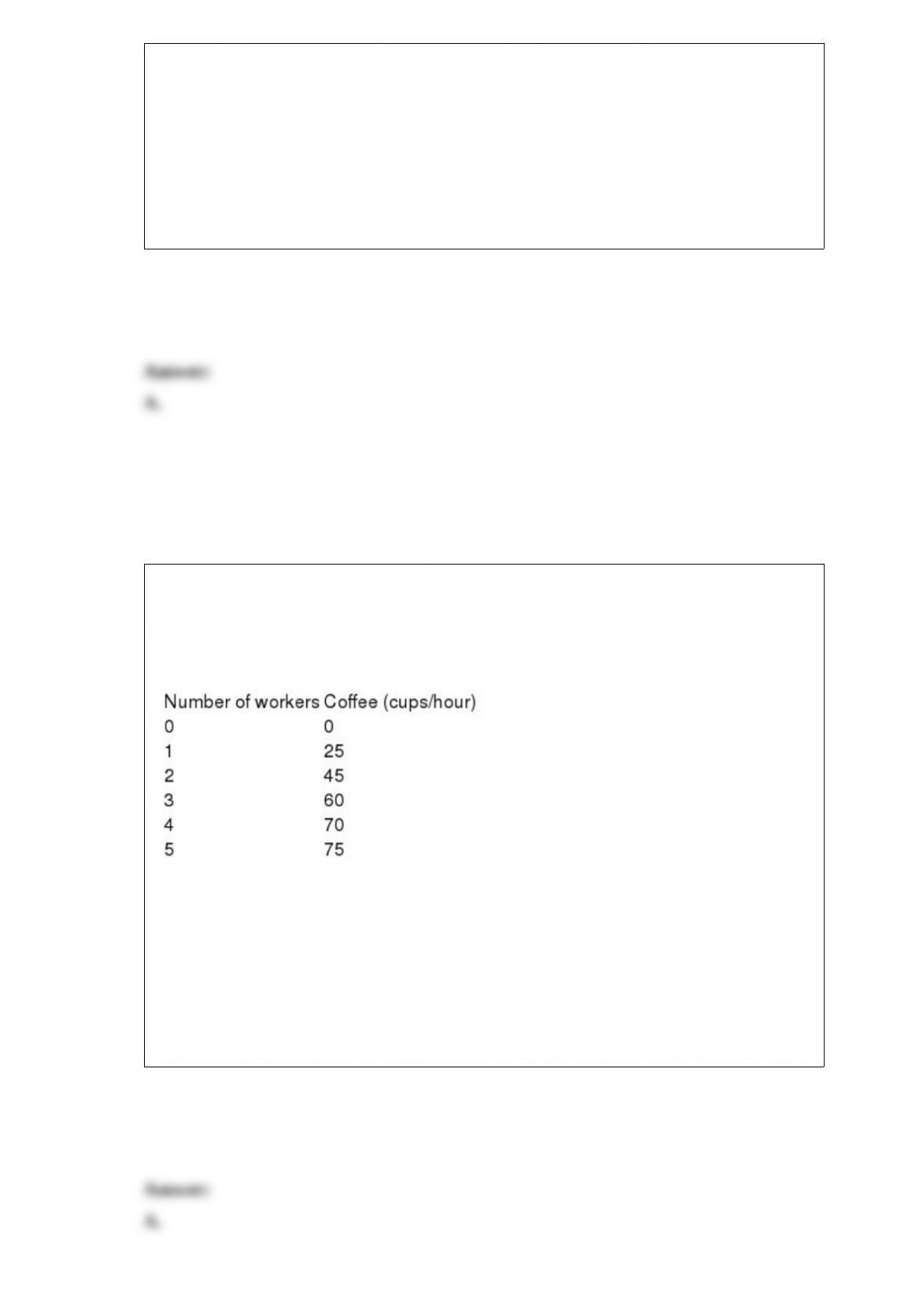
Espresso Yourself Coffee Shop hires workers in a competitive labor market to make
coffee. The ingredients required to make each cup of coffee cost 50 cents. The coffee
shop’s hourly output of coffee varies with the number of workers hired, as shown in the
table below. Each cup of coffee sells for $2.00.
The value of marginal product of the first worker is ______ per hour.
A. $37.50
B. $25.00
C. $2.00
D. $1.50

The following table shows the relationship between the speed of a computer’s CPU and
its benefits and costs. Assume that all other features of the computer are the same (that
is, CPU speed is the only source of variation), and only the CPU speeds listed below are
available for purchase.
Choosing a 3.5GHz computer would be irrational because:
A. its marginal benefit is less than its marginal cost.
B. its marginal benefit is equal to its marginal cost.
C. it is impossible to tell the difference compared to a 3.0GHz computer.
D. its marginal benefit is greater than its marginal cost.
Changes in business inventories are:
A. classified as consumption expenditures.
B. classified as investment expenditures.
C. classified as government purchases.
D. excluded from GDP.

MegaCable and Acme are competing for an exclusive contract to provide the city of
Dustin with cable television for the next year. The firm that wins the contract will earn
an economic profit of $5 million. The contact will be awarded to the firm that spends
the most on lobbying. If both firms spend the same amount on lobbying, then the
winner will be determined by a coin flip, so each will have a 50 percent chance of
winning. The socially optimal amount for each firm to spend on lobbying is ______.
A. $0
B. $2,500,000
C. $5,000,000
D. $10,000,000
For the Fall semester, you had to pay a nonrefundable fee of $600 for your meal plan,
which gives you up to 150 meals. If you eat 100 meals, your average cost for a meal is:
A. $6.
B. $5.
C. $4.
D. $0.25.
Suppose a small island nation imports sugar for its population at the world price of
$1,500 per ton. The domestic market for sugar is shown below.
With no subsidy, what is producer surplus?
A. $0 per day
B. $1,000 per day
C. $4,000 per day
D. $8,000 per day
An increase in aggregate supply is usually shown by a ______ shift of the AS curve.
A. inverse
B. upward
C. leftward
D. rightward
The Federal Reserve System first began operations in:
A. 1789.
B. 1865.
C. 1914.
D. 1934
The table below shows the marginal benefit and marginal cost of purchasing an
additional unit of 3 different public goods.
The government is spending more than is socially optimal on:
A. public good 1
B. public good 2
C. public good 3
D. public good 1 and public good 2
Refer to the figure below.
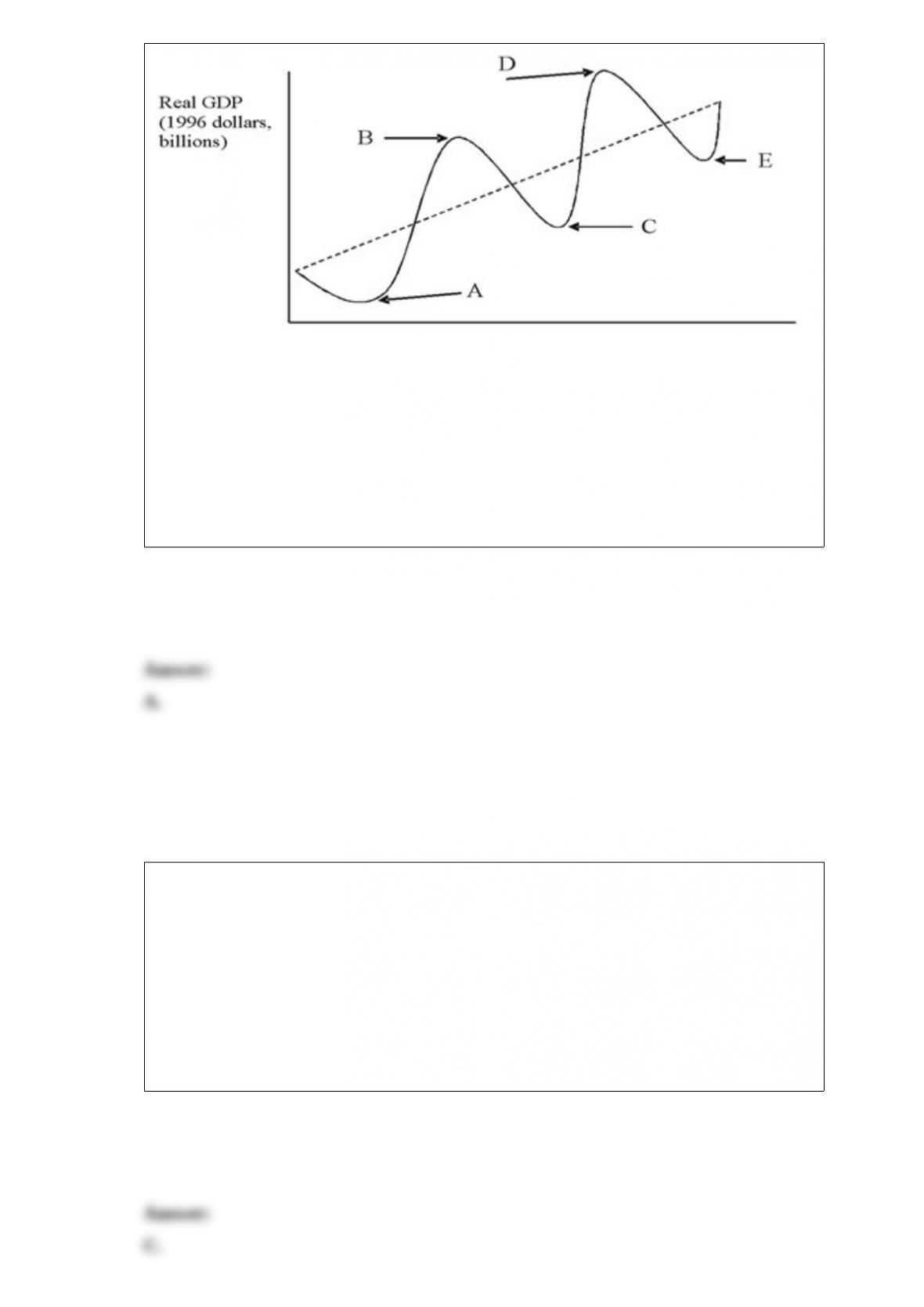
In the figure, a business cycle trough is shown by which point(s)?
A. A and C and E
B. B and D
C. A only
D. D only
A real interest rate that causes the quantity of saving supplied to be equal to the quantity
of saving (or investment) demanded is an example of the:
A. scarcity principle.
B. principle of comparative advantage.
C. equilibrium principle.
D. principle of increasing opportunity cost.

Kyle works for a perfectly competitive firm where he receives a wage rate of $15. From
this, one can infer that:
A. Kyle’s marginal product is at least $15.
B. the price of the firm’s output is at least $15.
C. Kyle’s reservation wage is $15.
D. Kyle’s value of marginal product is at least $15.
Due to menu costs, many firms in the economy will increase their output:
A. only after they raise the price at which they are willing to sell their output.
B. before raising the price at which they are willing to sell their output.
C. instead of raising the price at which they sell their output.
D. or raise the price at which they sell their output, but never both.
The essential feature that differentiates imperfectly competitive firms from perfectly
competitive firms is that an imperfectly competitive firm:
A. produces a good with no close substitutes.
B. faces high barriers to entry.
C. coordinates their output decisions with other firms.
D. faces a downward-sloping demand curve.
If total output is calculated by adding up the market value of goods and services
produced, then more expensive items:
A. receive the same weight as cheaper items.
B. receive a greater weight than cheaper items.
C. receive a smaller weight than cheaper items.
D. are double counted.

The largest component of planned aggregate expenditure is:
A. consumption.
B. investment.
C. government purchases.
D. exports.
A rapidly growing supply of money will lead to:
A. rising real GDP.
B. rising velocity.
C. unemployment.
D. inflation.
Assume that each day ten thousand children watch Sesame Street on public television
and that watching Sesame Street generates a benefit of $100 per child per year. Once a
year, public televisions hold a pledge drive asking viewers to make voluntary
contributions in order to keep the programming available to everyone.
The broadcast of Sesame Street yields a total social benefit of _____ per year.
A. $0

B. $100
C. $10,000
D. $1,000,000
If the income-expenditure multiplier equals 2.5 and a 1 percent increase in the real
interest rate reduces autonomous spending by 200 units, then a 1,000 unit expansionary
gap can be eliminated by ______ the real interest rate by ______ percent.
A. increasing; 2.5
B. increasing; 4.0
C. increasing; 2.0
D. decreasing; 2.0
An external benefit implies that private markets will provide ______ than the socially
optimal quantity, and an external cost implies that private markets will provide ______
than the socially optimal quantity.
A. more; more
B. less; less
C. more; less
D. less; more
Buyers and sellers of a particular good comprise the:
A. market for the good.
B. demand for the good.
C. supply for the good.
D. production possibilities curve for the good.
The marginal propensity to consume (mpc) is the:
A. amount by which disposable income increases when consumption increases by $1.
B. amount by which consumption increases when disposable income increases by $1.
C. percentage by which consumption increases when disposable income increases by 1
percent.
D. percentage by which disposable income increases when consumption increases by 1

percent.