Variables X and Y are independent of each other. If we plot X on the horizontal axis and
Y on the vertical axis, the line that connects combinations of X and Y in a two-variable
diagram is
a. parallel to the horizontal axis.
b. downward-sloping (left to right).
c. parallel to the vertical axis.
d. upward-sloping (left to right).
e. a or c
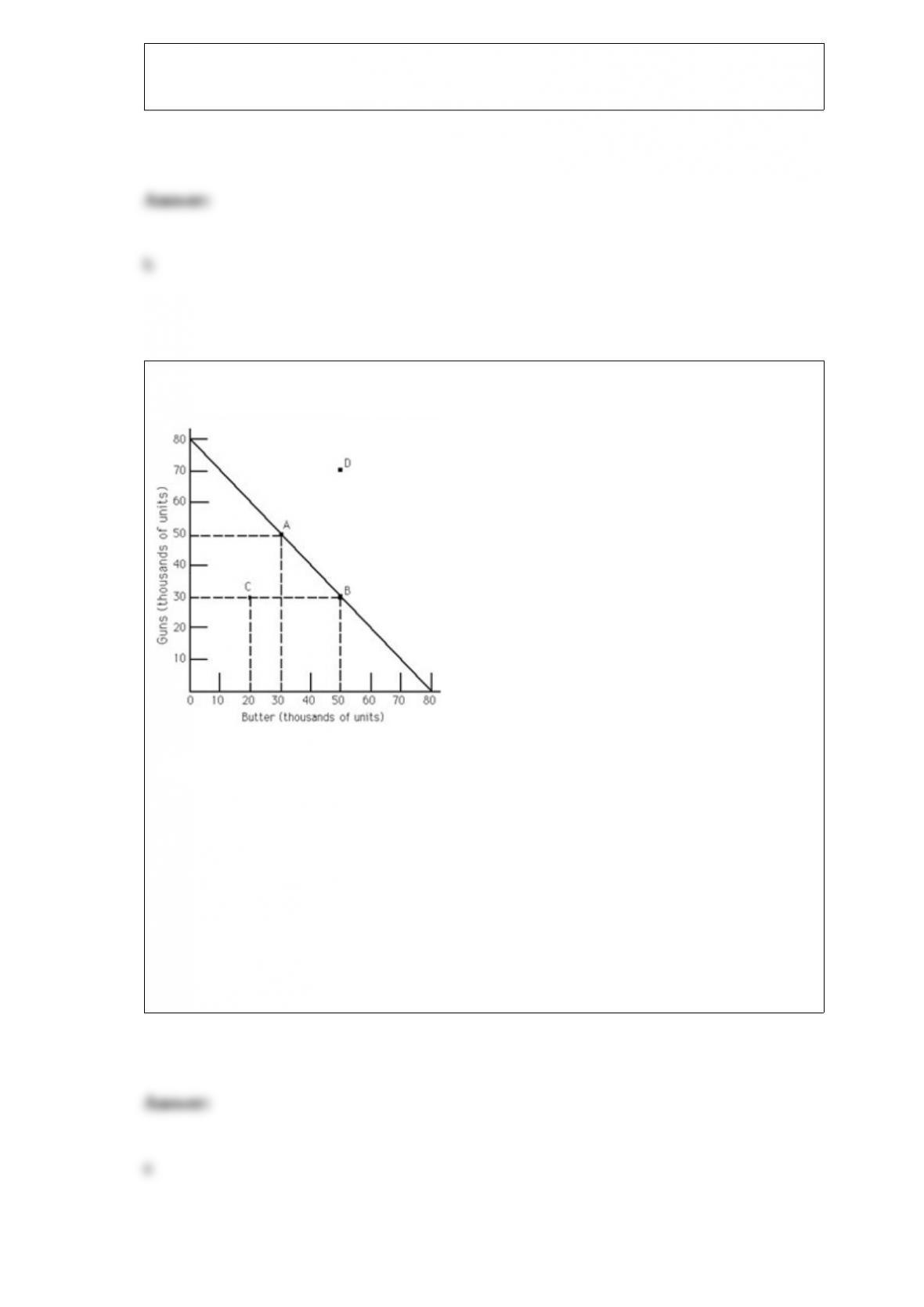
Exhibit 35-5 U.S. $ Equivalent Foreign Currency
per U.S. $
Based on the information provided in this table, between Monday and Tuesday, the U.S.
dollar ____________ against the Mexican peso and the peso _____________ against
the U.S. dollar.
a. appreciated; appreciated
b. depreciated; appreciated
c. appreciated; depreciated
d. depreciated; depreciated
Exhibit 2-1
The PPF illustrates
a. constant opportunity costs between guns and butter.
b. that guns are more important than butter.
c. increasing opportunity costs between guns and butter.
d. the opportunity cost of one unit of guns is four units of butter.
e. none of the above

Prices of goods and services are high in cities such as Tokyo and New York City as a
result of high land rents in those cities.
a. True
b. False
Why can’t an economist say for certain that a monopolistic competitive firm will always
earn zero economic profits in the long run?
a. Barriers to entry are significant in monopolistic competition.
b. The very large number of buyers indicates that there will always be demand for the
firm’s product.
c. The firms in the industry do not produce identical products.
d. The firms practice price competition, so at least some firms will always be charging a
lower price than other firms and will sell more as a result.
e. The firms face a horizontal demand curve.
Suppose a particular production process results in a large amount of pollution and the
government decides to impose a tax to correct for this externality, such that the socially
optimal output will be produced. The tax will have the effect of shifting the
a. marginal private benefit curve to the right.
b. marginal social benefit curve to the right.

c. marginal private cost curve to the left.
d. marginal social cost curve to the left.
e. marginal private cost curve to the right.
Suppose the local pharmacy charges lower prices to senior citizens than it charges to
younger customers.The pharmacy is practicing
a. perfect price discrimination.
b. second-degree price discrimination.
c. arbitrage.
d. third-degree price discrimination.
e. non-cost discrimination.
The term outsourcing is used to describe work done for a company by individuals
working for another company in a different country.
a. True
b. False
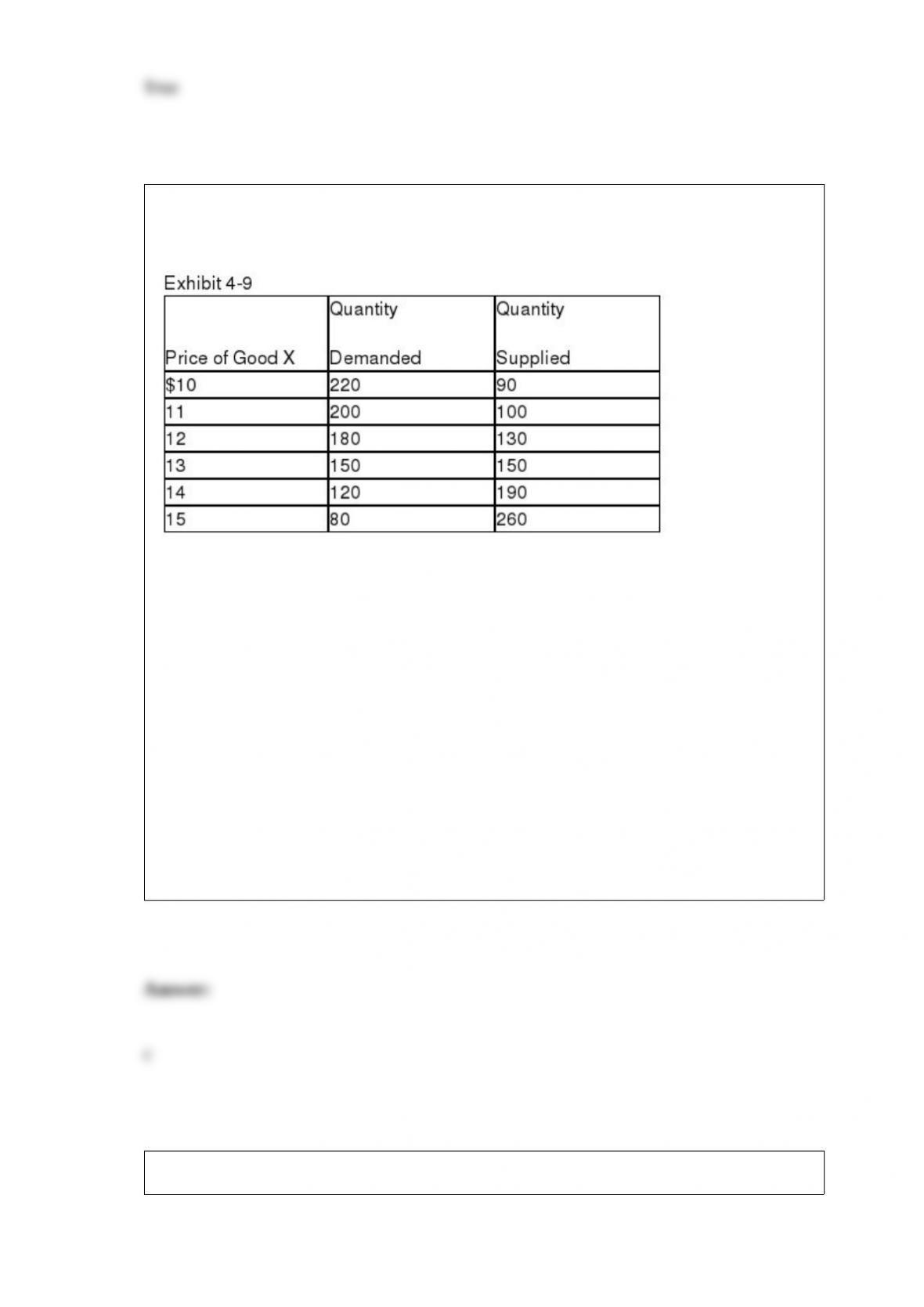
Suppose that the government imposes a price ceiling at a price of $10.The number of
units that would be exchanged in this market would be
a. 150, since that is the equilibrium quantity and the price ceiling is below the
equilibrium price.
b. 220, since that is the number of units demanded at the price ceiling (and the quantity
demanded is greater than the quantity supplied).
c. 90, since that is the number of units supplied at the price ceiling (and the quantity
supplied is less than the quantity demanded).
d. 155, since that is the average of the quantity demanded and the quantity supplied at
the price ceiling.
Exhibit 3-9
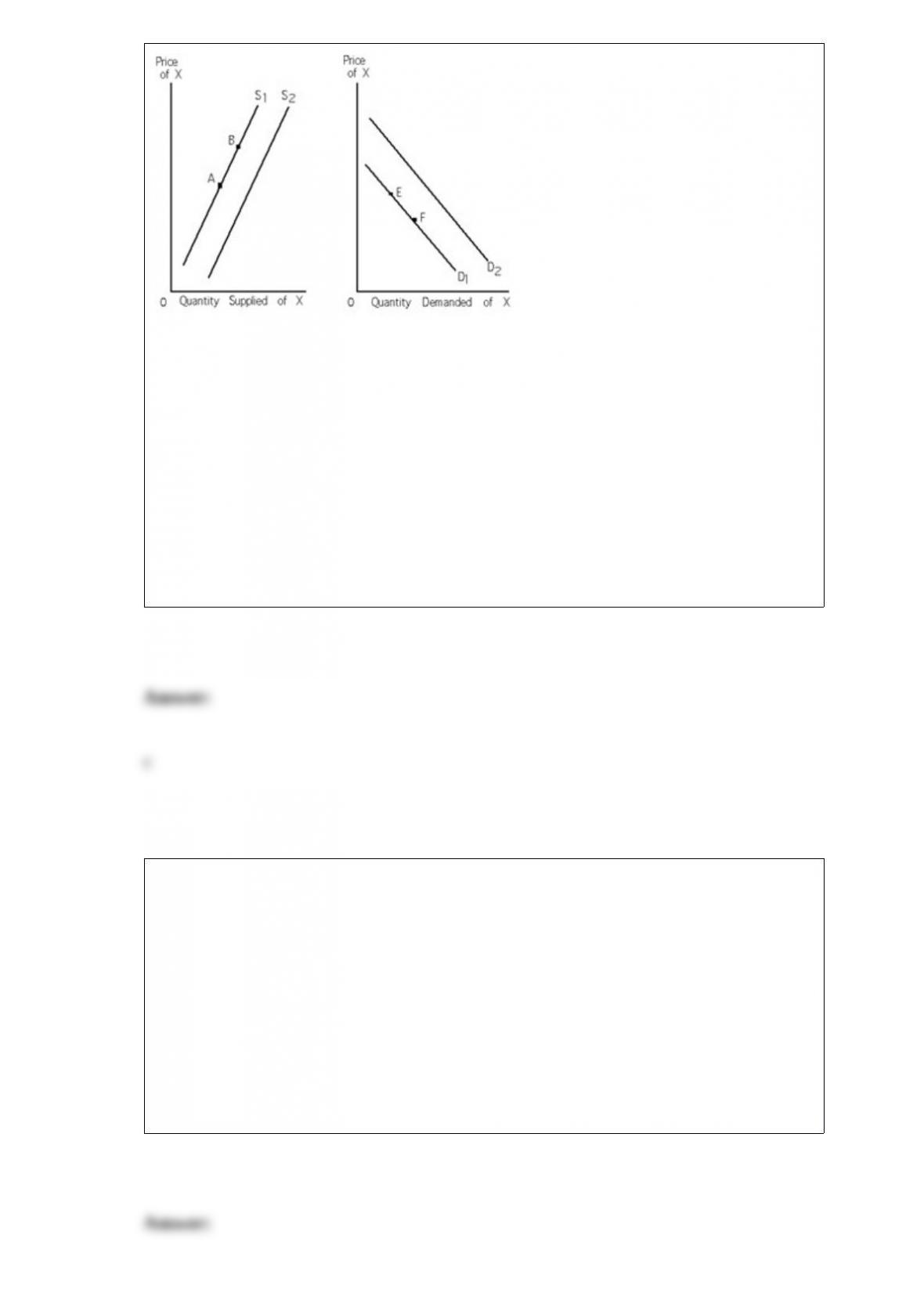
A wave of immigrants who love to consume X enters the country. An economist would
expect a movement in the market for X from
a. S1 to S2.
b. D2 to D1.
c. D1 to D2.
d. S2 to S1.
“New industries should be protected from older established foreign competitors until
they are mature enough to compete on an equal basis.” This argument for trade
restrictions is called the __________ argument.
a. low-foreign-wages
b. foreign export-subsidies
c. anti-dumping
d. infant-industry

Suppose U.S. peanut butter producers are facing increased foreign competition. Which
argument is least likely to be used by the U.S. firms’ lobbyists to urge legislation to
restrict imports of peanut butter?
a. Peanut butter is important in military rations, so we cannot risk losing our supply of
it.
b. Foreign peanut butter is made by virtual slave labor, working in horrible conditions.
c. Economic profits of the U.S. firms are already at a very low level.
d. Thousands of U.S. peanut farmers face hard times without this protection against
imports.
The change in the price of a foodstuff will be greater,
a. the smaller the change in the supply of the foodstuff.
b. the greater the change in the supply of the foodstuff and the more inelastic the
demand curve for the foodstuff.
c. the lesser the change in the supply of the foodstuff and the more inelastic the demand
curve for the foodstuff.
d. the greater the change in the supply of the foodstuff and the more elastic the demand
curve for the foodstuff.
e. the lesser the change in the supply of the foodstuff and the more elastic the demand
curve for the foodstuff.
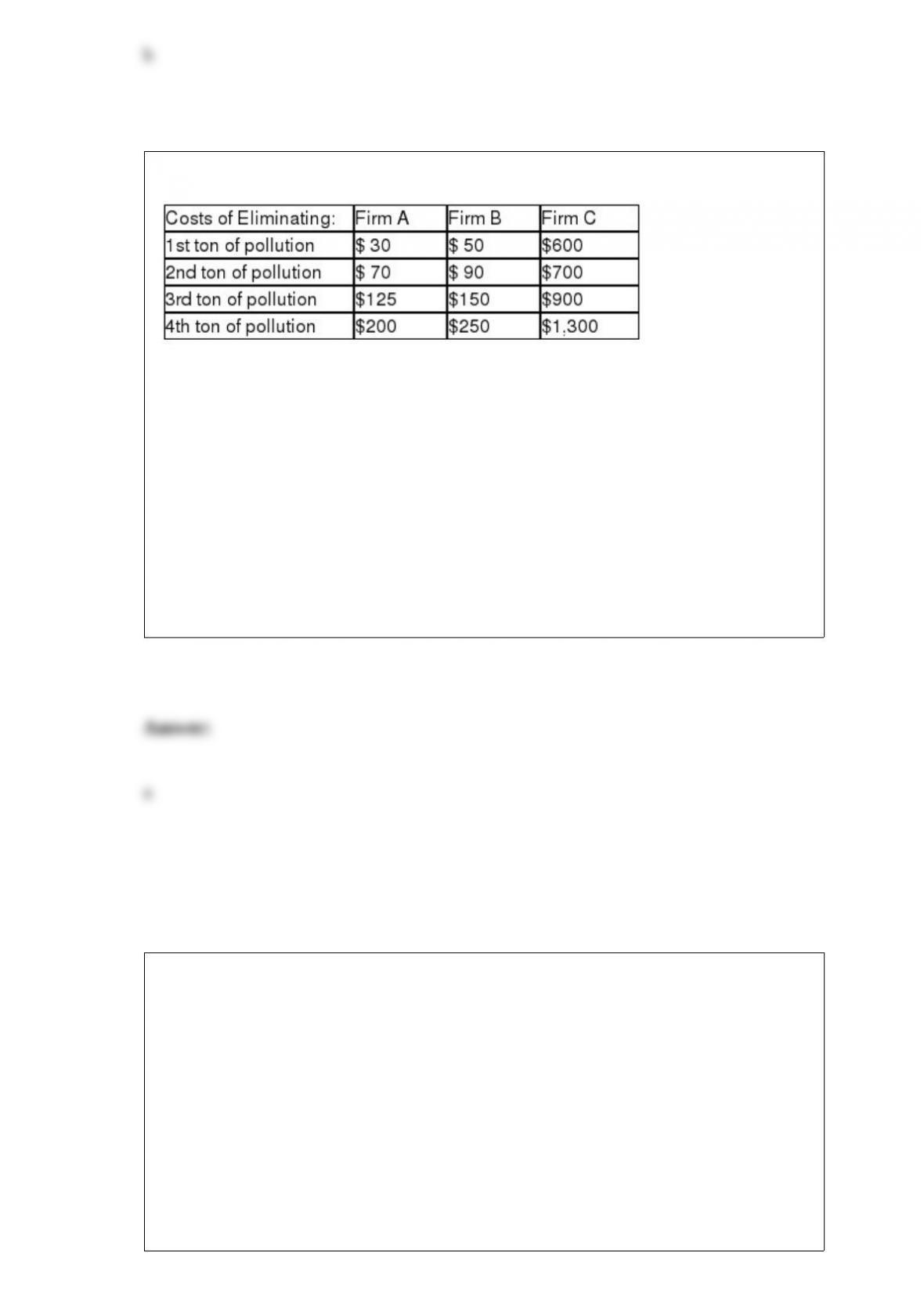
Exhibit 31-3
What is the cost to Firm C of eliminating 2 tons of pollution?
a. $1,300
b. $300
c. $1,500
d. $2,200
e. $3,500
A monopolist can sell 8,000 units at a price of $10 per unit. Lowering price to all buyers
by $1 raises the quantity demanded by 500 units. What is the change in total revenue
resulting from this price change?
a. $3,500
b. -$12,500
c. -$3,500
d. -$18,000
e. There is not enough information provided to answer the question.
A monopolist is a _______________ and a monopolistic competitor is
______________________.
a. price searcher; also a price searcher
b. price taker; a price searcher
c. price taker; also a price taker
d. price searcher; a price taker