Suppose firm X is a monopolist and is receiving positive economic profits. What
prevents other firms from directly competing away the profits?
a. high barriers to entry
b. antitrust laws
c. low barriers to entry
d. diseconomies of scale
e. none of the above
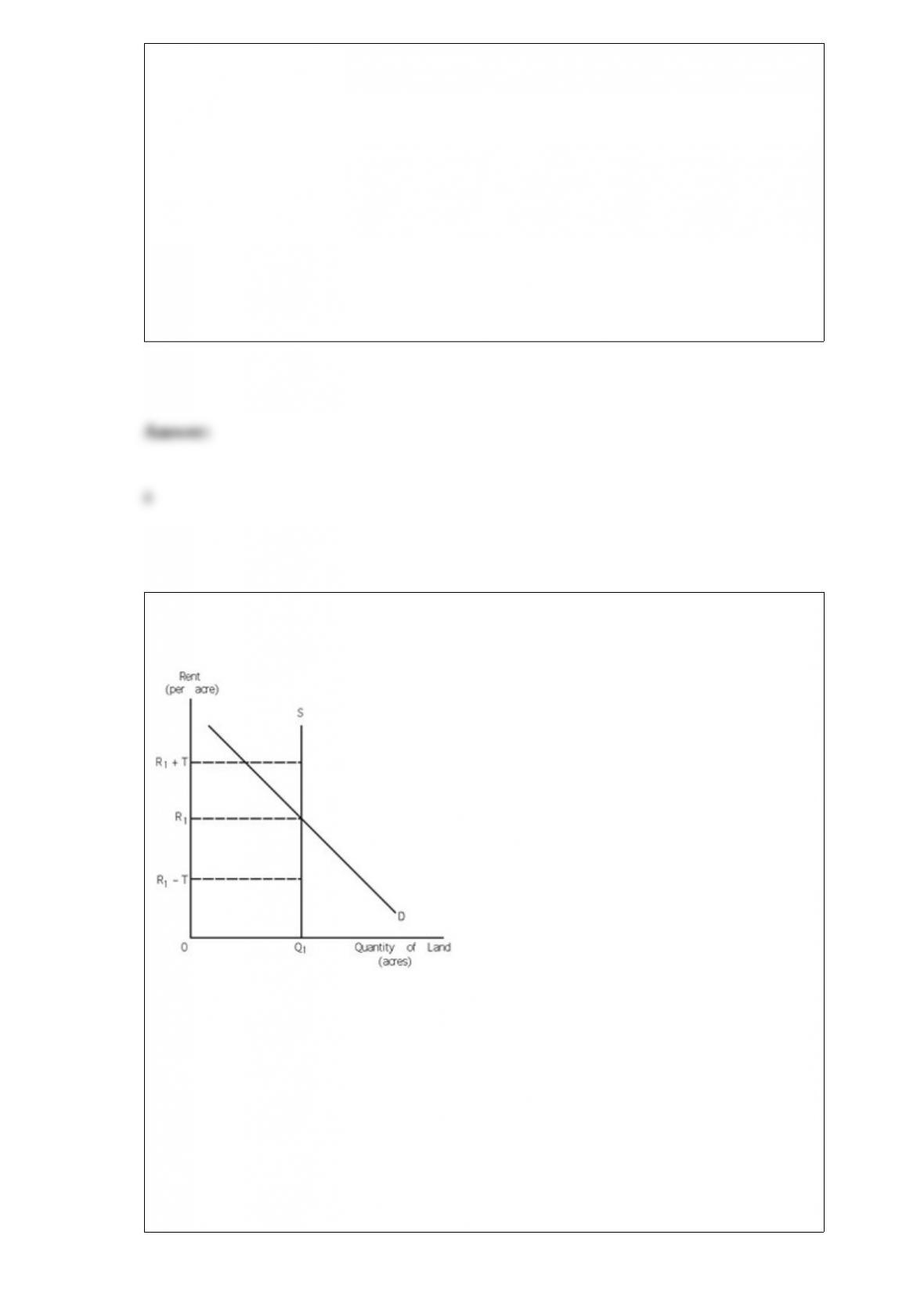
Exhibit 30-4
At the equilibrium point shown, what is the pure economic rent on land?
a. Q1 x (R1 – T)
b. Q1 x R1
c. Q1 x (R1 + T)
d. 0

The perfectly competitive firm charges ____________ price for each unit of the good it
sells, and the perfectly price-discriminating monopolist charges _________________
price for each unit of the good it sells.
a. the same; the same
b. a different; the same
c. the same; a different
d. a different; a different
The synonym economists commonly use for additional is
a. capital.
b. rational.
c. marginal.
d. economic.

Exhibit 3-1
At a price of $6 there is a
a. surplus of 100 units.
b. surplus of 150 units.
c. surplus of 200 units.
d. shortage of 150 units.
e. shortage of 200 units.
Risk is
a. different than uncertainty in that the probability of an uncertain event can be
estimated whereas the probability of a risky event cannot be.
b. the source of all economic rent.
c. considered a major factor in the theory of profit that emphasizes the entrepreneur as
innovator.
d. equal to the probability that an event will occur divided by the probability that the
event will not occur.
e. none of the above
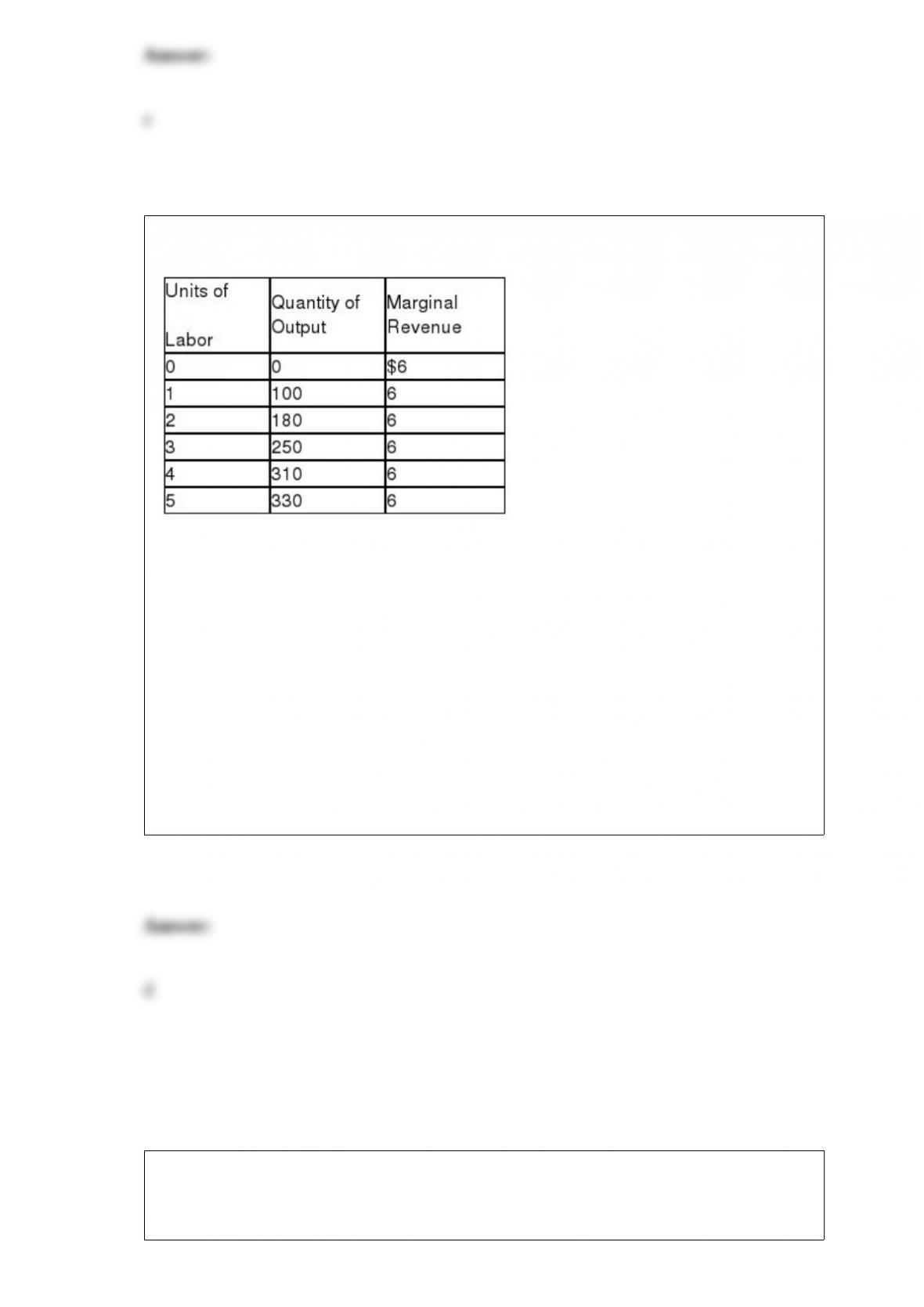
Exhibit 27-5
Assume the firm is a factor price taker and that the price of a unit of labor is constant at
$360. The firm should hire __________ of labor.
a. one unit
b. two units
c. three units
d. four units
e. five units
Total utility
a. is the total amount of satisfaction derived from consuming a particular quantity of a

good.
b. for quantity Y can be calculated by summing the marginal utilities of each unit that
comprises quantity Y.
c. is the sum of the amounts of utility derived from consuming each unit of a good.
d. a and b
e. all of the above
To reduce pollution, economists generally prefer a corrective tax to a
command-and-control policy because the same goals can be achieved but in an efficient
manner with a corrective tax.
a. True
b. False
Suppose the production of a good results in negative externalities. If all costs are taken
into account, then
a. output will occur at the socially optimal level.
b. the price of the product will be higher than if all costs are not taken into account.
c. more output will be produced than if all costs are not taken into account.
d. a and b

e. a, b, and c
The answer is: “The price of one currency in terms of another currency.” What is the
question?
a. What is a foreign currency?
b. What is an exchange rate?
c. What is a flexible exchange rate system?
d. What is a fixed exchange rate system?
A perfectly competitive firm that maximizes profit exhibits resource allocative
efficiency because it produces where price
a. equals minimum average total cost.
b. equals marginal revenue.
c. equals marginal cost.
d. is greater than minimum average variable cost.