1)
2)
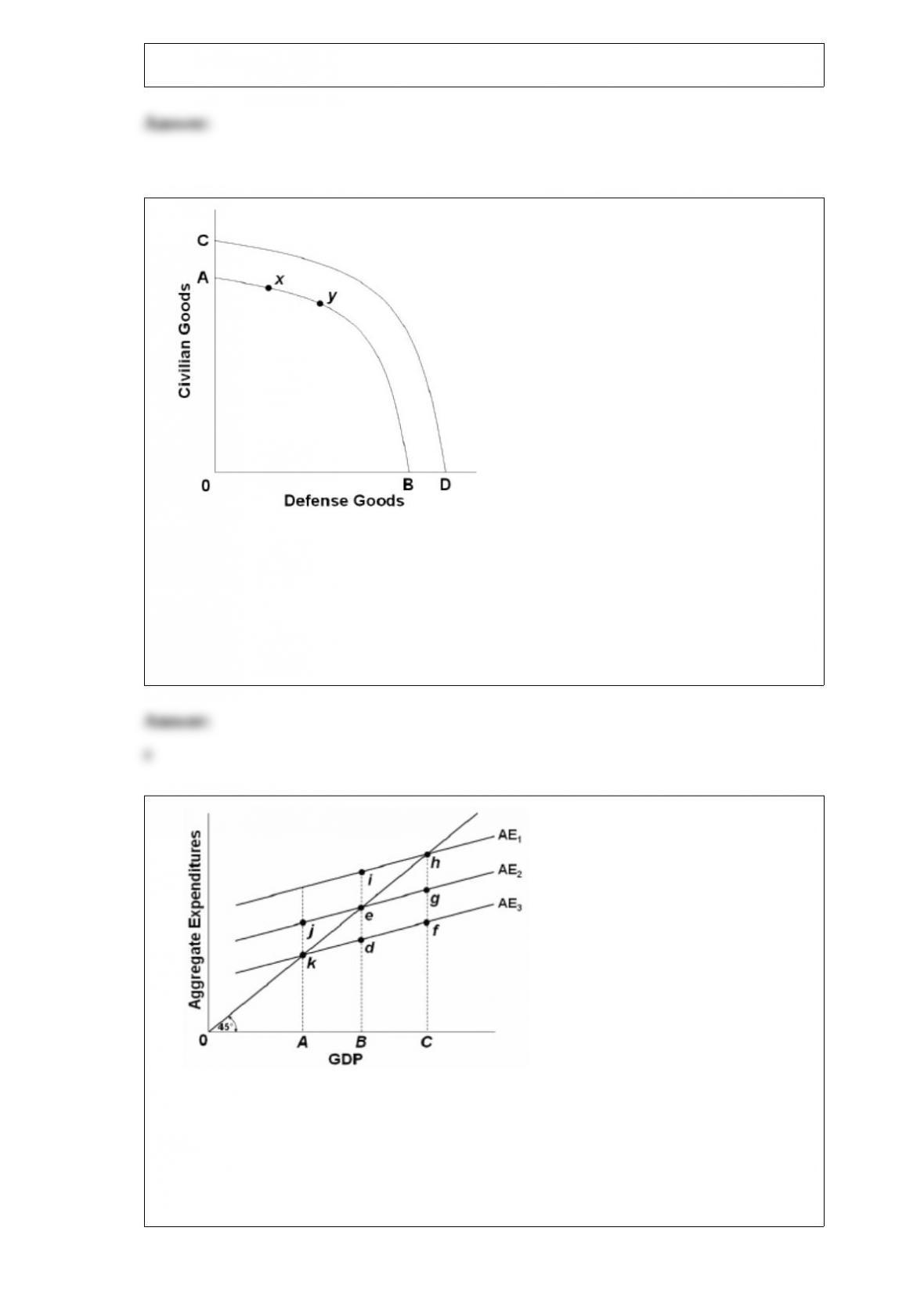
(consider this) refer to the above diagram. the direct economic impact of the destruction
and loss of lives caused by the terrorist attacks of september 11, 2001 is illustrated by
the:
a.shift of the production possibilities curve from cd to ab.
b.shift of the production possibilities curve from ab to cd.
c.move from x to y on production possibilities curve ab.
d.move from y to x on production possibilities curve ab.
3)
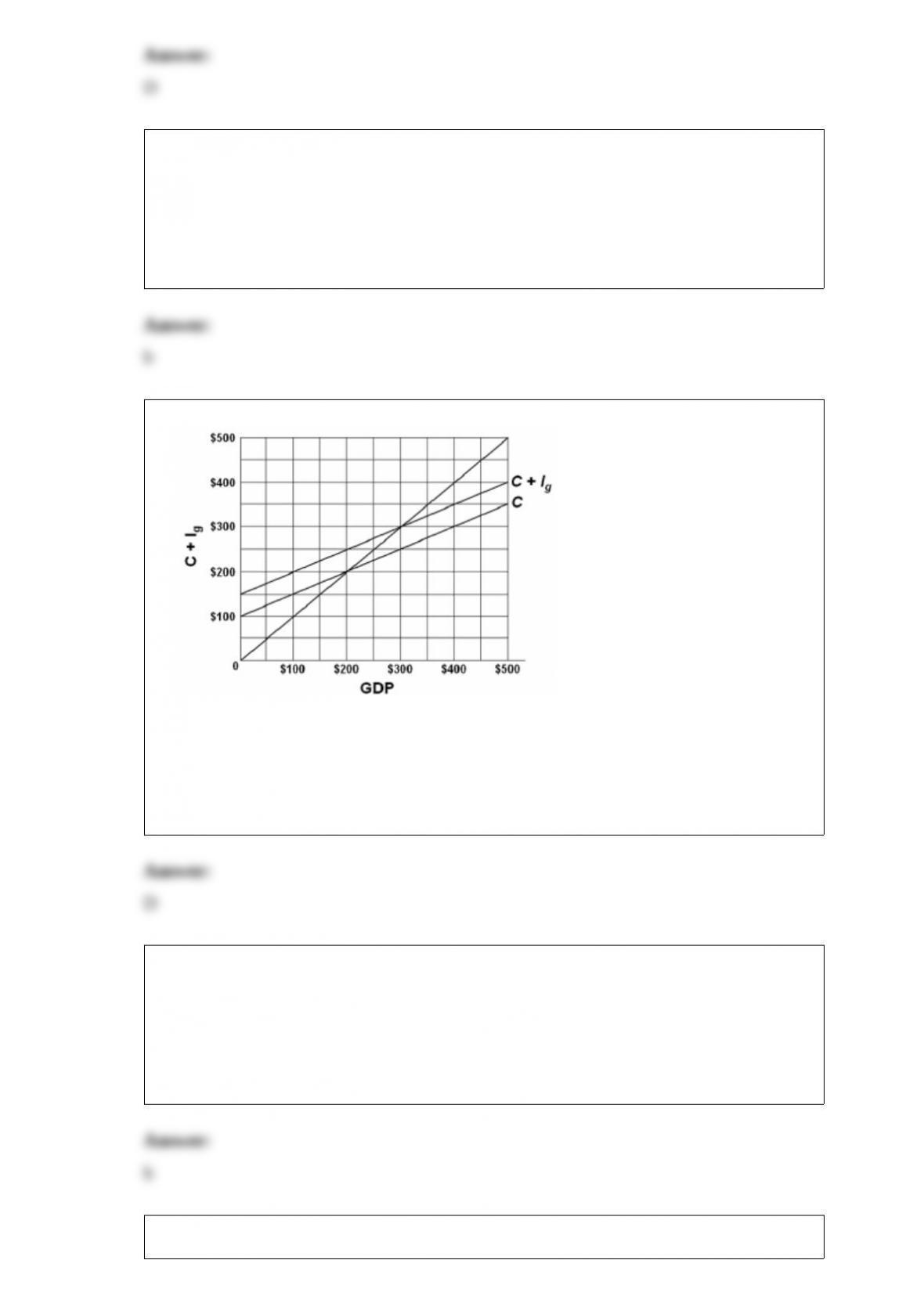
Refer to the above diagram. If the full-employment level of GDP is B and aggregate
expenditures are at AE2, the:
A.inflationary expenditure gap is ed.
B.recessionary expenditure gap is BC.
C.inflationary expenditure gap is eg.
D.economy is in equilibrium, at full employment.
4) which of the following is a true statement?
a.the united states has the world’s largest ratio of exports to gdp.
b.the united states is almost entirely dependent on other countries in obtaining items
such as silk, nickel, tin, and coffee.
c.u.s. exports to china greatly exceed u.s. imports from china.
d.since 1947 the united states has accounted for a rising percentage of total world trade.
5)
Refer to the above diagram for a private closed economy. The $400 level of GDP is:
A.that output at which saving is zero.
B.too high because consumption exceeds investment.
C.unstable because aggregate expenditures exceed GDP.
D.unstable because aggregate expenditures are less than GDP.
6) listed in descending order of relative size, total consumption spending is comprised
of:
a.nondurable goods, durable goods, and services.
b.services, nondurable goods, and durable goods.
c.services, durable goods, and nondurable goods.
d.durable goods, nondurable goods, and services.
7)
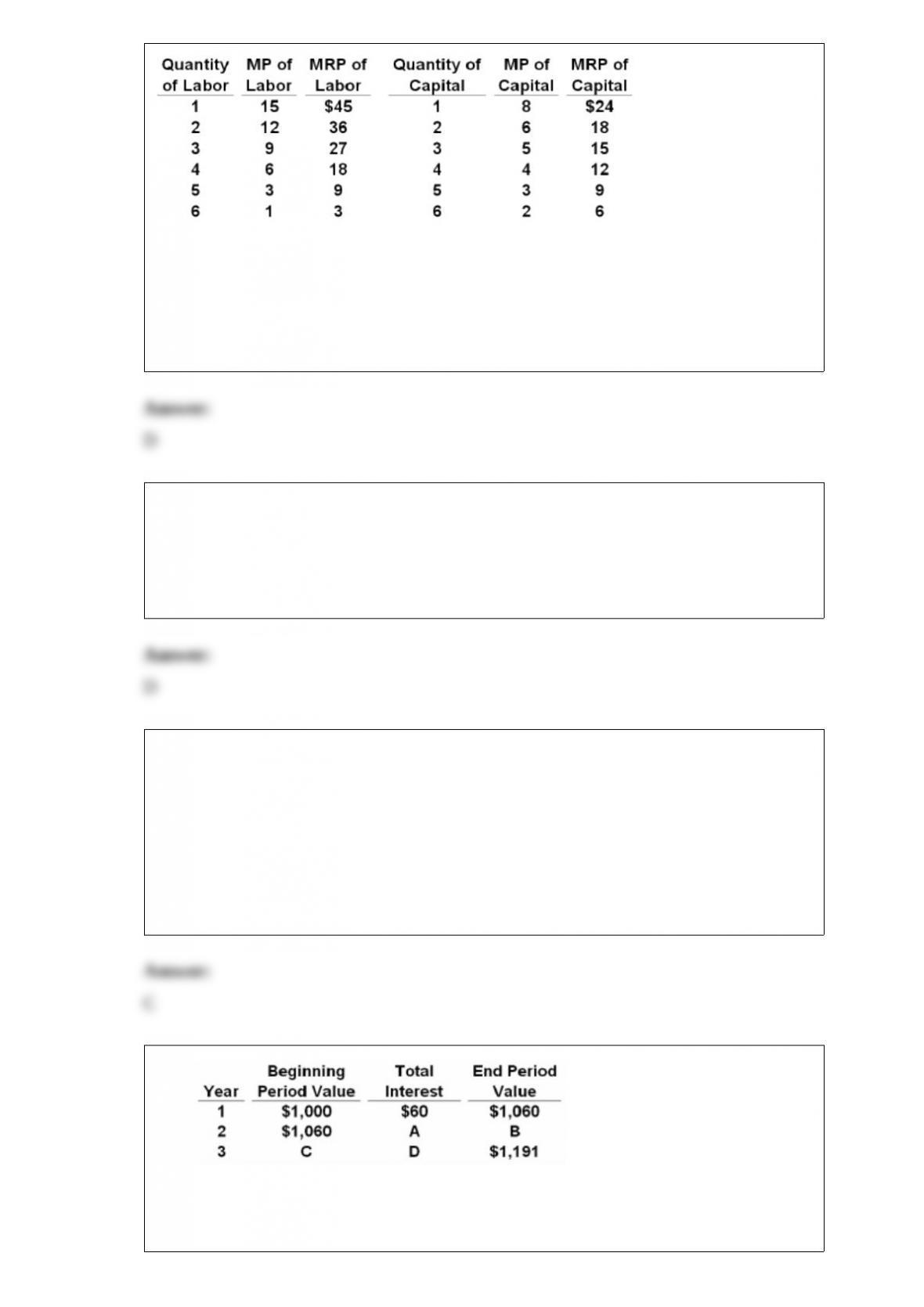
Refer to the above data. If the prices of labor and capital are $9 and $15 respectively, at
the profit-maximizing level of output the firm’s total revenue will be:
A.$114.
B.$180.
C.$129.
D.$192.
8) All of the following can file antitrust charges under the Sherman Act except:
A.the U.S. Justice Department.
B.state attorney generals.
C.injured private parties.
D.the Federal Energy Regulatory Commission.
9) Suppose a loan customer is considering two alternative $22,000 loans. Loan 1
requires payment of $1,100 of interest each year and Loan 2 has a 6 percent annual
interest rate. Other things equal, the loan customer will:
A.be indifferent between the two loans because they both have the same annual
percentage rate.
B.reject both loans because they each carry too high an interest rate.
C.choose Loan 1 because it has a lower annual interest rate than Loan 2.
D.choose Loan 2 because it has a lower annual interest rate than Loan 1.
10)
Refer to the above table representing Darcy’s bank account. Assuming that $1000 was
deposited into her account at the beginning of year 1, and no further deposits or
withdrawals were made, which cell(s) represents the future value of the initial deposit if

the money remains in the account for two years?
A.Cell B only
B.Cell A only
C.Cells A and D
D.Cells B and C
11) Which of the following does not correlate positively with economic growth?
A.output per capita
B.life expectancy
C.the percentage of the population engaged in agriculture
D.the literacy rate
12) An economic analysis of the relationship between proposed legislation affecting
major employers in each state and the voting patterns of Senators and representatives in
Congress on that legislation would fit within the subcategory of economics called:
A.the economics of fiscal policy.
B.public choice theory.
C.behavioral economics.
D.monetarism.
13) when total product is diminishing, marginal product is:
a.positive and increasing.
b.positive and decreasing.
c.constant.
d.negative.
14) the average tax rate is:
a.equal to the marginal tax rate if the tax is progressive.
b.the total tax rate minus the marginal tax rate.
c.the ratio of total taxes paid to total taxable income.
d.the tax rate that applies to incremental dollars of income.

15) a perfectly elastic demand curve implies that the firm:
a.must lower price to sell more output.
b.can sell as much output as it chooses at the existing price.
c.realizes an increase in total revenue which is less than product price when it sells an
extra unit.
d.is selling a differentiated (heterogeneous) product.
16) Suppose that in an economy with a MPC of .5 the government wanted to shift the
aggregate demand curve rightward by $80 billion at each price level to expand real
GDP. It could:
A.reduce taxes by $160 billion.
B.increase government spending by $80 billion.
C.reduce taxes by $40 billion.
D.increase government spending by $40 billion.
17) To be classified as a low-income developing country, annual per capita income in
2006 needed to be:
A.$905 or less.
B.$649 or less.
C.$3,056 or less.
D.$510 or less.
18) if all discrimination in the united states were eliminated, the economy would:
a.have a less concave production possibilities curve.
b.produce at some point closer to its production possibilities curve.
c.be able to produce at some point outside of its production possibilities curve.
d.produce more consumer goods and fewer investment goods.
19) Marginal revenue product (MRP) of labor refers to the:
A.increase in total revenue resulting from the sale of an additional unit of output.

B.amount by which a firm’s total resource cost increases when it employs one more unit
of labor.
C.increase in total revenue resulting from the hire of one more unit of labor.
D.price at which additional units of labor can be employed in a monopsonized labor
market.
20) The earnings of highly educated workers:
A.rise more slowly than those of less-educated workers.
B.rise more rapidly than those of less-educated workers.
C.rise at about the same rate as those of less-educated workers.
D.stagnate earlier than do those of less-educated workers.