Adverse selection refers to the actions people take after they have entered into a
transaction that make the other party to the transaction worse off.
One problem with deflation is that it can raise the real value of debt.
A positive technological change will cause the quantity supplied of a good to increase.
The GDP deflator is a measure of the price level which is calculated as nominal GDP
divided by real GDP and multiplied by 100.
The labor force participation rates of women have rapidly increased since 1948.
Economists have not found a way to predict when recessions will begin and end.
The larger the MPC, the smaller the value of the multiplier.
A decrease in disposable income will shift the aggregate demand curve to the left.
If planned investment is greater than actual investment, then aggregate expenditure is
less than GDP.
If the Fed attempts to reach and maintain very low rates of unemployment, we would
expect the rate of inflation to rise.
Buying a house during a recession may be a good idea if your job seems secure because
the Federal Reserve often lowers interest rates during a recession.
In an open economy, the government purchases multiplier will be smaller the
A) smaller the marginal propensity to import.
B) larger the tax rate.
C) larger the marginal propensity to consume.
D) All of the above are correct.

A goal of ________ is to give patients an incentive to pay more attention to the prices
of medical services. This would tend to increase economic efficiency by decreasing the
costs of medical services
A) the Patient Protection and Affordable Care Act (ACA)
B) market-based reforms of the health care system
C) government-provided health care
D) socialized medicine
How does an increase in the budget deficit affect the demand for dollars and the supply
of dollars on the foreign exchange market?
A) The demand for dollars falls, and the supply of dollars falls.
B) The demand for dollars rises, and the supply of dollars rises.
C) The demand for dollars rises, and the supply of dollars falls.
D) The demand for dollars falls, and the supply of dollars rises.
A decrease in the price level in the United States will have what effect on the aggregate
expenditure line?
A) Aggregate expenditure will shift downward.
B) Aggregate expenditure will become steeper.
C) Aggregate expenditure will shift upward.
D) Aggregate expenditure will not be affected by an increase in the price level in the
United States.
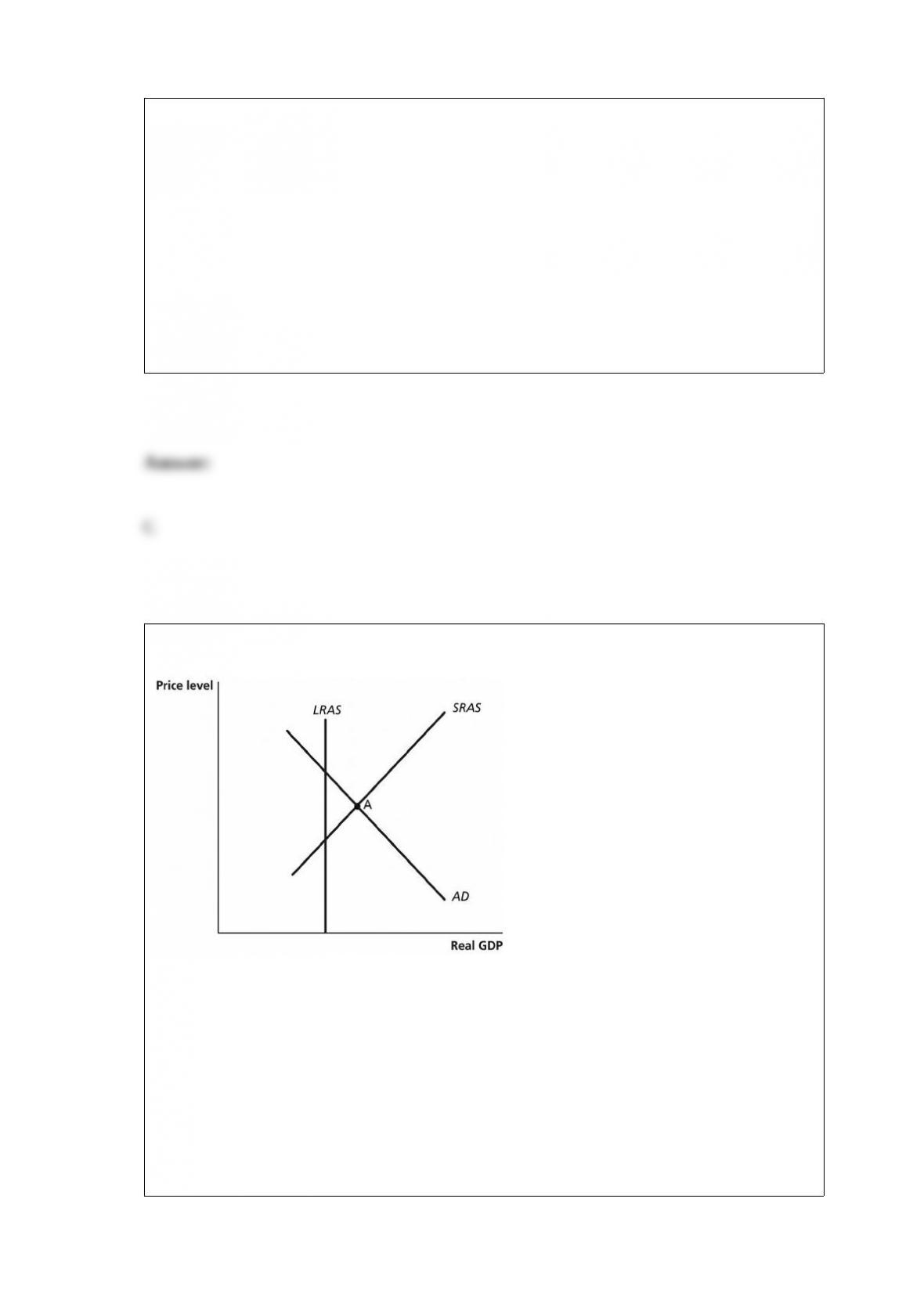
Figure 15-8
Refer to Figure 15-8. In the figure above, if the economy is at point A, the appropriate
monetary policy by the Federal Reserve would be to
A) lower interest rates.
B) raise interest rates.
C) lower income taxes.
D) raise income taxes.
The size of the underground economy would tend to decrease if the government of a
country
A) decreased government regulations on businesses.
B) made over-the-counter drugs illegal.
C) increased income tax rates.
D) increased business taxes.
Planned aggregate expenditure is equal to
A) consumption spending only.
B) consumption spending plus planned investment spending.
C) planned investment spending only.
D) consumption spending plus planned investment spending plus government purchases
plus net exports.
When the United States sends money to Indonesia to help tsunami survivors, in what
account is this transaction recorded?
A) the financial account
B) the capital account
C) the current account
D) the foreign exchange account
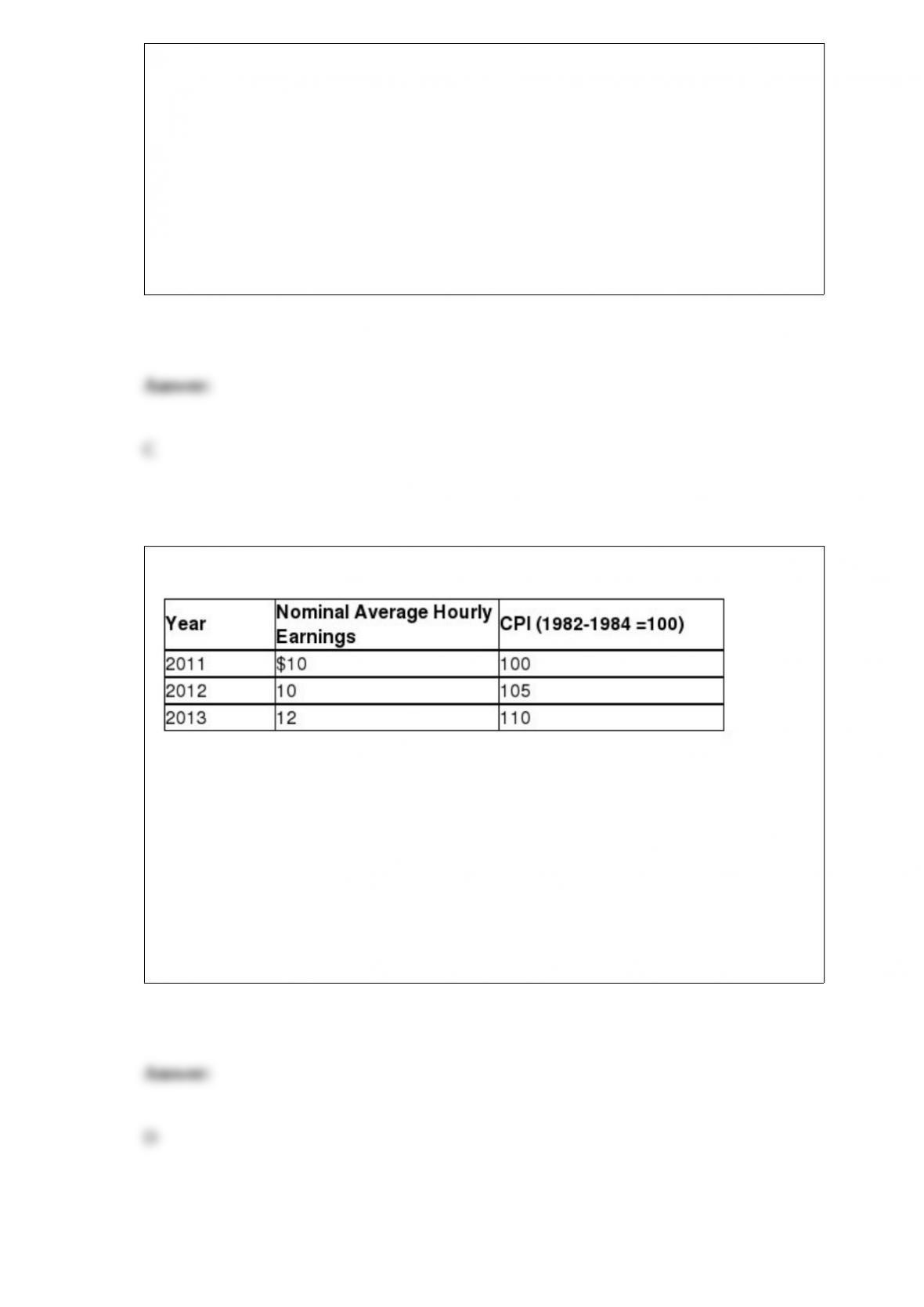
Table 9-19
Refer to Table 9-19. Looking at the table above, what is the approximate rate of growth
of real average hourly earnings from 2011 to 2012?
A) 15%
B) 4.4%
C) -1.5%
D) -4.8%

Workers and firms both expect that prices will be 3% higher next year than they are this
year. As a result,
A) workers will be willing to take lower wages next year.
B) the purchasing power of wages will rise if wages increase by 3%.
C) the short-run aggregate supply curve will shift to the left as wages increase.
D) aggregate demand will increase by 3%.
When a recession ends,
A) interest rates decrease.
B) households decrease spending on durable goods.
C) the household sector decreases spending substantially.
D) firms increase the amount of borrowing.
Which of the following statements is false?
A) Anytime you have to decide which action to take you are facing an economic
trade-off.
B) Trade-offs do not apply when the consumers purchase a product for which there is
excess supply, such as a stock clearance sale.
C) Every individual, no matter how rich or poor, is faced with making trade-offs.
D) Economics is a social science that studies the trade-offs we are forced to make
because of scarcity.
In the 1930s the United States charged an average tariff rate
A) that was less than its average tariff rate in 2007.
B) that cut its exports to other countries by 50 percent.
C) that was less than 2 percent.
D) that exceeded 50 percent.
________ consumption is consumption that does not depend upon the level of GDP.
A) Autonomous
B) Induced
C) Voluntary
D) Disposable

If the Fed raises the interest rate, this will ________ inflation and ________ real GDP
in the short run.
A) reduce; raise
B) increase; lower
C) increase; raise
D) reduce; lower
Which of the following would decrease the natural rate of unemployment?
A) a decrease in the number of younger, less skilled workers in the economy
B) an increase in the generosity of unemployment insurance programs
C) fewer restrictions on unions to negotiate wage changes with companies
D) a decrease in government-sponsored programs that train unemployed workers so
they can find new jobs quickly
Generally with bond ratings, the higher the rating, the ________ the interest rate an
investor will receive and the ________ the risk that the issuer of the bond will default.
A) higher; higher
B) higher; lower
C) lower; higher
D) lower; lower
Which of the following goods would see the largest decline in demand during a
recession?
A) automobiles
B) food
C) clothing
D) haircuts
The long-run Phillips curve is ________ than the short-run Phillips curve.
A) flatter
B) steeper
C) less stable
D) more volatile
Why will there be less crowding out of private spending by government spending the
less sensitive consumption, investment, and net exports are to changes in interest rates?
How might have the educational system of the United States contributed to the
productivity slowdown of the mid-1970s to the mid-1990s?
Is fiscal policy more or less effective in manipulating aggregate demand in an open
economy?
What is the difference between federal purchases and federal expenditures?
Money cannot serve as a medium of exchange unless it also serves as a store of value.
Is this statement true or false? Explain.
What is a surplus? What is a shortage?
Describe the structure of the Fed’s Open Market Committee (FOMC). What is this
committee’s primary responsibility?
What are the key differences between how we illustrate an expansionary fiscal policy in
the basic aggregate demand and aggregate supply model and in the dynamic aggregate
demand and aggregate supply model?
Suppose you transfer $2,000 from your mutual fund account to your checking account.
What is the immediate impact of this transfer on M1 and M2?