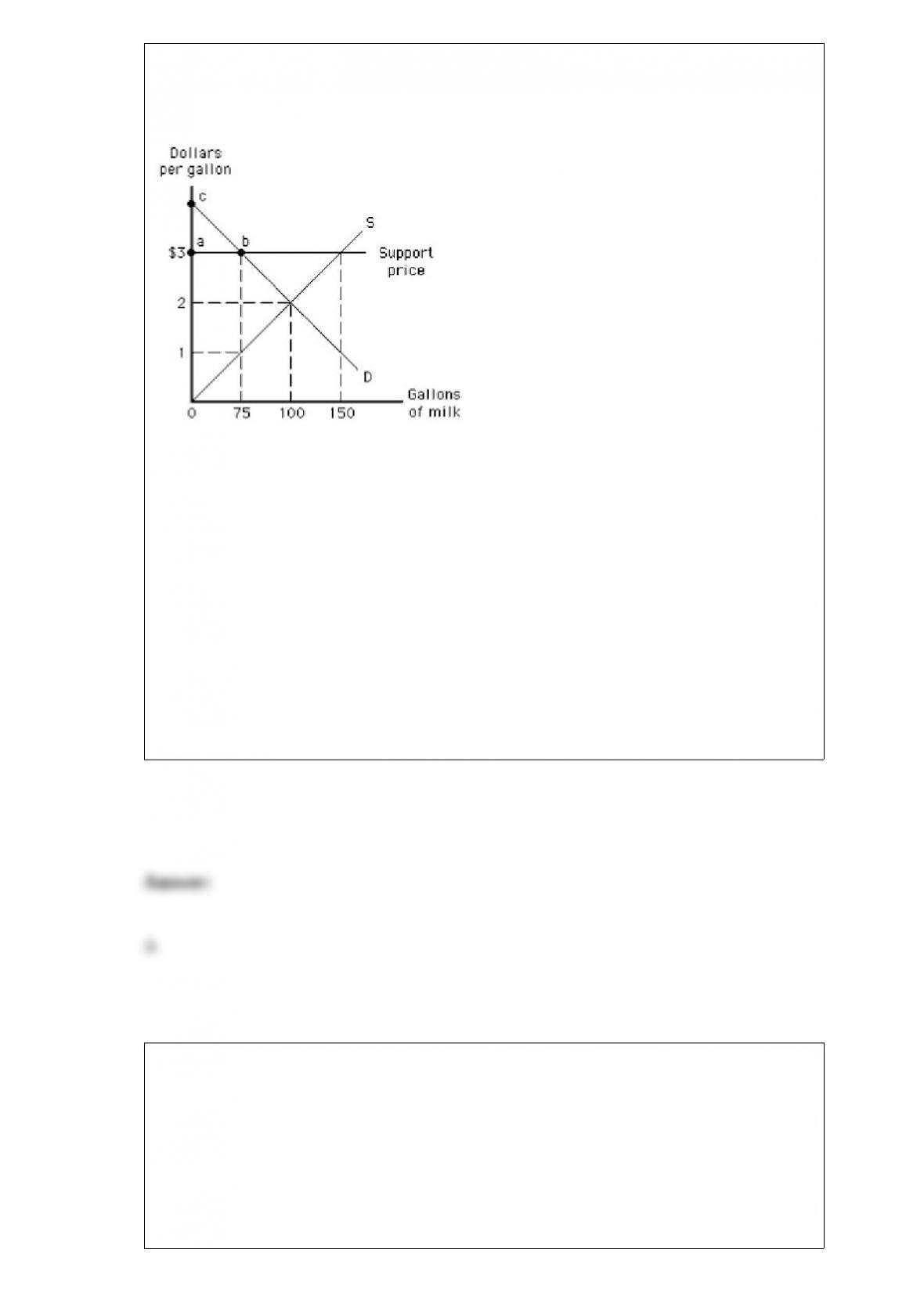
Exhibit 16-1
Consider Exhibit 16-1. Considering government expenditures on surplus milk but
ignoring storage costs, how much do consumers pay per gallon for the quantity
purchased at the support price?
a. $3.00
b. $4.00
c. $5.00
d. $1.00
e. $2.00
If an industry consists of only two firms with equal market shares, then the Herfindahl
index is
a. 50
b. 100
c. 2,500

d. 5,000
e. 10,000
A PPF will not shift because of an increase in
a. the stability of the rules of the game
b. capital stock
c. resource availability
d. unemployment
e. technological change
The more inelastic the supply, the less of a tax is paid by producers
a. True
b. False

If a decrease in the price of a good causes a rightward shift of the demand curve for that
good, then it is an inferior good.
a. True
b. False
Suppose that the price of compact disks (CDs) increases, other things equal. Which of
the following in the most likely effect in the market for DVDs?
a. a decrease in demand for DVDs
b. an increase in demand for DVDs
c. an increase in quantity demanded of DVDs
d. a decrease in quantity demanded of DVDs
e. a decrease in the quantity supplied of DVDs

Normative economic statements refer to what should be.
a. True
b. False
Price elasticity of demand is typically negative because
a. as price decreases, quantity demanded decreases
b. as price decreases, quantity demanded increases
c. as price decreases, demand decreases
d. as price decreases, demand increases
e. consumers rarely respond to a change in price
The most recent data indicates households in the top fifth of the income distribution
earn more than ten times as much income as those in the bottom fifth.
a. True
b. False

Other things equal, the supply of index cards is likely to be affected by all of the
following except one. Which is the exception?
a. the price of wood pulp used in the production of index cards
b. the technology in the index card production process
c. the price of index cards
d. the price of packaging material (a substitute in production)
e. the future price of index cards expected by producers
The percentage change in the demand for film divided by the percentage change in the
price of cameras indicates
a. the cross-price elasticity of demand between film and cameras
b. the cross-price elasticity of demand for photographs
c. the price elasticity of demand for film
d. the price elasticity of demand for cameras
e. nothing because the two goods fall into the broadly defined category of photographic
equipment

The purchasing power parity theory
a. is more a predictor of a long-run tendency than of the day-to-day relationship
between changes in the price level and the exchange rate
b. predicts that exchange rates between two currencies will adjust in the long run to
reflect the price level difference between two countries
c. is more a predictor of a short-run phenomenon than of a long-run relationship
between the price level and the exchange rate between two countries
d. is helpful in explaining long-run trends, even though trade barriers and central bank
intervention may hinder the usefulness of the theory
e. tells us that a country’s currency generally will appreciate if its inflation rate is lower
than that of the rest of the world
If supply is perfectly elastic, the supply curve is
a. vertical
b. horizontal
c. any straight-line supply curve
d. any supply curve intersecting a perfectly elastic demand curve
e. any supply curve intersecting a demand curve which is unit elastic
For a perfectly competitive firm operating at the profit-maximizing output level in the
short run,
a. MR = TR
b. MC = price
c. MC = ATC
d. MC = AVC
e. AFC = price
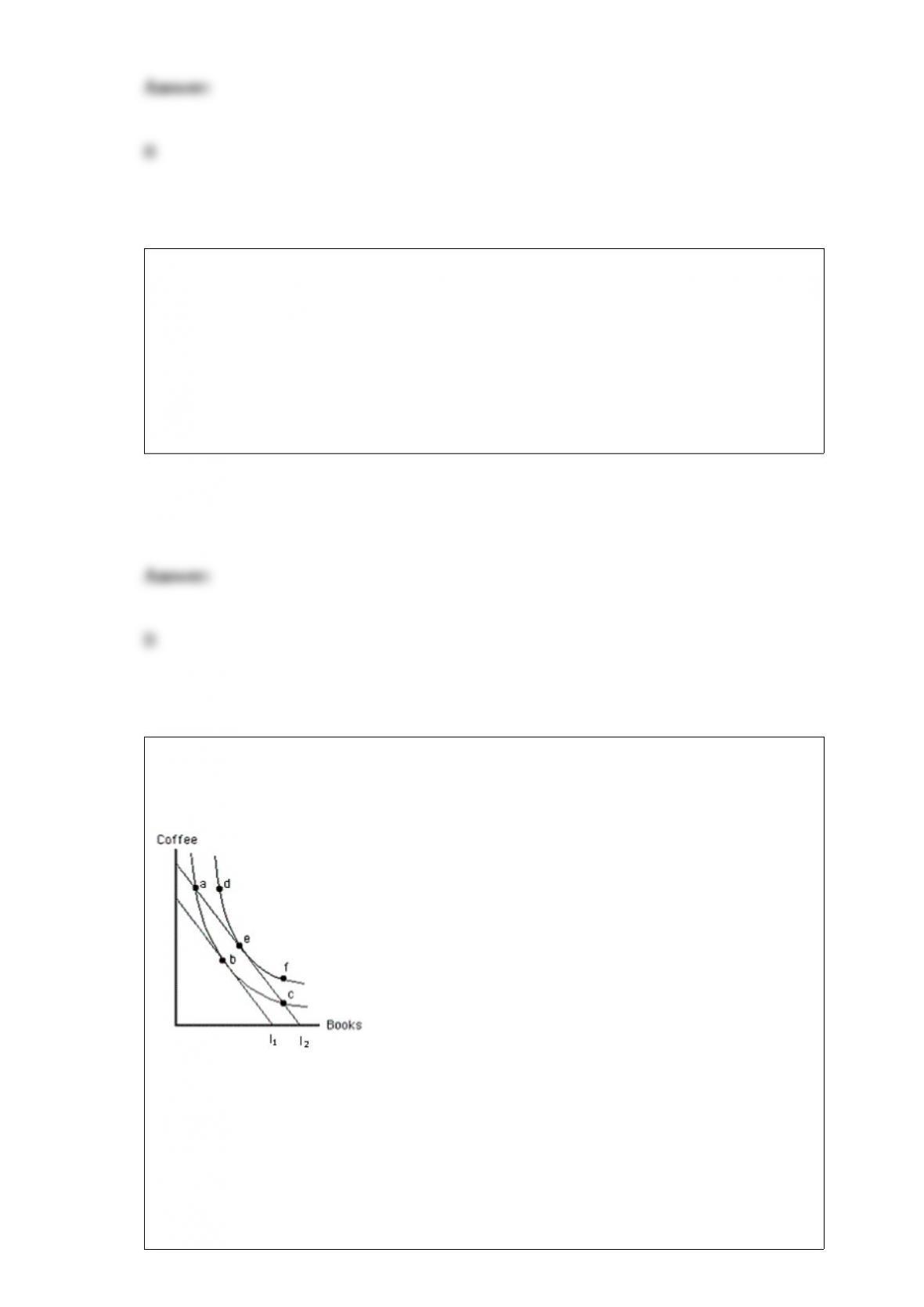
Exhibit 6-25
Point e in Exhibit 6-25 is better than which other point?
a. Point a because e represents the same utility at a lower level of expenditure.
b. Point a because e represents higher utility at the same level of expenditure.
c. Point b because e represents the same utility at a lower level of expenditure.

d. Point b because e represents higher utility at the same level of expenditure.
e. Point a because e represents higher utility at a lower level of expenditure.
The slope of a horizontal line is
a. infinitely large
b. zero
c. positive
d. negative
e. infinitely small
Exhibit 8-1
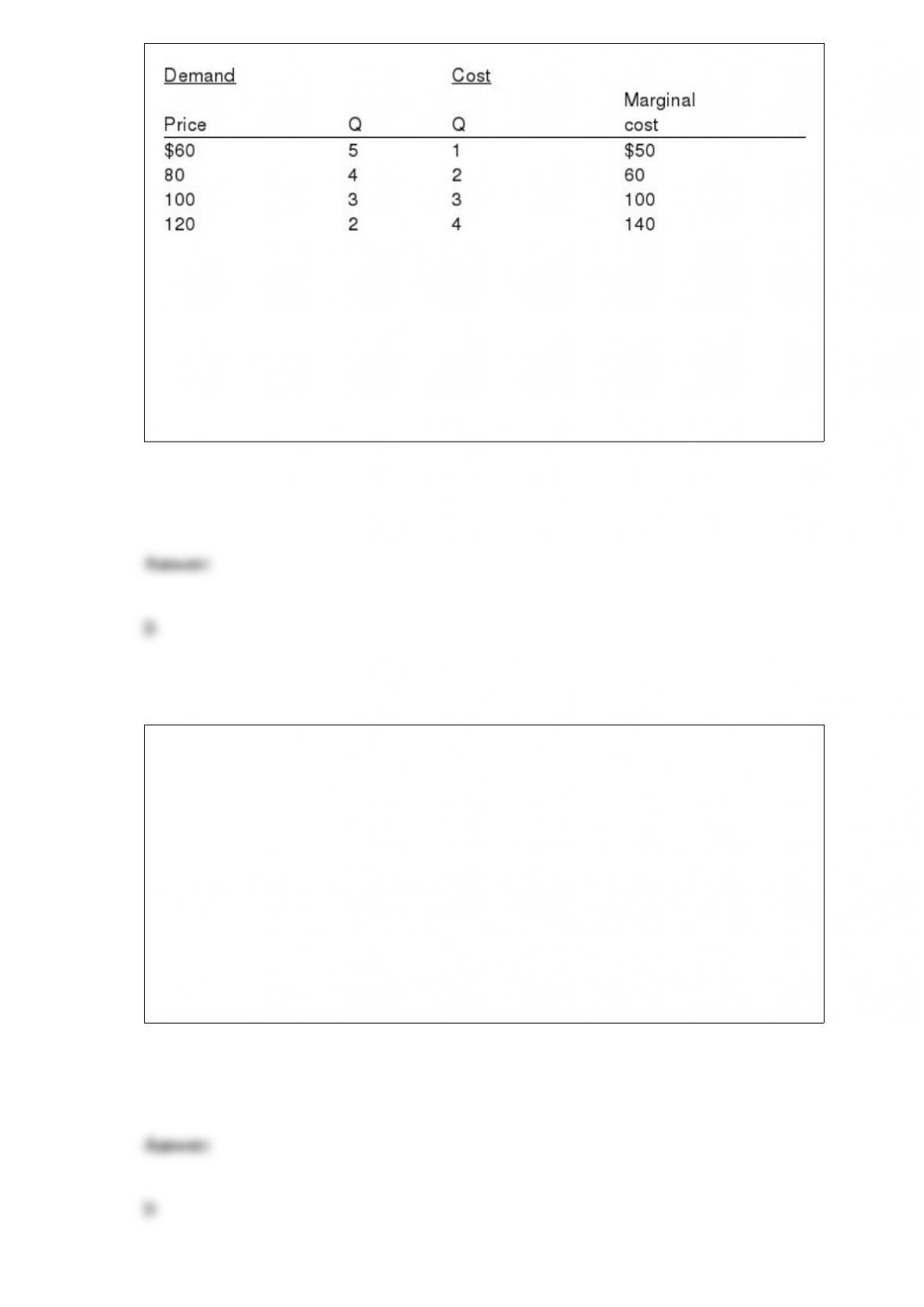
The perfectly competitive firewood market is composed of 1,000 identical consumers
and 1,000 identical firms. Exhibit 8-1 shows cost data for one firm and demand data for
one consumer. What does the demand curve facing a single firm look like?
a. horizontal at a price of $120
b. horizontal at a price of $100
c. horizontal at a price of $80
d. horizontal at a price of $60
e. same as the demand for a single consumer
Assume that a consumer is initially in equilibrium at point a in Exhibit 6-31. Then the
price of good B falls. The movement from point c to point b represents
a. the substitution effect
b. the income effect
c. the substitution effect minus the income effect
d. the sum of the substitution and income effects
e. the income effect minus the substitution effect

The marginal resource cost of a resource is the additional cost of employing one
additional unit of the resource.
a. True
b. False
An implicit cost is
a. any cost a firm cannot avoid in the short run
b. any expenditure a firm makes
c. an opportunity cost
d. accurately measured in accounting statements
e. ignored by economists
A public good is one that is supplied to
a. only people who pay for it
b. only people who do not pay for it

c. all people, regardless of whether they pay or not
d. the government from private firms
e. foreign governments from our federal government
For which of the following goods would you expect the demand to be most price
elastic?
a. Cigarettes
b. Meat
c. Vegetables
d. Beer
e. Coors Lite Beer
Roundabout production occurs when
a. entrepreneurs hire others to work for them, rather than taking the time to produce
things themselves
b. workers avoid intermediary entrepreneurs and cooperate to produce output
themselves
c. inefficient technology is used
d. producers make capital goods instead of consumption goods

e. a company takes time to market shares in the company
A family on a trip budgets $200 for restaurant meals and fast food. If the price of a
fast-food meal for the whole family is $20, what is the vertical intercept of the budget
line when fast food is measured on the horizontal axis?
a. 10
b. 20
c. 200
d. 400
e. it is impossible to tell from the information given
Monopolistically competitive firms do not achieve allocative efficiency in the long run
because
a. marginal cost equals marginal revenue
b. marginal cost is greater than marginal revenue
c. marginal cost is less than marginal revenue
d. price is less than marginal cost

e. price is greater than marginal cost
Generally, as a movie theater adds more screens, it experiences
a. declining profit
b. higher prices
c. diseconomies of scale
d. economies of scale
e. diminishing marginal returns
Why is the principal-agent problem less likely when getting a haircut than when getting
a car repaired?
a. Haircuts are less expensive than car repairs.
b. There are no hidden actions when getting your hair cut.
c. There are no hidden actions when getting your car repaired.
d. Auto mechanics are less honest than hair stylists.
e. There is no principal-agent relationship in car repair.

If supply is inelastic, the imposition of a tax will
a. fall more heavily on producers
b. fall more heavily on consumers
c. fall more heavily on profit making firms relative to non-profit firms
d. be equally distributed between buyers and sellers
e. change consumer expectations because they do not know what sellers will do
Suppose I am willing to pay $300 for a pair of Rollerblades and I purchase them on sale
for $200. My consumer surplus is
a. $300
b. 3/2
c. $100
d. $200
e. $0

The firm becomes the dominant organization type whenever
a. markets exist
b. markets don’t exist
c. the net value of centralized, organized production exceeds the net value of
market-arranged production
d. the net value of market-arranged production exceeds the net value of centralized,
organized production
e. private enterprise eliminates shirking
The equilibrium point represents the only price-quantity combination in a market that
a. causes both buyers and sellers to agree to a price increase
b. causes both buyers and sellers to agree to a price decrease
c. exactly matches the independent plans of buyers and sellers
d. allows buyers to purchase what they want
e. allows sellers to earn a profit

In the long run in monopolistic competition, firms earn zero economic profit.
a. True
b. False