
The quantity demanded of money decreases as the supply of money increases.
a. True
b. False
The space on the freeway is fixed at any instant of time. A supply curve that shows this
is
a. perfectly horizontal.
b. upward sloping.
c. downward sloping.
d. perfectly vertical.
The higher the opportunity cost of doing something, the more likely it will be done.
a. True
b. False

Suppose the Fed forecasts a reduction in excess reserve holdings by banks. It might
offset the effect of this on the money supply by
a. buying government securities.
b. lowering the required reserve ratio.
c. lowering the discount rate.
d. selling government securities.
e. a, b, and c
Labor is a resource that is necessary to produce many goods. “If the price of labor
falls,” says the economist, “the prices of goods will soon follow.” How does this work?
a. If the price of labor falls, the supply of goods rises, and the prices of those goods fall.
b. If the price of labor falls, the quantity supplied of goods rises, and the prices of those
goods fall.
c. If the price of labor falls, the demand for goods falls, and the prices of those goods
fall.
d. If the price of labor falls, the demand for goods rises, and the prices of those goods
fall.
e. If the price of labor falls, the supply of goods falls, and the prices of those goods fall.

Exhibit 34-12
PW is the price that exists in a free world market. A quota is imposed and imports are
Q4 – Q3. Importers gain revenues equal to the area __________.
a. GKL + HIJ
b. GCE
c. GHJK
d. GFEH
e. none of the above
Under a gold standard, if the market price of gold is above the official price of gold (set
by the monetary authority) members of the public would likely buy gold
_______________ and sell it __________________, causing the market price of gold
to ____________________.
a. from the monetary authority; in the gold market; fall

b. from the monetary authority; in the gold market; rise
c. in the gold market; to the monetary authority; fall
d. in the gold market; to the monetary authority; rise
The wage rate rises. As a result, in the short run Real GDP will __________ and the
price level will __________.
a. rise; rise
b. fall; fall
c. remain constant; fall
d. fall; rise
e. rise; fall
Which of the following is a microeconomics topic?
a. the study of how prices are determined in the computer industry
b. the study of unemployment in the economy
c. the study of how changes in the nation’s money supply affect the nation’s output

d. a and c
e. b and c
The economy is in long-run equilibrium when government unexpectedly increases
aggregate demand. The expected inflation rate is slow to adjust to the higher (actual)
inflation rate. If follows that in the short run, according to the Friedman natural rate
theory, __________ rises and the __________ falls.
a. the unemployment rate, price level
b. Real GDP rises, unemployment rate
c. nominal interest rate, real interest rate
d. the unemployment rate, Real GDP level
e. none of the above
Money is an invention of government.
a. True
b. False

If $1 = 96 Japanese yen on Wednesday and on Thursday $1 = 100 Japanese yen, then
the dollar depreciated against the yen between Wednesday and Thursday.
a. True
b. False
Expansionary fiscal policy is ineffective if
a. there are idle resources in the economy.
b. the MPC is less than 0.60.
c. the government has a budget surplus.
d. there is complete crowding out.
e. a and d
A “money market deposit account” is a(n)

a. checking account that pays no interest.
b. bank account with a specified maturity date.
c. store of Federal Reserve Notes held in bank vaults to cash checkable deposits on
demand.
d. checking account created from an automatic transfer from a savings account.
e. interest-earning account at a bank or thrift institution that usually has a minimum
balance requirement.
Consider a setting in which there is a positive externality, but no negative
externality.The market outcome is __________________; government can bring about
the ___________________ outcome if it sets a subsidy equal to the
__________________.
a. inefficient; efficient; MEB
b. inefficient; efficient; MEC
c. efficient; inefficient; MPC
d. inefficient; efficient; MPB
e. inefficient; efficient; MSB
Exhibit 11-1
The economy is currently at point 1. Suppose the federal government increases
purchases and there is no crowding out. As a result, the aggregate demand (AD) curve
in the exhibit
a. maintains its present position at AD1.
b. shifts rightward, ideally so that it goes through point 2.
c. shifts rightward, ideally so that it goes beyond point 2.
d. shifts leftward.
e. does not shift, but the SRAS curve will shift rightward so that it goes through point 3.
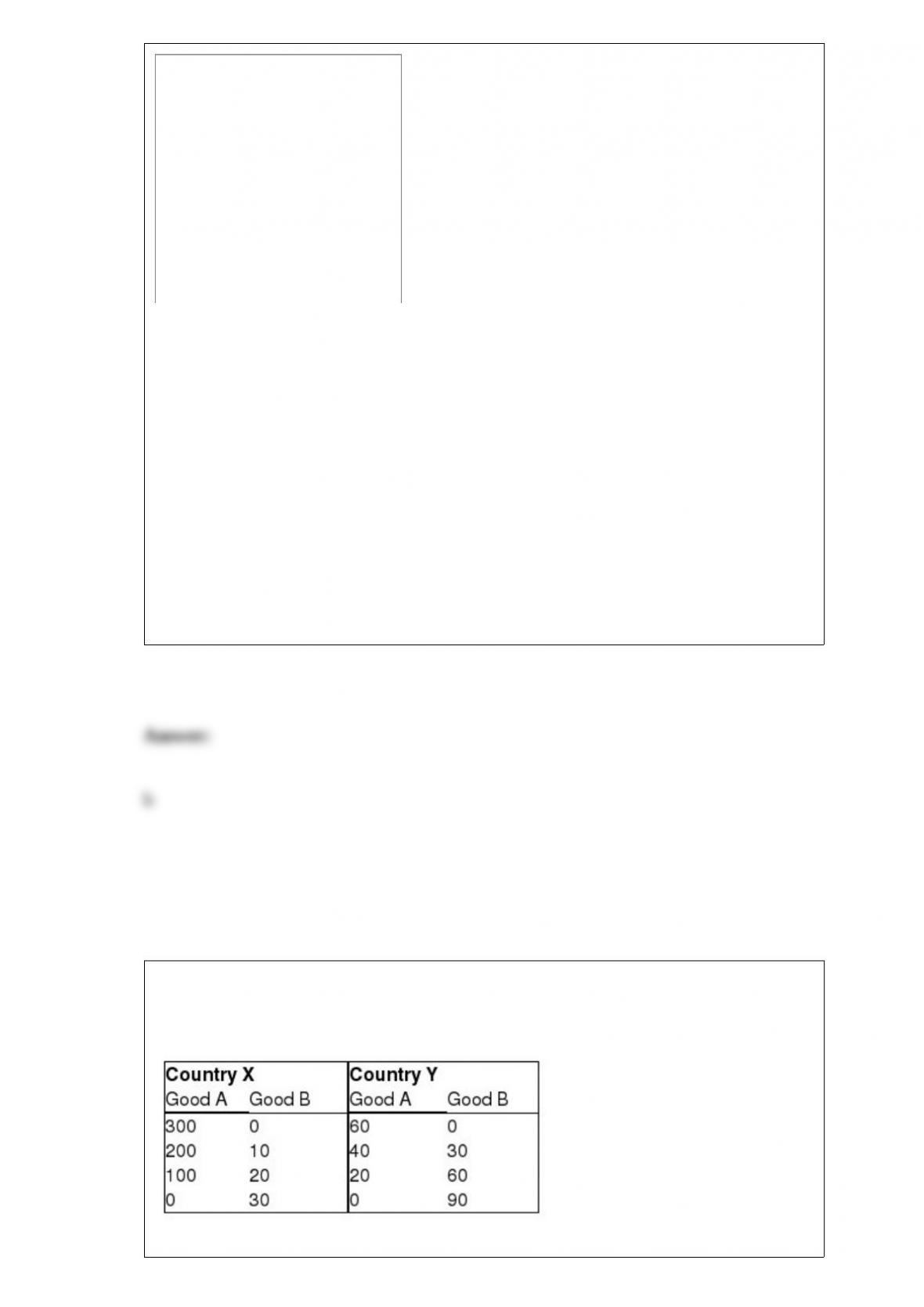
Exhibit 34-9
For country X, the opportunity cost of producing one unit of good A is __________

unit(s) of good B.
a. 2
b. 1/10
c. 1/2
d. 1/3
e. 10
Suppose the population of a country falls, but its Real GDP remains constant. As a
result, there is __________ economic growth.
a. both absolute economic growth and per-capita real
b. absolute economic growth, but not per-capita real
c. per-capita real economic growth, but not absolute
d. neither absolute economic growth nor per-capita real
A decrease in the quantity of resources
a. shifts the PPF leftward.

b. shifts the PPF rightward.
c. moves the economy up a given PPF.
d. moves the economy down a given PPF.