
Being self-sufficient in the production of everything we need is efficient.
Suppose that Jack promises that if Jill chooses the high price, he will too. Jack has an
incentive to cheat on the agreement.
An income effect comes about because a price reduction of one product increases a
consumers real income.
The price elasticity of demand is constant along a downward-sloping linear demand
curve.

Since a large or small wind turbine have the same installation, operating and
maintenance costs, but a large turbine has four times the generating capacity but costs
less than three times as much as a small turbine, the wind power industry faces
decreasing returns to scale.
With anchoring, there is a first-mover advantage in negotiations over price.
The free-rider problem arises when the number of individuals who can benefit is large
and exclusion of most of them is possible.

If the quantity of a product demanded is greater than the quantity of a product supplied,
there is pressure in the market to push the price downward.
When you have a job and your employer compensates you for your time with money,
resulting in both of you being better off, it is an example of a voluntary exchange.
If the cost of producing a product goes down, this will cause the equilibrium price of
the product to go down and the equilibrium quantity of the product to go up.
Today, the average U.S. tariff is 4.6 percent of the value of imported goods, which is
very low by historical standards.

In the long run, monopolistically competitive firms become perfectly competitive firms.
Economists will always reach the same conclusion in their positive analyses.
Oligopoly is a market structure where many firms are competing by selling an identical
product.
When patents expire, new firms enter the market and prices fall.
For firms in perfect competition, price is equal to marginal cost at all levels of output.
According to the principle of diminishing returns, an additional worker decreases total
output.
The amount of a tax shifted forward depends on the price elasticities of supply and
demand.

A firm’s short-run supply curve is its marginal cost curve above the it average total cost
curve.
To maximize total profits, a firm should produce at the level of output at which there is
the greatest difference between marginal revenue and marginal cost.
If the opportunity cost of a table is 5 chairs in nation A and 1 chair in nation B, it makes
sense for nation B to produce chairs.

The notion of opportunity cost allows the measurement of tradeoffs.
Compared to a monopoly market, a perfectly competitive market will produce more
output at a higher price.
A point on a demand curve shows the utility maximizing quantity at that price.
Under GATT’s “Most Favored Nation” provision countries can reduce tariffs only for
their allies.

The earned income tax credit is an earnings subsidy for low-income households.
If demand is inelastic, then price and total revenue are directly related.
An increase in the wage rate means that the opportunity cost of leisure has fallen.
An increase in price causes exit from a constant cost industry.

Present bias occurs because there is a match in the timing of benefits and costs.
A product produced overseas and sold in another country is an export.
Wage rates may differ across workers because of differences in occupational
preferences.
A pollution tax allows a firm to externalize some of its internal costs.
Marginal utility of beer is the change in utility when production of beer changes.
Firms that can only lower pollution at a high cost will have a high willingness to pay for
pollution permits.
A monopolist picks the quantity of output at which price equals marginal cost.

Suppose that consumers expect that the price of a product will increase in the future.
The result is that:
A) the current demand for the product increases.
B) the current demand for the product decreases.
C) the current supply of the product increases.
D) the current supply of the product decreases.
Recall the Application about the price competition between satellite and cable TV
services to answer the following question(s).
Recall the Application. In most cases where satellite TV service is introduced in an area
with cable TV service, the price of the cable TV service usually:
A) increases.
B) decreases.
C) initially increases, then decreases.
D) is unaffected.
Price discrimination always benefits:
A) the firm and may benefit or harm the consumer.
B) the consumer and may benefit or harm the firm.
C) consumers and firms.
D) consumers only.
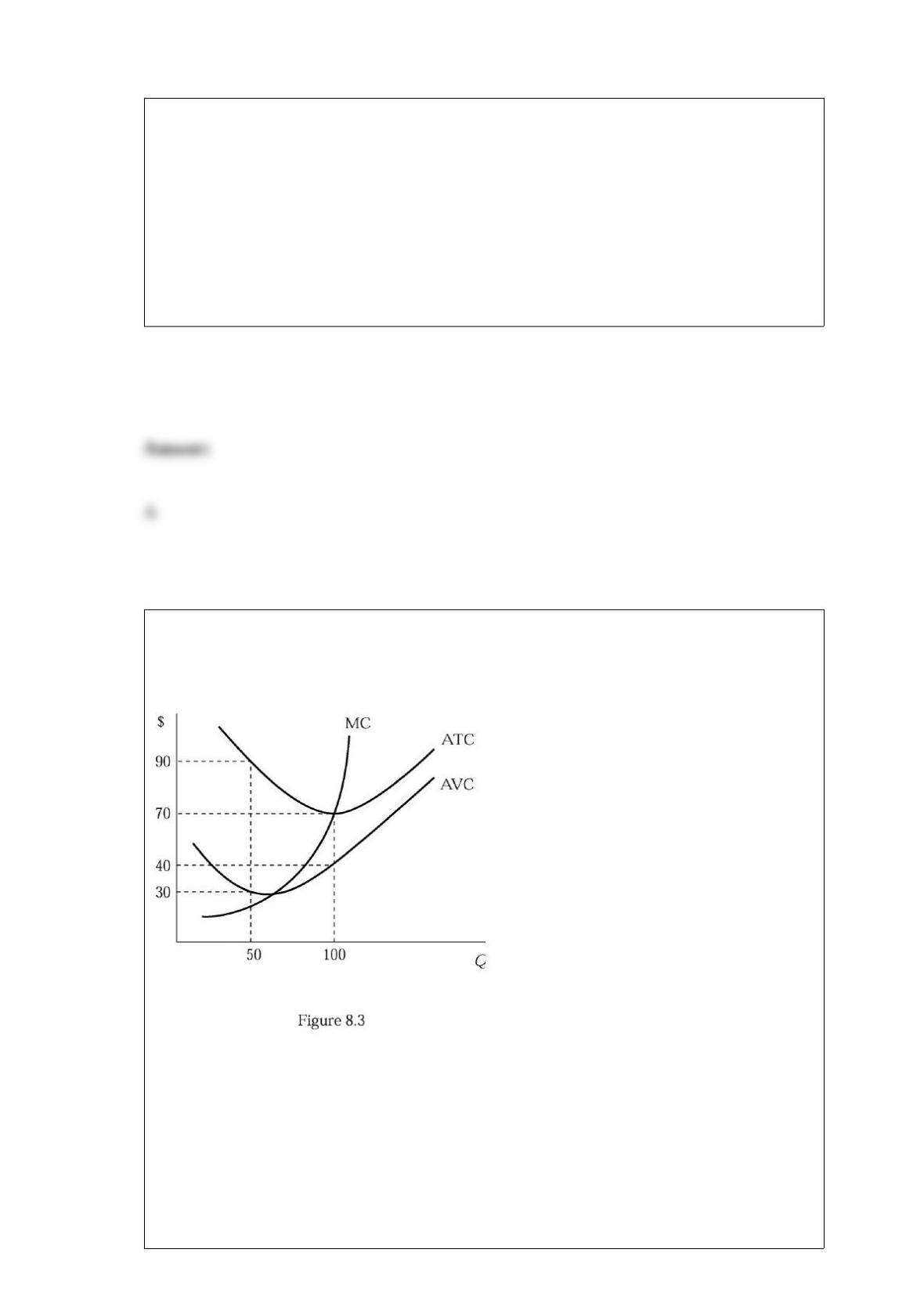
Figure 8.3 shows a firm’s marginal cost, average total cost, and average variable cost
curves. The average total cost curve is downward-sloping as output increases from
Q=50 to Q=100 because:
A) increasing average variable cost outweighs decreasing average fixed cost.
B) decreasing average fixed cost outweighs increasing average variable cost.
C) diminishing returns are not severe enough to outweigh decreasing average fixed
cost.
D) marginal cost is increasing.

The supply curve will be more inelastic when:
A) inputs to production are scarce.
B) firms’ response to a price change is limited by the limited capacity of their
production facilities.
C) a good has many substitutes.
D) the firm is experiencing diminishing returns to a variable input.
Consider Figure 12.3. The outcome of the game will be that:
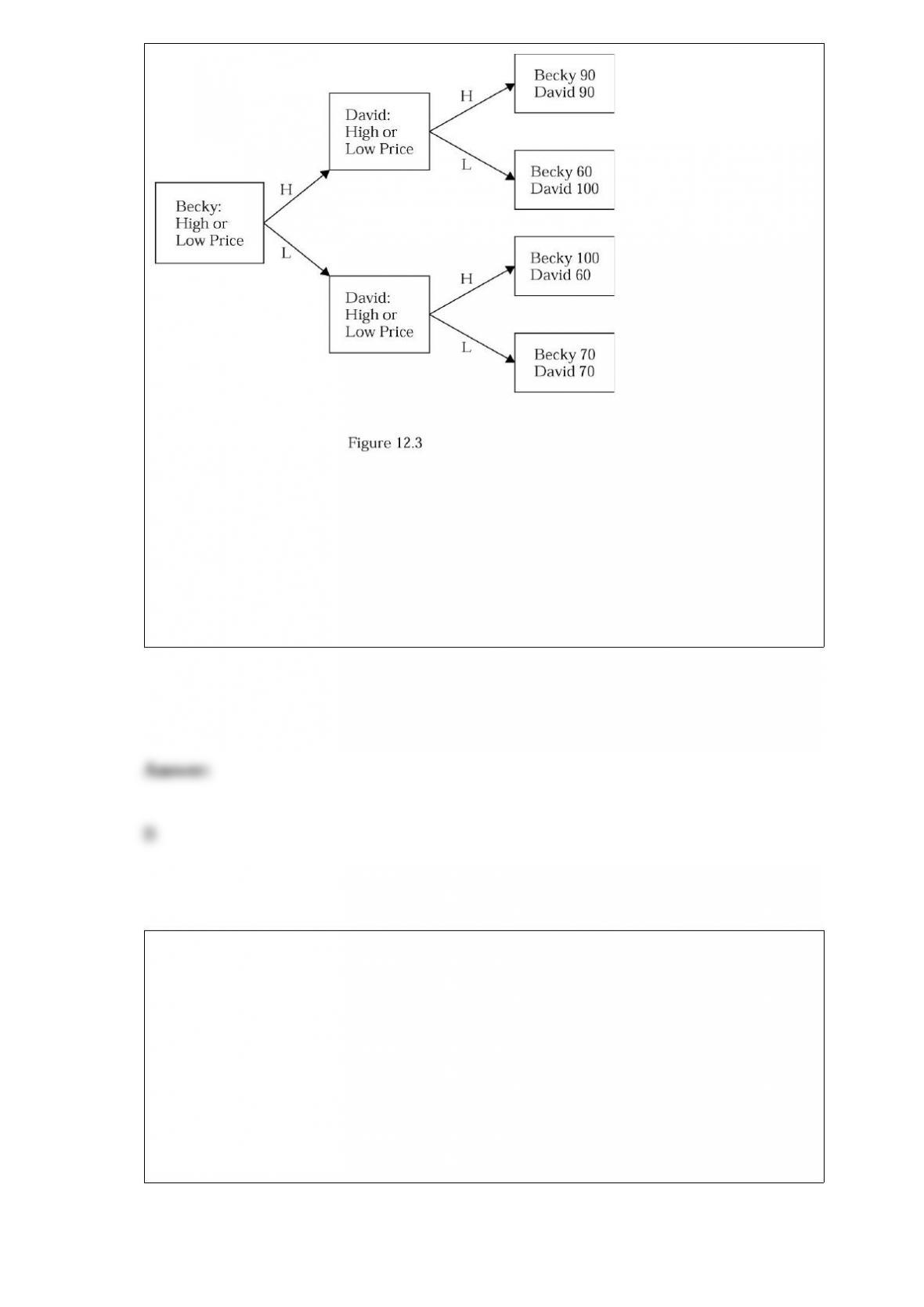
A) both choose a high price.
B) both choose a low price.
C) Becky chooses a high price and David chooses a low price.
D) David chooses a high price and Becky chooses a low price.
When demand decreases and the demand curve shifts to the left, equilibrium price
________ and equilibrium quantity ________.
A) increases; increases
B) increases; decreases
C) decreases; increases
D) decreases; decreases

In a modern market economy, most of the answers to the questions of what to produce,
how to produce it, and who should get the production are made by:
A) governments.
B) individuals.
C) firms.
D) both B and C.
The face value of money or income is called its ________ value.
A) real
B) marginal
C) nominal
D) external

Which of the following best defines the advertisers’ dilemma?
A) Firms A and B will be better off spending money on advertising, however each firm
decides not to advertise.
B) Firms A and B will be better off not spending money on advertising, however each
firm decides to advertise.
C) Firm A advertises, but firm B does not advertise.
D) Firm B advertises, but firm A does not advertise.
Economics is best defined as the study of:
A) financial decision-making.
B) how consumers make purchasing decisions.
C) the choices made by people faced with scarcity.
D) inflation, unemployment, and economic growth.
Which of the following are included in calculating economic costs?
A) implicit costs
B) explicit costs
C) accounting costs
D) All of the above are correct.
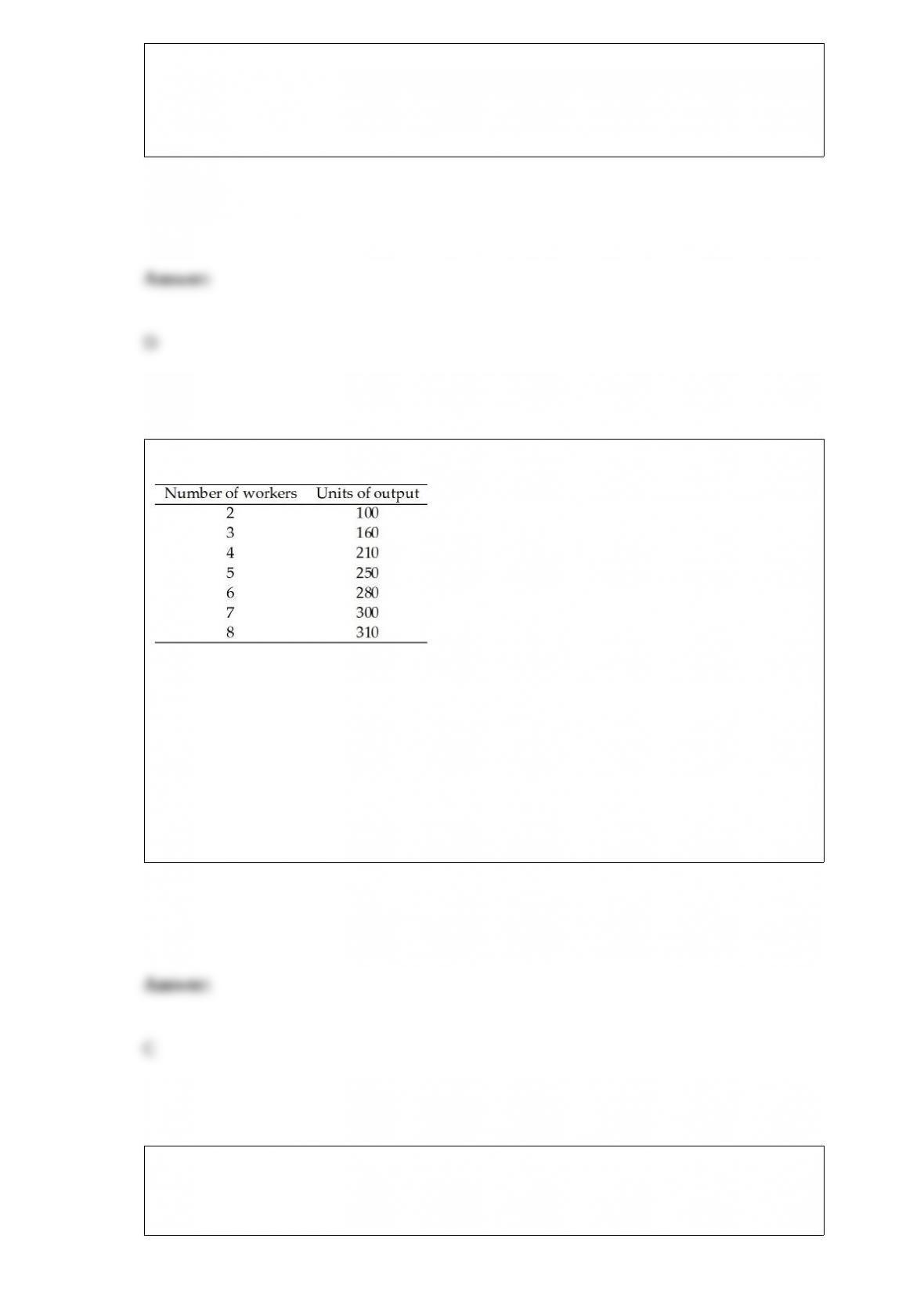
Refer to Table 17.1. The marginal product of the third unit of labor is:
Table 17.1
A) 30.
B) 50.
C) 60.
D) 160.
Consider two individuals, Rose and Sharon, who produce fish and coconuts. Rose and
Sharon’s hourly productivity are shown in Table 3.2. Rose’s opportunity cost of
producing 1 coconut is:
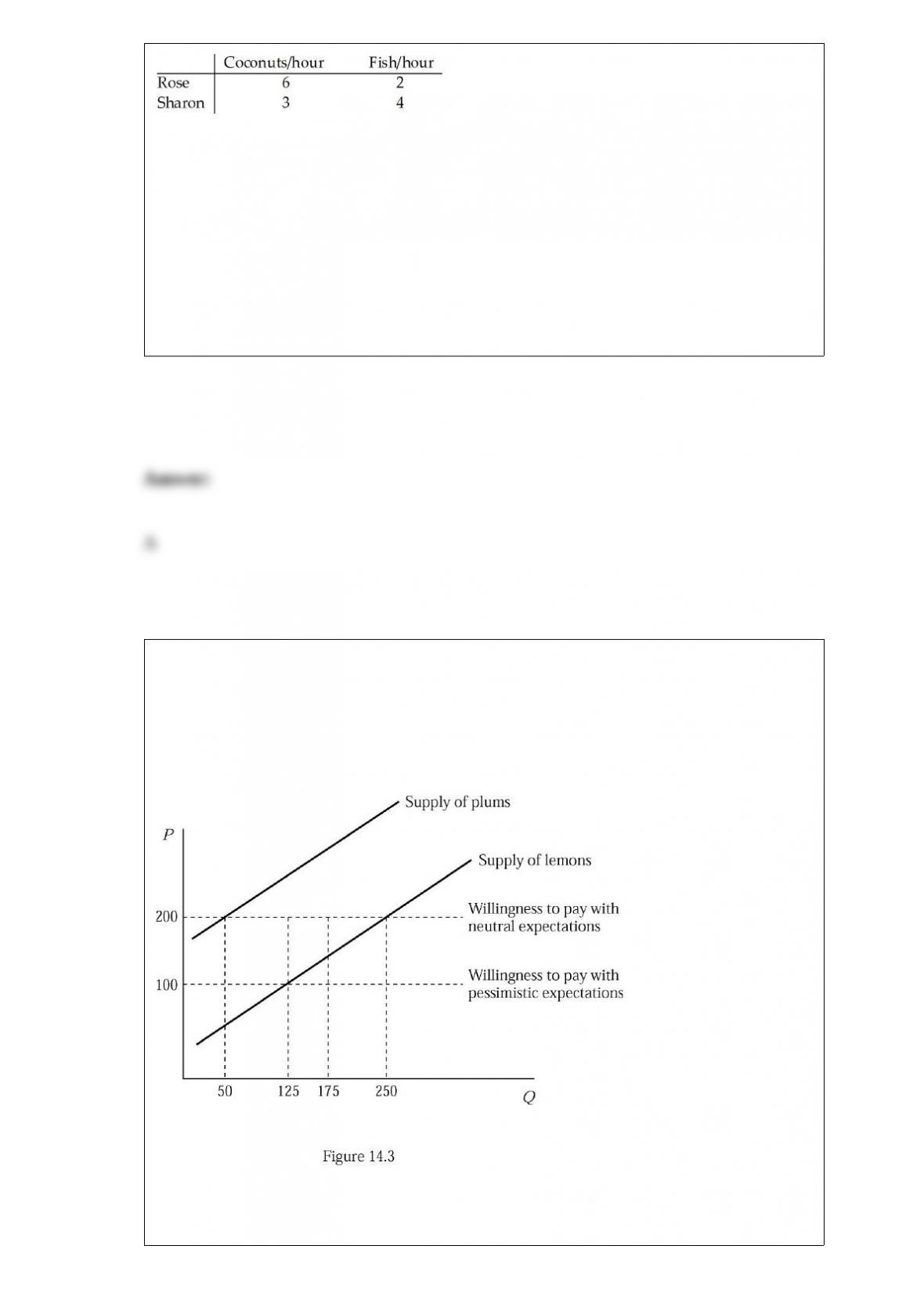
Table 3.2
A) 1/3 fish.
B) 1 1/2 fish.
C) 3 fish.
D) 6 fish.
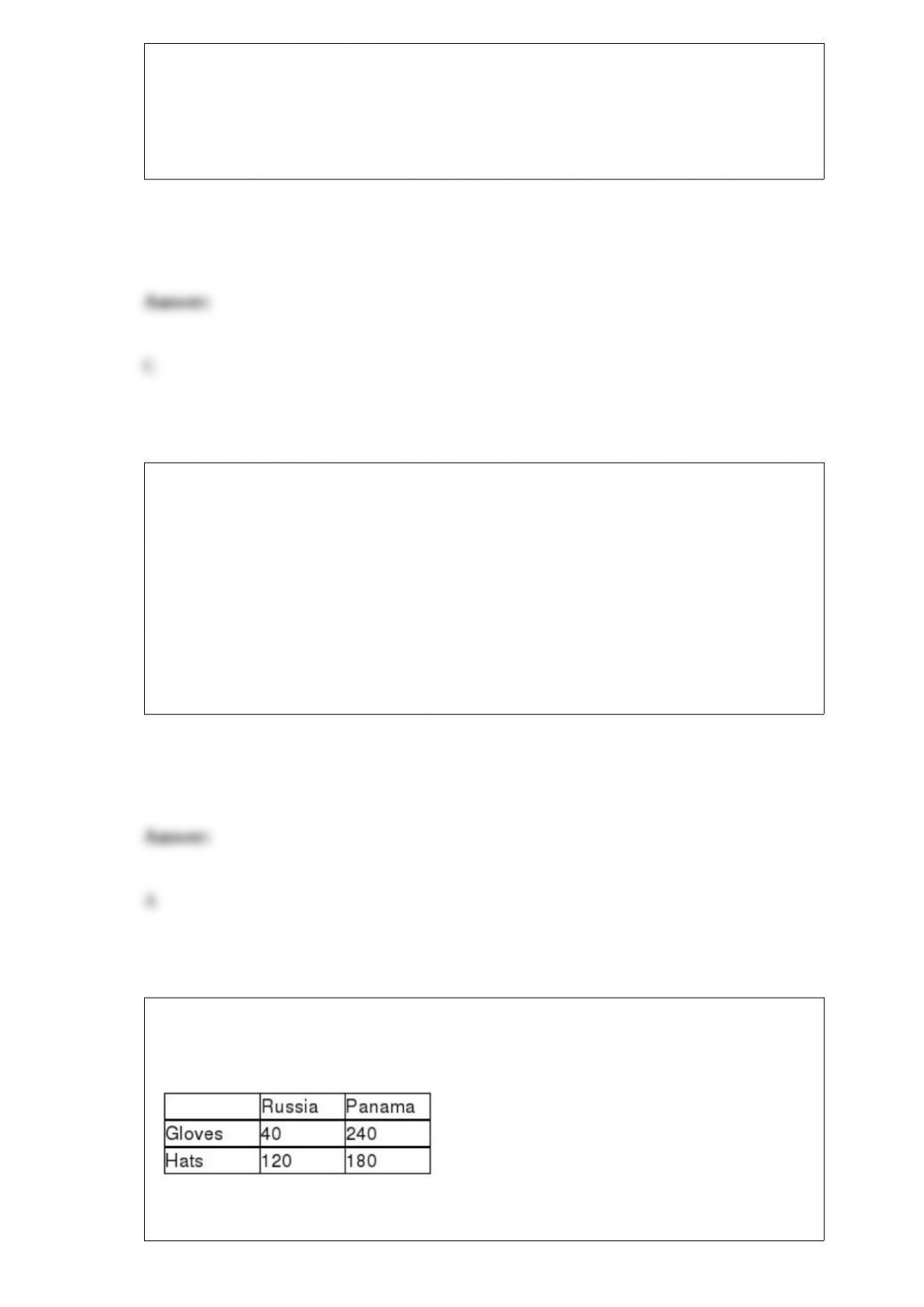
Figure 14.3 represents the market for used refrigerators. Suppose buyers are willing to
pay $300 for a plum (high-quality) used refrigerator and $100 for a lemon (low-quality)
used refrigerator. Initially buyers believe that 50% of used refrigerators in the market
are lemons (low quality). Compared to the outcome with neutral expectations, how
many fewer refrigerators are sold in equilibrium?
A) 50
B) 125
C) 175
D) 250
Which of the following firms rely on patents the most as the barrier to keep other firms
from entering the industry?
A) pharmaceutical firms
B) textbook publishers
C) law firms
D) wine makers
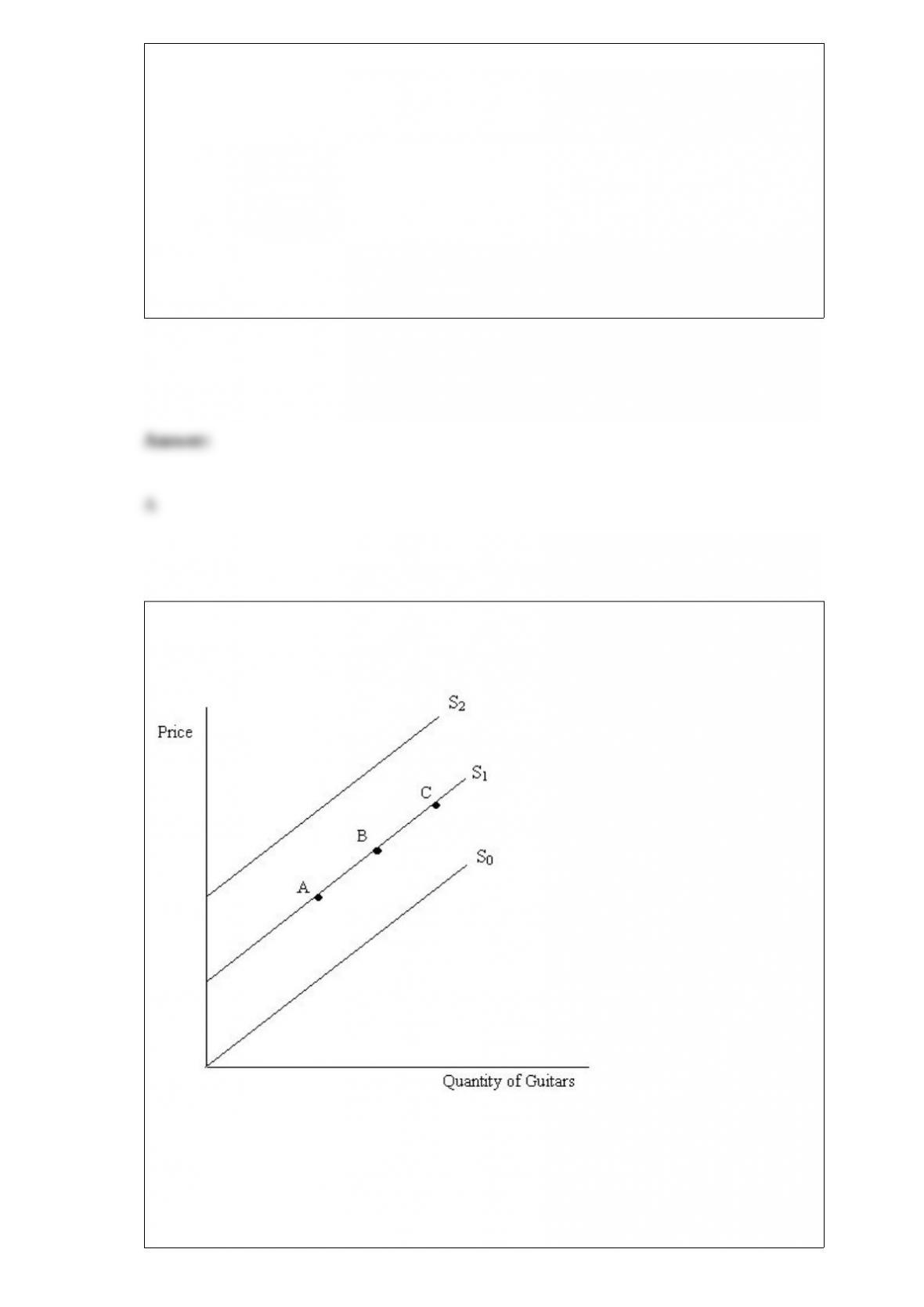
Refer to Table 18.1. Russia has a comparative advantage in:
Daily Output of Russia and Panama
Table 18.1

A) hats.
B) gloves.
C) both hats and gloves.
D) neither hats nor gloves.
Which of the following is a way of responding to the lemons problem?
A) a money-back guarantee
B) a warranty
C) a repair guarantee
D) all of the above
Which of the following is an example of something that economists would consider a
cost but accountants would not?
A) the wages paid to employees of a firm
B) the wages that the owner of a firm could have earned in some alternative job
C) rent paid to a business’s landlord

D) the cost of leather used in the production of footballs
An economic model is a:
A) realistic version of an economic environment.
B) detailed version of an economic issue.
C) fictional representation of an entire economy.
D) simplified representation of an economic environment.
Additional Application
Do implicit costs affect decision-making in the real world? For the first time nationwide
the number of golf courses closing in a year will exceed the number that is opening.
This can be explained by a number of reasons. One is the cost of insuring golf courses,
which has increased in many areas. Also the number of rounds played has decreased 4%
in the last six years. But another explanation is the opportunity cost of owning a golf
course. As property prices have increased, the land that golf courses are on is worth a
great deal more as housing developments. The owners must continually decide whether
the return from operating a golf course is greater than, or at least equal to, the return the
owners could get if the land was developed for another use. Furthermore, one
explanation for the decline in rounds being played is attributed to the time it takes to
play golf. As the opportunity cost of a golfer’s time increases, the fewer hours he/she is
willing to spend on the golf course. Implicit costs are real and play a role in

decision-making of both supply and demand.
“Blues on the Green: Why Golf is in Decline,” The Economist, October 14, 2006, p. 70.
Which of the following would be an implicit cost of operating a golf course?
A) the cost of fertilizers and water
B) the cost of groundskeepers
C) the cost of property insurance
D) the cost of not developing houses on the property
When the EPA requires that specific abatement equipment be installed in cars:
A) total vehicle emissions might increase.
B) total vehicle emissions must decrease, and the most efficient technology is used.
C) total emissions will remain the same, but the most efficient technology must be used.
D) total emissions must decrease, but the technology may not be the most efficient.
Refer to Scenario 9.1. 21st Century Pen Inc.’s profit is:
Scenario 9.1: 21st Century Pen Inc. produces 2000 pens per day, and hires 20 workers
at a cost of $200 per day per worker. The price of each pen is $5 each. 21st Century Pen
Inc. pays a daily rental rate of $60 on its factory and a daily insurance rate of $20. 21st
Century Pen Inc. has a ten year lease on the factory and insurance contract for a year,
the company has no other expenses.
A) $5920 per day.
B) $6000 per day.
C) $4000 per day.
D) $4060 per day.
Figure 4.5 illustrates the supply of guitars. A technological advancement that makes
guitars cheaper to produce would most likely cause a movement from:
Figure 4.5
A) point B to point C.
B) point B to point A.

C) S1 to S0.
D) S1 to S2.
What encourages firms to enter markets?
A) The diversity of products offered must be small.
B) Firms believe they can violate patent protection with impunity.
C) No firms in the industry can experience losses.
D) Some existing firms in the market must be earning economic profits.
Kaitlyn and Larissa have formed a dog bathing and grooming business business. The
number of dogs they can bathe or groom in any given day is depicted in Table 2.1.
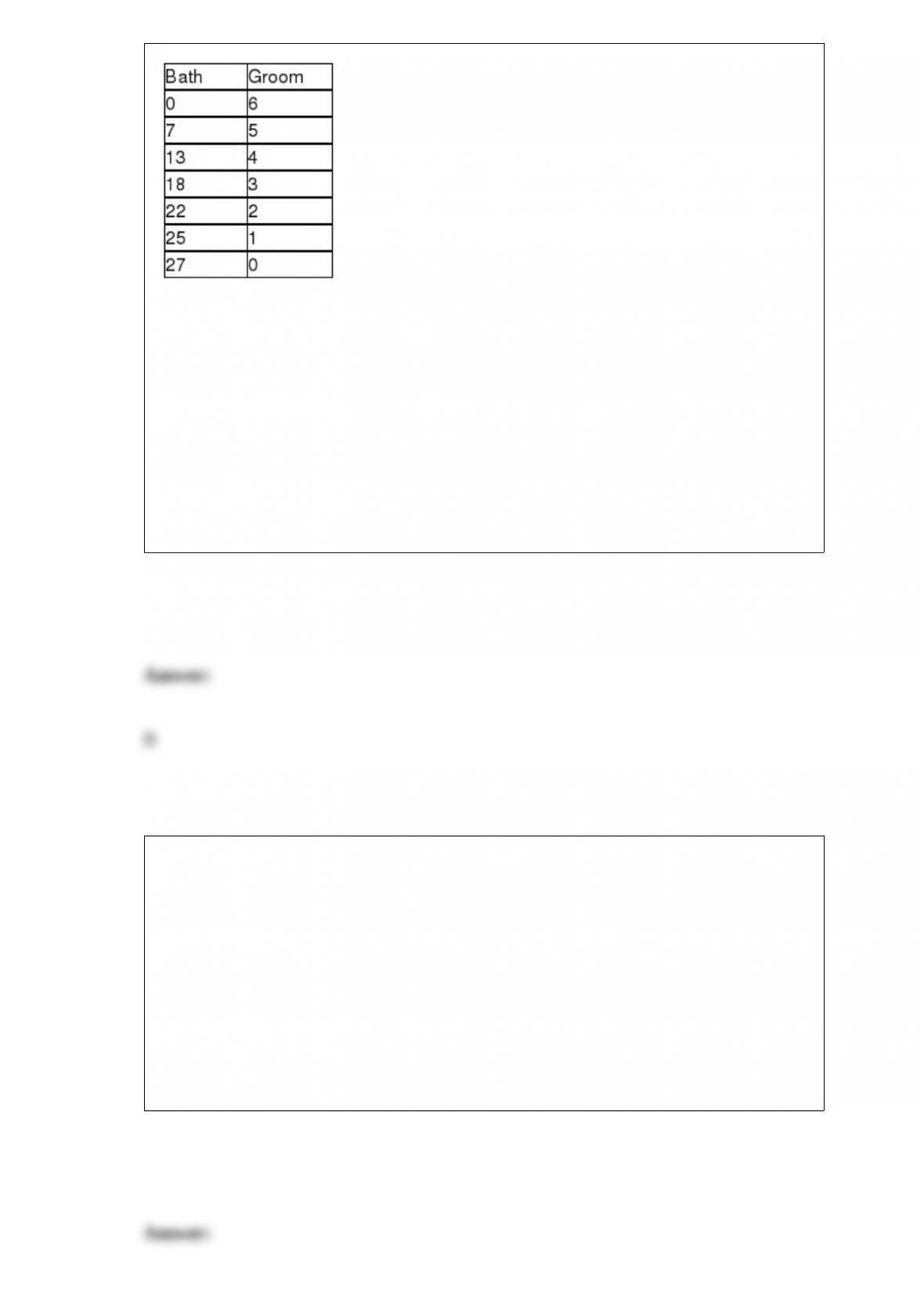
Table 2.1
The opportunity cost of grooming the third dog in a day is bathing ________ dog(s).
A) 3
B) 4
C) 5
D) 18
Suppose that a market for a product is in equilibrium at a price of $5 per unit. At any
price above $5 per unit:
A) there will be an excess demand for the product.
B) there will be an excess supply of the product.
C) the quantity supplied of the product will be greater than the quantity demanded of
that product.
D) both B and C.

Suppose a car is completely produced and assembled in Germany and is sold to the
United States. In this example, the country that imports the car is ________ while the
country that exports the car is ________.
A) the United States; Germany
B) Germany; the United States
C) Germany; Germany
D) the United States; the United States
Recall Application 4, “Trade, Consumption and Inequality,” to answer the
following questions:
According to the application, living standards have NOT become more unequal
because:
A) the prices of goods and services that low income groups have paid have risen slower
than the prices of goods and services that high income groups have paid.
B) the prices of goods and services that low income groups have paid have risen faster
than the prices of goods and services that high income groups have paid.
C) the prices of goods and services that low income groups have paid have been
dropping while the prices of goods and services that high income groups have not.
D) the prices of goods and services that low income groups have paid have risen while
the prices of goods and services that high income groups have not.
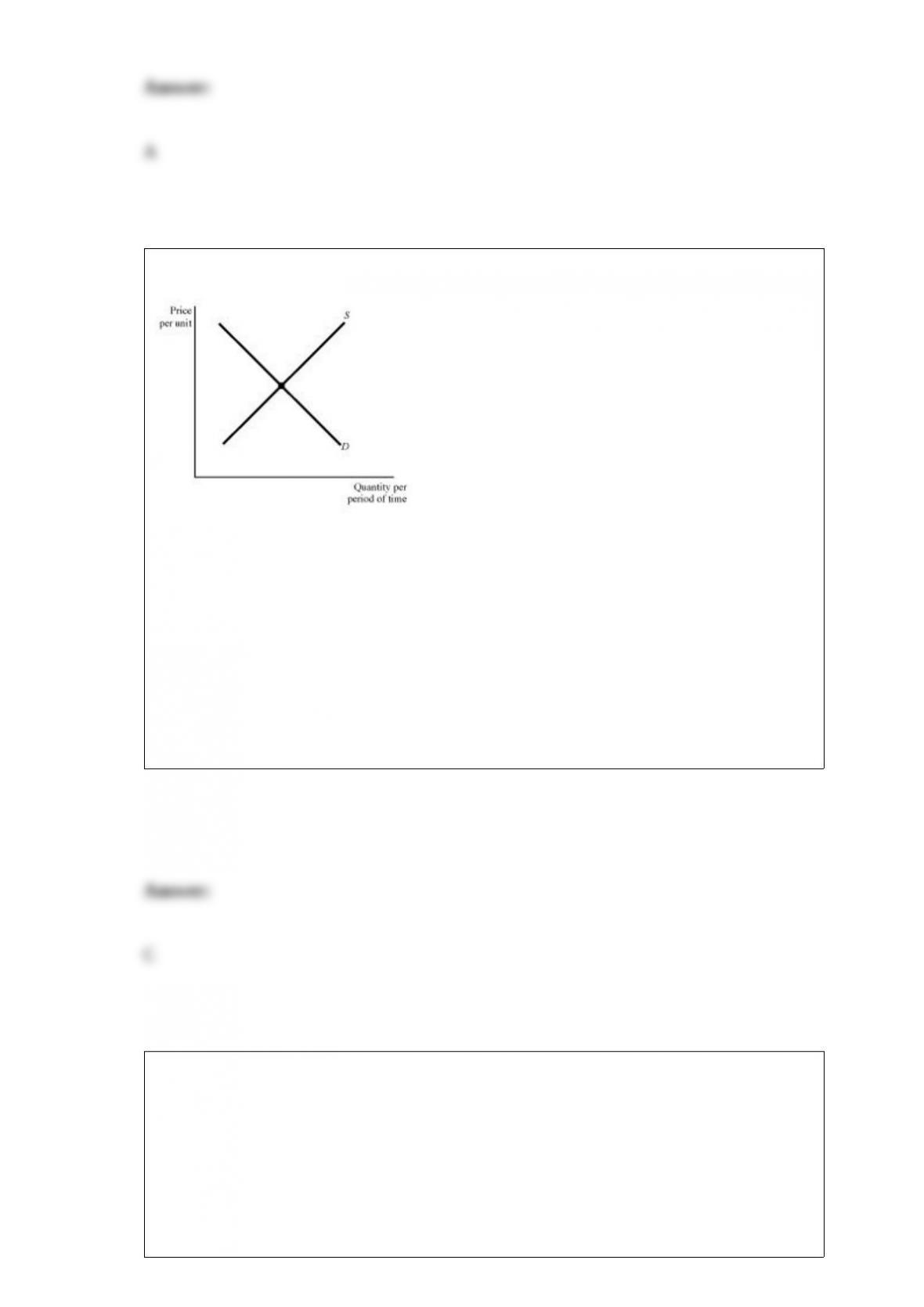
If demand and supply rise in Figure 4.7, then the equilibrium:
Figure 4.7
A) price rises.
B) price falls.
C) quantity rises.
D) quantity falls.
Ceteris paribus, if the prices of the goods a consumer purchases decrease, then the
consumer’s real income:
A) decreases.
B) increases.
C) remains the same.
D) It is impossible to tell with the information presented.
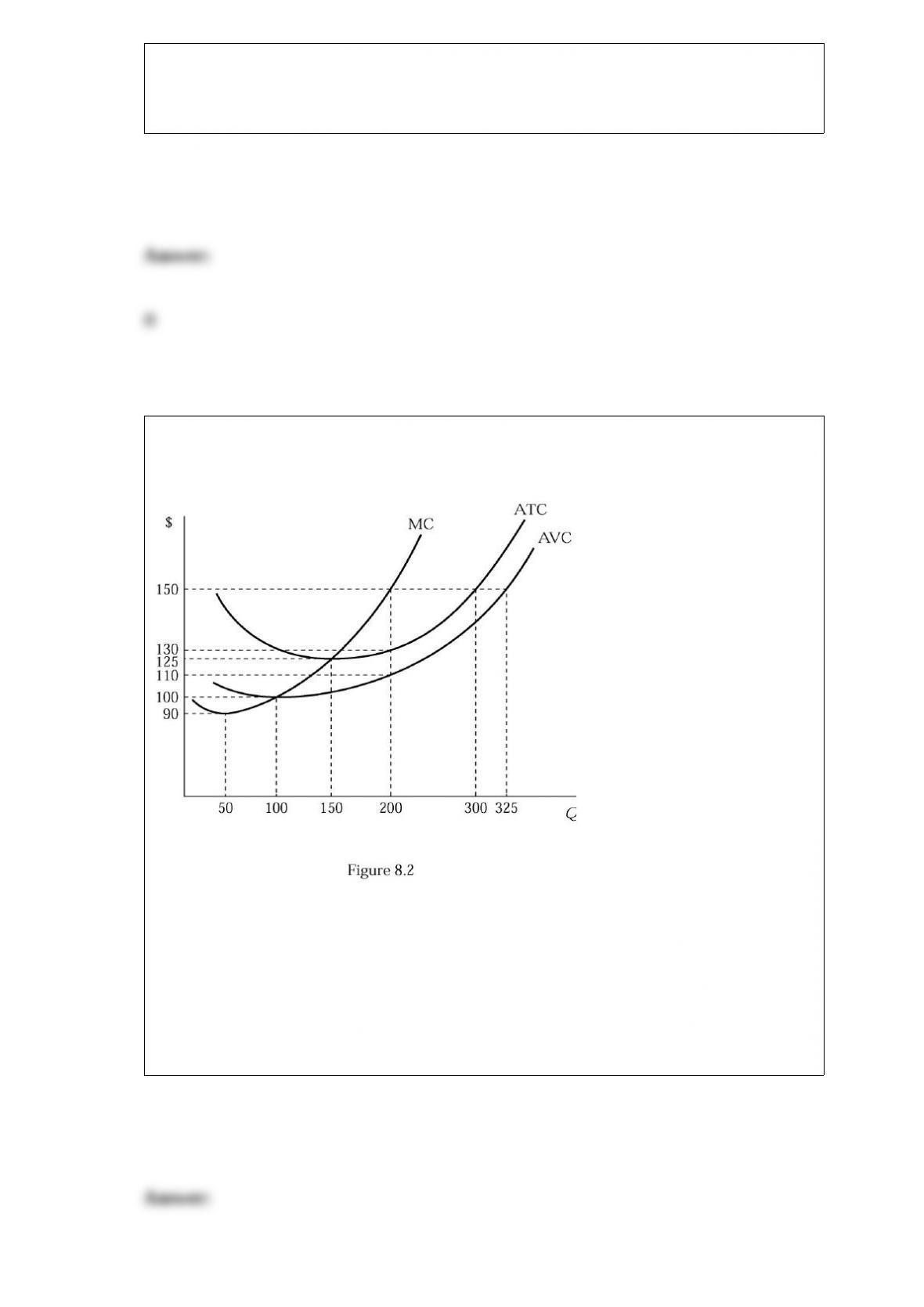
Figure 8.2 presents a firm’s marginal, average total, average fixed, and average variable
cost curves. The firm faces fixed costs of:
A) $20.
B) $110.
C) $130.
D) $4000.
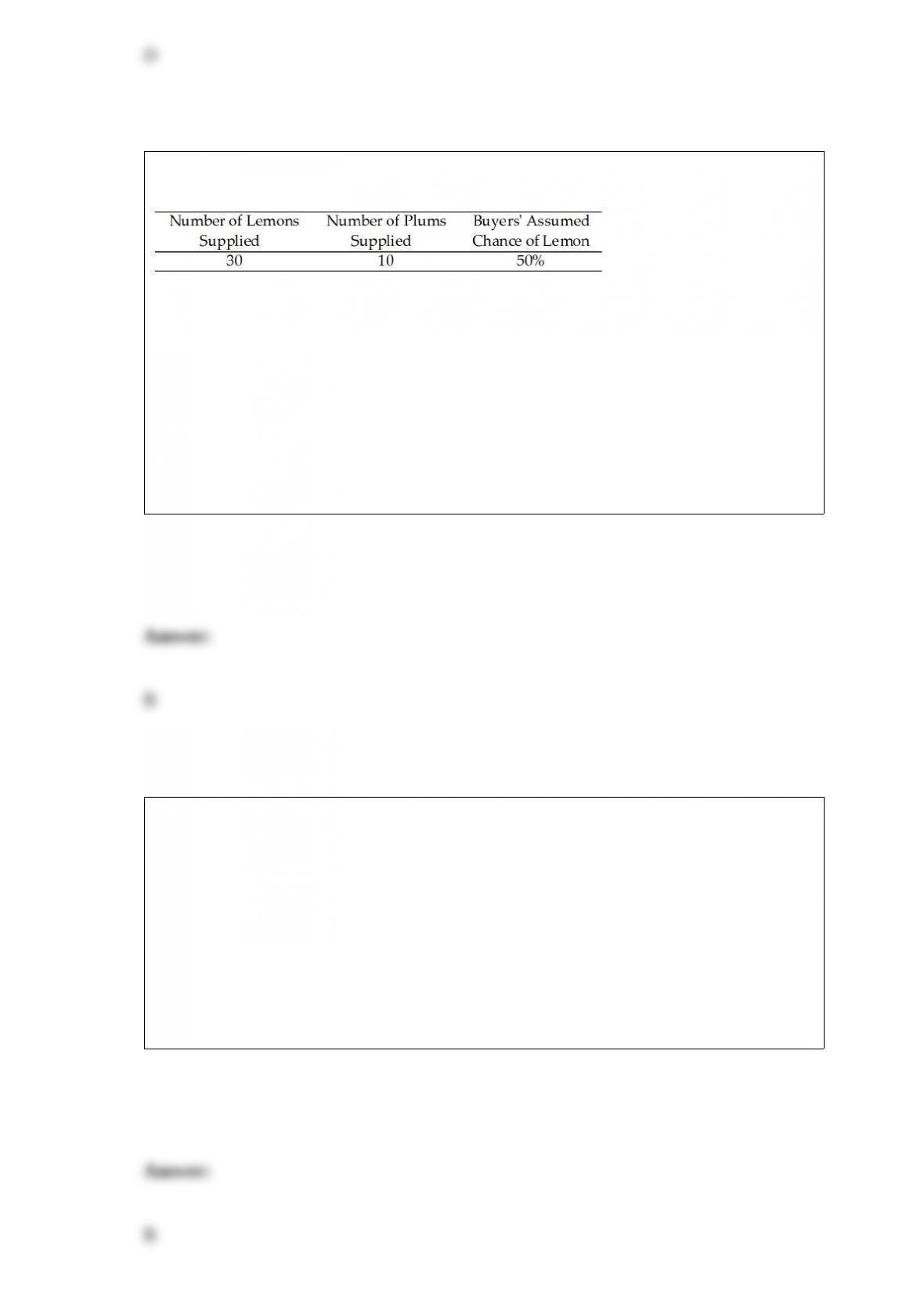
Refer to Table 14.1, which shows the market for used motorcycles in a small
Midwestern town. Which of the following is true?
Table 14.1
A) The market is in equilibrium.
B) We can expect the price of used motorcycles to fall.
C) We can expect the price of used motorcycles to rise.
D) Buyers’ willingness to pay for a used motorcycle will remain unchanged.
When Chris buys pizza for his football party and he gets to decide who will have a slice
of his pizza. This means his pizza is:
A) nonrival and nonexcludable.
B) a private good.
C) a public good.
D) rival, but nonexcludable.
What will make a change in supply cause a small change in price?
List four different theories of how the government operates.
What is a government franchise? Give an example.
Draw a graph to illustrate the effect of an increase in demand on the price and quantity
in a market.
Suppose that the equilibrium price of a bushel of corn is $0.75 per gallon. The
government decides to place a minimum price on corn and will not allow sellers to
charge less than $0.90 per bushel. Draw this situation using a graph. Make sure that you
show the original equilibrium and the effect of the minimum price on the market. What
will happen in this market? What will happen to total surplus?
How does a pollution tax work?
According to the book, what are the four elements of economic thinking?
When a firm hired its tenth worker, its factory output increased by four units per month.
Would you expect the firm’s output to increase by eight more units per month if the firm
hired two more workers?
Explain what diminishing marginal utility is.
What are some of the ways a private group can overcome a free rider problem?
Name three industries in which the government has broken up a monopoly.
Recall the Application about the free-agent market for professional baseball
pitchers to answer the following question(s).
Recall the Application. Why is there adverse selection in the baseball pitcher free agent
market?
If a government creates an excess demand for a product by setting a maximum price, it
is sometimes called a ________.
The price elasticity of demand for gasoline is 0.8. What must occur to the price of
gasoline in order for quantity demanded to rise by 20 percent?
Give an example of a public good. Explain what characteristics make this good a public
good.