1) foreign ownership of u.s. financial assets
a.has decreased since the 1960’s
b.has increased since the 1960’s
c.has made the u.s. a net borrower since the late 1980’s
d.both a and c
2) on the u.s. balance-of-payments statement, the following transactions are credits,
leading to the receipt of dollars from foreigners: merchandise exports, transportation
receipts, income received from investments abroad, and investments in the united states
by foreign residents.
a.true
b.false
3) concerning exchange rate forecasting, technical analysis extrapolates from past
exchange-rate trends while ignoring economic and political determinants of exchange
rates.
a.true
b.false
4) the deadweight losses of an import tariff consist of the protection effect plus the
consumption effect.
a.true
b.false
5) under the historic adjustable pegged exchange-rate system, member countries were
permitted to correct persistent and sizable payment deficits (i.e., fundamental
disequilibrium) by:
a.officially revaluing their currencies
b.officially devaluing their currencies
c.allowing their currencies to depreciate in the free market
d.allowing their currencies to appreciate in the free market
6) under a fixed exchange rate system, adjustment mechanisms work for the automatic
return to current-account balance after the initial balance has been disrupted.
a.true
b.false
7) referring to figure 2.1, the relative cost of steel in terms of aluminum is:
a.4.0 tons
b.2.0 tons
c.0.5 tons
d.0.25 tons
8) free traders maintain that an open economy is advantageous in that it provides all of
the following except:
a.increased competition for world producers
b.a wider selection of products for consumers
c.the utilization of the most efficient production methods
d.relatively high wage levels for all domestic workers
9) most developing-nation exports go to industrial nations while most
developing-nation imports originate in industrial nations.
a.true
b.false
10) given an upward-sloping supply schedule of pounds and a downward-sloping
demand schedule for pounds, a decrease in the demand schedule causes an appreciation
of the dollar against the pound.
a.true
b.false
11) under the provisions of the world trade organization, canada would have the right to
impose countervailing duties on imports of south korean steel when the south korean
government provides export subsidies to its steelmakers.
a.true
b.false
12) industrial policy seeks to direct resources to declining industries in which
productivity is low, linkages to the rest of the economy are weak, and future
competitiveness is remote.
a.true
b.false
13) figure 5.1 illustrates the steel market for mexico, assumed to be a ‘small” country
that is unable to affect the world price. suppose the world price of steel is given and
constant at $200 per ton. now suppose the mexican steel industry is able to obtain trade
protection.
figure 5.1. alternative nontariff trade barriers levied by a ‘small” country
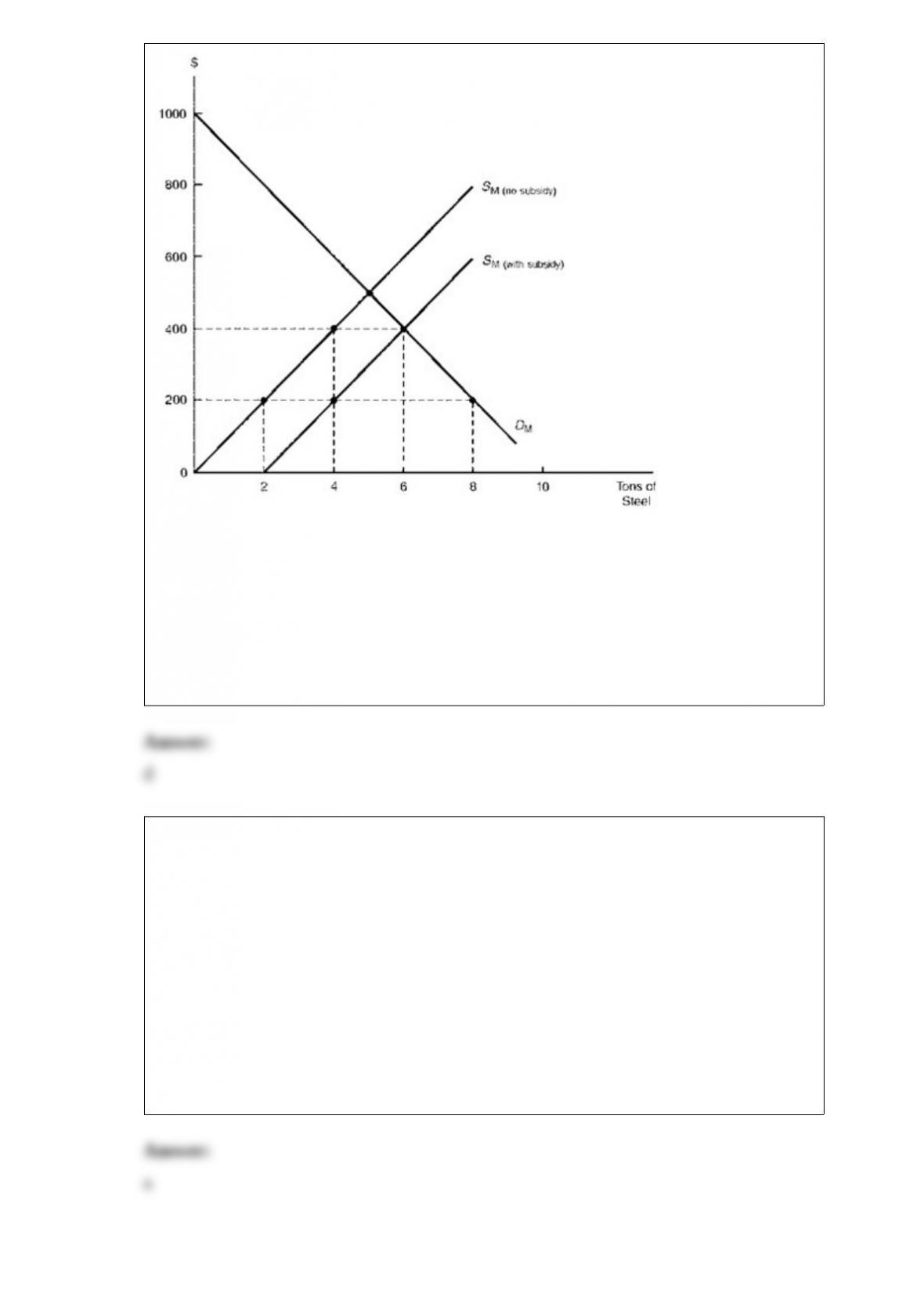
consider figure 5.1. suppose the mexican government provides a subsidy of $200 per
ton to its steel producers, as indicated by the supply schedule sm (with subsidy).
the quantity of imports equals:
a.1 ton
b.2 tons
c.3 tons
d.4 tons
14) exhibit 11.1
assume the following: (1) the interest rate on 6-month treasury bills is 8 percent per
annum in the united kingdom and 4 percent per annum in the united states; (2) today’s
spot price of the pound is $1.50 while the 6-month forward price of the pound is
$1.485.
refer to exhibit 11.1. if u.s. investors cover their exchange rate risk, the extra return for
the 6 months on the u.k. treasury bills is:
a.1.0 percent
b.1.5 percent
c.2.0 percent
d.2.5 percent
15) when the price of foreign currency (i.e., the exchange rate) is above the equilibrium
level:
a.an excess supply of that currency exists in the foreign exchange market
b.an excess demand for that currency exists in the foreign exchange market
c.the supply of foreign exchange shifts outward to the right
d.the supply of foreign exchange shifts backward to the left
16) under the gold standard of the 1800s, exchange rates were allowed to float freely in
the currency markets.
a.true
b.false