
As the price of good Z falls, the quantity demanded of good Z rises, but the quantity
supplied of good Z does not change.Based upon this information we can conclude that
the demand curve for good Z is ________________ and the supply curve for good Z is
________________.
a. downward sloping; upward sloping
b. upward sloping; downward sloping
c. upward sloping; vertical
d. downward sloping; vertical
e. vertical; downward sloping
Which of the following is not one of the four broad categories of resources?
a. labor
b. government
c. capital
d. entrepreneurship
e. land
The perfectly competitive firm charges ____________ price for each unit of the good it
sells, and the perfectly price-discriminating monopolist charges _________________
price for each unit of the good it sells.

a. the same; the same
b. a different; the same
c. the same; a different
d. a different; a different
If the demand for a good rises by more than the supply of the good falls, then the good’s
equilibrium price will __________ and its equilibrium quantity will __________.
a. rise; fall
b. rise; rise
c. fall; fall
d. fall; rise
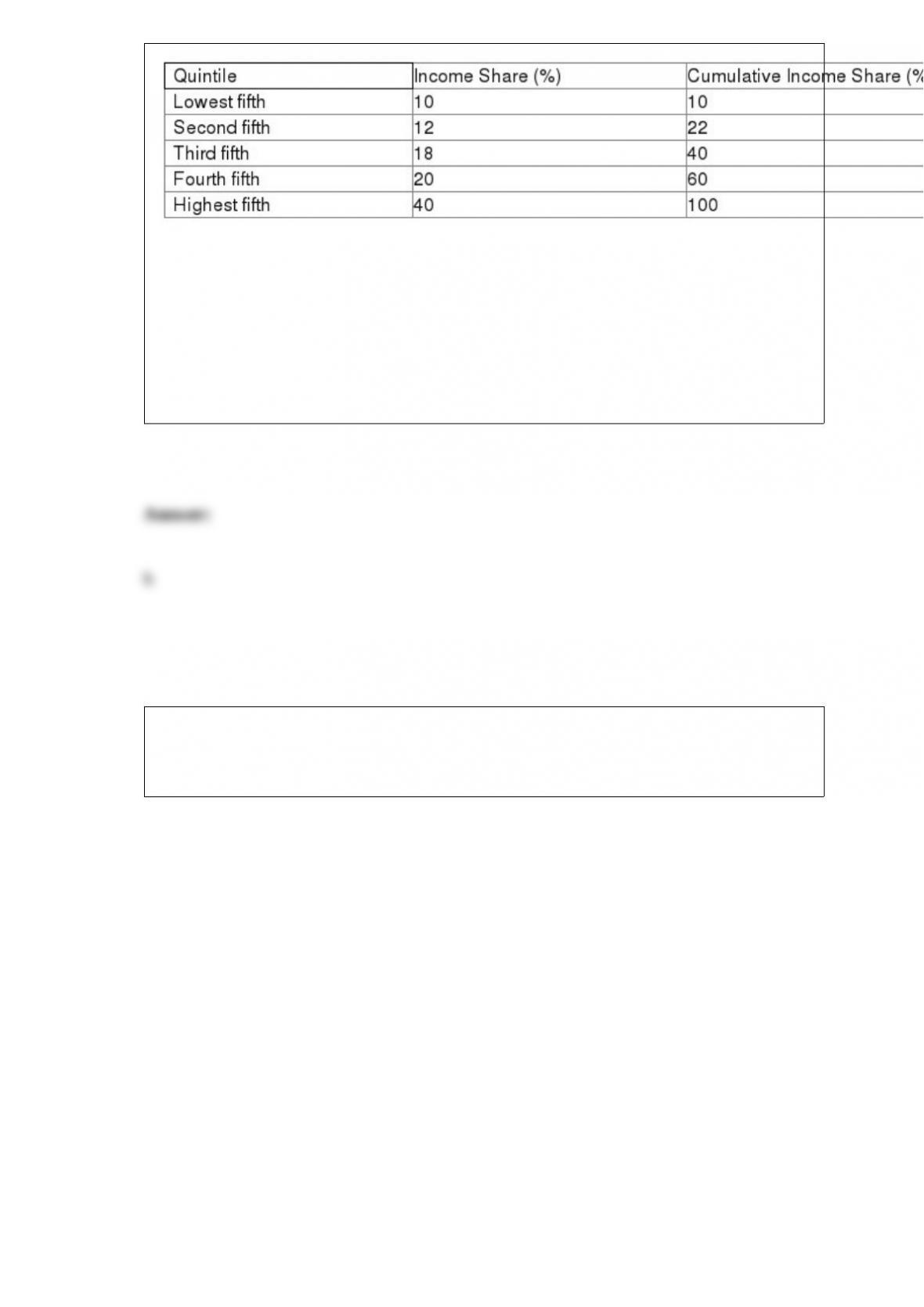
Refer to Exhibit 29-3. The Gini coefficient for the income distribution of the country
depicted in the exhibit is
Exhibit 29-3
a. a number less than 0.
b. a number between 0 and 1.
c. equal to 1.
d. equal to 0.
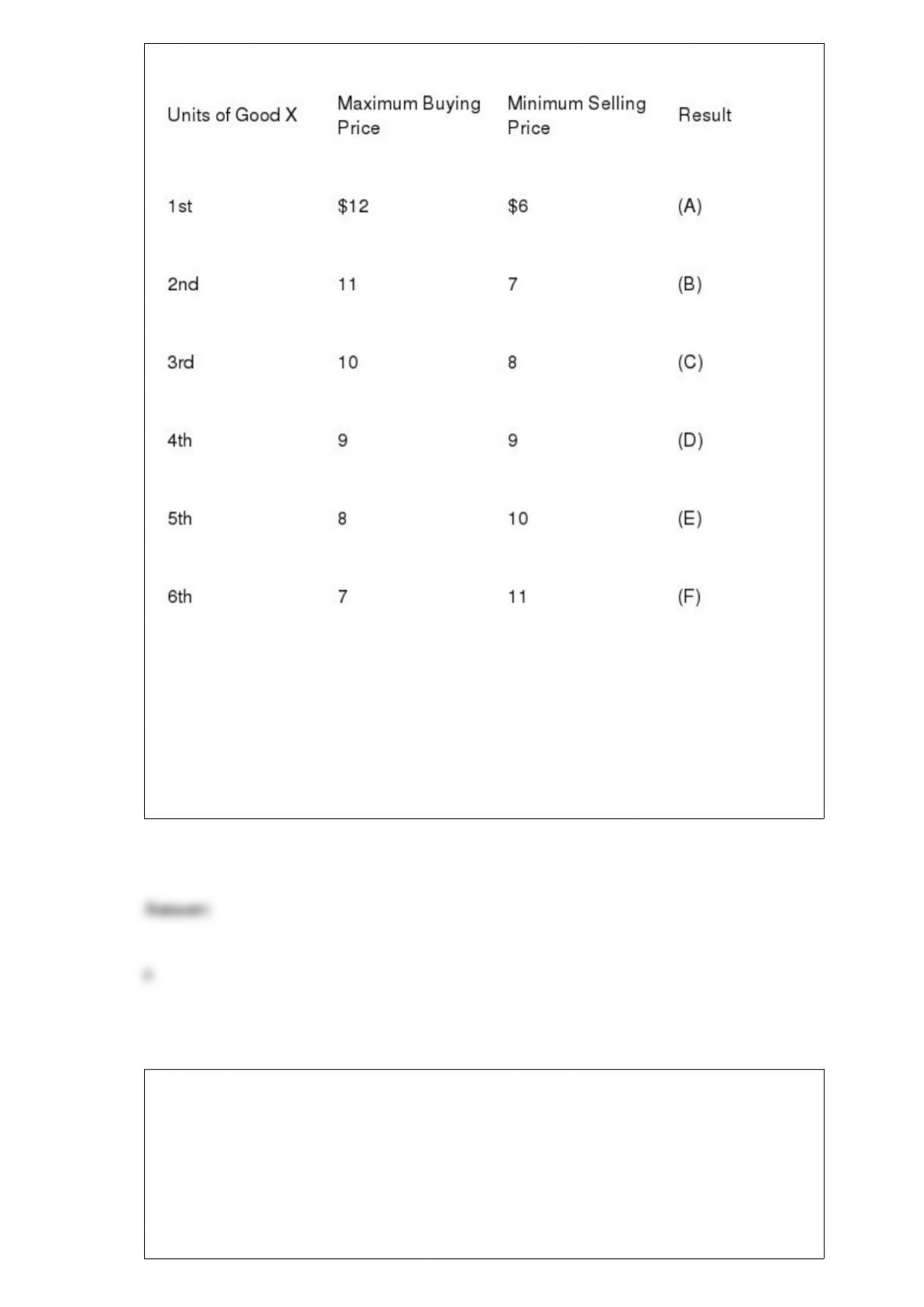
Refer to Exhibit 3-11.Fill in blanks (C) and (D) respectively with “Exchange” or “No
Exchange”to indicate whether or not exchange would take place at the given prices.
Exhibit 3-11
a. Exchange; Exchange
b. Exchange; No Exchange
c. No Exchange; Exchange
d. No Exchange; No Exchange
Assuming only two goods X and Y, if MUX/PX = MUY/PY, then
a. the consumer is in equilibrium.
b. the consumer cannot be made better off by redirecting his purchases.
c. the consumer is deriving the same marginal utility per dollar spent on both goods.

d. a and c
e. a, b and c
John purchases a baseball card for $10 that turns out to be so rare that a collector offers
to buy it from him for $2,000. Instead, John decides to give the card to his sister (an
avid baseball-card collector) as a birthday present. The opportunity cost of John’s
generosity is
a. $10, the purchase price.
b. $0, because at the time the decision is made, $10 are sunk cost, i.e., at that point there
is no cost to John of giving the card away.
c. $2,000, the amount offered by the collector.
d. $1,005, the average of $10 and $2,000.
What is the reason for the law of increasing opportunity costs?
a. There is no reason: it is just one of the laws of economics.
b. Resources have varying abilities and those with lower opportunity costs of producing
a good will be used to produce it before resources with higher opportunity costs
produce it.

c. The price of a good rises as more of it is demanded.
d. As more of a good is produced, the taxes applied to the production of the good rise.
e. c and d
In long run equilibrium, a monopolistic competitive firm’s price will most likely be
a. equal to average total cost, but higher than marginal cost.
b. greater than both average total cost and marginal cost.
c. less than both average total cost and marginal cost.
d. equal to marginal cost, but higher than average total cost.
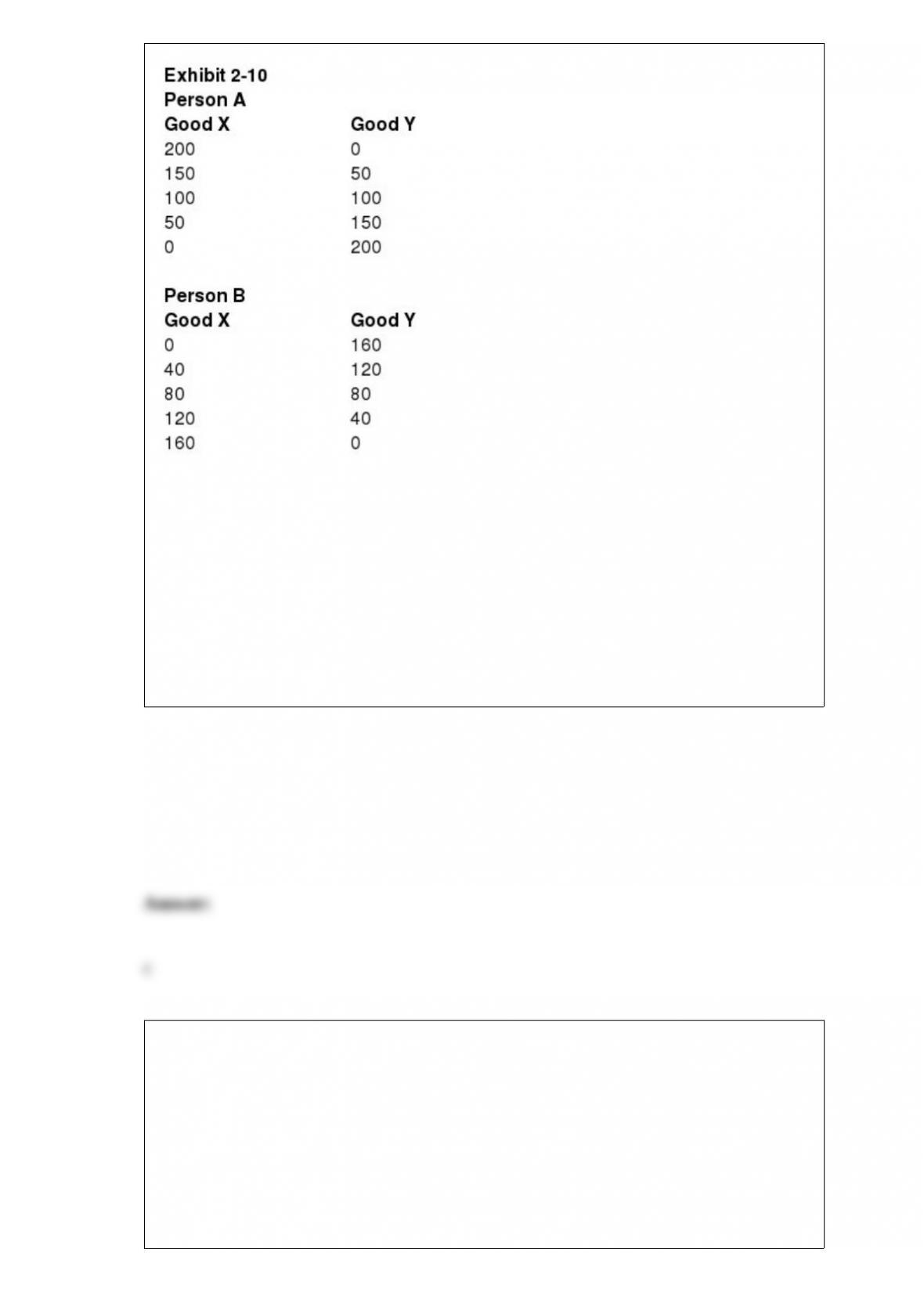
Refer Exhibit 2-10. Person A has the comparative advantage in the production of
_____________ and person B has the comparative advantage in the production of
__________________.
a. X; Y
b. Y; X
c. neither good X nor good Y; neither good X nor good Y
d. both good X and good Y; neither good X nor good Y
e. neither good X nor good Y; both good X and good Y
When a perfectly competitive firm (that sells its good for $20 per unit) hires 1 unit of
factor X it produces 70 units of output and when it hires 2 units of factor X it produces
85 units of output. Marginal revenue product of the second unit of factor X is equal to
a. $30.
b. $530.
c. $265.

d. $300.
e. none of the above
The public interest theory of regulation holds that
a. regulators are seeking to do and will do through regulation what is in the best interest
of the public or society at large.
b. even though regulators seek to do what is in the best interest of the public at large,
through regulation they end up doing what is in the best interest of the special interests
of the industry that is being regulated.
c. even though regulators seek to do what is in the best interest of special interests of
the industry that is being regulated, through regulation they end up doing what is in the
best interest of the public at large.
d. regulators are seeking to do and will do through regulation what is in the best interest
of the special interests of the industry that is being regulated.
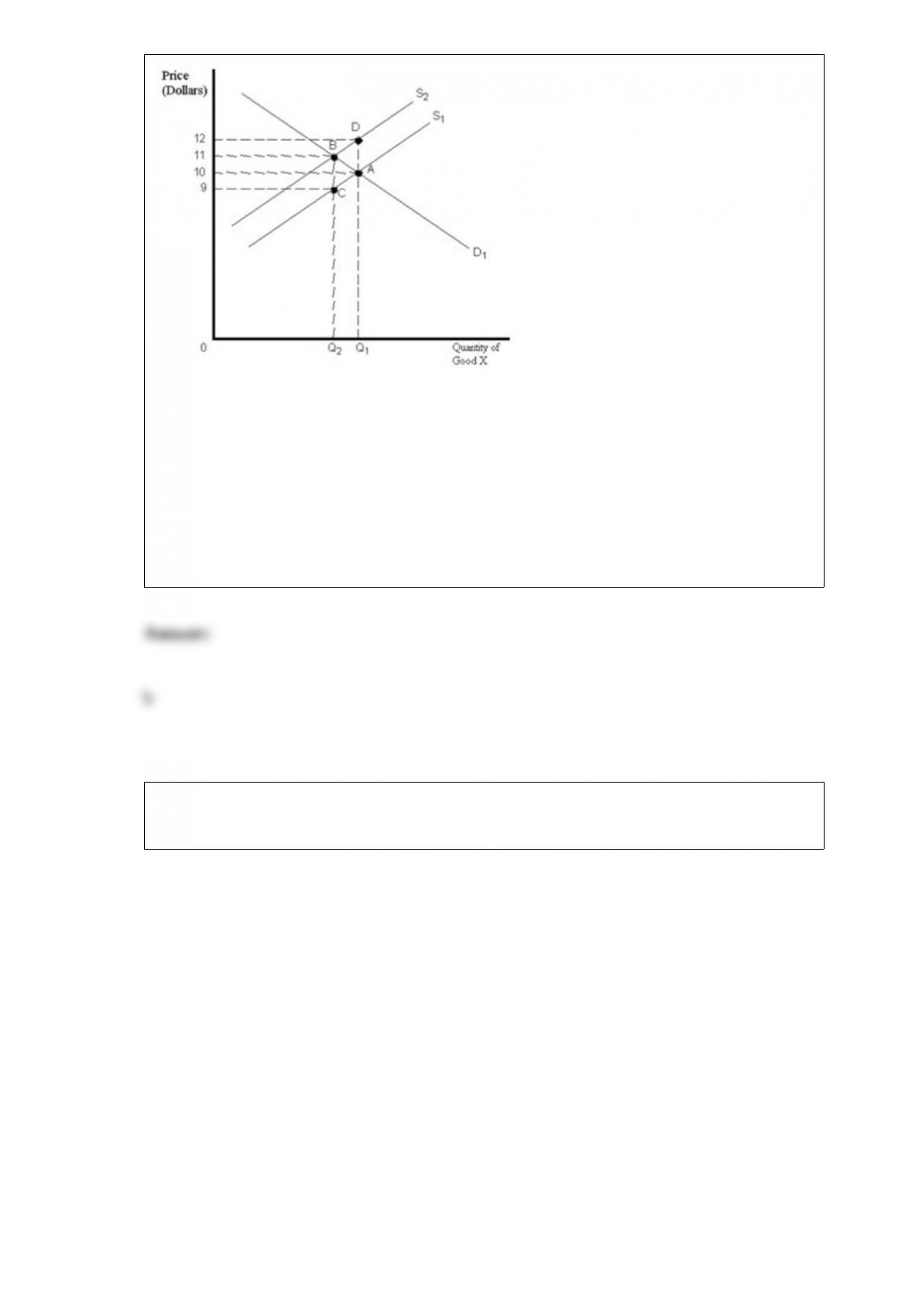
Refer to Exhibit 20-8. The market for good X is initially at point A. A tax is then placed
on the production of good X. It follows that the tax is equal to
Exhibit 20-8
a. $1 per unit.
b. $2 per unit.
c. $12 in total.
d. $10 in total.
e. none of the above
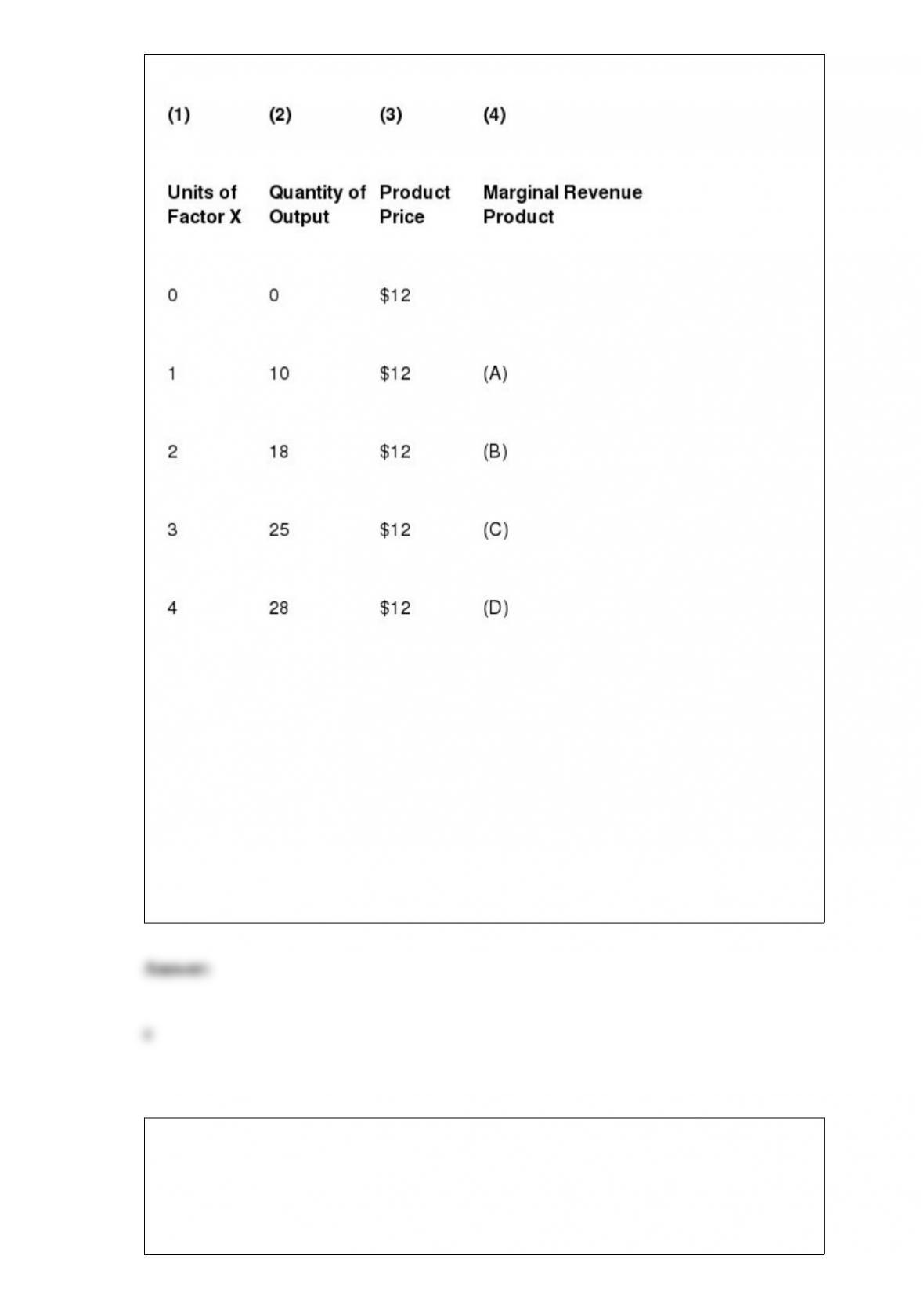
Refer to Exhibit 27-1. For this firm, the demand curve for factor X is
Exhibit 27-1
a. downward-sloping.
b. upward-sloping.
c. vertical.
d. horizontal.
e. There is not enough information given to determine the shape of the factor X demand
curve.
Suppose U.S. peanut butter producers are facing increased foreign competition. Which
argument is least likely to be used by the U.S. firms’ lobbyists to urge legislation to
restrict imports of peanut butter?
a. Peanut butter is important in military rations, so we cannot risk losing our supply of

it.
b. Foreign peanut butter is made by virtual slave labor, working in horrible conditions.
c. Economic profits of the U.S. firms are already at a very low level.
d. Thousands of U.S. peanut farmers face hard times without this protection against
imports.