1) (Consider This) The story about economist Irving Fisher’s conversation with his
masseuse illustrates that interest payments arise because of:
A.the possibility of inflation.
B.the reality of credit risk.
C.imperfect information about the future.
D.the time-value of money.
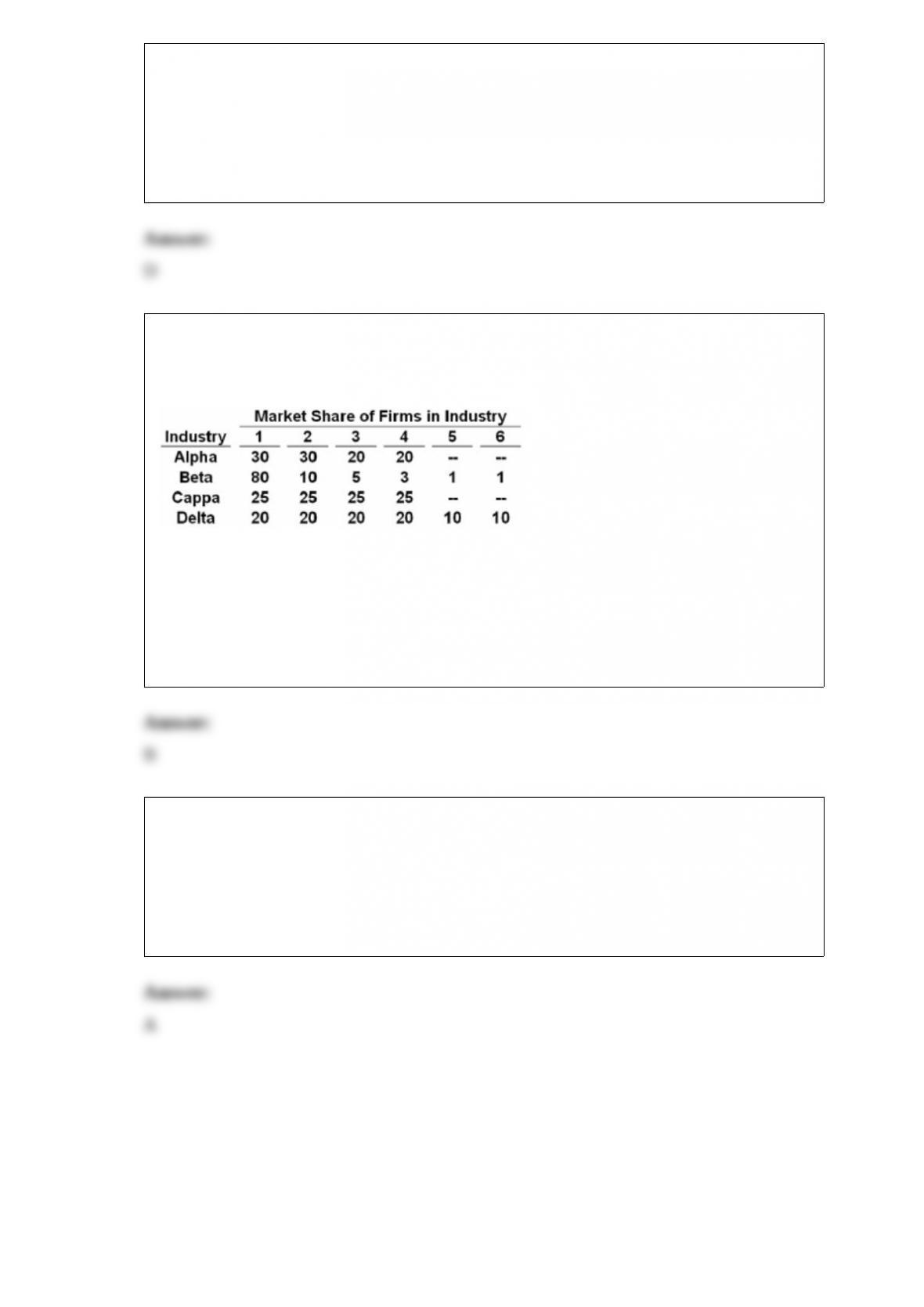
2) The basis of the following table shows market shares of firms in hypothetical
industries. Assume these are distinct industries with no buyer-seller relationships or
competition among them.
Refer to the above table. The industry with the greatest market power as measured by
the Herfindahl index is:
A.Alpha.
B.Beta.
C.Cappa.
D.Delta.
3) In 2006, the official poverty line for a household of four in the United States was
about:
A.$20,000.
B.$26,800.
C.$9,800.
D.$29,500.
4)
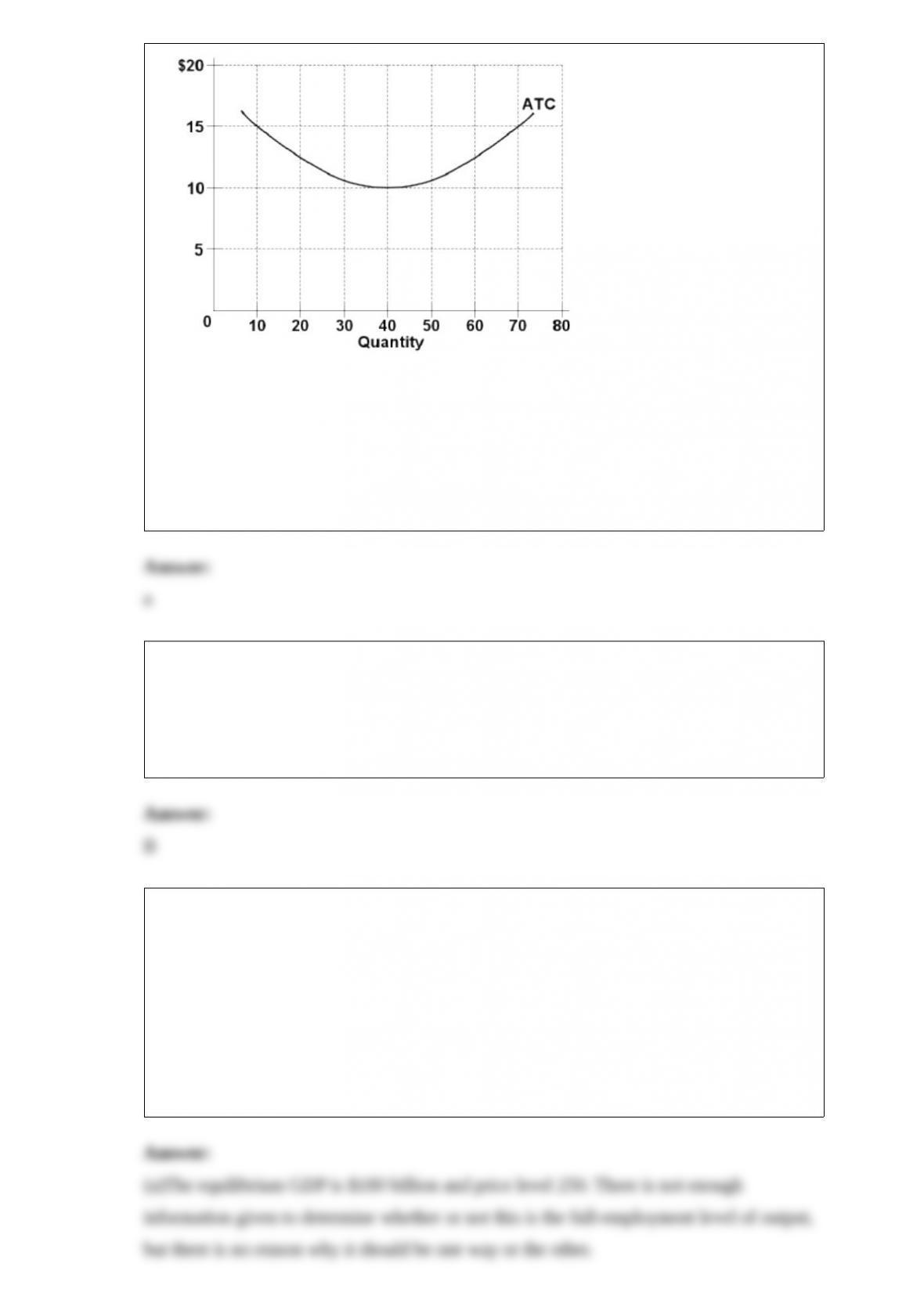
refer to the above diagram showing the average total cost curve for a purely competitive
firm. suppose that total variable cost is $300 at 40 units of output. at that level of
output, average fixed cost:
a.is $2.50.
b.is $4.
c.is $100.
d.cannot be determined from the information provided.
5) Labor unions may attempt to raise wage rates by:
A.increasing the supply of labor.
B.forcing employers, under the threat of a strike, to pay above-equilibrium wage rates.
C.decreasing the demand for labor.
D.increasing the price of complementary resources.
6) Suppose the aggregate demand and supply schedules for a hypothetical economy are
as shown below:
(a)What will be the equilibrium price and output level in this hypothetical economy? Is
it also the full-employment level of output? Explain.
(b)Why wont the 200 index be the equilibrium price level? Why wont the 300 index be
the equilibrium price level?
(c)Suppose demand increases by $120 billion at each price level. What will be the new
equilibrium price and output levels?
(d)List five factors that might cause a change in aggregate demand.
7) a fixed cost is:
a.associated with any productive resource whose price is fixed.
b.any cost which increases proportionately with output.
c.any cost which a firm would incur even if output was zero.
d.associated with all inputs whose short-run supply is perfectly inelastic.
8) In which of the following cases was the firm found not guilty of violating the
Sherman Act?
A.Standard Oil case
B.Microsoft case
C.Alcoa case
D.DuPont cellophane case
9) broadly defined, competition involves:
a.private property and freedom of expression.
b.independently acting buyers and sellers and freedom to enter or leave markets.
c.increasing opportunity costs and diminishing marginal utility.
d.capital goods and division of labor.

10) a competitive firm will maximize profits at that output at which:
a.total revenue exceeds total cost by the greatest amount.
b.total revenue and total cost are equal.
c.price exceeds average total cost by the largest amount.
d.the difference between marginal revenue and price is at a maximum.